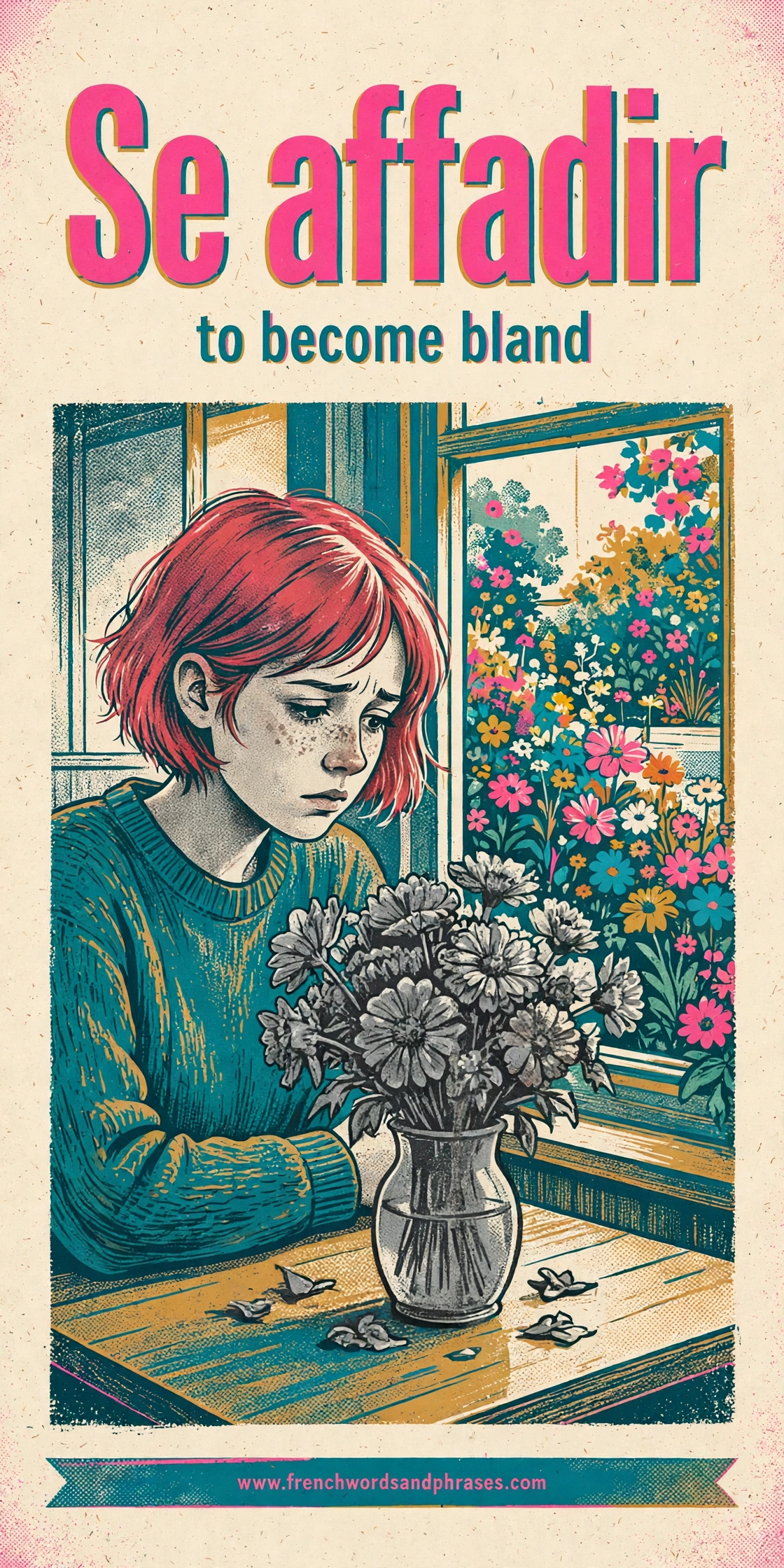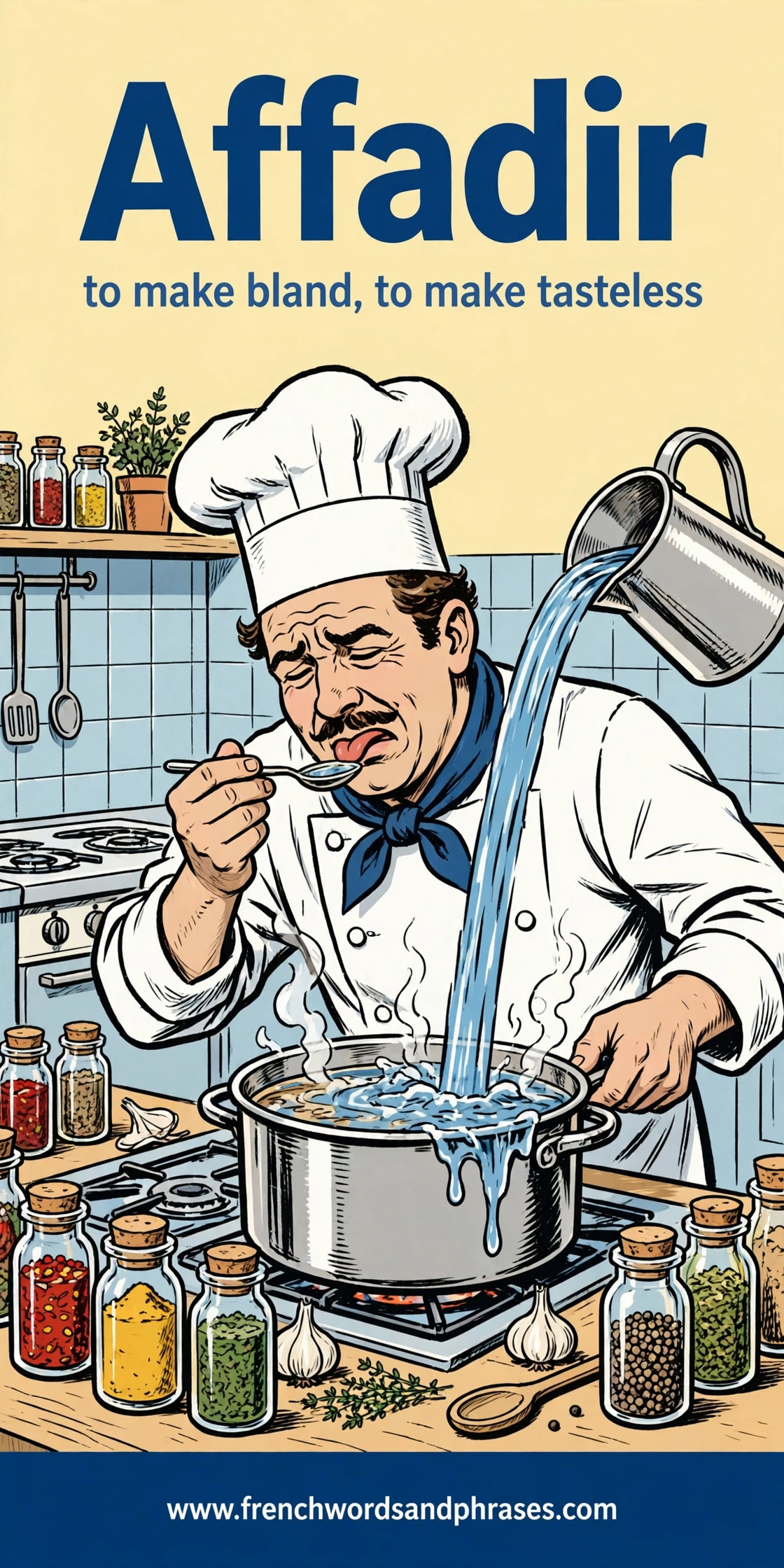
A French Word to Live By
How to Conjugate Affadir in French
/a.fa.diʁ/
Affadir means to make bland, to make tasteless — to drain the flavour out of a dish, a colour or a piece of writing.
A sauce stretched with too much water, a soup cooked until its character gives up, a lively draft edited into grey politeness — affadir is the verb of flavour leaking away under someone’s hands.
In this guide, you’ll learn how to conjugate affadir in all the major French tenses and moods. Explore complete conjugation tables, French examples, English translations, and practice quizzes.
Understanding the French Verb Affadir
Affadir is a regular French verb belonging to the second group of verbs, those ending in -ir.
It means to make bland, to make tasteless. Its home is the kitchen — overcooked, over-diluted, under-seasoned food — but critics borrow it constantly for style: a translation, a speech or a novel can be affadi by caution, its salt and spice edited away until nothing offends and nothing delights.
Verb classification: Second group (-ir)
Auxiliary verb: Avoir
Past participle: affadi
Present participle: affadissant
English equivalents: To make bland, to make tasteless; affadir une sauce — to water down a sauce; affadir un plat — to take the flavour out of a dish; affadir un texte — to flatten a text, to drain its colour; affadir les couleurs — to mute the colours.
One important detail: affadir is a regular second-group -ir verb, conjugated exactly like finir — j’affadis, nous affadissons, ils affadissent, past participle affadi. The -iss- that appears in the plural present, the imperfect and the subjunctive is the badge of the group. Inside it sits the adjective fade, bland: affadir is literally to make fade, and its reflexive twin s’affadir is what happens to the dish when nobody acts.
Experience the Word
Affadir is the verb of the vanishing flavour — the cook is still there, the dish is still there, but the taste has quietly left the room.
Imagine a village cook making soup for a fête. Fearing complaints, she adds water, then more water, skips the pepper, fears the salt — elle affadit la soupe à force de prudence, and the whole village eats politely and remembers nothing.
Nothing was spoiled or burnt. The soup was simply made bland — affadie — one careful spoonful at a time.
How to Conjugate Affadir: Complete French Conjugation Guide
Let’s explore every major conjugation of affadir, beginning with the indicative mood.
How to Conjugate Affadir in the Indicative Mood
The indicative mood is used to express facts, observations, actions, and events.
How to Conjugate Affadir in the Present Tense (Présent)
Used for actions happening now, habitual actions, and general truths.
| Subject | Conjugation |
|---|---|
| je | affadis |
| tu | affadis |
| il / elle | affadit |
| nous | affadissons |
| vous | affadissez |
| ils / elles | affadissent |
Example
Trop d’eau affadit la sauce.
Too much water makes the sauce bland.
Quick Quiz 1
Complete the sentence:
Trop d’eau ______ la sauce.
Reveal the answer
affadit
Trop d’eau affadit la sauce.
Too much water makes the sauce bland.
How to Conjugate Affadir in the Passé Composé
Used for completed actions in the past. Affadir takes the auxiliary verb avoir.
| Subject | Conjugation |
|---|---|
| j’ | ai affadi |
| tu | as affadi |
| il / elle | a affadi |
| nous | avons affadi |
| vous | avez affadi |
| ils / elles | ont affadi |
Example
La longue cuisson a affadi le ragoût.
The long cooking made the stew tasteless.
How to Conjugate Affadir in the Imparfait (Imperfect Tense)
Used for habitual past actions, descriptions, and ongoing situations in the past.
| Subject | Conjugation |
|---|---|
| je | affadissais |
| tu | affadissais |
| il / elle | affadissait |
| nous | affadissions |
| vous | affadissiez |
| ils / elles | affadissaient |
Example
Il affadissait tous ses plats par peur du sel.
He used to make all his dishes bland out of fear of salt.
Quick Quiz 2
Choose the correct form:
We are making the sauce bland (present).
Nous ______ la sauce. (affadissons / affadons)
Reveal the answer
affadissons
Nous affadissons la sauce.
Affadir is a second-group -ir verb: the plural stem takes -iss-, like finir.
How to Conjugate Affadir in the Plus-que-parfait
Used to describe an action that had already been completed before another past event.
| Subject | Conjugation |
|---|---|
| j’ | avais affadi |
| tu | avais affadi |
| il / elle | avait affadi |
| nous | avions affadi |
| vous | aviez affadi |
| ils / elles | avaient affadi |
Example
Elle avait affadi la soupe en y ajoutant de l’eau.
She had made the soup bland by adding water to it.
How to Conjugate Affadir in the Passé Simple
Primarily used in formal writing, literature, and historical narratives. It is rarely used in everyday conversation.
| Subject | Conjugation |
|---|---|
| je | affadis |
| tu | affadis |
| il / elle | affadit |
| nous | affadîmes |
| vous | affadîtes |
| ils / elles | affadirent |
Example
Le cuisinier affadit le bouillon avant le service.
The cook watered down the broth before the service.
How to Conjugate Affadir in the Passé Antérieur
A literary tense used to express an action completed immediately before another past action, generally in the passé simple.
| Subject | Conjugation |
|---|---|
| j’ | eus affadi |
| tu | eus affadi |
| il / elle | eut affadi |
| nous | eûmes affadi |
| vous | eûtes affadi |
| ils / elles | eurent affadi |
Example
Quand il eut affadi la sauce, le chef goûta et fronça les sourcils.
When he had made the sauce bland, the chef tasted it and frowned.
How to Conjugate Affadir in the Future Tense (Futur Simple)
Used to describe actions that will take place in the future.
| Subject | Conjugation |
|---|---|
| je | affadirai |
| tu | affadiras |
| il / elle | affadira |
| nous | affadirons |
| vous | affadirez |
| ils / elles | affadiront |
Example
Si tu ajoutes ce lait, tu affadiras la soupe.
If you add that milk, you will make the soup bland.
How to Conjugate Affadir in the Futur Antérieur (Future Perfect)
Used for an action that will have been completed before a particular point in the future.
| Subject | Conjugation |
|---|---|
| j’ | aurai affadi |
| tu | auras affadi |
| il / elle | aura affadi |
| nous | aurons affadi |
| vous | aurez affadi |
| ils / elles | auront affadi |
Example
À force de corrections, ils auront affadi tout le texte.
With correction after correction, they will have flattened the whole text.
How to Conjugate Affadir in the Near Future (Futur Proche)
Used to describe something that is going to happen soon. Formed with aller + infinitive.
| Subject | Conjugation |
|---|---|
| je | vais affadir |
| tu | vas affadir |
| il / elle | va affadir |
| nous | allons affadir |
| vous | allez affadir |
| ils / elles | vont affadir |
Example
Attention, tu vas affadir le curry !
Careful, you are going to make the curry bland!
How to Conjugate Affadir in the Conditional Mood
The conditional mood expresses what would happen under certain circumstances. It is also frequently used to make polite requests or express wishes.
How to Conjugate Affadir in the Present Conditional
| Subject | Conjugation |
|---|---|
| je | affadirais |
| tu | affadirais |
| il / elle | affadirait |
| nous | affadirions |
| vous | affadiriez |
| ils / elles | affadiraient |
Example
Un peu plus d’eau affadirait complètement ce plat.
A little more water would make this dish completely tasteless.
How to Conjugate Affadir in the Past Conditional
| Subject | Conjugation |
|---|---|
| j’ | aurais affadi |
| tu | aurais affadi |
| il / elle | aurait affadi |
| nous | aurions affadi |
| vous | auriez affadi |
| ils / elles | auraient affadi |
Example
Sans les épices, ce plat aurait affadi même les souvenirs.
Without the spices, this dish would have dulled even memories.
Affadir in the Literary Past Conditional Form
This less common literary form uses the imperfect subjunctive of avoir.
| Subject | Conjugation |
|---|---|
| j’ | eusse affadi |
| tu | eusses affadi |
| il / elle | eût affadi |
| nous | eussions affadi |
| vous | eussiez affadi |
| ils / elles | eussent affadi |
Example
Il eût affadi la sauce sans les conseils du chef.
He would have made the sauce bland without the chef’s advice.
How to Conjugate Affadir in the Subjunctive Mood
The subjunctive is used to express wishes, emotions, doubts, necessity, and uncertainty. It frequently follows expressions such as il faut que (it is necessary that) or bien que (although).
How to Conjugate Affadir in the Present Subjunctive
| Subject | Conjugation |
|---|---|
| que je | affadisse |
| que tu | affadisses |
| qu’il / qu’elle | affadisse |
| que nous | affadissions |
| que vous | affadissiez |
| qu’ils / qu’elles | affadissent |
Example
Je crains que ce bouillon n’affadisse le riz.
I fear this broth will make the rice bland.
Quick Quiz 3
Complete the sentence using the subjunctive:
Je crains que ce bouillon n’______ le riz.
Reveal the answer
affadisse
Je crains que ce bouillon n’affadisse le riz.
I fear this broth will make the rice bland.
How to Conjugate Affadir in the Imperfect Subjunctive
A literary tense, rarely encountered in modern spoken French.
| Subject | Conjugation |
|---|---|
| que je | affadisse |
| que tu | affadisses |
| qu’il / qu’elle | affadît |
| que nous | affadissions |
| que vous | affadissiez |
| qu’ils / qu’elles | affadissent |
Example
Il fallait doser l’eau pour qu’elle n’affadît pas la soupe.
The water had to be measured so that it would not make the soup bland.
How to Conjugate Affadir in the Pluperfect Subjunctive
A literary construction used to express an action completed before another past action.
| Subject | Conjugation |
|---|---|
| que j’ | eusse affadi |
| que tu | eusses affadi |
| qu’il / qu’elle | eût affadi |
| que nous | eussions affadi |
| que vous | eussiez affadi |
| qu’ils / qu’elles | eussent affadi |
Example
On disait qu’il eût affadi le plat exprès.
People said he had made the dish bland on purpose.
How to Conjugate Affadir in the Past Subjunctive
| Subject | Conjugation |
|---|---|
| que j’ | aie affadi |
| que tu | aies affadi |
| qu’il / qu’elle | ait affadi |
| que nous | ayons affadi |
| que vous | ayez affadi |
| qu’ils / qu’elles | aient affadi |
Example
Je regrette que la cuisson ait affadi le ragoût.
I regret that the cooking made the stew tasteless.
How to Conjugate Affadir in the Imperative
The imperative is used to give commands, instructions, invitations, or suggestions. Subject pronouns are omitted.
How to Conjugate Affadir in the Present Imperative
| Person | Conjugation |
|---|---|
| (tu) | affadis |
| (nous) | affadissons |
| (vous) | affadissez |
Example
N’affadis pas la sauce, goûte avant d’ajouter de l’eau !
Do not make the sauce bland, taste before adding water!
Quick Quiz 4
How would you say Do not make the sauce bland (tu form)?
Reveal the answer
N’affadis pas la sauce !
French Participles of Affadir
Participles are verb forms that can be used in compound tenses and other grammatical constructions.
Present Participle of Affadir
affadissant
En affadissant ses phrases, l’auteur a perdu ses lecteurs.
By flattening his sentences, the author lost his readers.
Past Participle of Affadir
affadi
Affadie par trop d’eau, la soupe n’avait plus aucun goût.
Made bland by too much water, the soup no longer had any taste.
Affadir in Everyday French: Real-Life Examples
Now that you know the conjugations, let’s see how affadir appears in everyday French.
Example 1 — Present
Trop d’eau affadit la sauce.
Too much water makes the sauce bland.
Example 2 — Passé composé
La longue cuisson a affadi le ragoût.
The long cooking made the stew tasteless.
Example 3 — Imparfait
Il affadissait tous ses plats par peur du sel.
He used to make all his dishes bland out of fear of salt.
Example 4 — Future
Tu affadiras la soupe si tu ajoutes ce lait.
You will make the soup bland if you add that milk.
Example 5 — Conditional
Un peu plus d’eau affadirait complètement ce plat.
A little more water would make this dish completely tasteless.
Example 6 — Imperative
N’affadis pas la sauce !
Do not make the sauce bland!
Beyond Translation: The Meaning of Affadir
Inside affadir is the adjective fade — bland, insipid — a word French also uses for people and evenings: un homme fade, une soirée fade.
The verb is the adjective caught in the act of happening.
To affadir is to fade-ify: cooks do it with water, editors do it with caution, and time does it to everything left too long on the stove.
How to Remember the French Verb Affadir
Remember it this way: Affadir is about the soup stretched with one spoonful of water too many.
- Regular -ir like finir: j’affadis, nous affadissons, affadi.
- Inside it is fade, bland — affadir means to make fade.
- Its mirror is se affadir: the cook affadit la sauce; la sauce s’affadit.
The key idea is the soup stretched with one spoonful of water too many.
Test Your Knowledge of Affadir
Let’s see how much you’ve learned. Try answering these questions before revealing the answers.
Question 1
To which group does affadir belong, and what is its badge?
Reveal the answer
The second group (-ir), like finir — the badge is -iss-: nous affadissons, ils affadissent.
Question 2
How do you say Too much water makes the sauce bland in French?
Reveal the answer
Trop d’eau affadit la sauce.
Question 3
Translate: The long cooking made the stew tasteless.
Reveal the answer
La longue cuisson a affadi le ragoût.
Question 4
What is the past participle of affadir?
Reveal the answer
Affadi — affadie, affadis, affadies.
Question 5
Complete the sentence:
Je crains que ce bouillon n’______ le riz.
Reveal the answer
affadisse
Je crains que ce bouillon n’affadisse le riz.
I fear this broth will make the rice bland.
Your Final Challenge
Can You Use It?
How would you say this in French?
Whoever makes the soup bland out of caution feeds the bodies and starves the memories.
Reveal the answer
Qui affadit la soupe par prudence nourrit les corps et affame les mémoires.
Whoever makes the soup bland out of caution feeds the bodies and starves the memories.
A little French. A little curiosity. A richer everyday life.
LEARN FRENCH ONE WORD AT A TIME