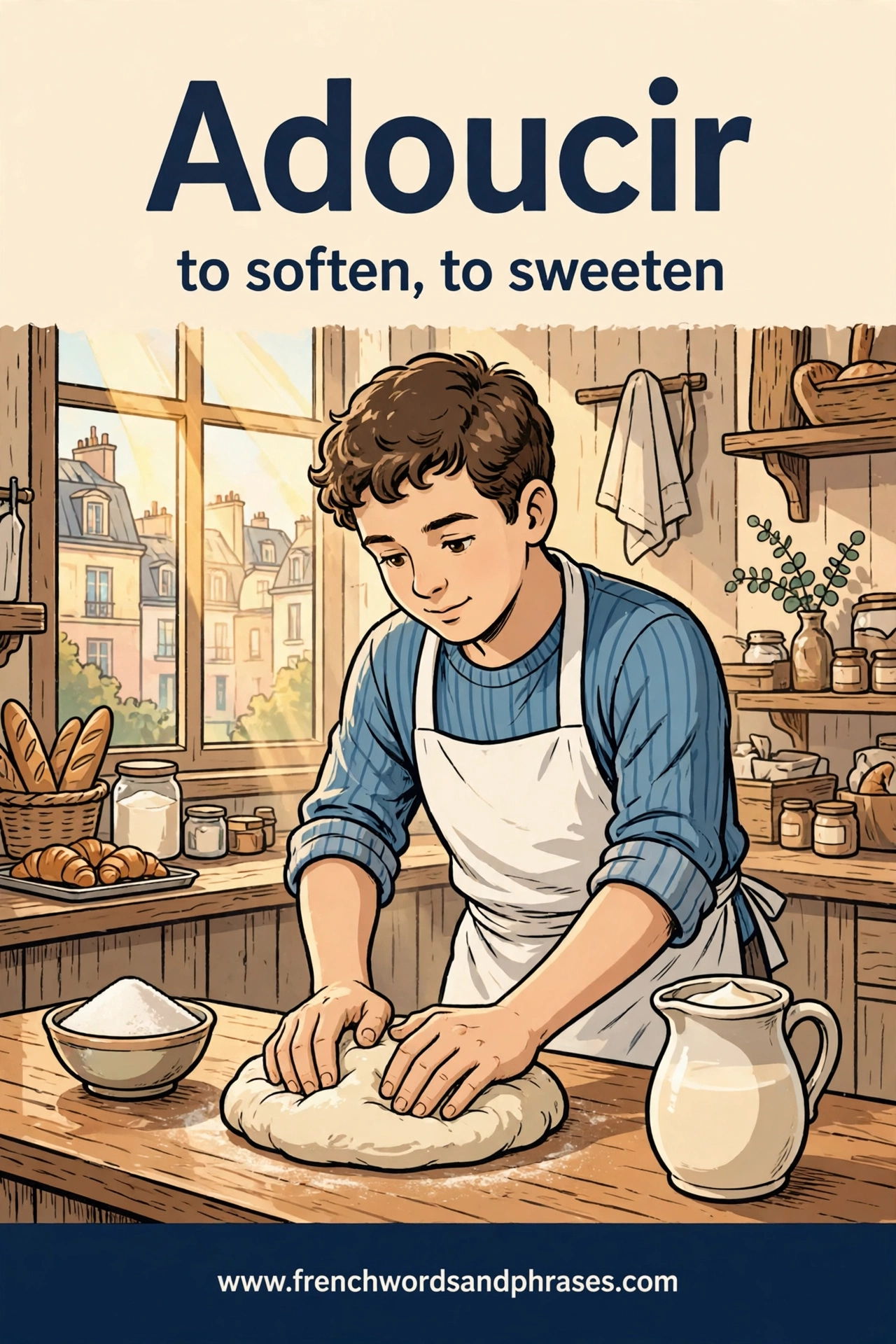
A French Word to Live By
How to Conjugate Adoucir in French
/a.du.siʁ/
Adoucir means to soften, to sweeten — to take the hardness, the bitterness or the harshness out of a thing, whether water, light, a voice or a grief.
A cream softening winter skin, honey taking the edge off a sauce, evening light gentling the colours of a room, time slowly softening a sorrow — adoucir is the verb of merciful reduction: whatever is too hard, too bitter or too loud, it brings down to bearable.
In this guide, you’ll learn how to conjugate adoucir in all the major French tenses and moods. Explore complete conjugation tables, French examples, English translations, and practice quizzes.
Understanding the French Verb Adoucir
Adoucir is a regular French verb belonging to the second group of verbs, those ending in -ir.
It means to soften, to sweeten. It is commonly used in the bathroom and the kitchen (adoucir la peau, adoucir une sauce), in the house (adoucir l’eau, with un adoucisseur), in photography and rooms (adoucir la lumière), and figuratively for voices, tempers, laws and griefs that lose their edge: le temps adoucit tout, time softens everything.
Verb classification: Second group (-ir)
Auxiliary verb: Avoir
Past participle: adouci
Present participle: adoucissant
English equivalents: To soften, to sweeten, to soothe; adoucir la peau — to soften the skin; adoucir l’eau — to soften water; adoucir sa voix — to soften one’s voice; adoucir la peine — to soothe grief; un adoucisseur d’eau — a water softener.
One important detail: adoucir is a second-group -ir verb, conjugated exactly like finir: j’adoucis, tu adoucis, il adoucit, nous adoucissons, vous adoucissez, ils adoucissent, past participle adouci. Its name carries its meaning — inside it sleeps doux, soft and sweet, the same word for a gentle voice and a mild taste. If you can say it of a thing, that thing has become more doux: water, light, skin, tempers and sorrows all take the same verb.
Experience the Word
Adoucir is the verb of taking the edge off — the world’s harshness, turned down one degree at a time.
Imagine a kitchen in late afternoon. The sauce is too sharp; a spoon of honey goes in and the cook tastes again — adoucie. Upstairs, a grandmother lowers her voice at a child’s bedside, and down the street the evening light adoucit les toits, softening every roof in the village. One verb is quietly at work in all three rooms.
Nothing has been removed, only gentled. Everything has been softened — adouci — and the day can be borne.
How to Conjugate Adoucir: Complete French Conjugation Guide
Let’s explore every major conjugation of adoucir, beginning with the indicative mood.
How to Conjugate Adoucir in the Indicative Mood
The indicative mood is used to express facts, observations, actions, and events.
How to Conjugate Adoucir in the Present Tense (Présent)
Used for actions happening now, habitual actions, and general truths.
| Subject | Conjugation |
|---|---|
| je | adoucis |
| tu | adoucis |
| il / elle | adoucit |
| nous | adoucissons |
| vous | adoucissez |
| ils / elles | adoucissent |
Example
Cette crème adoucit la peau en quelques jours.
This cream softens the skin in a few days.
Quick Quiz 1
Complete the sentence:
Nous ______ l’eau avec ce nouvel appareil.
Reveal the answer
adoucissons
Nous adoucissons l’eau avec ce nouvel appareil.
We are softening the water with this new device.
How to Conjugate Adoucir in the Passé Composé
Used for completed actions in the past. Adoucir takes the auxiliary verb avoir.
| Subject | Conjugation |
|---|---|
| j’ | ai adouci |
| tu | as adouci |
| il / elle | a adouci |
| nous | avons adouci |
| vous | avez adouci |
| ils / elles | ont adouci |
Example
Le temps a adouci sa peine.
Time has softened her grief.
How to Conjugate Adoucir in the Imparfait (Imperfect Tense)
Used for habitual past actions, descriptions, and ongoing situations in the past.
| Subject | Conjugation |
|---|---|
| je | adoucissais |
| tu | adoucissais |
| il / elle | adoucissait |
| nous | adoucissions |
| vous | adoucissiez |
| ils / elles | adoucissaient |
Example
La lumière du soir adoucissait les couleurs du paysage.
The evening light used to soften the colours of the landscape.
Quick Quiz 2
Choose the correct form:
The rain softened the dry earth.
La pluie ______ la terre sèche. (a adouci / est adoucie)
Reveal the answer
a adouci
La pluie a adouci la terre sèche.
Adoucir takes avoir.
How to Conjugate Adoucir in the Plus-que-parfait
Used to describe an action that had already been completed before another past event.
| Subject | Conjugation |
|---|---|
| j’ | avais adouci |
| tu | avais adouci |
| il / elle | avait adouci |
| nous | avions adouci |
| vous | aviez adouci |
| ils / elles | avaient adouci |
Example
Elle avait adouci sa voix pour parler à l’enfant.
She had softened her voice to speak to the child.
How to Conjugate Adoucir in the Passé Simple
Primarily used in formal writing, literature, and historical narratives. It is rarely used in everyday conversation.
| Subject | Conjugation |
|---|---|
| je | adoucis |
| tu | adoucis |
| il / elle | adoucit |
| nous | adoucîmes |
| vous | adoucîtes |
| ils / elles | adoucirent |
Example
Un sourire adoucit son visage sévère.
A smile softened his stern face.
How to Conjugate Adoucir in the Passé Antérieur
A literary tense used to express an action completed immediately before another past action, generally in the passé simple.
| Subject | Conjugation |
|---|---|
| j’ | eus adouci |
| tu | eus adouci |
| il / elle | eut adouci |
| nous | eûmes adouci |
| vous | eûtes adouci |
| ils / elles | eurent adouci |
Example
Quand il eut adouci le ton, la discussion reprit calmement.
When he had softened his tone, the discussion resumed calmly.
How to Conjugate Adoucir in the Future Tense (Futur Simple)
Used to describe actions that will take place in the future.
| Subject | Conjugation |
|---|---|
| je | adoucirai |
| tu | adouciras |
| il / elle | adoucira |
| nous | adoucirons |
| vous | adoucirez |
| ils / elles | adouciront |
Example
Ce traitement adoucira l’eau de la maison.
This treatment will soften the house’s water.
How to Conjugate Adoucir in the Futur Antérieur (Future Perfect)
Used for an action that will have been completed before a particular point in the future.
| Subject | Conjugation |
|---|---|
| j’ | aurai adouci |
| tu | auras adouci |
| il / elle | aura adouci |
| nous | aurons adouci |
| vous | aurez adouci |
| ils / elles | auront adouci |
Example
À la fin du livre, l’auteur aura adouci le caractère de son héros.
By the end of the book, the author will have softened his hero’s character.
How to Conjugate Adoucir in the Near Future (Futur Proche)
Used to describe something that is going to happen soon. Formed with aller + infinitive.
| Subject | Conjugation |
|---|---|
| je | vais adoucir |
| tu | vas adoucir |
| il / elle | va adoucir |
| nous | allons adoucir |
| vous | allez adoucir |
| ils / elles | vont adoucir |
Example
Je vais adoucir la sauce avec un peu de miel.
I am going to sweeten the sauce with a little honey.
How to Conjugate Adoucir in the Conditional Mood
The conditional mood expresses what would happen under certain circumstances. It is also frequently used to make polite requests or express wishes.
How to Conjugate Adoucir in the Present Conditional
| Subject | Conjugation |
|---|---|
| je | adoucirais |
| tu | adoucirais |
| il / elle | adoucirait |
| nous | adoucirions |
| vous | adouciriez |
| ils / elles | adouciraient |
Example
Un peu de sucre adoucirait ce café amer.
A little sugar would sweeten this bitter coffee.
How to Conjugate Adoucir in the Past Conditional
| Subject | Conjugation |
|---|---|
| j’ | aurais adouci |
| tu | aurais adouci |
| il / elle | aurait adouci |
| nous | aurions adouci |
| vous | auriez adouci |
| ils / elles | auraient adouci |
Example
Elle aurait adouci ses paroles si elle avait su la vérité.
She would have softened her words if she had known the truth.
Adoucir in the Literary Past Conditional Form
This less common literary form uses the imperfect subjunctive of avoir.
| Subject | Conjugation |
|---|---|
| j’ | eusse adouci |
| tu | eusses adouci |
| il / elle | eût adouci |
| nous | eussions adouci |
| vous | eussiez adouci |
| ils / elles | eussent adouci |
Example
Le temps eût adouci cette douleur sans les souvenirs.
Time would have softened this pain without the memories.
How to Conjugate Adoucir in the Subjunctive Mood
The subjunctive is used to express wishes, emotions, doubts, necessity, and uncertainty. It frequently follows expressions such as il faut que (it is necessary that) or bien que (although).
How to Conjugate Adoucir in the Present Subjunctive
| Subject | Conjugation |
|---|---|
| que je | adoucisse |
| que tu | adoucisses |
| qu’il / qu’elle | adoucisse |
| que nous | adoucissions |
| que vous | adoucissiez |
| qu’ils / qu’elles | adoucissent |
Example
Il faut que tu adoucisses la lumière de la chambre.
You must soften the light in the bedroom.
Quick Quiz 3
Complete the sentence using the subjunctive:
Il faut que vous ______ votre ton avec les enfants.
Reveal the answer
adoucissiez
Il faut que vous adoucissiez votre ton avec les enfants.
You must soften your tone with the children.
How to Conjugate Adoucir in the Imperfect Subjunctive
A literary tense, rarely encountered in modern spoken French.
| Subject | Conjugation |
|---|---|
| que je | adoucisse |
| que tu | adoucisses |
| qu’il / qu’elle | adoucît |
| que nous | adoucissions |
| que vous | adoucissiez |
| qu’ils / qu’elles | adoucissent |
Example
On voulait qu’elle adoucît son jugement.
People wanted her to soften her judgement.
How to Conjugate Adoucir in the Pluperfect Subjunctive
A literary construction used to express an action completed before another past action.
| Subject | Conjugation |
|---|---|
| que j’ | eusse adouci |
| que tu | eusses adouci |
| qu’il / qu’elle | eût adouci |
| que nous | eussions adouci |
| que vous | eussiez adouci |
| qu’ils / qu’elles | eussent adouci |
Example
On disait qu’il eût adouci les mœurs de la cour.
People said he had softened the manners of the court.
How to Conjugate Adoucir in the Past Subjunctive
| Subject | Conjugation |
|---|---|
| que j’ | aie adouci |
| que tu | aies adouci |
| qu’il / qu’elle | ait adouci |
| que nous | ayons adouci |
| que vous | ayez adouci |
| qu’ils / qu’elles | aient adouci |
Example
Je suis heureux que la pluie ait adouci la terre sèche.
I am glad the rain softened the dry earth.
How to Conjugate Adoucir in the Imperative
The imperative is used to give commands, instructions, invitations, or suggestions. Subject pronouns are omitted.
How to Conjugate Adoucir in the Present Imperative
| Person | Conjugation |
|---|---|
| (tu) | adoucis |
| (nous) | adoucissons |
| (vous) | adoucissez |
Example
Adoucis ta voix, le bébé dort !
Soften your voice, the baby is asleep!
Quick Quiz 4
How would you say Soften your voice, the baby is asleep (tu form)?
Reveal the answer
Adoucis ta voix, le bébé dort !
French Participles of Adoucir
Participles are verb forms that can be used in compound tenses and other grammatical constructions.
Present Participle of Adoucir
adoucissant
En adoucissant son ton, elle a calmé tout le monde.
By softening her tone, she calmed everyone down.
Past Participle of Adoucir
adouci
Adoucie par les années, sa colère n’est plus qu’un souvenir.
Softened by the years, her anger is now only a memory.
Adoucir in Everyday French: Real-Life Examples
Now that you know the conjugations, let’s see how adoucir appears in everyday French.
Example 1 — Present
Cette crème adoucit la peau en quelques jours.
This cream softens the skin in a few days.
Example 2 — Passé composé
Le temps a adouci sa peine.
Time has softened her grief.
Example 3 — Imparfait
La lumière du soir adoucissait les couleurs.
The evening light used to soften the colours.
Example 4 — Future
Ce traitement adoucira l’eau de la maison.
This treatment will soften the house’s water.
Example 5 — Conditional
Un peu de sucre adoucirait ce café amer.
A little sugar would sweeten this bitter coffee.
Example 6 — Imperative
Adoucis ta voix, le bébé dort !
Soften your voice, the baby is asleep!
Beyond Translation: The Meaning of Adoucir
At the centre of adoucir stands doux — soft, sweet, gentle — one French word where English needs three.
The verb is simply ‘to make doux’.
That is why it ranges so wide: water grows doux in the adoucisseur under the sink, a voice grows doux at a bedside, a climate grows doux in spring. Learn adoucir and you have learned the French theory of comfort: nothing needs to be removed — it only needs to be made gentler.
How to Remember the French Verb Adoucir
Remember it this way: Adoucir is about honey in the sauce, evening light on the roofs — everything made doux.
- Doux is inside it: adoucir = to make doux — softer, sweeter, gentler.
- Second-group -ir, like finir: j’adoucis, nous adoucissons, past participle adouci.
- The machine under the sink is un adoucisseur d’eau — a water softener.
The key idea is honey in the sauce, evening light on the roofs — everything made doux.
Test Your Knowledge of Adoucir
Let’s see how much you’ve learned. Try answering these questions before revealing the answers.
Question 1
Which adjective sleeps inside adoucir, and what does it mean?
Reveal the answer
Doux — soft, sweet, gentle: adoucir is to make a thing more doux.
Question 2
How do you say Time has softened her grief in French?
Reveal the answer
Le temps a adouci sa peine.
Question 3
Translate: This cream softens the skin in a few days.
Reveal the answer
Cette crème adoucit la peau en quelques jours.
Question 4
What is the past participle of adoucir?
Reveal the answer
Adouci.
Question 5
Complete the sentence:
Il faut que tu ______ la lumière de la chambre.
Reveal the answer
adoucisses
Il faut que tu adoucisses la lumière de la chambre.
You must soften the light in the bedroom.
Your Final Challenge
Can You Use It?
How would you say this in French?
Time softens the sharpest griefs, provided you give it years.
Reveal the answer
Le temps adoucit les peines les plus vives, à condition de lui laisser des années.
Time softens the sharpest griefs, provided you give it years.
A little French. A little curiosity. A richer everyday life.
LEARN FRENCH ONE WORD AT A TIME