A French Word to Live By
How to Conjugate Adouber in French
/a.du.be/
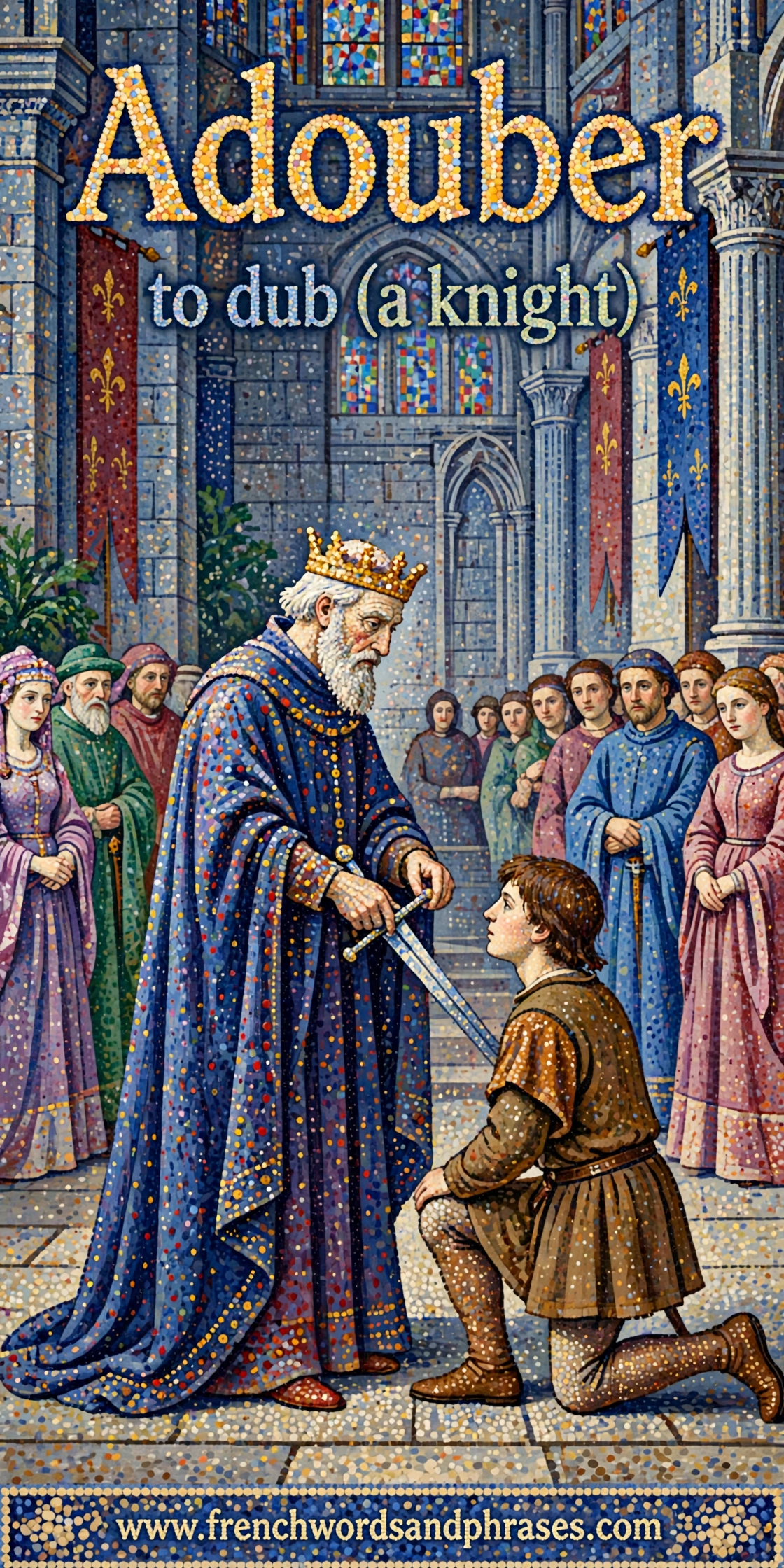
Adouber means to dub (a knight) — to make a squire into a knight with the flat of a sword on the shoulder, in the great ceremony of the Middle Ages.
A young squire kneeling through a night of prayer, a bath, a white robe, and at dawn the sword touching each shoulder while the lord pronounces the words — adouber is the verb of that transformation: the moment a servant of the sword becomes a knight.
In this guide, you’ll learn how to conjugate adouber in all the major French tenses and moods. Explore complete conjugation tables, French examples, English translations, and practice quizzes.
Understanding the French Verb Adouber
Adouber is a regular French verb belonging to the first group of verbs, those ending in-er.
It means to dub (a knight). It is commonly used in history, novels and games for the medieval ceremony itself, and figuratively in journalism for the moment a respected figure publicly endorses a successor. The person who confers the honour adoube; the one who receives it se fait adouber — is dubbed.
Verb classification: First group (-er)
Auxiliary verb: Avoir
Past participle: adoubé
Present participle: adoubant
English equivalents: To dub (a knight), to knight; adouber un écuyer — to dub a squire; se faire adouber — to be knighted; l’adoubement — the dubbing ceremony; (modern, figurative) être adoubé par un maître — to be anointed, endorsed by a master.
One important detail: adouber is a regular -er verb (j’adoube, nous adoubons, adoubé) with a ceremonial heart. The ceremony is l’adoubement, and its central gesture is l’accolade — originally a blow or embrace at the neck, later the touch of the sword’s flat on the shoulder. Modern French keeps the verb alive in a figurative sense: a young chef, artist or politician adoubé par an elder is one who has received the master’s public blessing — knighted, in effect, by reputation.
Experience the Word
Adouber is the verb of the sword on the shoulder — one kneeling moment that changes a man’s name for life.
Imagine a chapel in 1240, cold before dawn. The squire has prayed all night beside his sword on the altar. Now the lord rises, takes the blade, and touches him — once, twice — on the shoulders: il adoube le jeune homme. When the young man stands, the room bows to a knight.
Nothing about him has changed but everything has. He has been dubbed — adoubé — and the word will follow him to his tomb.
How to Conjugate Adouber: Complete French Conjugation Guide
Let’s explore every major conjugation of adouber, beginning with the indicative mood.
How to Conjugate Adouber in the Indicative Mood
The indicative mood is used to express facts, observations, actions, and events.
How to Conjugate Adouber in the Present Tense (Présent)
Used for actions happening now, habitual actions, and general truths.
| Subject | Conjugation |
|---|---|
| je | adoube |
| tu | adoubes |
| il / elle | adoube |
| nous | adoubons |
| vous | adoubez |
| ils / elles | adoubent |
Example
Le roi adoube le jeune écuyer devant la cour.
The king dubs the young squire before the court.
Quick Quiz 1
Complete the sentence:
Nous ______ les écuyers à l’aube, selon la coutume.
Reveal the answer
adoubons
Nous adoubons les écuyers à l’aube, selon la coutume.
We dub the squires at dawn, according to custom.
How to Conjugate Adouber in the Passé Composé
Used for completed actions in the past. Adouber takes the auxiliary verb avoir.
| Subject | Conjugation |
|---|---|
| j’ | ai adoubé |
| tu | as adoubé |
| il / elle | a adoubé |
| nous | avons adoubé |
| vous | avez adoubé |
| ils / elles | ont adoubé |
Example
Le seigneur a adoubé son fils au matin de ses vingt ans.
The lord knighted his son on the morning of his twentieth year.
How to Conjugate Adouber in the Imparfait (Imperfect Tense)
Used for habitual past actions, descriptions, and ongoing situations in the past.
| Subject | Conjugation |
|---|---|
| je | adoubais |
| tu | adoubais |
| il / elle | adoubait |
| nous | adoubions |
| vous | adoubiez |
| ils / elles | adoubaient |
Example
On adoubait les chevaliers la veille des batailles.
Knights used to be dubbed on the eve of battles.
Quick Quiz 2
Choose the correct form:
The lord knighted his son.
Le seigneur ______ son fils. (a adoubé / est adoubé)
Reveal the answer
a adoubé
Le seigneur a adoubé son fils.
Adouber takes avoir.
How to Conjugate Adouber in the Plus-que-parfait
Used to describe an action that had already been completed before another past event.
| Subject | Conjugation |
|---|---|
| j’ | avais adoubé |
| tu | avais adoubé |
| il / elle | avait adoubé |
| nous | avions adoubé |
| vous | aviez adoubé |
| ils / elles | avaient adoubé |
Example
Il avait adoubé son neveu l’année précédente.
He had knighted his nephew the previous year.
How to Conjugate Adouber in the Passé Simple
Primarily used in formal writing, literature, and historical narratives. It is rarely used in everyday conversation.
| Subject | Conjugation |
|---|---|
| je | adoubai |
| tu | adoubas |
| il / elle | adouba |
| nous | adoubâmes |
| vous | adoubâtes |
| ils / elles | adoubèrent |
Example
Le roi adouba le héros après la victoire.
The king knighted the hero after the victory.
How to Conjugate Adouber in the Passé Antérieur
A literary tense used to express an action completed immediately before another past action, generally in the passé simple.
| Subject | Conjugation |
|---|---|
| j’ | eus adoubé |
| tu | eus adoubé |
| il / elle | eut adoubé |
| nous | eûmes adoubé |
| vous | eûtes adoubé |
| ils / elles | eurent adoubé |
Example
Quand le prêtre eut adoubé le chevalier, les cloches sonnèrent.
When the priest had dubbed the knight, the bells rang out.
How to Conjugate Adouber in the Future Tense (Futur Simple)
Used to describe actions that will take place in the future.
| Subject | Conjugation |
|---|---|
| je | adouberai |
| tu | adouberas |
| il / elle | adoubera |
| nous | adouberons |
| vous | adouberez |
| ils / elles | adouberont |
Example
Demain, le prince adoubera trois écuyers.
Tomorrow, the prince will dub three squires.
How to Conjugate Adouber in the Futur Antérieur (Future Perfect)
Used for an action that will have been completed before a particular point in the future.
| Subject | Conjugation |
|---|---|
| j’ | aurai adoubé |
| tu | auras adoubé |
| il / elle | aura adoubé |
| nous | aurons adoubé |
| vous | aurez adoubé |
| ils / elles | auront adoubé |
Example
À la fin de la cérémonie, le roi aura adoubé douze chevaliers.
By the end of the ceremony, the king will have dubbed twelve knights.
How to Conjugate Adouber in the Near Future (Futur Proche)
Used to describe something that is going to happen soon. Formed with aller + infinitive.
| Subject | Conjugation |
|---|---|
| je | vais adouber |
| tu | vas adouber |
| il / elle | va adouber |
| nous | allons adouber |
| vous | allez adouber |
| ils / elles | vont adouber |
Example
Le vieux roi va adouber son petit-fils.
The old king is going to knight his grandson.
How to Conjugate Adouber in the Conditional Mood
The conditional mood expresses what would happen under certain circumstances. It is also frequently used to make polite requests or express wishes.
How to Conjugate Adouber in the Present Conditional
| Subject | Conjugation |
|---|---|
| je | adouberais |
| tu | adouberais |
| il / elle | adouberait |
| nous | adouberions |
| vous | adouberiez |
| ils / elles | adouberaient |
Example
En temps de guerre, on adouberait les jeunes gens plus tôt.
In wartime, young men would be knighted earlier.
How to Conjugate Adouber in the Past Conditional
| Subject | Conjugation |
|---|---|
| j’ | aurais adoubé |
| tu | aurais adoubé |
| il / elle | aurait adoubé |
| nous | aurions adoubé |
| vous | auriez adoubé |
| ils / elles | auraient adoubé |
Example
Il aurait adoubé son écuyer si la bataille n’avait pas commencé.
He would have knighted his squire if the battle had not begun.
Adouber in the Literary Past Conditional Form
This less common literary form uses the imperfect subjunctive of avoir.
| Subject | Conjugation |
|---|---|
| j’ | eusse adoubé |
| tu | eusses adoubé |
| il / elle | eût adoubé |
| nous | eussions adoubé |
| vous | eussiez adoubé |
| ils / elles | eussent adoubé |
Example
Le seigneur eût adoubé le berger pour son courage.
The lord would have knighted the shepherd for his courage.
How to Conjugate Adouber in the Subjunctive Mood
The subjunctive is used to express wishes, emotions, doubts, necessity, and uncertainty. It frequently follows expressions such as il faut que (it is necessary that) or bien que (although).
How to Conjugate Adouber in the Present Subjunctive
| Subject | Conjugation |
|---|---|
| que je | adoube |
| que tu | adoubes |
| qu’il / qu’elle | adoube |
| que nous | adoubions |
| que vous | adoubiez |
| qu’ils / qu’elles | adoubent |
Example
Il faut que le roi adoube l’écuyer avant la fête.
The king must dub the squire before the feast.
Quick Quiz 3
Complete the sentence using the subjunctive:
Il faut que vous ______ cet écuyer avant la fête.
Reveal the answer
adoubiez
Il faut que vous adoubiez cet écuyer avant la fête.
You must dub this squire before the feast.
How to Conjugate Adouber in the Imperfect Subjunctive
A literary tense, rarely encountered in modern spoken French.
| Subject | Conjugation |
|---|---|
| que je | adoubasse |
| que tu | adoubasses |
| qu’il / qu’elle | adoubât |
| que nous | adoubassions |
| que vous | adoubassiez |
| qu’ils / qu’elles | adoubassent |
Example
On espérait que le prince adoubât son ami d’enfance.
People hoped the prince would knight his childhood friend.
How to Conjugate Adouber in the Pluperfect Subjunctive
A literary construction used to express an action completed before another past action.
| Subject | Conjugation |
|---|---|
| que j’ | eusse adoubé |
| que tu | eusses adoubé |
| qu’il / qu’elle | eût adoubé |
| que nous | eussions adoubé |
| que vous | eussiez adoubé |
| qu’ils / qu’elles | eussent adoubé |
Example
On racontait que le roi eût adoubé un simple soldat.
People said the king had knighted a common soldier.
How to Conjugate Adouber in the Past Subjunctive
| Subject | Conjugation |
|---|---|
| que j’ | aie adoubé |
| que tu | aies adoubé |
| qu’il / qu’elle | ait adoubé |
| que nous | ayons adoubé |
| que vous | ayez adoubé |
| qu’ils / qu’elles | aient adoubé |
Example
Je suis ému que le vieux roi ait adoubé ce jeune homme.
I am moved that the old king knighted this young man.
How to Conjugate Adouber in the Imperative
The imperative is used to give commands, instructions, invitations, or suggestions. Subject pronouns are omitted.
How to Conjugate Adouber in the Present Imperative
| Person | Conjugation |
|---|---|
| (tu) | adoube |
| (nous) | adoubons |
| (vous) | adoubez |
Example
Adoube-le chevalier, il l’a mérité !
Knight him, he has earned it!
Quick Quiz 4
How would you say Knight him, he has earned it (tu form)?
Reveal the answer
Adoube-le chevalier, il l’a mérité !
French Participles of Adouber
Participles are verb forms that can be used in compound tenses and other grammatical constructions.
Present Participle of Adouber
adoubant
En adoubant l’écuyer, le roi lui touche l’épaule de son épée.
In dubbing the squire, the king touches his shoulder with his sword.
Past Participle of Adouber
adoubé
Adoubé par le roi lui-même, le jeune chevalier relève la tête.
Dubbed by the king himself, the young knight raises his head.
Adouber in Everyday French: Real-Life Examples
Now that you know the conjugations, let’s see how adouber appears in everyday French.
Example 1 — Present
Le roi adoube le jeune écuyer devant la cour.
The king dubs the young squire before the court.
Example 2 — Passé composé
Le seigneur a adoubé son fils au matin de ses vingt ans.
The lord knighted his son on the morning of his twentieth year.
Example 3 — Imparfait
On adoubait les chevaliers la veille des batailles.
Knights used to be dubbed on the eve of battles.
Example 4 — Future
Demain, le prince adoubera trois écuyers.
Tomorrow, the prince will dub three squires.
Example 5 — Conditional
En temps de guerre, on adouberait les jeunes gens plus tôt.
In wartime, young men would be knighted earlier.
Example 6 — Imperative
Adoube-le chevalier, il l’a mérité !
Knight him, he has earned it!
Beyond Translation: The Meaning of Adouber
English dub — to dub a knight — is the same gesture wearing another language, and scholars trace both words to an old Germanic root for the blow that seals the rite.
The ceremony survives wherever a master blesses a successor.
When a great chef presents his protégé to the cameras, French newspapers reach for this medieval verb: le jeune cuisinier a été adoubé par son maître. The sword is gone; the shoulder-touch of public blessing remains.
How to Remember the French Verb Adouber
Remember it this way: Adouber is about the sword’s flat on the kneeling squire’s shoulder at dawn.
- The ceremony is l’adoubement; its gesture, the sword’s flat on the shoulder, is l’accolade.
- Regular -er: j’adoube, nous adoubons, past participle adoubé.
- Modern life: être adoubé par un maître — to be anointed as someone’s chosen successor.
The key idea is the sword’s flat on the kneeling squire’s shoulder at dawn.
Test Your Knowledge of Adouber
Let’s see how much you’ve learned. Try answering these questions before revealing the answers.
Question 1
What is the ceremony of adouber called?
Reveal the answer
L’adoubement — the dubbing, with the accolade of the sword on the shoulder.
Question 2
How do you say The king knighted the hero after the victory in French?
Reveal the answer
Le roi adouba le héros après la victoire.
Question 3
Translate: The king dubs the young squire before the court.
Reveal the answer
Le roi adoube le jeune écuyer devant la cour.
Question 4
What is the past participle of adouber?
Reveal the answer
Adoubé.
Question 5
Complete the sentence:
Il faut que le roi ______ l’écuyer avant la fête.
Reveal the answer
adoube
Il faut que le roi adoube l’écuyer avant la fête.
The king must dub the squire before the feast.
Your Final Challenge
Can You Use It?
How would you say this in French?
The king dubbed him at daybreak, and the young man rose a knight.
Reveal the answer
Le roi l’a adoubé au lever du jour, et le jeune homme s’est relevé chevalier.
The king dubbed him at daybreak, and the young man rose a knight.
A little French. A little curiosity. A richer everyday life.
LEARN FRENCH ONE WORD AT A TIME