A French Word to Live By
Translate Fait à to English
/fɛ a/
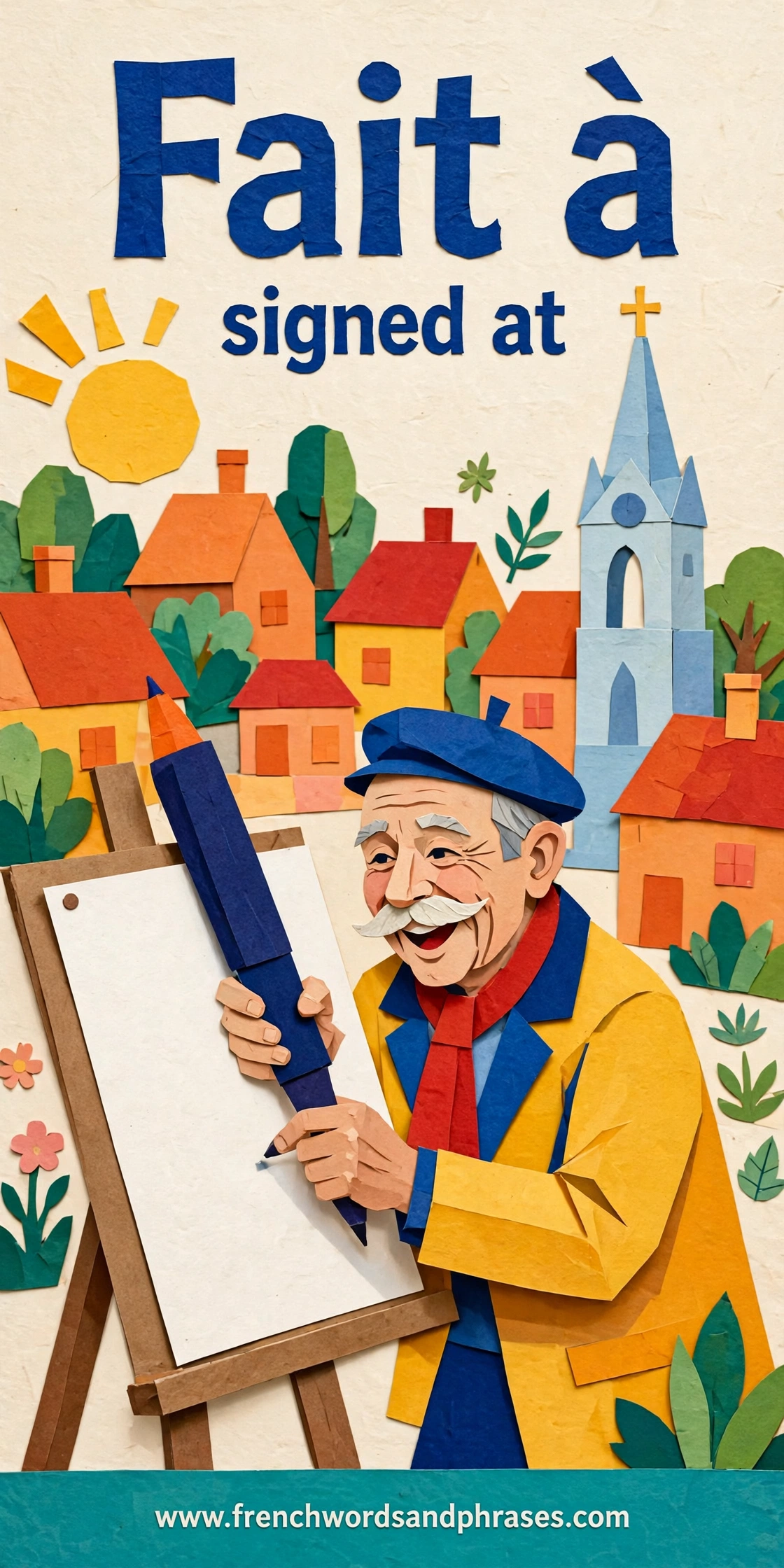
Fait à means signed at — the place line that opens the closing block of a signed document.
The certificate is ready at the mairie counter: name, dates, the official stamp in violet ink. The clerk turns it around and points to the bottom, where two small words wait for the town’s name to complete them — the line that anchors the whole document to a place and a day: « Fait à… »
Let’s explore how fait à works in French, beginning with the whole phrase on one card.
Understanding the French Phrase Fait à
Fait à is a fixed French formula built from fait — the past participle of faire, used here in its old sense of ‘done, drawn up’ — and the preposition à, followed by the name of a place. The full line runs: Fait à Paris, le 12 mai 2026 — signed at Paris, on 12 May 2026. It closes letters, contracts, certificates and attestations all over the French-speaking world.
It means signed at — it records where a document was drawn up and signed, and its partner le gives the date. Fait à is never a complete sentence on its own; it is the first half of a two-part line, place then date, that sits just above the signature block. A town follows the à with no article — Fait à Lyon, Fait à Bruxelles — and the whole formula carries a capital F when it opens the line.
Type: Fixed written formula — participle + à + place, followed by le + date
Answers the need: Recording where, and with le, when a document was signed
Register: Formal and written only — certificates, contracts, official letters
Strength: Administrative and exact — it anchors a document to a place and a day
One important usage detail: the place takes no article — Fait à Marseille, never Fait à la Marseille. The date follows after a comma, introduced by le: Fait à Marseille, le 4 juin. The formula is the mirror of the letter’s opening line, which also gives place and date; fait à belongs at the end, just above lu et approuvé and the signature.
Experience the Word
Fait à is the smallest geography lesson in French paperwork — every signed document must confess where it was born.
Imagine the attestation for a child’s school, written at a kitchen table in a village of three hundred people. The letter is formal, the request is humble — and at the bottom, the village’s name takes its place after Fait à, as proudly as Paris on a treaty. The formula gives every place, however small, the same dignity.
Paper travels; signatures wander. Fait à pins the document to one spot on the map and one day on the calendar, and that is why officials trust it.
How to Use Fait à in French: Complete Guide
Let’s explore how fait à works in French, beginning with the whole phrase on one card.
Fait à at a Glance
The Whole Phrase on One Card
Real meaning, literal picture, English twin and register — fait à in five lines.
| Point | Fait à |
|---|---|
| What it really means | signed at — the place where the document was drawn up and signed |
| Word for word | done at — fait is the past participle of faire, in its sense of drawn up |
| English equivalent | signed at / done at (place), on (date) |
| Register | formal, written only — the closing block of official documents |
| Use it for | certificates, attestations, contracts, official letters — always with le + date |
Example
Fait à Nantes, le 2 avril.
Signed at Nantes, on 2 April.
Word by Word: Building the Place Line
Two pieces — an old participle and the smallest preposition in French.
| Word | Literal meaning | Its job in the phrase |
|---|---|---|
| fait | done, made | the past participle of faire — here it means drawn up, executed, as in a deed |
| à | at | it introduces the place — and the place follows with no article, however grand or small |
Example
Fait à Bordeaux, le 15 septembre.
Signed at Bordeaux, on 15 September.
Quick Quiz 1
Which two facts does the full line give — Fait à Lille, le 9 mars?
Reveal the answer
The place and the date — signed at Lille, on 9 March. Place after à, date after le.
Fait à Lille, le 9 mars, et signé le même jour.
Signed at Lille, on 9 March, and signed the same day.
When You Write It: The Signing Places
Fait à is written at moments like these — a document finished, a place and a day to record.
| Situation | Example |
|---|---|
| A work certificate | fait à Paris, le 30 juin — signed at Paris, on 30 June |
| An attestation | fait à Annecy, le 5 janvier — signed at Annecy, on 5 January |
| Selling a car | le certificat est fait à Grenoble — the certificate is drawn up at Grenoble |
| An internship agreement | fait à Toulouse, le 1er septembre — signed at Toulouse, on 1 September |
| A formal letter | fait à Strasbourg, le 20 novembre — signed at Strasbourg, on 20 November |
Example
L’attestation est faite à Dijon, le 8 octobre.
The certificate is drawn up at Dijon, on 8 October.
Make It Yours: The Closing Block in Full
Fait à opens the closing block — learn the whole ceremony, line by line.
| Form | French | In English |
|---|---|---|
| Place only | Fait à Lyon | Signed at Lyon |
| Place and date | Fait à Lyon, le 3 mars | Signed at Lyon, on 3 March |
| With the formula | Fait à Lyon, le 3 mars — Lu et approuvé | Signed at Lyon, on 3 March — Read and approved |
| In two copies | Fait en deux exemplaires | Drawn up in two copies |
| The date alone | le 3 mars 2026 | on 3 March 2026 |
| Question | Fait à quelle ville ? | Signed in which town? |
Example
Fait à Rennes, le 18 juillet, en deux exemplaires.
Drawn up at Rennes, on 18 July, in two copies.
Quick Quiz 2
Is it Fait à Paris or Fait à la Paris?
Reveal the answer
Fait à Paris — town names follow à with no article in this formula.
Fait à Paris, le 25 décembre.
Signed at Paris, on 25 December.
Everyday Expressions: Building on the Place Line
Fait à slots into these frames at the foot of French documents — each one ready to use.
| Frame | In English |
|---|---|
| Fait à + ville, le + date | Signed at (town), on (date) — the complete line |
| fait en deux exemplaires | drawn up in two copies — one for each side |
| fait à la main | handmade — the same fait, a completely different life |
| délivré à | issued at — the cousin used on certificates and licences |
| Fait à…, le… | the skeleton itself, waiting for its town and its day |
Example
Le document, fait à Lille, est signé des deux parties.
The document, drawn up at Lille, is signed by both parties.
Close Cousins: The Other Closing Formulas
The closing-block shelf — fait à gives the place; its cousins certify the reading, the agreement and the copies.
| Expression | The difference |
|---|---|
| fait à | signed at — it gives the place (and, with le, the date) of signing |
| lu et approuvé | read and approved — the handwritten certification that follows, before the signature |
| bon pour accord | good for agreement — the acceptance formula |
| en date du | dated — it gives the date alone, inside a sentence: votre lettre en date du 3 mars |
| délivré à | issued at — used when an authority hands over a certificate or a licence |
Example
Fait à Metz, lu et approuvé, bon pour accord.
Signed at Metz, read and approved, good for agreement.
Quick Quiz 3
Which formula gives ONLY the date, inside a sentence — fait à or en date du?
Reveal the answer
En date du — your letter en date du 3 mars, your letter dated 3 March. Fait à always carries a place with it.
Votre courrier en date du 3 mars est bien arrivé.
Your letter dated 3 March has arrived safely.
Fait à and Its Neighbours
The official-paper shelf around the phrase — the documents it closes and the marks that complete them.
| French | In English |
|---|---|
| une attestation | a certificate, a sworn statement |
| un certificat | a certificate |
| un tampon | an official stamp |
| la date | the date |
| le lieu | the place |
| une signature | a signature |
Example
Le tampon de la mairie suit la mention « Fait à ».
The town hall’s stamp follows the words ‘Fait à’.
Watch Out: The Traps Around Fait à
The traps: an article that must not appear, a handmade twin, and a line that is never finished alone.
| Trap | The truth |
|---|---|
| the forbidden article | towns follow à bare — Fait à Paris, Fait à Lyon; the article appears only in names that carry one, like Le Havre: Fait au Havre |
| the handmade twin | fait à la main means handmade — same words, kitchen-and-craft world, nothing to do with signing |
| never alone | fait à is half a line — it waits for its town, and its town waits for le and the date |
| the capital F | opening the closing line, the formula takes a capital: Fait à…; mid-sentence it stays small: le document fait à… |
Example
Ce document, fait à Tours, n’a rien d’un objet fait à la main.
This document, drawn up at Tours, is nothing like a handmade object.
Quick Quiz 4
True or false: fait à la main belongs to the same world of signatures and certificates.
Reveal the answer
False — fait à la main means handmade, a matter of crafts and cooking. Fait à on a document is followed by a town, not by la main.
Ce sac est fait à la main, ce certificat est fait à Nice.
This bag is handmade, this certificate is drawn up at Nice.
Fait à in Everyday French: Real-Life Examples
Now that you know the word, let’s see how fait à appears in everyday French.
Example 1 — At the mairie
Fait à Clermont-Ferrand, le 14 février.
Signed at Clermont-Ferrand, on 14 February.
Example 2 — The work certificate
Le certificat de travail est fait à Paris, le 31 mai.
The work certificate is drawn up at Paris, on 31 May.
Example 3 — Selling the car
Fait à Angers, le 6 septembre, en deux exemplaires.
Drawn up at Angers, on 6 September, in two copies.
Example 4 — The school attestation
Elle écrit « Fait à Pau, le 10 janvier » et elle signe.
She writes ‘Signed at Pau, on 10 January’ and she signs.
Example 5 — The internship
La convention est faite à Montpellier, le 2 octobre.
The agreement is drawn up at Montpellier, on 2 October.
Example 6 — The formal letter
Fait à Besançon, le 27 novembre. Veuillez agréer…
Signed at Besançon, on 27 November. Yours faithfully…
Beyond Translation: The Meaning of Fait à
Every French document ends with a tiny act of geography. Treaties between nations and notes for a child’s absence close with the same two words, because the instinct is the same: a promise is stronger when it says where it was made. English writes ‘signed at’ only in legal corners; French puts Fait à on school attestations and car sales alike, a small ceremony of place available to everyone.
Fait à is the document’s birthplace, written in its own last line.
Paris or a village of three hundred — the formula measures no importance, only location, and that equality is its charm.
How to Remember the French Phrase Fait à
Remember it this way: Fait à is the document’s birthplace — the place line that pins a signature to a spot on the map.
- You pair the facts — à carries the place, le carries the date: Fait à Lyon, le 3 mars.
- You strip the article — towns stand bare after à: Fait à Paris, Fait à Lyon (only Le Havre keeps its own: Fait au Havre).
- You keep the twins apart — fait à + a town signs documents; fait à la main makes jam and jumpers.
The key idea is fait à means signed at — the place line of a document, completed by le and the date.
Test Your Knowledge of Fait à
Let’s see how much you’ve learned. Try answering these questions before revealing the answers.
Question 1
What does Fait à mean, and what completes the line?
Reveal the answer
Signed at — a town follows the à, and le plus the date completes the line: Fait à Lyon, le 3 mars.
Question 2
How do you write ‘Signed at Marseille, on 4 June’?
Reveal the answer
Fait à Marseille, le 4 juin — no article before the town, le before the date.
Question 3
What does fait en deux exemplaires mean?
Reveal the answer
Drawn up in two copies — one original for each side of the agreement.
Question 4
What is the difference between fait à and fait à la main?
Reveal the answer
Fait à plus a town signs a document; fait à la main means handmade — crafts, not certificates.
Question 5
Complete the line:
Fait ______ Nice, le 8 août. (Signed at Nice, on 8 August.)
Reveal the answer
à
Fait à Nice, le 8 août.
Signed at Nice, on 8 August.
Your Final Challenge
Can You Use It?
How would you say this in French?
“Signed at Marseille, on 4 June.”
Reveal the answer
Fait à Marseille, le 4 juin.
Signed at Marseille, on 4 June.
A little French. A little curiosity. A richer everyday life.
LEARN FRENCH ONE WORD AT A TIME