A French Word to Live By
How to Conjugate Confronter in French
/kɔ̃.fʁɔ̃.te/
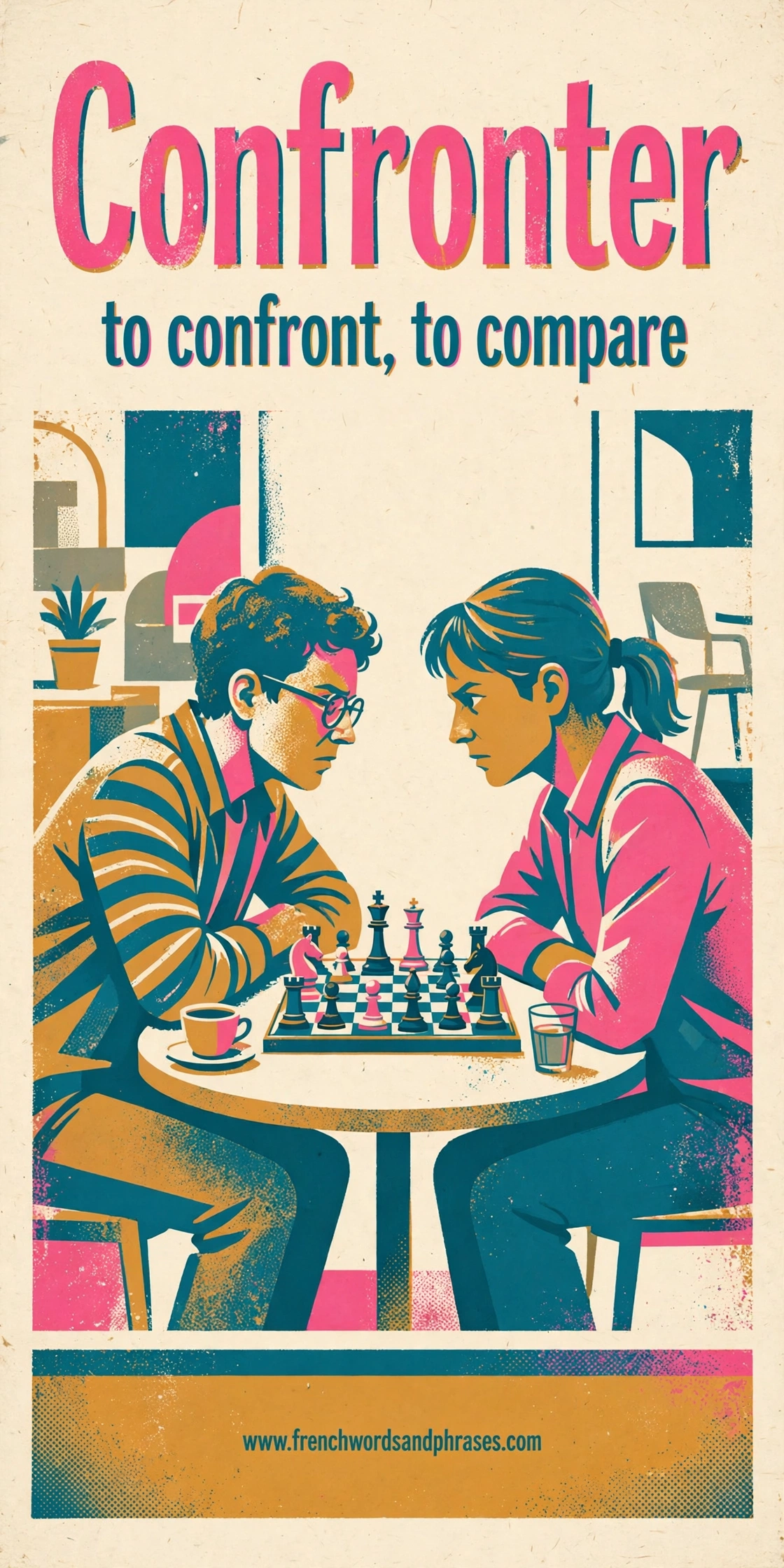
Confronter means to confront, to compare — to bring two people, two accounts or one person and one hard truth face to face.
A witness brought face to face with the suspect, a journalist setting two versions of the facts side by side, a son finally facing his father’s silence — confronter is the verb of the face-to-face: it puts people and truths front to front and lets the sparks, or the answers, come.
In this guide, you’ll learn how to conjugate confronter in all the major French tenses and moods. Explore complete conjugation tables, French examples, English translations, and practice quizzes.
Understanding the French Verb Confronter
Confronter is a regular French verb belonging to the first group of verbs, those ending in-er.
It means to confront, to compare. It works in three rooms: the police station and the court, where witnesses are formally brought face to face (la confrontation); the library, where scholars confront manuscripts and versions; and ordinary life, where reality confronts us with choices, costs and consequences we did not schedule.
Verb classification: First group (-er)
Auxiliary verb: Avoir
Past participle: confronté
Present participle: confrontant
English equivalents: To confront, to face, to compare, to collate; confronter quelqu’un à quelque chose — to confront someone with something; confronter deux témoignages — to compare two accounts; confronter les manuscrits — to collate the manuscripts; être confronté à — to be faced with.
One important detail: confronter is built on à. Its flagship construction is confronter quelqu’un à quelque chose — to confront someone with something: confronter le suspect au témoin, confronter son fils à la réalité. With two things side by side it compares: confronter les deux versions, confronter A et B. Do not confuse it with affronter, to face bravely and actively: circumstances and judges confront you (confronter); you yourself affrontez a storm or an opponent. The passive-style twin être confronté à — to be faced with — agrees like an adjective: confronté, confrontée, confrontés. The verb is a regular -er: je confronte, nous confrontons; its noun is une confrontation.
Experience the Word
Confronter is the verb of the face-to-face — two foreheads, two versions, and nowhere left to look away.
Imagine a small office at the end of a long inquiry. The inspector places two statements on the desk, side by side. One says the car was blue; the other swears it was grey. This afternoon the two witnesses will be brought into the same room — on va les confronter — and by evening, one of the versions will have changed.
No shouting, no drama. Just confrontés — placed face to face, until the truth shows.
How to Conjugate Confronter: Complete French Conjugation Guide
Let’s explore every major conjugation of confronter, beginning with the indicative mood.
How to Conjugate Confronter in the Indicative Mood
The indicative mood is used to express facts, observations, actions, and events.
How to Conjugate Confronter in the Present Tense (Présent)
Used for actions happening now, habitual actions, and general truths.
| Subject | Conjugation |
|---|---|
| je | confronte |
| tu | confrontes |
| il / elle | confronte |
| nous | confrontons |
| vous | confrontez |
| ils / elles | confrontent |
Example
Le juge confronte le suspect aux déclarations du témoin.
The judge confronts the suspect with the witness’s statements.
Quick Quiz 1
Complete the sentence:
Nous ______ les chiffres des deux années.
Reveal the answer
confrontons
Nous confrontons les chiffres des deux années.
We are comparing the figures from the two years.
How to Conjugate Confronter in the Passé Composé
Used for completed actions in the past. Confronter takes the auxiliary verb avoir.
| Subject | Conjugation |
|---|---|
| j’ | ai confronté |
| tu | as confronté |
| il / elle | a confronté |
| nous | avons confronté |
| vous | avez confronté |
| ils / elles | ont confronté |
Example
Elle a confronté son frère à ses propres mensonges.
She confronted her brother with his own lies.
How to Conjugate Confronter in the Imparfait (Imperfect Tense)
Used for habitual past actions, descriptions, and ongoing situations in the past.
| Subject | Conjugation |
|---|---|
| je | confrontais |
| tu | confrontais |
| il / elle | confrontait |
| nous | confrontions |
| vous | confrontiez |
| ils / elles | confrontaient |
Example
Les historiens confrontaient les manuscrits ligne par ligne.
The historians used to compare the manuscripts line by line.
Quick Quiz 2
Choose the correct form:
He had compared the two versions.
Il ______ les deux versions. (avait confronté / était confronté)
Reveal the answer
avait confronté
Il avait confronté les deux versions.
Confronter takes avoir.
How to Conjugate Confronter in the Plus-que-parfait
Used to describe an action that had already been completed before another past event.
| Subject | Conjugation |
|---|---|
| j’ | avais confronté |
| tu | avais confronté |
| il / elle | avait confronté |
| nous | avions confronté |
| vous | aviez confronté |
| ils / elles | avaient confronté |
Example
Il avait confronté les deux versions avant de décider.
He had compared the two versions before deciding.
How to Conjugate Confronter in the Passé Simple
Primarily used in formal writing, literature, and historical narratives. It is rarely used in everyday conversation.
| Subject | Conjugation |
|---|---|
| je | confrontai |
| tu | confrontas |
| il / elle | confronta |
| nous | confrontâmes |
| vous | confrontâtes |
| ils / elles | confrontèrent |
Example
Le directeur confronta l’employé aux faits, calmement.
The director calmly confronted the employee with the facts.
How to Conjugate Confronter in the Passé Antérieur
A literary tense used to express an action completed immediately before another past action, generally in the passé simple.
| Subject | Conjugation |
|---|---|
| j’ | eus confronté |
| tu | eus confronté |
| il / elle | eut confronté |
| nous | eûmes confronté |
| vous | eûtes confronté |
| ils / elles | eurent confronté |
Example
Quand l’inspecteur eut confronté les témoignages, la vérité apparut.
When the inspector had compared the testimonies, the truth appeared.
How to Conjugate Confronter in the Future Tense (Futur Simple)
Used to describe actions that will take place in the future.
| Subject | Conjugation |
|---|---|
| je | confronterai |
| tu | confronteras |
| il / elle | confrontera |
| nous | confronterons |
| vous | confronterez |
| ils / elles | confronteront |
Example
Demain, nous confronterons les résultats des deux laboratoires.
Tomorrow, we will compare the results from the two laboratories.
How to Conjugate Confronter in the Futur Antérieur (Future Perfect)
Used for an action that will have been completed before a particular point in the future.
| Subject | Conjugation |
|---|---|
| j’ | aurai confronté |
| tu | auras confronté |
| il / elle | aura confronté |
| nous | aurons confronté |
| vous | aurez confronté |
| ils / elles | auront confronté |
Example
À la fin de l’enquête, ils auront confronté tous les témoins.
By the end of the inquiry, they will have confronted all the witnesses.
How to Conjugate Confronter in the Near Future (Futur Proche)
Used to describe something that is going to happen soon. Formed with aller + infinitive.
| Subject | Conjugation |
|---|---|
| je | vais confronter |
| tu | vas confronter |
| il / elle | va confronter |
| nous | allons confronter |
| vous | allez confronter |
| ils / elles | vont confronter |
Example
Je vais confronter ces chiffres avec ceux de l’an dernier.
I am going to compare these figures with last year’s.
How to Conjugate Confronter in the Conditional Mood
The conditional mood expresses what would happen under certain circumstances. It is also frequently used to make polite requests or express wishes.
How to Conjugate Confronter in the Present Conditional
| Subject | Conjugation |
|---|---|
| je | confronterais |
| tu | confronterais |
| il / elle | confronterait |
| nous | confronterions |
| vous | confronteriez |
| ils / elles | confronteraient |
Example
Un bon journaliste confronterait les sources avant de publier.
A good journalist would cross-check the sources before publishing.
How to Conjugate Confronter in the Past Conditional
| Subject | Conjugation |
|---|---|
| j’ | aurais confronté |
| tu | aurais confronté |
| il / elle | aurait confronté |
| nous | aurions confronté |
| vous | auriez confronté |
| ils / elles | auraient confronté |
Example
Sans ce document, nous n’aurions jamais confronté les deux récits.
Without this document, we would never have compared the two accounts.
Confronter in the Literary Past Conditional Form
This less common literary form uses the imperfect subjunctive of avoir.
| Subject | Conjugation |
|---|---|
| j’ | eusse confronté |
| tu | eusses confronté |
| il / elle | eût confronté |
| nous | eussions confronté |
| vous | eussiez confronté |
| ils / elles | eussent confronté |
Example
Il eût confronté son accusateur sans trembler.
He would have confronted his accuser without trembling.
How to Conjugate Confronter in the Subjunctive Mood
The subjunctive is used to express wishes, emotions, doubts, necessity, and uncertainty. It frequently follows expressions such as il faut que (it is necessary that) or bien que (although).
How to Conjugate Confronter in the Present Subjunctive
| Subject | Conjugation |
|---|---|
| que je | confronte |
| que tu | confrontes |
| qu’il / qu’elle | confronte |
| que nous | confrontions |
| que vous | confrontiez |
| qu’ils / qu’elles | confrontent |
Example
Il faut que tu confrontes ton fils à la réalité.
You must confront your son with reality.
Quick Quiz 3
Complete the sentence using the subjunctive:
Il faut que vous ______ le témoin à ses déclarations.
Reveal the answer
confrontiez
Il faut que vous confrontiez le témoin à ses déclarations.
You must confront the witness with his statements.
How to Conjugate Confronter in the Imperfect Subjunctive
A literary tense, rarely encountered in modern spoken French.
| Subject | Conjugation |
|---|---|
| que je | confrontasse |
| que tu | confrontasses |
| qu’il / qu’elle | confrontât |
| que nous | confrontassions |
| que vous | confrontassiez |
| qu’ils / qu’elles | confrontassent |
Example
On exigeait que l’éditeur confrontât les manuscrits anciens.
The editor was required to collate the ancient manuscripts.
How to Conjugate Confronter in the Pluperfect Subjunctive
A literary construction used to express an action completed before another past action.
| Subject | Conjugation |
|---|---|
| que j’ | eusse confronté |
| que tu | eusses confronté |
| qu’il / qu’elle | eût confronté |
| que nous | eussions confronté |
| que vous | eussiez confronté |
| qu’ils / qu’elles | eussent confronté |
Example
On racontait qu’ils eussent confronté les témoins dès le premier jour.
People said they had confronted the witnesses from the very first day.
How to Conjugate Confronter in the Past Subjunctive
| Subject | Conjugation |
|---|---|
| que j’ | aie confronté |
| que tu | aies confronté |
| qu’il / qu’elle | ait confronté |
| que nous | ayons confronté |
| que vous | ayez confronté |
| qu’ils / qu’elles | aient confronté |
Example
Je suis content qu’elle ait confronté le problème de front.
I am glad she tackled the problem head-on.
How to Conjugate Confronter in the Imperative
The imperative is used to give commands, instructions, invitations, or suggestions. Subject pronouns are omitted.
How to Conjugate Confronter in the Present Imperative
| Person | Conjugation |
|---|---|
| (tu) | confronte |
| (nous) | confrontons |
| (vous) | confrontez |
Example
Confronte les faits, pas les rumeurs !
Compare the facts, not the rumours!
Quick Quiz 4
How would you say Compare the facts (tu form)?
Reveal the answer
Confronte les faits !
French Participles of Confronter
Participles are verb forms that can be used in compound tenses and other grammatical constructions.
Present Participle of Confronter
confrontant
En confrontant les deux lettres, elle a découvert la supercherie.
By comparing the two letters, she discovered the deception.
Past Participle of Confronter
confronté
Confrontés l’un à l’autre, les deux récits ne concordaient pas.
Set against each other, the two accounts did not agree.
Confronter in Everyday French: Real-Life Examples
Now that you know the conjugations, let’s see how confronter appears in everyday French.
Example 1 — Present
Le juge confronte les témoins.
The judge confronts the witnesses.
Example 2 — Passé composé
Elle a confronté les deux versions.
She compared the two versions.
Example 3 — Imparfait
Les savants confrontaient les manuscrits.
The scholars used to collate the manuscripts.
Example 4 — Future
Nous confronterons les chiffres demain.
We will compare the figures tomorrow.
Example 5 — Conditional
Je confronterais les sources avant de publier.
I would cross-check the sources before publishing.
Example 6 — Imperative
Confronte les faits !
Compare the facts!
Beyond Translation: The Meaning of Confronter
The anatomy is in the word: Latin frons is the forehead, and confronter puts foreheads together — English confront is the same gesture in a borrowed coat.
French law still performs it literally.
La confrontation is a formal step of an investigation, where witnesses and suspects are placed in the same room to defend their versions face to face. And the everyday phrase de front — head-on — is the same forehead: aborder un problème de front, to tackle a problem head-on.
How to Remember the French Verb Confronter
Remember it this way: Confronter is about two foreheads, two versions of the truth, face to face.
- Confronter quelqu’un à quelque chose: the à is essential — someone is confronted WITH the facts, the witness, the truth.
- Two things side by side, it compares: confronter les versions, les chiffres, les manuscrits.
- Regular -er: je confronte, nous confrontons, past participle confronté — and être confronté à means to be faced with.
The key idea is two foreheads, two versions of the truth, face to face.
Test Your Knowledge of Confronter
Let’s see how much you’ve learned. Try answering these questions before revealing the answers.
Question 1
Complete the construction: confronter quelqu’un ___ quelque chose.
Reveal the answer
À — confronter le suspect au témoin, confronter son fils à la réalité.
Question 2
How do you say She compared the two versions in French?
Reveal the answer
Elle a confronté les deux versions.
Question 3
Translate: The judge confronts the suspect with the witness’s statements.
Reveal the answer
Le juge confronte le suspect aux déclarations du témoin.
Question 4
What is the past participle of confronter?
Reveal the answer
Confronté — as in être confronté à, to be faced with.
Question 5
Complete the sentence:
Il faut que tu ______ ton fils à la réalité.
Reveal the answer
confrontes
Il faut que tu confrontes ton fils à la réalité.
You must confront your son with reality.
Your Final Challenge
Can You Use It?
How would you say this in French?
By comparing the two accounts, the judge saw the truth take shape between the lines.
Reveal the answer
En confrontant les deux récits, la juge a vu la vérité se dessiner entre les lignes.
By comparing the two accounts, the judge saw the truth take shape between the lines.
A little French. A little curiosity. A richer everyday life.
LEARN FRENCH ONE WORD AT A TIME