A French Word to Live By
Translate Nom de famille to English
/nɔ̃ də fa.mij/
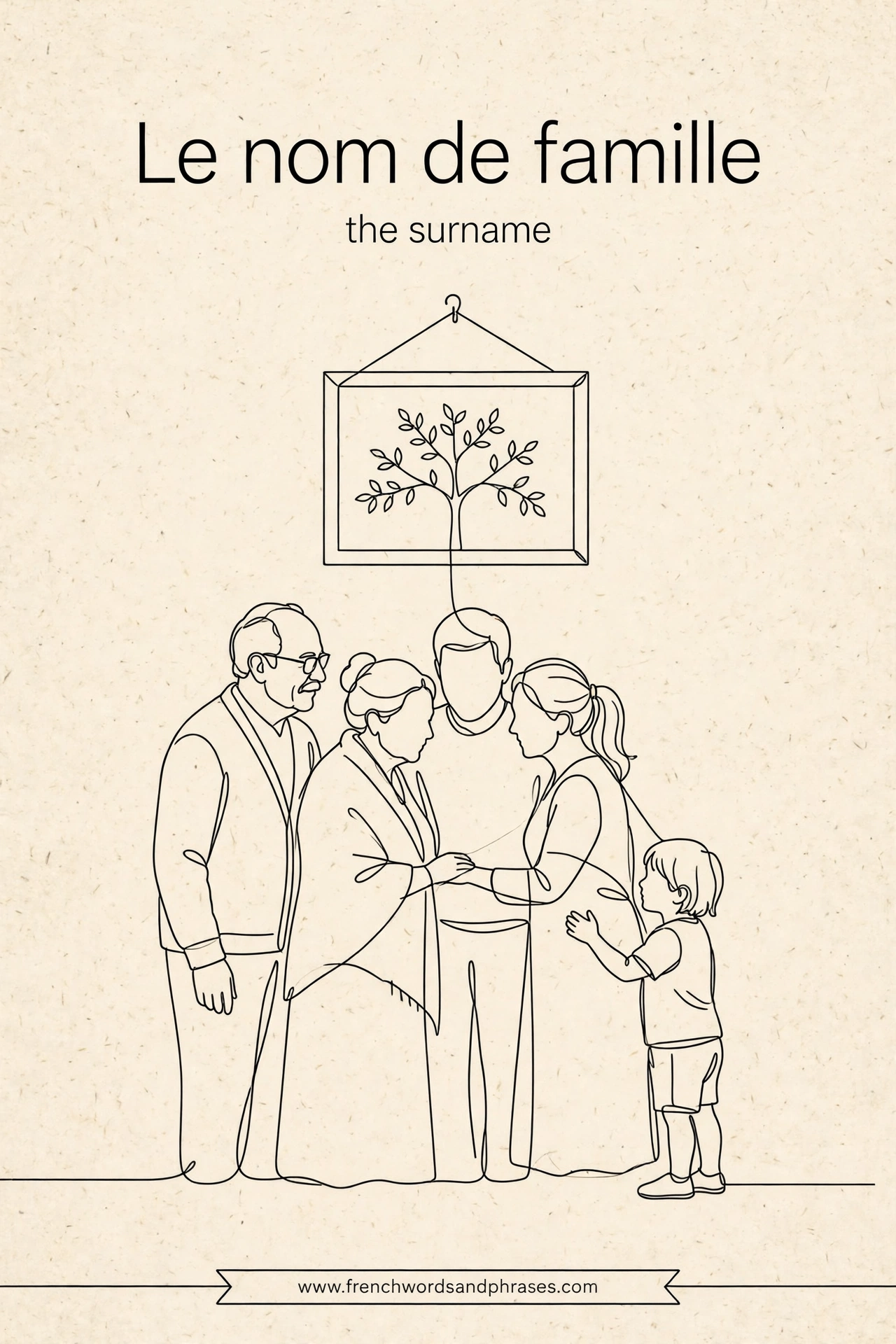
Le nom de famille means the surname.
The clerk at the mairie slides the form across the counter and taps the very first box with her pen: « Nom de famille ? » Not your first name, not your nickname — the name you share with your parents and your children: le nom de famille.
In this guide, you’ll learn what nom de famille means in English, how to use it with its articles, how to form its plural, and how it appears in everyday French. Explore French examples, English translations, and practice quizzes.
Understanding the French Noun Nom de famille
Nom de famille is a masculine French noun phrase, learned with its article: le nom de famille, un nom de famille. The head word is nom (masculine), and the tail — de famille — never changes: it stays exactly the same in the plural and after every adjective.
It means the surname — the family name, the last name in English. It is the name you inherit, the one printed in capital letters on your passport and your bank card. It stands opposite le prénom (the first name): on almost every French form, the two boxes come as a pair — Nom de famille first, Prénom second.
Gender: Masculine — the head word nom is masculine
Definite article: le — le nom de famille (the surname)
Indefinite article: un — un nom de famille (a surname)
Plural: les noms de famille — famille stays unchanged
Head word: nom (a name) + de famille (of family)
English equivalents: The surname; the family name; the last name.
One important usage detail: French forms love capital letters for this box. You will often see simply « Nom : » with the instruction en majuscules — and that box always wants the family name, never the first name. To spell it out loud, French says épeler: « Je vous épelle mon nom de famille : D-U-P-O-N-T. »
Experience the Word
Nom de famille is more than a line on a form. It is the name on the doorbell, the name the teacher calls out on the first day of school, the name that ties you to people you may never have met.
Imagine the scene at the préfecture: a queue, a glass window, and the same question asked a hundred times a day — « Votre nom de famille, s’il vous plaît ? » Answer it well, and the whole appointment flows.
You have not just filled in a box. You have stated who you belong to — your name, your family, your place in the line.
How to Use Nom de famille in French: Complete Guide
Let’s explore how nom de famille works in French, beginning with its articles — and watch how only the little word nom changes while de famille stands still.
Nom de famille with the Definite Article (Le, Les)
Used for the surname everyone in the conversation already knows — yours, on your own documents.
| Form | French |
|---|---|
| Masculine singular | le nom de famille |
| Plural | les noms de famille |
Example
Le nom de famille s’écrit toujours en majuscules sur ce formulaire.
The surname is always written in capital letters on this form.
Nom de famille with the Indefinite Article (Un, Des)
Used for a surname in general — a name you are hearing or reading for the first time.
| Form | French |
|---|---|
| Masculine singular | un nom de famille |
| Plural | des noms de famille |
Example
Dupont est un nom de famille très répandu en France.
Dupont is a very common surname in France.
Nom de famille with Quantities (No Partitive)
A surname is counted, not measured, so the partitive (du, de la) never appears — French uses quantity words instead.
| Quantity | French |
|---|---|
| one single surname | un seul nom de famille |
| a double surname | un nom de famille double |
| both surnames | les deux noms de famille |
| every surname | chaque nom de famille |
Example
Elle porte un nom de famille double, avec un trait d’union.
She has a double surname, with a hyphen.
Quick Quiz 1
You are filling in a French form. Which box receives « DUPONT »?
Reveal the answer
Le nom de famille
Nom de famille : DUPONT — the family name goes in that box, in capital letters; your first name goes under Prénom.
The Plural of Nom de famille
Only nom takes the -s: les noms de famille. The words de famille stay frozen, exactly as they are.
| Number | French |
|---|---|
| Singular | le nom de famille |
| Plural | les noms de famille |
Example
Sur la liste, les noms de famille sont classés par ordre alphabétique.
On the list, the surnames are arranged in alphabetical order.
Nom de famille with Possessive Adjectives (Mon, Ton, Son…)
Possessives agree with nom, which is masculine: mon nom de famille, whatever the family.
| Owner | French |
|---|---|
| my | mon nom de famille |
| your (tu) | ton nom de famille |
| his / her | son nom de famille |
| our | notre nom de famille |
| your (vous) | votre nom de famille |
| their | leur nom de famille |
Example
Son nom de famille est difficile à prononcer pour les étrangers.
Her surname is hard for foreigners to pronounce.
Quick Quiz 2
Complete the sentence:
______ nom de famille est Martin. (My)
Reveal the answer
Mon
Mon nom de famille est Martin.
My surname is Martin — mon, because nom is masculine.
Nom de famille with Demonstrative Adjectives (Ce, Ces)
Used to point at a particular name — on a list, a doorbell, a register.
| Form | French |
|---|---|
| Masculine singular | ce nom de famille |
| Plural | ces noms de famille |
Example
Ce nom de famille me dit quelque chose, je l’ai déjà lu.
That surname rings a bell, I have read it before.
Nom de famille with Adjectives
Adjectives agree with nom (masculine) and usually follow the whole phrase — the de famille stays untouched.
| Adjective | With Nom de famille |
|---|---|
| composé (compound) | un nom de famille composé |
| double (double) | un nom de famille double |
| rare (rare, unusual) | un nom de famille rare |
| long (long) | un nom de famille long |
| célèbre (famous) | un nom de famille célèbre |
Example
Il a un nom de famille composé : il s’appelle Jean de la Tour.
He has a compound surname: his name is Jean de la Tour.
Quick Quiz 3
Complete the sentence:
Les ______ de famille sont écrits en majuscules. (surnames)
Reveal the answer
noms
Les noms de famille sont écrits en majuscules.
The surnames are written in capital letters — only nom takes the -s.
Everyday Expressions with Nom de famille
Counters, telephones and school gates — the surname phrases of daily life.
| Expression | In English |
|---|---|
| Quel est votre nom de famille ? | What is your surname? |
| épeler son nom de famille | to spell out one’s surname |
| écrire son nom de famille en majuscules | to write one’s surname in capital letters |
| changer de nom de famille | to change one’s surname |
| porter un nom de famille célèbre | to bear a famous surname |
| le nom de famille de naissance | the birth surname |
Example
Au téléphone, elle épelle son nom de famille lettre par lettre.
On the phone, she spells out her surname letter by letter.
Words from the Same Family as Nom de famille
Names of every kind — the words that travel with nom de famille.
| French | In English |
|---|---|
| le nom | the name; also the noun in grammar |
| le prénom | the first name |
| le surnom | the nickname |
| la famille | the family |
| le nom de naissance | the birth name |
| familial | family (as an adjective) |
Example
Son surnom est Léo, mais son nom de famille est Bernard.
His nickname is Léo, but his surname is Bernard.
Quick Quiz 4
What is le surnom?
Reveal the answer
The nickname — the affectionate extra name friends give you, from the same family as nom.
Tout le monde connaît son surnom.
Everyone knows his nickname.
Nom de famille in Everyday French: Real-Life Examples
Now that you know the word, let’s see how nom de famille appears in everyday French.
Example 1 — At the mairie
L’employée demande : « Votre nom de famille, s’il vous plaît ? »
The clerk asks: “Your surname, please?”
Example 2 — On the telephone
Je vous épelle mon nom de famille : B-E-R-N-A-R-D.
Let me spell my surname for you: B-E-R-N-A-R-D.
Example 3 — At the airport
Le nom de famille sur le billet doit correspondre au passeport.
The surname on the ticket must match the passport.
Example 4 — At school
L’institutrice lit les noms de famille de sa nouvelle classe.
The teacher reads out the surnames of her new class.
Example 5 — At the bank
Écrivez votre nom de famille en majuscules, sans accent.
Write your surname in capital letters, without accents.
Example 6 — Meeting someone
Enchanté ! Mon nom de famille est Moreau, comme le docteur.
Pleased to meet you! My surname is Moreau, like the doctor.
Beyond Translation: The Meaning of Nom de famille
French surnames are little pieces of history. Many began as trades — Boulanger the baker, Meunier the miller — others as places, descriptions or a father’s first name. The nom de famille only became fixed and hereditary quite late, and today it is guarded by law: changing it is a serious administrative journey, not a whim.
To say nom de famille is to carry a whole line of people in two or three syllables.
It evokes the doorbell plate and the mailbox, the wedding register and the school roll — the name that was there before you and will outlast you.
How to Remember the French Noun Nom de famille
Remember it this way: Nom de famille is the surname — nom means a name, and de famille pins it to the family it comes from.
- You see the head word — le nom, a name, masculine.
- You add the tail — de famille, of family, and it never changes.
- You form the plural — les noms de famille, only nom takes the -s.
The key idea is le nom de famille — the name of the family.
Test Your Knowledge of Nom de famille
Let’s see how much you’ve learned. Try answering these questions before revealing the answers.
Question 1
Is nom de famille masculine or feminine?
Reveal the answer
Masculine — le nom de famille, because the head word nom is masculine.
Question 2
What is the plural of le nom de famille?
Reveal the answer
Les noms de famille — only nom changes; de famille stays frozen.
Question 3
Translate: What is your surname?
Reveal the answer
Quel est votre nom de famille ?
Question 4
What is the difference between le nom de famille and le prénom?
Reveal the answer
Le nom de famille is the surname you share with your family; le prénom is your own first name.
Question 5
Complete the sentence:
Elle écrit ______ nom de famille en majuscules. (her)
Reveal the answer
son
Elle écrit son nom de famille en majuscules.
She writes her surname in capital letters — son agrees with nom, not with the owner.
Your Final Challenge
Can You Use It?
How would you say this in French?
“The clerk asks for her surname.”
Reveal the answer
L’employée demande son nom de famille.
The clerk asks for her surname.
A little French. A little curiosity. A richer everyday life.
LEARN FRENCH ONE WORD AT A TIME