A French Word to Live By
How to Conjugate Pleurer in French
/plœ.ʁe/
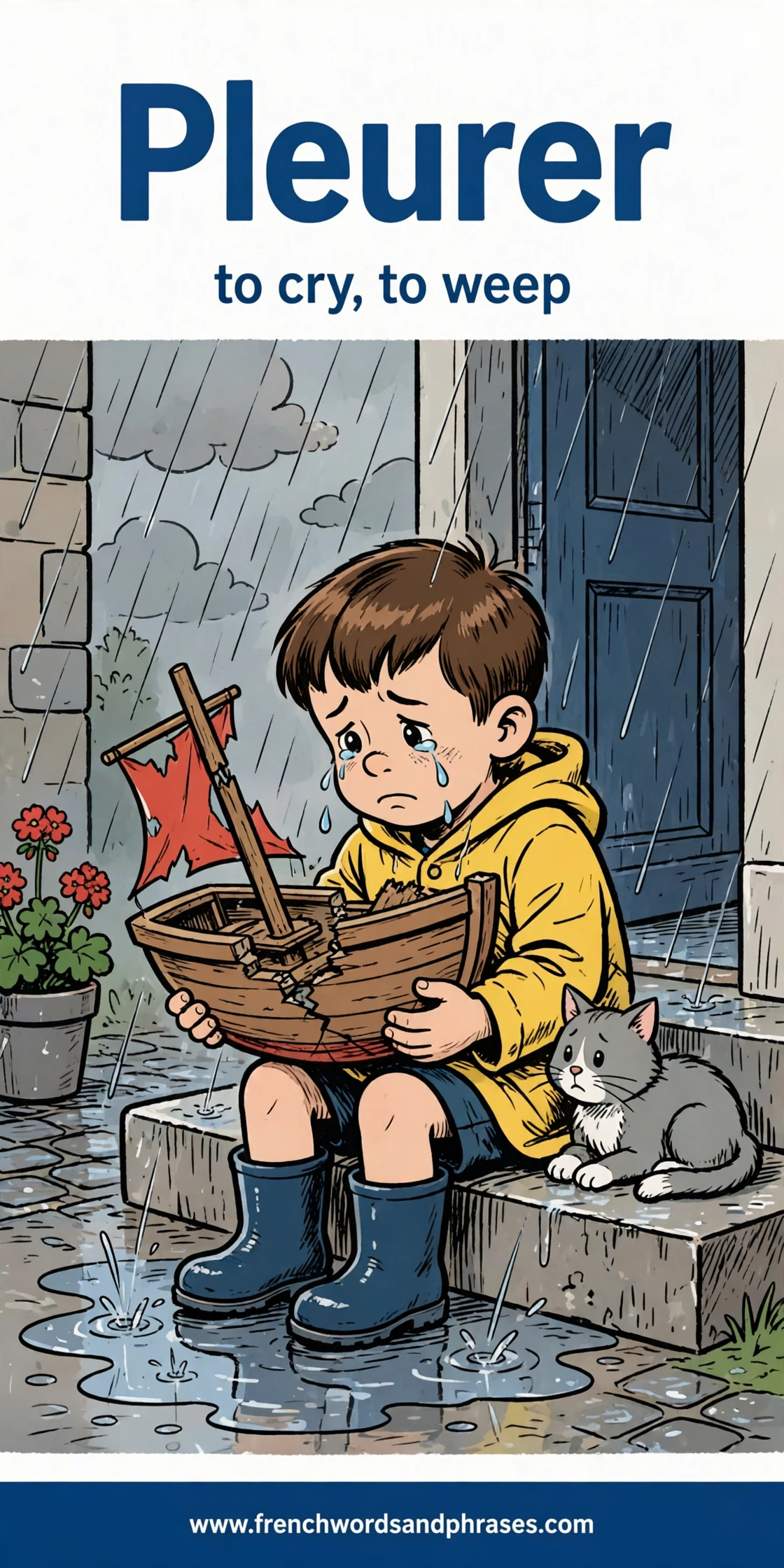
Pleurer means to cry, to weep — to let the tears fall, whether from grief, from joy, from laughter, or from peeling onions.
A baby in the night, a bride at the altar, a whole cinema laughing until the tears run — pleurer is the verb of tears in all their weather: sorrow, relief, joy and the sting of a cut onion.
In this guide, you’ll learn how to conjugate pleurer in all the major French tenses and moods. Explore complete conjugation tables, French examples, English translations, and practice quizzes.
Understanding the French Verb Pleurer
Pleurer is a regular French verb belonging to the first group of verbs, those ending in-er.
It means to cry, to weep. It is the everyday verb for crying, from a baby’s hunger to an adult’s grief, and it sits in the middle of the synonym table Mike found: its neighbour rire is its exact opposite, and whole scenes turn on the swing between them — pleurer de rire is to laugh until you cry. For very literary weeping, French also has verser des larmes, to shed tears, but pleurer does all the real work.
Verb classification: First group (-er)
Auxiliary verb: Avoir
Past participle: pleuré
Present participle: pleurant
English equivalents: To cry, to weep; pleurer de joie — to cry with joy; pleurer de rire — to cry with laughter; pleurer à chaudes larmes — to cry one’s eyes out; pleurer sur quelque chose — to cry over something; avoir les yeux qui pleurent — to have watering eyes.
One important detail: pleurer says what makes the tears flow with the preposition de — pleurer de joie, pleurer de rire, pleurer de fatigue — and what the tears are shed over with sur: pleurer sur son sort, to cry over one’s fate. The verb itself is a model regular -er: je pleure, nous pleurons, ils pleurent, past participle pleuré. And the tears do not need a tragedy at all: onions, smoke and cold wind all make les yeux pleurer — in French, eyes themselves cry.
Experience the Word
Pleurer is the verb of tears let go — the moment feelings become water and run down a face.
Imagine a station platform at dusk. A young woman reads a letter twice, folds it slowly, and begins to pleurer — not loudly, not for show; the tears simply arrive, the way rain arrives, and the whole platform understands without a word.
Nothing is broken and nothing is fixed. She has cried — pleuré — and the day can go on.
How to Conjugate Pleurer: Complete French Conjugation Guide
Let’s explore every major conjugation of pleurer, beginning with the indicative mood.
How to Conjugate Pleurer in the Indicative Mood
The indicative mood is used to express facts, observations, actions, and events.
How to Conjugate Pleurer in the Present Tense (Présent)
Used for actions happening now, habitual actions, and general truths.
| Subject | Conjugation |
|---|---|
| je | pleure |
| tu | pleures |
| il / elle | pleure |
| nous | pleurons |
| vous | pleurez |
| ils / elles | pleurent |
Example
Le bébé pleure parce qu’il a faim.
The baby is crying because he is hungry.
Quick Quiz 1
Complete the sentence:
Nous ______ de rire devant ce spectacle.
Reveal the answer
pleurons
Nous pleurons de rire devant ce spectacle.
We are crying with laughter at this show.
How to Conjugate Pleurer in the Passé Composé
Used for completed actions in the past. Pleurer takes the auxiliary verb avoir.
| Subject | Conjugation |
|---|---|
| j’ | ai pleuré |
| tu | as pleuré |
| il / elle | a pleuré |
| nous | avons pleuré |
| vous | avez pleuré |
| ils / elles | ont pleuré |
Example
Elle a pleuré de joie en lisant la lettre.
She cried with joy while reading the letter.
How to Conjugate Pleurer in the Imparfait (Imperfect Tense)
Used for habitual past actions, descriptions, and ongoing situations in the past.
| Subject | Conjugation |
|---|---|
| je | pleurais |
| tu | pleurais |
| il / elle | pleurait |
| nous | pleurions |
| vous | pleuriez |
| ils / elles | pleuraient |
Example
Enfant, il pleurait chaque fois qu’il perdait un match.
As a child, he used to cry every time he lost a match.
Quick Quiz 2
Choose the correct form:
She cried with joy.
Elle ______ de joie. (a pleuré / est pleuré)
Reveal the answer
a pleuré
Elle a pleuré de joie.
Pleurer takes avoir.
How to Conjugate Pleurer in the Plus-que-parfait
Used to describe an action that had already been completed before another past event.
| Subject | Conjugation |
|---|---|
| j’ | avais pleuré |
| tu | avais pleuré |
| il / elle | avait pleuré |
| nous | avions pleuré |
| vous | aviez pleuré |
| ils / elles | avaient pleuré |
Example
Elle avait pleuré toute la soirée avant de s’endormir.
She had cried all evening before falling asleep.
How to Conjugate Pleurer in the Passé Simple
Primarily used in formal writing, literature, and historical narratives. It is rarely used in everyday conversation.
| Subject | Conjugation |
|---|---|
| je | pleurai |
| tu | pleuras |
| il / elle | pleura |
| nous | pleurâmes |
| vous | pleurâtes |
| ils / elles | pleurèrent |
Example
En apprenant la nouvelle, elle pleura longuement.
On hearing the news, she wept for a long time.
How to Conjugate Pleurer in the Passé Antérieur
A literary tense used to express an action completed immediately before another past action, generally in the passé simple.
| Subject | Conjugation |
|---|---|
| j’ | eus pleuré |
| tu | eus pleuré |
| il / elle | eut pleuré |
| nous | eûmes pleuré |
| vous | eûtes pleuré |
| ils / elles | eurent pleuré |
Example
Quand il eut pleuré un moment, il se sentit plus léger.
When he had cried for a while, he felt lighter.
How to Conjugate Pleurer in the Future Tense (Futur Simple)
Used to describe actions that will take place in the future.
| Subject | Conjugation |
|---|---|
| je | pleurerai |
| tu | pleureras |
| il / elle | pleurera |
| nous | pleurerons |
| vous | pleurerez |
| ils / elles | pleureront |
Example
Tu pleureras de rire en voyant ce film.
You will cry with laughter when you see this film.
How to Conjugate Pleurer in the Futur Antérieur (Future Perfect)
Used for an action that will have been completed before a particular point in the future.
| Subject | Conjugation |
|---|---|
| j’ | aurai pleuré |
| tu | auras pleuré |
| il / elle | aura pleuré |
| nous | aurons pleuré |
| vous | aurez pleuré |
| ils / elles | auront pleuré |
Example
À la fin du film, tout le monde aura pleuré au moins une fois.
By the end of the film, everyone will have cried at least once.
How to Conjugate Pleurer in the Near Future (Futur Proche)
Used to describe something that is going to happen soon. Formed with aller + infinitive.
| Subject | Conjugation |
|---|---|
| je | vais pleurer |
| tu | vas pleurer |
| il / elle | va pleurer |
| nous | allons pleurer |
| vous | allez pleurer |
| ils / elles | vont pleurer |
Example
Attention, le bébé va pleurer si tu pars maintenant.
Careful, the baby is going to cry if you leave now.
How to Conjugate Pleurer in the Conditional Mood
The conditional mood expresses what would happen under certain circumstances. It is also frequently used to make polite requests or express wishes.
How to Conjugate Pleurer in the Present Conditional
| Subject | Conjugation |
|---|---|
| je | pleurerais |
| tu | pleurerais |
| il / elle | pleurerait |
| nous | pleurerions |
| vous | pleureriez |
| ils / elles | pleureraient |
Example
À sa place, je pleurerais aussi.
In her place, I would cry too.
How to Conjugate Pleurer in the Past Conditional
| Subject | Conjugation |
|---|---|
| j’ | aurais pleuré |
| tu | aurais pleuré |
| il / elle | aurait pleuré |
| nous | aurions pleuré |
| vous | auriez pleuré |
| ils / elles | auraient pleuré |
Example
Elle aurait pleuré si elle avait entendu ces mots cruels.
She would have cried if she had heard those cruel words.
Pleurer in the Literary Past Conditional Form
This less common literary form uses the imperfect subjunctive of avoir.
| Subject | Conjugation |
|---|---|
| j’ | eusse pleuré |
| tu | eusses pleuré |
| il / elle | eût pleuré |
| nous | eussions pleuré |
| vous | eussiez pleuré |
| ils / elles | eussent pleuré |
Example
Il eût pleuré de honte sans le soutien de ses amis.
He would have cried with shame without his friends’ support.
How to Conjugate Pleurer in the Subjunctive Mood
The subjunctive is used to express wishes, emotions, doubts, necessity, and uncertainty. It frequently follows expressions such as il faut que (it is necessary that) or bien que (although).
How to Conjugate Pleurer in the Present Subjunctive
| Subject | Conjugation |
|---|---|
| que je | pleure |
| que tu | pleures |
| qu’il / qu’elle | pleure |
| que nous | pleurions |
| que vous | pleuriez |
| qu’ils / qu’elles | pleurent |
Example
Je ne veux pas que tu pleures pour si peu.
I do not want you to cry over so little.
Quick Quiz 3
Complete the sentence using the subjunctive:
Je ne veux pas que vous ______ pendant le film.
Reveal the answer
pleuriez
Je ne veux pas que vous pleuriez pendant le film.
I do not want you to cry during the film.
How to Conjugate Pleurer in the Imperfect Subjunctive
A literary tense, rarely encountered in modern spoken French.
| Subject | Conjugation |
|---|---|
| que je | pleurasse |
| que tu | pleurasses |
| qu’il / qu’elle | pleurât |
| que nous | pleurassions |
| que vous | pleurassiez |
| qu’ils / qu’elles | pleurassent |
Example
Elle redoutait que l’enfant pleurât pendant la cérémonie.
She feared the child might cry during the ceremony.
How to Conjugate Pleurer in the Pluperfect Subjunctive
A literary construction used to express an action completed before another past action.
| Subject | Conjugation |
|---|---|
| que j’ | eusse pleuré |
| que tu | eusses pleuré |
| qu’il / qu’elle | eût pleuré |
| que nous | eussions pleuré |
| que vous | eussiez pleuré |
| qu’ils / qu’elles | eussent pleuré |
Example
On disait qu’elle eût pleuré des heures après son départ.
People said she had cried for hours after he left.
How to Conjugate Pleurer in the Past Subjunctive
| Subject | Conjugation |
|---|---|
| que j’ | aie pleuré |
| que tu | aies pleuré |
| qu’il / qu’elle | ait pleuré |
| que nous | ayons pleuré |
| que vous | ayez pleuré |
| qu’ils / qu’elles | aient pleuré |
Example
Je suis désolé qu’elle ait pleuré à cause de moi.
I am sorry she cried because of me.
How to Conjugate Pleurer in the Imperative
The imperative is used to give commands, instructions, invitations, or suggestions. Subject pronouns are omitted.
How to Conjugate Pleurer in the Present Imperative
| Person | Conjugation |
|---|---|
| (tu) | pleure |
| (nous) | pleurons |
| (vous) | pleurez |
Example
Ne pleure pas, tout va s’arranger !
Do not cry, everything will work out!
Quick Quiz 4
How would you say Do not cry (tu form)?
Reveal the answer
Ne pleure pas !
French Participles of Pleurer
Participles are verb forms that can be used in compound tenses and other grammatical constructions.
Present Participle of Pleurer
pleurant
En pleurant, elle serrait la lettre contre elle.
While crying, she clutched the letter to her chest.
Past Participle of Pleurer
pleuré
Pleurée par tout le village, la vieille institutrice a eu de belles funérailles.
Mourned by the whole village, the old schoolteacher had a beautiful funeral.
Pleurer in Everyday French: Real-Life Examples
Now that you know the conjugations, let’s see how pleurer appears in everyday French.
Example 1 — Present
Le bébé pleure parce qu’il a faim.
The baby is crying because he is hungry.
Example 2 — Passé composé
Elle a pleuré de joie à la gare.
She cried with joy at the station.
Example 3 — Imparfait
Enfant, il pleurait pour un rien.
As a child, he used to cry over nothing.
Example 4 — Future
Tu pleureras de rire devant ce film.
You will cry with laughter at this film.
Example 5 — Conditional
À ta place, je pleurerais aussi.
In your place, I would cry too.
Example 6 — Imperative
Ne pleure pas, je suis là !
Do not cry, I am here!
Beyond Translation: The Meaning of Pleurer
English implore and deplore are cousins of pleurer — all three grow from Latin plorare, to cry out and weep; to implore is to beg with tears in it.
French also cries in its idioms.
Pleurer comme une Madeleine is to cry buckets, after Mary Magdalene’s tears; pleurer toutes les larmes de son corps is to cry every tear in one’s body; and les larmes de crocodile — crocodile tears — are the false ones, shed by someone who feels nothing at all.
How to Remember the French Verb Pleurer
Remember it this way: Pleurer is about tears on a station platform — grief, joy and laughter all use the same verb.
- De for the cause, sur for the thing mourned: pleurer de joie, pleurer sur son sort.
- Eyes cry too: les yeux qui pleurent — watering eyes from onions, smoke or cold wind.
- Regular -er throughout: je pleure, nous pleurons, past participle pleuré, auxiliary avoir.
The key idea is tears on a station platform — grief, joy and laughter all use the same verb.
Test Your Knowledge of Pleurer
Let’s see how much you’ve learned. Try answering these questions before revealing the answers.
Question 1
Which preposition introduces the cause of the tears in pleurer de rire?
Reveal the answer
De — pleurer de joie, pleurer de rire, pleurer de fatigue.
Question 2
How do you say She cried with joy in French?
Reveal the answer
Elle a pleuré de joie.
Question 3
Translate: The baby is crying because he is hungry.
Reveal the answer
Le bébé pleure parce qu’il a faim.
Question 4
What is the past participle of pleurer?
Reveal the answer
Pleuré.
Question 5
Complete the sentence:
Je ne veux pas que tu ______ pour si peu.
Reveal the answer
pleures
Je ne veux pas que tu pleures pour si peu.
I do not want you to cry over so little.
Your Final Challenge
Can You Use It?
How would you say this in French?
She is crying with joy on the station platform, and nobody finds it strange.
Reveal the answer
Elle pleure de joie sur le quai de la gare, et personne ne trouve cela étrange.
She is crying with joy on the station platform, and nobody finds it strange.
A little French. A little curiosity. A richer everyday life.
LEARN FRENCH ONE WORD AT A TIME