A French Word to Live By
How to Conjugate Rater in French
/ʁa.te/
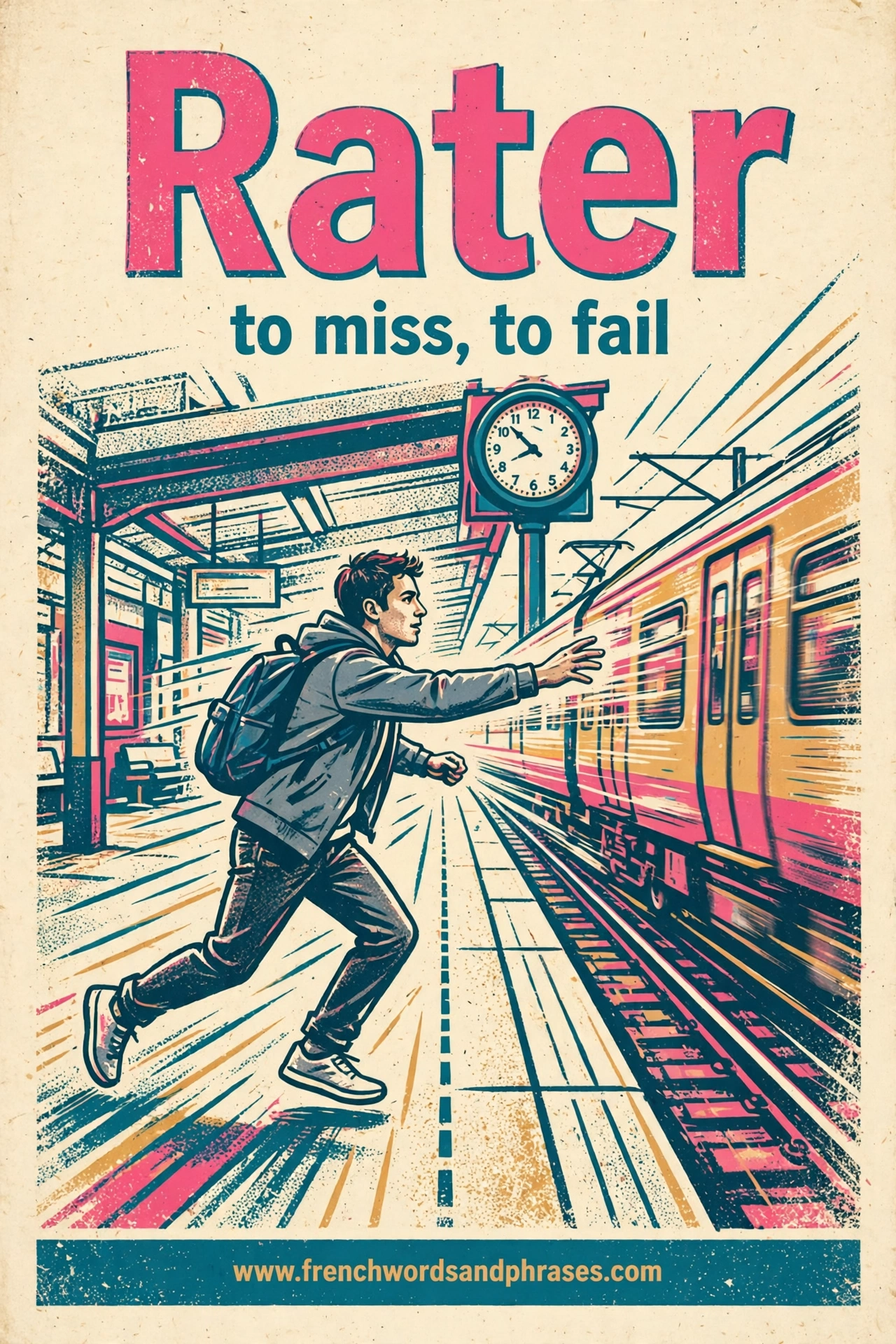
Rater means to miss, to fail — to arrive a second too late for the train, or to fall short in an exam.
A platform emptying as the train pulls away, a target untouched on the range, an exam paper handed back with a red line through it — rater is the verb of the near-miss and the fallen-short: whatever you aimed at, and did not get.
In this guide, you’ll learn how to conjugate rater in all the major French tenses and moods. Explore complete conjugation tables, French examples, English translations, and practice quizzes.
Understanding the French Verb Rater
Rater is a regular French verb belonging to the first group of verbs, those ending in-er.
It means to miss, to fail. It covers both halves of the English pair in its gloss: missing things that move or wait (trains, targets, opportunities, the start of films) and failing tests and undertakings (exams, driving tests, recipes, jokes that fall flat). A comedian whose joke dies has raté sa blague; a cook has raté sa sauce. In the synonym table it stands as an antonym of réussir, to succeed — and the two verbs divide student life between them.
Verb classification: First group (-er)
Auxiliary verb: Avoir
Past participle: raté
Present participle: ratant
English equivalents: To miss, to fail; rater le train — to miss the train; rater son examen — to fail one’s exam; rater la cible — to miss the target; rater une occasion — to miss an opportunity; un plat raté — a ruined dish; ne pas rater — not to miss (a must-see).
One important detail: rater takes its object directly, with no preposition — rater le train, rater son examen, rater la cible. Do not let English smuggle one in: you miss the train, and in French you simply ratez le train. The verb is a perfectly regular -er (je rate, nous ratons, past participle raté), and the participle lives a second life as an adjective: un examen raté is a failed exam, un plat raté a spoiled dish, une occasion ratée a missed chance. To fail an exam can also be échouer à un examen — its table neighbour — but rater is the everyday word, and the one students use about themselves.
Experience the Word
Rater is the verb of the almost — the door closing, the train leaving, the answer that was on the tip of your tongue.
Imagine a student at the station at 7:59, coffee in hand, watching the 8:00 pull out without her. She has raté her train, and with it, perhaps, the exam at the other end — one small verb holding the whole bad morning.
She did not lose the train or forget it. She missed it — raté — by seconds, which is the cruellest way.
How to Conjugate Rater: Complete French Conjugation Guide
Let’s explore every major conjugation of rater, beginning with the indicative mood.
How to Conjugate Rater in the Indicative Mood
The indicative mood is used to express facts, observations, actions, and events.
How to Conjugate Rater in the Present Tense (Présent)
Used for actions happening now, habitual actions, and general truths.
| Subject | Conjugation |
|---|---|
| je | rate |
| tu | rates |
| il / elle | rate |
| nous | ratons |
| vous | ratez |
| ils / elles | ratent |
Example
Si tu traînes, tu rates ton train.
If you dawdle, you will miss your train.
Quick Quiz 1
Complete the sentence:
Nous ______ toujours le début du film.
Reveal the answer
ratons
Nous ratons toujours le début du film.
We always miss the beginning of the film.
How to Conjugate Rater in the Passé Composé
Used for completed actions in the past. Rater takes the auxiliary verb avoir.
| Subject | Conjugation |
|---|---|
| j’ | ai raté |
| tu | as raté |
| il / elle | a raté |
| nous | avons raté |
| vous | avez raté |
| ils / elles | ont raté |
Example
Il a raté son examen de conduite pour la deuxième fois.
He failed his driving test for the second time.
How to Conjugate Rater in the Imparfait (Imperfect Tense)
Used for habitual past actions, descriptions, and ongoing situations in the past.
| Subject | Conjugation |
|---|---|
| je | ratais |
| tu | ratais |
| il / elle | ratait |
| nous | rations |
| vous | ratiez |
| ils / elles | rataient |
Example
Avant, elle ratait toujours le début des films.
Before, she always used to miss the beginning of films.
Quick Quiz 2
Choose the correct form:
He failed his exam.
Il ______ son examen. (a raté / est raté)
Reveal the answer
a raté
Il a raté son examen.
Rater takes avoir.
How to Conjugate Rater in the Plus-que-parfait
Used to describe an action that had already been completed before another past event.
| Subject | Conjugation |
|---|---|
| j’ | avais raté |
| tu | avais raté |
| il / elle | avait raté |
| nous | avions raté |
| vous | aviez raté |
| ils / elles | avaient raté |
Example
Nous avions raté la correspondance à Lyon.
We had missed the connection in Lyon.
How to Conjugate Rater in the Passé Simple
Primarily used in formal writing, literature, and historical narratives. It is rarely used in everyday conversation.
| Subject | Conjugation |
|---|---|
| je | ratai |
| tu | ratas |
| il / elle | rata |
| nous | ratâmes |
| vous | ratâtes |
| ils / elles | ratèrent |
Example
Il visa lentement, tira, et rata la cible.
He aimed slowly, fired, and missed the target.
How to Conjugate Rater in the Passé Antérieur
A literary tense used to express an action completed immediately before another past action, generally in the passé simple.
| Subject | Conjugation |
|---|---|
| j’ | eus raté |
| tu | eus raté |
| il / elle | eut raté |
| nous | eûmes raté |
| vous | eûtes raté |
| ils / elles | eurent raté |
Example
Quand il eut raté deux fois son permis, il changea d’auto-école.
When he had failed his licence twice, he changed driving schools.
How to Conjugate Rater in the Future Tense (Futur Simple)
Used to describe actions that will take place in the future.
| Subject | Conjugation |
|---|---|
| je | raterai |
| tu | rateras |
| il / elle | ratera |
| nous | raterons |
| vous | raterez |
| ils / elles | rateront |
Example
Pars maintenant, sinon tu rateras ton avion.
Leave now, or you will miss your plane.
How to Conjugate Rater in the Futur Antérieur (Future Perfect)
Used for an action that will have been completed before a particular point in the future.
| Subject | Conjugation |
|---|---|
| j’ | aurai raté |
| tu | auras raté |
| il / elle | aura raté |
| nous | aurons raté |
| vous | aurez raté |
| ils / elles | auront raté |
Example
À ce rythme, elle aura raté trois rendez-vous avant midi.
At this rate, she will have missed three appointments before noon.
How to Conjugate Rater in the Near Future (Futur Proche)
Used to describe something that is going to happen soon. Formed with aller + infinitive.
| Subject | Conjugation |
|---|---|
| je | vais rater |
| tu | vas rater |
| il / elle | va rater |
| nous | allons rater |
| vous | allez rater |
| ils / elles | vont rater |
Example
Dépêche-toi, on va rater le dernier métro !
Hurry up, we are going to miss the last metro!
How to Conjugate Rater in the Conditional Mood
The conditional mood expresses what would happen under certain circumstances. It is also frequently used to make polite requests or express wishes.
How to Conjugate Rater in the Present Conditional
| Subject | Conjugation |
|---|---|
| je | raterais |
| tu | raterais |
| il / elle | raterait |
| nous | raterions |
| vous | rateriez |
| ils / elles | rateraient |
Example
Sans ce retard, je ne raterais pas la réunion.
Without this delay, I would not miss the meeting.
How to Conjugate Rater in the Past Conditional
| Subject | Conjugation |
|---|---|
| j’ | aurais raté |
| tu | aurais raté |
| il / elle | aurait raté |
| nous | aurions raté |
| vous | auriez raté |
| ils / elles | auraient raté |
Example
Elle aurait raté son train sans ton coup de fil.
She would have missed her train without your phone call.
Rater in the Literary Past Conditional Form
This less common literary form uses the imperfect subjunctive of avoir.
| Subject | Conjugation |
|---|---|
| j’ | eusse raté |
| tu | eusses raté |
| il / elle | eût raté |
| nous | eussions raté |
| vous | eussiez raté |
| ils / elles | eussent raté |
Example
Il eût raté sa chance sans ce conseil de dernière minute.
He would have missed his chance without that last-minute advice.
How to Conjugate Rater in the Subjunctive Mood
The subjunctive is used to express wishes, emotions, doubts, necessity, and uncertainty. It frequently follows expressions such as il faut que (it is necessary that) or bien que (although).
How to Conjugate Rater in the Present Subjunctive
| Subject | Conjugation |
|---|---|
| que je | rate |
| que tu | rates |
| qu’il / qu’elle | rate |
| que nous | rations |
| que vous | ratiez |
| qu’ils / qu’elles | ratent |
Example
Je crains qu’il rate encore son examen.
I fear he will fail his exam again.
Quick Quiz 3
Complete the sentence using the subjunctive:
Je crains que vous ______ votre correspondance.
Reveal the answer
ratiez
Je crains que vous ratiez votre correspondance.
I fear you will miss your connection.
How to Conjugate Rater in the Imperfect Subjunctive
A literary tense, rarely encountered in modern spoken French.
| Subject | Conjugation |
|---|---|
| que je | ratasse |
| que tu | ratasses |
| qu’il / qu’elle | ratât |
| que nous | ratassions |
| que vous | ratassiez |
| qu’ils / qu’elles | ratassent |
Example
Elle serrait les dents, de peur qu’il ratât sa cible.
She clenched her teeth, afraid he might miss his target.
How to Conjugate Rater in the Pluperfect Subjunctive
A literary construction used to express an action completed before another past action.
| Subject | Conjugation |
|---|---|
| que j’ | eusse raté |
| que tu | eusses raté |
| qu’il / qu’elle | eût raté |
| que nous | eussions raté |
| que vous | eussiez raté |
| qu’ils / qu’elles | eussent raté |
Example
On murmurait qu’il eût raté l’occasion de sa vie.
People whispered that he had missed the opportunity of his life.
How to Conjugate Rater in the Past Subjunctive
| Subject | Conjugation |
|---|---|
| que j’ | aie raté |
| que tu | aies raté |
| qu’il / qu’elle | ait raté |
| que nous | ayons raté |
| que vous | ayez raté |
| qu’ils / qu’elles | aient raté |
Example
C’est dommage qu’elle ait raté son entretien.
It is a pity she missed her interview.
How to Conjugate Rater in the Imperative
The imperative is used to give commands, instructions, invitations, or suggestions. Subject pronouns are omitted.
How to Conjugate Rater in the Present Imperative
| Person | Conjugation |
|---|---|
| (tu) | rate |
| (nous) | ratons |
| (vous) | ratez |
Example
Ne rate pas cette occasion, elle ne reviendra pas !
Do not miss this opportunity, it will not come back!
Quick Quiz 4
How would you say Do not miss this opportunity (tu form)?
Reveal the answer
Ne rate pas cette occasion !
French Participles of Rater
Participles are verb forms that can be used in compound tenses and other grammatical constructions.
Present Participle of Rater
ratant
En ratant son train, il a rencontré sa future femme.
By missing his train, he met his future wife.
Past Participle of Rater
raté
Un examen raté n’est pas une vie ratée.
A failed exam is not a failed life.
Rater in Everyday French: Real-Life Examples
Now that you know the conjugations, let’s see how rater appears in everyday French.
Example 1 — Present
Tu rates ton train si tu traînes.
You will miss your train if you dawdle.
Example 2 — Passé composé
Il a raté son examen de conduite.
He failed his driving test.
Example 3 — Imparfait
Elle ratait toujours le début des films.
She always used to miss the start of films.
Example 4 — Future
Tu rateras ton avion si tu ne pars pas.
You will miss your plane if you do not leave.
Example 5 — Conditional
Je ne raterais pas la réunion sans ce retard.
I would not miss the meeting without this delay.
Example 6 — Imperative
Ne rate pas cette occasion !
Do not miss this opportunity!
Beyond Translation: The Meaning of Rater
Nobody is quite sure where rater comes from — it appears in the 17th century, probably from the world of firearms that misfire: a shot that fails to go off, then any shot that fails at all.
The misfire became the miss, and the miss became the failure.
Its family is small but expressive: un raté is a misfire, a flop, and — rudely — a failure of a person; raté ! on its own is what you say when the bus pulls away: missed it!
How to Remember the French Verb Rater
Remember it this way: Rater is about the train pulling out at 8:00 while you run up at 7:59.
- Direct object, no preposition: rater le train, rater son examen, rater la cible.
- One verb for both English words: to miss (a train) and to fail (an exam).
- Regular -er: je rate, nous ratons, past participle raté — which doubles as the adjective in un plat raté.
The key idea is the train pulling out at 8:00 while you run up at 7:59.
Test Your Knowledge of Rater
Let’s see how much you’ve learned. Try answering these questions before revealing the answers.
Question 1
Which two English verbs does rater cover?
Reveal the answer
To miss and to fail — rater le train (to miss the train), rater son examen (to fail one’s exam).
Question 2
How do you say He failed his driving test in French?
Reveal the answer
Il a raté son examen de conduite.
Question 3
Translate: We had missed the connection in Lyon.
Reveal the answer
Nous avions raté la correspondance à Lyon.
Question 4
What is the past participle of rater, and what adjective use does it have?
Reveal the answer
Raté — un examen raté (a failed exam), un plat raté (a spoiled dish).
Question 5
Complete the sentence:
Je crains qu’il ______ encore son examen.
Reveal the answer
rate
Je crains qu’il rate encore son examen.
I fear he will fail his exam again.
Your Final Challenge
Can You Use It?
How would you say this in French?
He missed his train by a few seconds, and it was on the next one that he met the love of his life.
Reveal the answer
Il a raté son train de quelques secondes, et c’est dans le suivant qu’il a rencontré l’amour.
He missed his train by a few seconds, and it was on the next one that he met the love of his life.
A little French. A little curiosity. A richer everyday life.
LEARN FRENCH ONE WORD AT A TIME