A French Word to Live By
Translate Contribuer à to English
/kɔ̃.tʁi.bɥe a/
Contribuer à means to contribute to — to play your part in bringing something about.
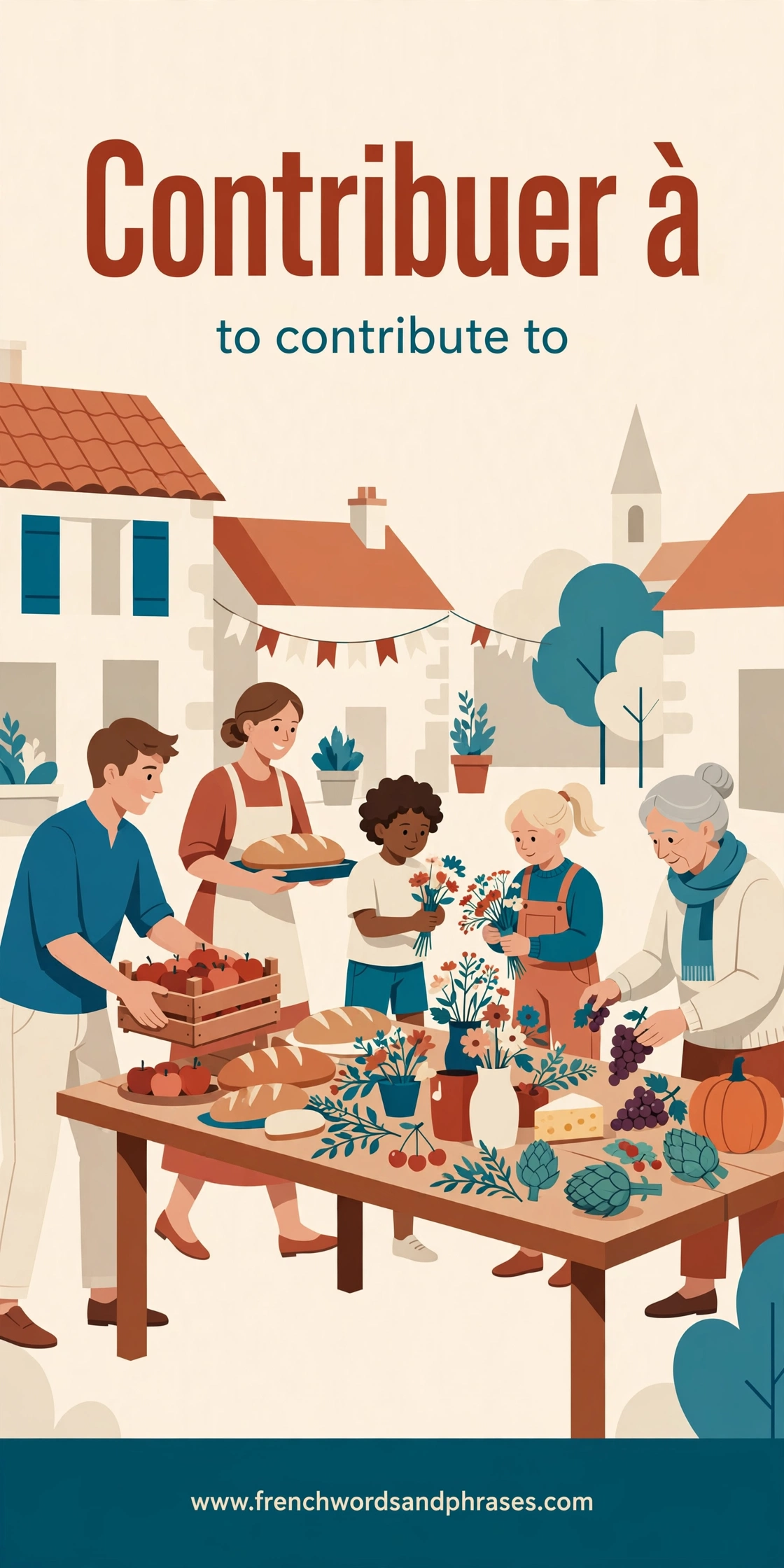
The village square was grey concrete for thirty years. Then the school planted flowers, the café added benches, two retired gardeners built raised beds, and the bakery sponsored a fountain. Nobody did it alone — and that is exactly the point of the verb the mayor used in her speech: « Chacun a contribué à transformer notre place. »
Let’s explore how contribuer à works in French, beginning with the whole phrase on one card.
Understanding the French Phrase Contribuer à
Contribuer à is a French verb construction built from contribuer (a regular -er verb, to contribute) and the preposition à, which is part of the verb and never leaves it. What follows the à is either a noun — contribuer au succès — or an infinitive: contribuer à réduire la pollution.
It means to contribute to — to be one of the causes or one of the helpers behind a result. Nobody contribue alone: the word always implies other hands, other causes, a shared effort. It serves for results (contribuer à améliorer la qualité de l’air), for projects (contribuer au projet) and for money (contribuer à la collecte).
Type: Verb + preposition construction — the à belongs to the verb
Answers the need: Saying something plays its part in a result, alongside other causes
Register: Neutral to formal — reports, essays, news, speeches
Strength: Partial by design — one contribution among others, never the whole cause
One important usage detail: the à is compulsory and never becomes de — contribuer à la réussite, contribuer à protéger les abeilles. Watch the contractions: à + le gives au (contribuer au succès) and à + les gives aux (contribuer aux efforts). After à, French uses the infinitive, where English often uses the -ing form: contribuer à réduire, to contribute to reducing.
Experience the Word
Contribuer à is the most honest verb of teamwork — it claims a share of the credit and refuses the rest.
Imagine the schoolteacher reading the results of the class garden: the sun helped, the rain helped, the children helped. She does not say the children did everything. She says each pair of small hands a contribué à la récolte — and the sentence teaches the children something true about how results happen in the world.
French keeps the modesty inside the grammar. With contribuer à, no one ever has to say ‘it was all me’ — the word will not allow it.
How to Use Contribuer à in French: Complete Guide
Let’s explore how contribuer à works in French, beginning with the whole phrase on one card.
Contribuer à at a Glance
The Whole Phrase on One Card
Real meaning, literal picture, English twin and register — contribuer à in five lines.
| Point | Contribuer à |
|---|---|
| What it really means | to contribute to — to help cause or achieve something, with others |
| Word for word | to contribute to/towards — the à points at the goal |
| English equivalent | to contribute to / to play a part in / to help bring about |
| Register | neutral to formal — reports, essays, the news |
| Use it for | results, improvements, projects, collections of money |
Example
Le sport contribue à la santé.
Sport contributes to health.
Word by Word: Building the Contribution
Two pieces — a sharing verb and the little arrow that aims it.
| Word | Literal meaning | Its job in the phrase |
|---|---|---|
| contribuer | to contribute, to give one’s share | a regular -er verb — it always implies other contributors beside you |
| à | to, towards | the fixed preposition of the verb — it aims the contribution at its goal, a noun or an infinitive |
Example
Chacun contribue à sa manière.
Everyone contributes in their own way.
Quick Quiz 1
Can you drop the à and say contribuer le succès?
Reveal the answer
No — the à belongs to the verb, and with le it contracts: contribuer au succès.
Tout le monde a contribué au succès de la fête.
Everyone contributed to the success of the festival.
When You Say It: The Contribution Moments
Contribuer à appears wherever a result has several parents — credit is shared, never claimed alone.
| Situation | Example |
|---|---|
| The environment | les arbres contribuent à purifier l’air — trees contribute to purifying the air |
| Health | bien dormir contribue à la mémoire — sleeping well contributes to memory |
| A team result | chaque joueur contribue à la victoire — every player contributes to the victory |
| Money | les voisins contribuent à la réparation — the neighbours contribute to the repair |
| Science | cette découverte contribue à comprendre la maladie — this discovery contributes to understanding the disease |
Example
Les transports en commun contribuent à réduire le trafic.
Public transport contributes to reducing traffic.
Make It Yours: Contributing in Every Form
Contribuer is a regular -er verb — only the à and its contractions need watching.
| Form | French | In English |
|---|---|---|
| Present, I | je contribue au projet | I contribute to the project |
| Present, it | cela contribue à améliorer les choses | that contributes to improving things |
| Past | ils ont contribué à la collecte | they contributed to the collection |
| With an infinitive | contribuer à protéger la nature | to contribute to protecting nature |
| Future | vous contribuerez au résultat | you will contribute to the result |
| Negative | le bruit ne contribue pas au calme | noise does not contribute to calm |
Example
Nous avons tous contribué à ce résultat.
We all contributed to this result.
Quick Quiz 2
Fill the gap: contribuer ___ succès — à le, or au?
Reveal the answer
Au — à + le always contracts to au (and à + les to aux).
Son expérience contribue au succès de l’équipe.
His experience contributes to the team’s success.
Everyday Expressions: Building on the Contribution
Contribuer à slots into these frames — the first four are its favourite partners.
| Frame | In English |
|---|---|
| contribuer à améliorer | to contribute to improving |
| contribuer à réduire | to contribute to reducing |
| contribuer à développer | to contribute to developing |
| contribuer à renforcer | to contribute to strengthening |
| contribuer à la réussite de | to contribute to the success of |
Example
La lecture contribue à développer l’imagination.
Reading contributes to developing the imagination.
Close Cousins: Sharing the Credit
The teamwork shelf — contribuer shares a result; its cousins show up in person, help directly, or pay for everything.
| Expression | The difference |
|---|---|
| contribuer à | to contribute to — to be one cause or helper among others |
| participer à | to take part in — you are present and active in the event itself |
| aider à | to help to — a more direct, personal hand: aider à porter, to help carry |
| jouer un rôle dans | to play a role in — the same shared credit, said with a picture |
| financer | to fund — to pay for the whole thing, no sharing implied |
Example
Elle participe au cours et contribue à son succès.
She takes part in the class and contributes to its success.
Quick Quiz 3
You attend the meeting and speak in it. Participer à or contribuer à?
Reveal the answer
Participer à — taking part means being there and joining in. Contribuer à is about helping a result come about, which you can even do from a distance.
Il participe à la réunion et contribue au projet.
He takes part in the meeting and contributes to the project.
Contribuer à and Its Neighbours
The shared-effort shelf around the phrase — the people, the money and the results.
| French | In English |
|---|---|
| une contribution | a contribution |
| un effort collectif | a collective effort |
| une collecte | a collection, a fundraiser |
| un don | a donation, a gift |
| le bénévolat | volunteering |
| un résultat | a result, an outcome |
Example
Chaque don, même petit, contribue à la collecte.
Every donation, even a small one, contributes to the collection.
Watch Out: The Traps Around Contribuer à
The traps: a preposition that wants to wander, a contraction that is not optional, and an English -ing that becomes an infinitive.
| Trap | The truth |
|---|---|
| the wandering preposition | it is always à — never de, never pour: contribuer à la fête, not contribuer de la fête |
| the compulsory contraction | à + le = au, à + les = aux — contribuer au succès, contribuer aux travaux; ‘à le succès’ is impossible |
| the -ing trap | English says ‘contributes to reducing’; French puts the infinitive after à: contribue à réduire |
| credit inflation | contribuer claims a share, not the whole — for ‘he did it all’, French says c’est grâce à lui, it is thanks to him |
Example
Le calme contribue au travail, et le travail contribue au calme.
Calm contributes to work, and work contributes to calm.
Quick Quiz 4
True or false: contribuer can be followed directly by an infinitive, with no preposition.
Reveal the answer
False — the à always comes first: contribuer à faire, contribuer à construire.
Les bénévoles contribuent à construire des maisons.
The volunteers contribute to building houses.
Contribuer à in Everyday French: Real-Life Examples
Now that you know the word, let’s see how contribuer à appears in everyday French.
Example 1 — In the garden
Les abeilles contribuent à la vie du jardin.
Bees contribute to the life of the garden.
Example 2 — At the office
Son organisation contribue au calme de toute l’équipe.
Her organisation contributes to the calm of the whole team.
Example 3 — A fundraiser
Chaque euro contribue à réparer le toit de l’école.
Every euro contributes to repairing the school roof.
Example 4 — Good habits
Marcher chaque jour contribue à une meilleure santé.
Walking every day contributes to better health.
Example 5 — In the kitchen
Un peu de citron contribue à réveiller le plat.
A little lemon contributes to brightening the dish.
Example 6 — A class project
Tous les élèves ont contribué à la fresque de la cour.
All the pupils contributed to the playground mural.
Beyond Translation: The Meaning of Contribuer à
Contribuer descends from a Latin verb about giving with others — and the word has never forgotten it. English ‘contribute’ keeps the same secret: the con- at its heart means ‘with’. Both languages built the sharing into the word itself, so the sentence stays humble even when the speaker is proud.
To contribuer à is to add your stone to a wall other hands are also building.
That is why reports and speeches love this verb: it distributes praise the way the work was actually done — together.
How to Remember the French Phrase Contribuer à
Remember it this way: Contribuer à is the verb of shared credit — your stone goes into a wall that other hands are building too.
- You keep the à — it belongs to the verb: contribuer à réduire, contribuer au succès, never de, never nothing.
- You contract without thinking — à + le becomes au, à + les becomes aux, every single time.
- You share the credit — contribuer means one cause among others; nobody contribue alone.
The key idea is contribuer à means to contribute to — to play your part, with others, in a result.
Test Your Knowledge of Contribuer à
Let’s see how much you’ve learned. Try answering these questions before revealing the answers.
Question 1
What does contribuer à mean?
Reveal the answer
To contribute to — to help bring something about, as one cause or helper among others.
Question 2
Which preposition belongs to contribuer, and what happens before le?
Reveal the answer
À — and à + le contracts to au: contribuer au succès.
Question 3
How do you say ‘reading contributes to developing the imagination’?
Reveal the answer
La lecture contribue à développer l’imagination — after à, French uses the infinitive where English uses -ing.
Question 4
What is the difference between contribuer à and participer à?
Reveal the answer
Participer à is taking part in an event; contribuer à is helping a result happen — you can contribuer from a distance, but participer means being there.
Question 5
Complete the sentence:
Le sport ______ à la santé. (Sport contributes to health.)
Reveal the answer
contribue
Le sport contribue à la santé.
Sport contributes to health.
Your Final Challenge
Can You Use It?
How would you say this in French?
“Regular exercise contributes to good health.”
Reveal the answer
L’exercice régulier contribue à une bonne santé.
Regular exercise contributes to good health.
A little French. A little curiosity. A richer everyday life.
LEARN FRENCH ONE WORD AT A TIME