A French Word to Live By
Translate Être confronté à to English
/ɛtʁ kɔ̃.fʁɔ̃.te a/
Être confronté à means to be faced with, to be confronted with — to find a difficulty standing in front of you.
The young doctor opens the waiting room door at eight in the morning and stops for a second: forty patients, two nurses absent, and a computer that has chosen today to fail. She breathes out slowly. Like everyone in her profession, she knows this beginning: « Elle est confrontée à une journée impossible. »
Let’s explore how être confronté à works in French, beginning with the whole phrase on one card.
Understanding the French Phrase Être confronté à
Être confronté à is a French passive-style construction built from être (to be), confronté — the past participle of confronter, to confront — and the preposition à. The participle agrees with the person who is faced with the problem: confronté, confrontée, confrontés, confrontées.
It means to be faced with something difficult — a problem, a challenge, a hard choice — that stands in front of you and must be dealt with. It is the voice of news reports and serious conversation: young people confrontés à des difficultés financières, farmers confrontés à la sécheresse, a hospital confronté à un manque de personnel. Its natural companions are des difficultés, des défis, des problèmes and des changements.
Type: Passive-style construction — être + past participle + à
Answers the need: Saying a difficulty stands in front of someone and must be dealt with
Register: Neutral to formal — news, reports, essays, serious conversation
Strength: Serious and weighty — more formal than simply having a problem
One important usage detail: the participle agrees with the subject, because être is the auxiliary — elle est confrontée à, ils sont confrontés à, nous sommes confrontées à. The difficulty follows after à, usually as a noun: confronté à des difficultés, confronté à un choix. The active twin turns the sentence around: confronter quelqu’un à quelque chose, to confront someone with something.
Experience the Word
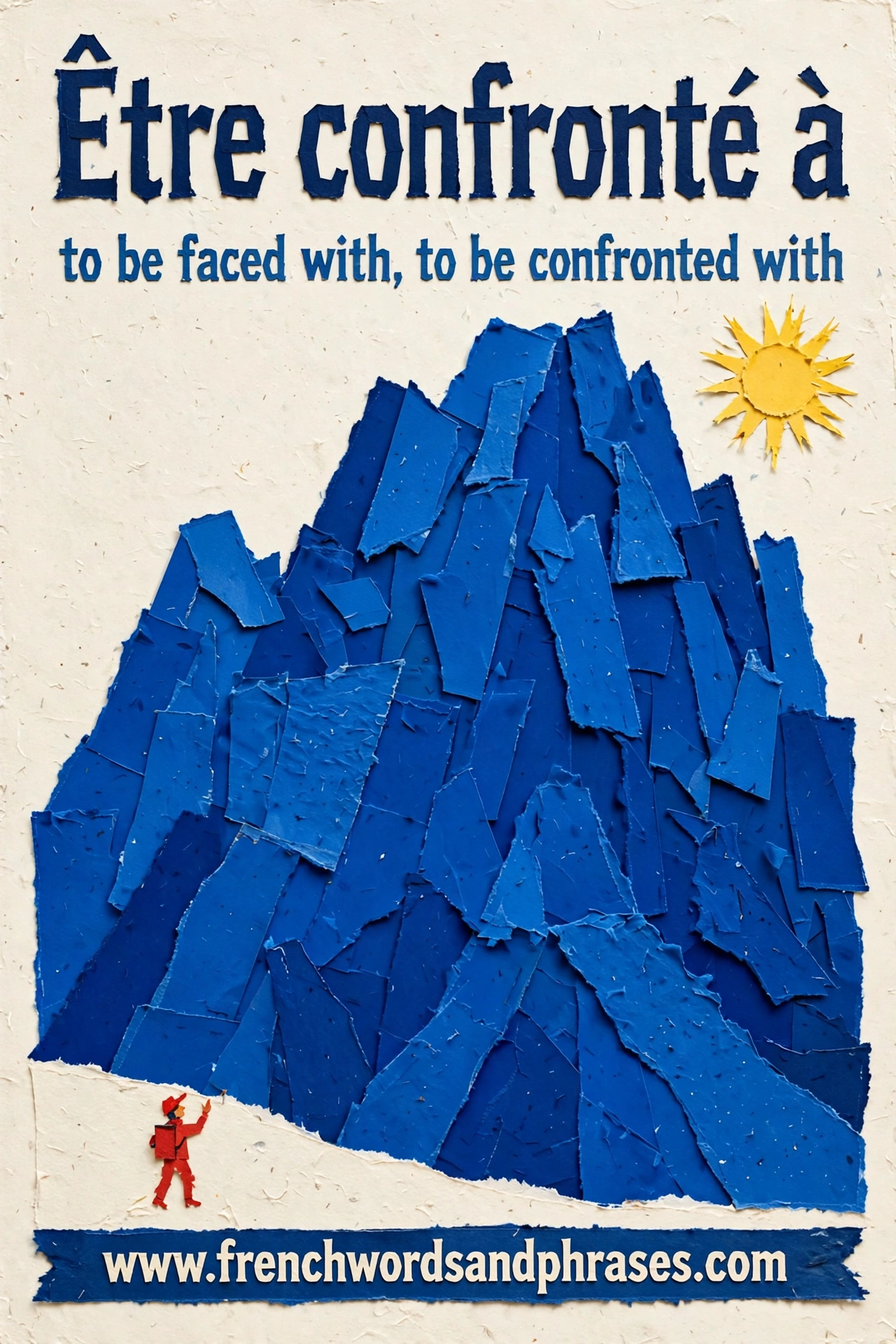
Être confronté à puts the problem in front of your eyes — the French word carries a face inside it, and the difficulty has one too.
Imagine the small shopkeeper opening his letters on a Monday: the rent has risen, the supplier has raised his prices, and a big store is opening across the street. He does not dramatise and he does not hide. Il est confronté à trois problèmes — he names them, one by one, the way you face things that are standing in front of you.
The phrase is calm, and that is its strength. It describes the obstacle without panic — facing is already the first half of dealing.
How to Use Être confronté à in French: Complete Guide
Let’s explore how être confronté à works in French, beginning with the whole phrase on one card.
Être confronté à at a Glance
The Whole Phrase on One Card
Real meaning, literal picture, English twin and register — être confronté à in five lines.
| Point | Être confronté à |
|---|---|
| What it really means | to be faced with a difficulty, a challenge or a hard situation |
| Word for word | to be confronted to — être plus the past participle of confronter |
| English equivalent | to be faced with / to be confronted with / to come up against |
| Register | neutral to formal — the news, reports, serious talk |
| Use it for | difficulties, challenges, problems, changes, hard choices |
Example
Nous sommes confrontés à un problème sérieux.
We are faced with a serious problem.
Word by Word: Building the Facing
Three pieces — a being verb, a participle that agrees, and the little word that presents the obstacle.
| Word | Literal meaning | Its job in the phrase |
|---|---|---|
| être | to be | the auxiliary — it carries the tense and forces the participle to agree |
| confronté | confronted | the past participle of confronter — it changes dress for its subject: confrontée, confrontés, confrontées |
| à | to, with | the fixed preposition — it introduces the difficulty that stands in front of you |
Example
Elle est confrontée à un choix difficile.
She is faced with a difficult choice.
Quick Quiz 1
For a woman, is it elle est confronté or elle est confrontée à un problème?
Reveal the answer
Elle est confrontée — with être, the participle agrees with the subject, so a woman takes confrontée with a final e.
Elle est confrontée à des frais imprévus.
She is faced with unexpected costs.
When You Say It: The Facing Moments
Être confronté à appears wherever life puts an obstacle on the path — the news uses it every single day.
| Situation | Example |
|---|---|
| Young people and money | les jeunes sont confrontés à des loyers élevés — young people are faced with high rents |
| Farmers and weather | les agriculteurs sont confrontés à la sécheresse — farmers are faced with drought |
| At the hospital | l’hôpital est confronté à un manque de personnel — the hospital is faced with a staff shortage |
| A hard choice | elle est confrontée à un dilemme — she is faced with a dilemma |
| Sudden change | les entreprises sont confrontées à de grands changements — companies are faced with great changes |
Example
Les étudiants sont souvent confrontés à un budget serré.
Students are often faced with a tight budget.
Make It Yours: The Facing for Every Person
The participle changes its ending with the subject — learn the four dresses it wears.
| Form | French | In English |
|---|---|---|
| I (man) | je suis confronté à | I am faced with |
| She | elle est confrontée à | she is faced with |
| They (men or mixed) | ils sont confrontés à | they are faced with |
| They (women) | elles sont confrontées à | they are faced with |
| Future | nous serons confrontés à des choix | we will be faced with choices |
| Past | il a été confronté à la vérité | he was confronted with the truth |
Example
Vous serez confrontés à des décisions importantes.
You will be faced with important decisions.
Quick Quiz 2
Two women are faced with delays: elles sont confrontés or elles sont confrontées?
Reveal the answer
Elles sont confrontées — feminine plural: the participle takes -ées for a group of women.
Elles sont confrontées à des retards chaque semaine.
They are faced with delays every week.
Everyday Expressions: What Stands in Front of You
Être confronté à keeps serious company — these are the obstacles it faces most often.
| Frame | In English |
|---|---|
| être confronté à des difficultés | to be faced with difficulties |
| être confronté à des défis | to be faced with challenges |
| être confronté à des problèmes | to be faced with problems |
| être confronté à des changements | to be faced with changes |
| être confronté à un choix | to be faced with a choice |
Example
Le village est confronté à des changements rapides.
The village is faced with rapid changes.
Close Cousins: Other Ways to Face It
The obstacle shelf — être confronté à states the situation; its cousins push back, bump into things, or simply meet trouble.
| Expression | The difference |
|---|---|
| être confronté à | to be faced with — the situation stated calmly, often in reports |
| faire face à | to face up to — more active: you stand up to it and deal with it |
| être face à | to be facing — the physical picture, face to face with something |
| se heurter à | to come up against — you bump into the obstacle as you advance |
| rencontrer des difficultés | to encounter difficulties — the plain, neutral way to say it |
Example
Confrontée à la tempête, l’équipe a fait face avec courage.
Faced with the storm, the team faced up to it with courage.
Quick Quiz 3
Which cousin means actively standing up to the problem — être confronté à or faire face à?
Reveal the answer
Faire face à — it adds the response: you face it AND deal with it. Être confronté à simply states that the problem is in front of you.
Confrontés à la crise, ils ont fait face ensemble.
Faced with the crisis, they faced up to it together.
Être confronté à and Its Neighbours
The difficulty shelf around the phrase — the obstacles, named one by one.
| French | In English |
|---|---|
| une difficulté | a difficulty |
| un défi | a challenge |
| un obstacle | an obstacle |
| une crise | a crisis |
| la sécheresse | drought |
| un manque de personnel | a staff shortage |
Example
Confronté à cet obstacle, il a cherché une autre route.
Faced with this obstacle, he looked for another road.
Watch Out: The Traps Around Être confronté à
The traps: an agreement that is easy to forget, an English ‘with’ that becomes à, and an active twin that reverses the roles.
| Trap | The truth |
|---|---|
| the forgotten agreement | the participle must match the subject — confrontée for her, confrontés for them; a bare confronté for everyone is wrong |
| with becomes à | English says confronted WITH; French says confronté À — never confronté avec in this construction |
| the reversed twin | confronter quelqu’un à quelque chose is active — the director confronts the team with the figures; être confronté à receives it |
| too heavy for small things | for a minor annoyance, French stays light — avoir un petit problème; confronté is for obstacles with real weight |
Example
Elle est confrontée à la vérité, pas à un petit souci.
She is confronted with the truth, not with a little worry.
Quick Quiz 4
True or false: confronté avec un problème is the correct French form.
Reveal the answer
False — the construction takes à: confronté à un problème. The English ‘with’ does not cross the Channel here.
Il est confronté à un problème de santé.
He is faced with a health problem.
Être confronté à in Everyday French: Real-Life Examples
Now that you know the word, let’s see how être confronté à appears in everyday French.
Example 1 — At the doctor’s
Le service est confronté à une longue liste d’attente.
The department is faced with a long waiting list.
Example 2 — Rent day
Les jeunes familles sont confrontées à des loyers qui augmentent.
Young families are faced with rising rents.
Example 3 — In the fields
Cet été, les fermiers sont confrontés à la sécheresse.
This summer, the farmers are faced with drought.
Example 4 — At the exam
Elle est confrontée à des questions très difficiles.
She is faced with very difficult questions.
Example 5 — A small business
Le café est confronté à la concurrence d’une grande chaîne.
The café is faced with competition from a large chain.
Example 6 — A hard choice
Nous sommes confrontés à un choix que nous n’aimons pas.
We are faced with a choice we do not like.
Beyond Translation: The Meaning of Être confronté à
Confronter carries a face inside it — front, the forehead, is hiding in the word’s Latin roots. To be confronté à something is to stand forehead to forehead with it: close enough to see it clearly, too close to pretend it is not there. English ‘faced with’ keeps the same picture, which makes this one of those rare phrases where the two languages agree completely.
To être confronté à a problem is to have it standing in front of you — and naming it is the first way of facing it.
That is why the phrase belongs to the news: before anything can be solved, someone has to stand in front of it and say its name.
How to Remember the French Phrase Être confronté à
Remember it this way: Être confronté à puts you forehead to forehead with the problem — the word itself carries a face.
- You dress the participle — confrontée for her, confrontés for them: with être, the ending always matches the person facing the problem.
- You keep the à — confronté à un problème, never avec, however loudly English says ‘with’.
- You save it for real weight — confronté faces difficulties, challenges and changes, not little worries.
The key idea is être confronté à means to be faced with — a difficulty standing in front of you, participle agreeing.
Test Your Knowledge of Être confronté à
Let’s see how much you’ve learned. Try answering these questions before revealing the answers.
Question 1
What does être confronté à mean?
Reveal the answer
To be faced with, to be confronted with — a difficulty or challenge stands in front of you and must be dealt with.
Question 2
How do you say ‘she is faced with a difficult choice’?
Reveal the answer
Elle est confrontée à un choix difficile — the participle takes a final -e for a woman.
Question 3
Which preposition follows confronté?
Reveal the answer
À — confronté à des difficultés. English uses ‘with’, French uses à.
Question 4
What is the difference between être confronté à and faire face à?
Reveal the answer
Être confronté à states the situation; faire face à adds the response — facing up to it and dealing with it.
Question 5
Complete the sentence:
Ils sont ______ à des changements importants. (They are faced with important changes.)
Reveal the answer
confrontés
Ils sont confrontés à des changements importants.
They are faced with important changes.
Your Final Challenge
Can You Use It?
How would you say this in French?
“Young families are often faced with rising prices.”
Reveal the answer
Les jeunes familles sont souvent confrontées à la hausse des prix.
Young families are often faced with rising prices.
A little French. A little curiosity. A richer everyday life.
LEARN FRENCH ONE WORD AT A TIME