A French Word to Live By
Translate Lèvre to English
/lɛvʁ/
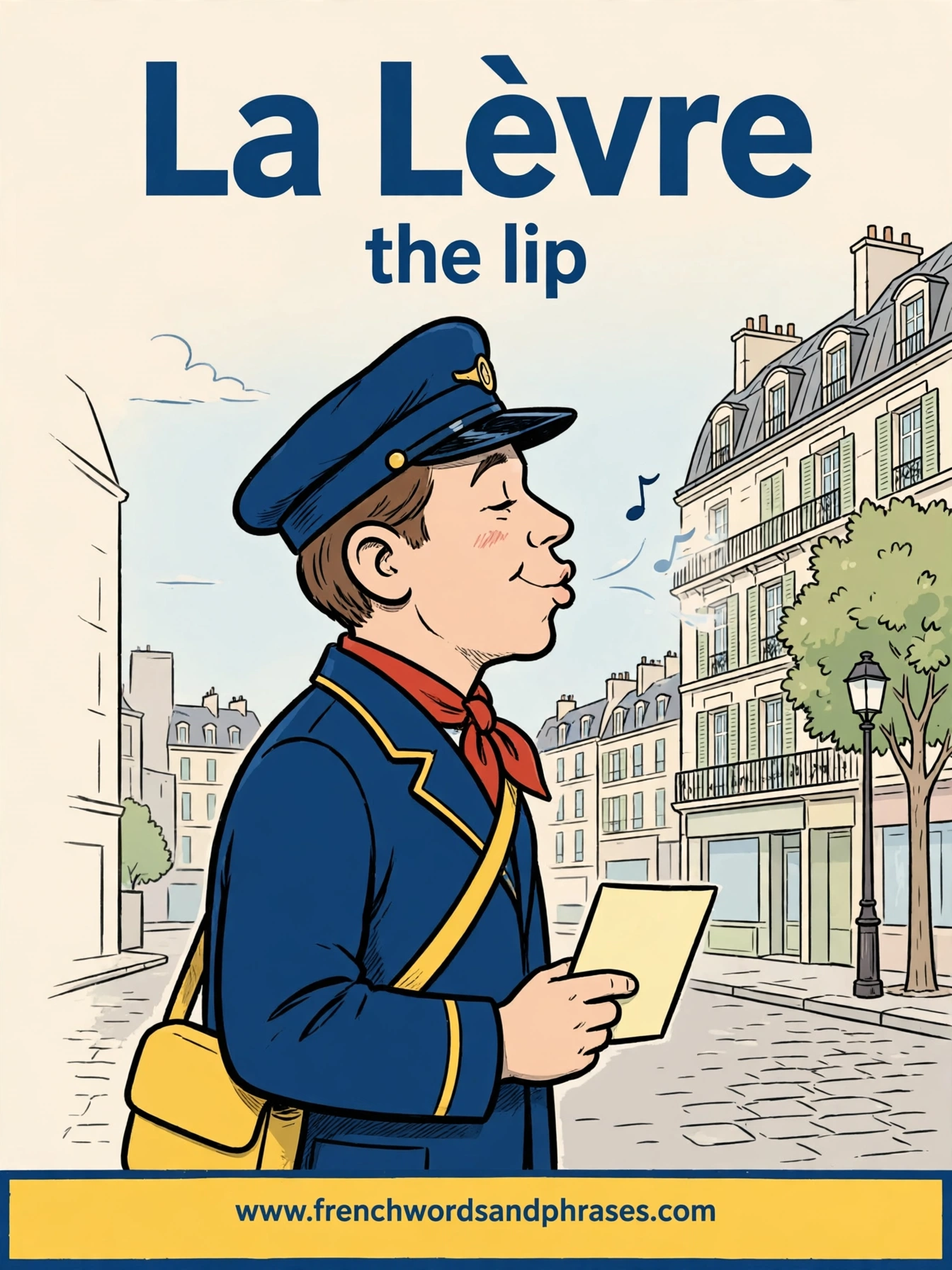
La lèvre means the lip.
The whole café falls silent as the old singer leans into the microphone; a hundred people hang on her next word, suspended — pendus à ses lèvres, hanging from her lips.
In this guide, you’ll learn what lèvre means in English, how to use it with its articles, how to form its plural, and how it appears in everyday French. Explore French examples, English translations, and practice quizzes.
Understanding the French Noun Lèvre
Lèvre is a feminine French noun, learned with its article: la lèvre, une lèvre. Like most of the face’s soft features, it lives mainly in the plural: les lèvres, the lips. The grave accent on the è gives the open « eh » sound.
It means the lip — each of the two soft edges of the mouth, la lèvre supérieure above and la lèvre inférieure below. Lips speak, smile, tremble and taste, and French keeps them busy: words are read sur les lèvres, gossip is sur toutes les lèvres — on everyone’s lips — and a half-hearted answer is given du bout des lèvres, from the very tip of them.
Gender: Feminine — la lèvre
Definite article: la — la lèvre (the lip)
Indefinite article: une — une lèvre (a lip)
Plural: les lèvres — the form of everyday life
Upper and lower: la lèvre supérieure, la lèvre inférieure
Lipstick: le rouge à lèvres — literally « red for lips »
English equivalents: The lip.
English speakers say « on everyone’s lips » for gossip — French agrees word for word: sur toutes les lèvres. But the most useful phrase is smaller: du bout des lèvres, from the tip of the lips, describes anything said or done without conviction — a thank-you murmured du bout des lèvres is barely a thank-you at all.
Experience the Word
Lèvre is where words are born. Before a sentence reaches the air, it crosses the lips — and the lips, honest traitors, tremble, smile and tighten long before the sentence arrives.
Imagine the storyteller by the fire: the children do not watch his hands or his book; they watch his lips, pendus à ses lèvres, drinking every word as it leaves them.
You have not just listened. You have hung on every word — suspendu, the French way.
How to Use Lèvre in French: Complete Guide
Let’s explore how lèvre works in French, beginning with its articles — la lèvre, une lèvre, and above all les lèvres.
Lèvre with the Definite Article (La, Les)
La for one lip, les for the pair — and the pair does nearly all the work.
| Form | French |
|---|---|
| Feminine singular | la lèvre |
| Plural | les lèvres |
Example
Elle se mord la lèvre quand elle réfléchit.
She bites her lip when she thinks.
Lèvre with the Indefinite Article (Une, Des)
Une lèvre for a single lip; des lèvres for lips in general.
| Form | French |
|---|---|
| Feminine singular | une lèvre |
| Plural | des lèvres |
Example
Il a des lèvres fines et un sourire discret.
He has thin lips and a discreet smile.
Lèvre with the Partitive and Quantities (Du bout des…)
Lips are measured in tips, touches and lipstick — the quantities of the lèvre.
| Quantity | French |
|---|---|
| both lips | les deux lèvres |
| the tip of the lips | le bout des lèvres |
| a touch of lipstick | une touche de rouge à lèvres |
| dry lips | des lèvres sèches |
| a smile on the lips | un sourire aux lèvres |
Example
Elle répond du bout des lèvres, sans conviction.
She answers half-heartedly, without conviction.
Quick Quiz 1
Complete the sentence:
Son nom est sur toutes ______ lèvres. (the — plural)
Reveal the answer
les
Son nom est sur toutes les lèvres.
Her name is on everyone’s lips.
The Plural of Lèvre
Lèvre adds an -s in the plural — les lèvres, the two soft gates of speech.
| Number | French |
|---|---|
| Singular | la lèvre |
| Plural | les lèvres |
Example
Ses lèvres tremblent un peu avant le discours.
His lips tremble slightly before the speech.
Lèvre with Possessive Adjectives (Ma, Ta, Sa…)
In the plural — the everyday case — the possessives are mes, tes, ses.
| Owner | French |
|---|---|
| my | mes lèvres |
| your (tu) | tes lèvres |
| his / her | ses lèvres |
| our | nos lèvres |
| your (vous) | vos lèvres |
| their | leurs lèvres |
Example
Mes lèvres sont sèches à cause du vent froid.
My lips are dry because of the cold wind.
Quick Quiz 2
Complete the sentence:
Elle lit sur ______ lèvres du professeur. (the — plural)
Reveal the answer
les
Elle lit sur les lèvres du professeur.
She reads the teacher’s lips — lire sur les lèvres, to lip-read.
Lèvre with Demonstrative Adjectives (Cette, Ces)
Used to point: ces lèvres, those lips.
| Form | French |
|---|---|
| Feminine singular | cette lèvre |
| Plural | ces lèvres |
Example
Ces lèvres sourient avant même les yeux.
Those lips smile before the eyes do.
Lèvre with Adjectives
Adjectives agree — feminine plural for the pair: des lèvres douces, des lèvres sèches.
| Adjective | With Lèvre |
|---|---|
| doux (soft) | des lèvres douces |
| sec (dry) | des lèvres sèches |
| plein (full) | des lèvres pleines |
| fin (thin) | des lèvres fines |
| rouge (red) | des lèvres rouges |
Example
En hiver, tout le monde a les lèvres sèches.
In winter, everyone has dry lips.
Quick Quiz 3
Complete the sentence:
Il a les lèvres ______ à cause du froid. (dry)
Reveal the answer
sèches
Il a les lèvres sèches à cause du froid.
His lips are dry because of the cold — sèches, feminine plural.
Everyday Expressions with Lèvre
Hanging, licking and lip-reading — the lèvre phrases of daily life.
| Expression | In English |
|---|---|
| être sur toutes les lèvres | to be on everyone’s lips |
| du bout des lèvres | half-heartedly, from the tip of the lips |
| pendre aux lèvres de quelqu’un | to hang on someone’s every word |
| lire sur les lèvres | to lip-read |
| se lécher les lèvres | to lick your lips |
| le rouge à lèvres | lipstick |
Example
Les élèves pendent aux lèvres de la conteuse.
The pupils hang on the storyteller’s every word.
Words from the Same Family as Lèvre
Mouths, licking and lipstick — the words that travel with lèvre.
| French | In English |
|---|---|
| la bouche | the mouth |
| se lécher | to lick oneself |
| le rouge à lèvres | the lipstick |
| labial | labial, relating to the lips |
| sourire | to smile |
Example
Elle sort son rouge à lèvres et se refait une beauté.
She takes out her lipstick and touches up her make-up.
Quick Quiz 4
What does du bout des lèvres mean?
Reveal the answer
Half-heartedly — from the very tip of the lips, without conviction.
Il accepte du bout des lèvres, mais on sent son hésitation.
He accepts half-heartedly, but you can feel his hesitation.
Lèvre in Everyday French: Real-Life Examples
Now that you know the word, let’s see how lèvre appears in everyday French.
Example 1 — Gossip
La nouvelle est sur toutes les lèvres ce matin.
The news is on everyone’s lips this morning.
Example 2 — Winter
Mets du baume, tes lèvres sont toutes sèches.
Put some balm on; your lips are all dry.
Example 3 — The storyteller
Les enfants pendent aux lèvres du grand-père.
The children hang on their grandfather’s every word.
Example 4 — A shy thank-you
Elle remercie du bout des lèvres, presque en chuchotant.
She says thank you half-heartedly, almost whispering.
Example 5 — Tasty food
Il se lèche les lèvres devant le gâteau au chocolat.
He licks his lips in front of the chocolate cake.
Example 6 — Make-up
Son rouge à lèvres est d’un rouge profond.
Her lipstick is a deep red.
Beyond Translation: The Meaning of Lèvre
French trusts the lips with its secrets and its judgements: a rumour lives sur toutes les lèvres, a reluctant yes dies du bout des lèvres, and the deaf read whole conversations sur les lèvres of others. The word is old Latin stock — labra, the lips — and it keeps a certain ceremony: in the age of the text message, pendre aux lèvres de quelqu’un remains the most beautiful description of attention ever coined, an audience literally hanging from a speaker’s mouth.
To say lèvre is to name the threshold every word must cross.
It evokes the storyteller’s spellbound circle, the murmured half-yes, and the red signature of a lipstick on a café cup.
How to Remember the French Noun Lèvre
Remember it this way: Lèvre is the lip — feminine, usually plural, and the busiest threshold in French: les lèvres.
- The gossip channel — sur toutes les lèvres, on everyone’s lips.
- The reluctant yes — du bout des lèvres, half-heartedly.
- The spellbound crowd — pendre aux lèvres, hanging on every word.
The key idea is la lèvre — the lip, mostly les lèvres.
Test Your Knowledge of Lèvre
Let’s see how much you’ve learned. Try answering these questions before revealing the answers.
Question 1
Is lèvre masculine or feminine?
Reveal the answer
Feminine — la lèvre, une lèvre.
Question 2
What is le rouge à lèvres?
Reveal the answer
Lipstick — literally « the red for lips ».
Question 3
Translate: Her name is on everyone’s lips.
Reveal the answer
Son nom est sur toutes les lèvres.
Question 4
What does pendre aux lèvres de quelqu’un mean?
Reveal the answer
To hang on someone’s every word — to listen with total, spellbound attention.
Question 5
Complete the sentence:
Elle a les lèvres ______ en hiver. (dry)
Reveal the answer
sèches
Elle a les lèvres sèches en hiver.
She has dry lips in winter.
Your Final Challenge
Can You Use It?
How would you say this in French?
“The children hang on the storyteller’s every word.”
Reveal the answer
Les enfants pendent aux lèvres de la conteuse.
The children hang on the storyteller’s every word.
A little French. A little curiosity. A richer everyday life.
LEARN FRENCH ONE WORD AT A TIME