A French Word to Live By
Translate Dent to English
/dɑ̃/
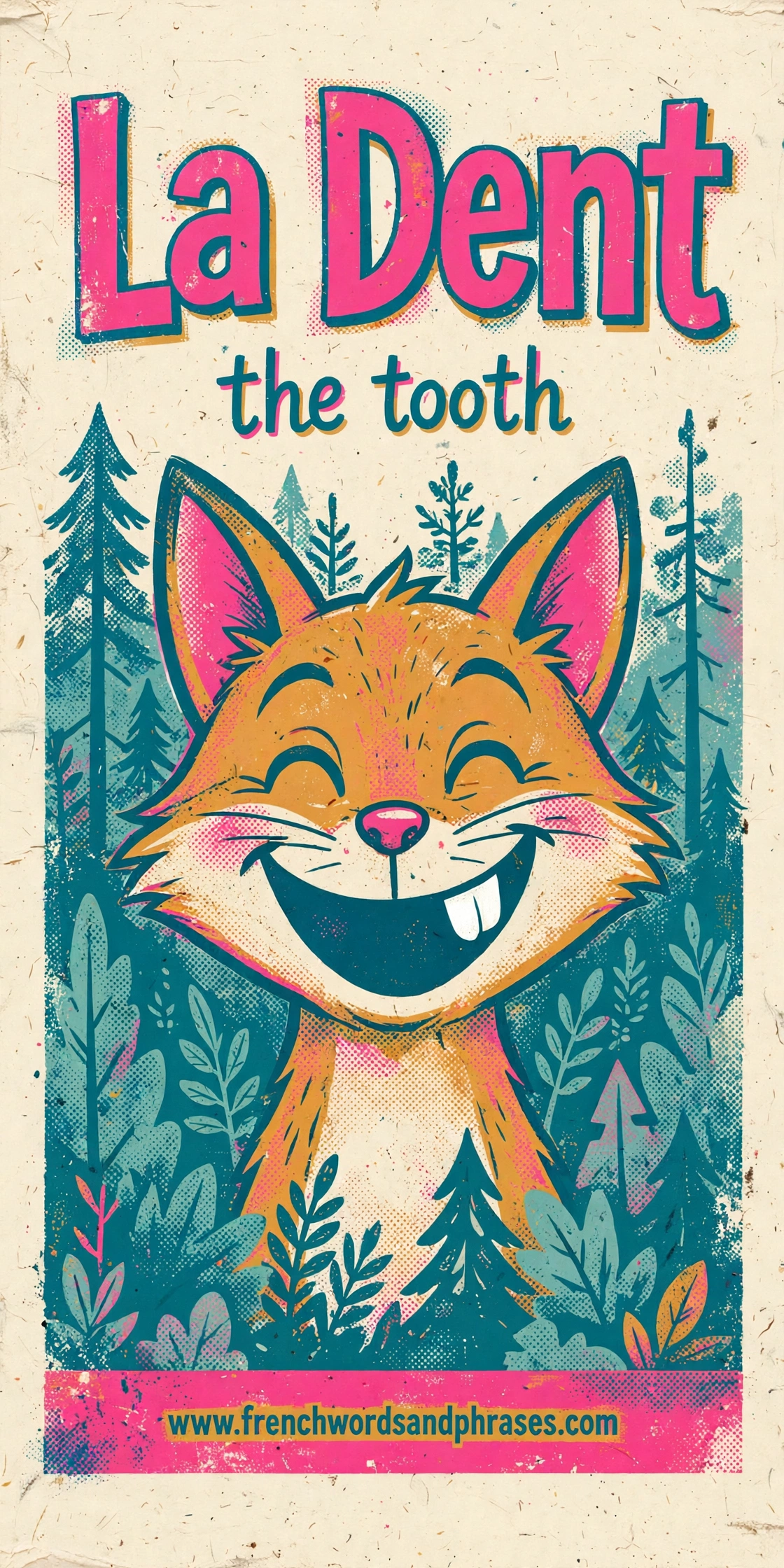
La dent means the tooth.
Under the pillow, carefully placed in a glass of water by some families, in a little box by others — a tiny white treasure waits for the mouse: la dent, the tooth.
In this guide, you’ll learn what dent means in English, how to use it with its articles, how to form its plural, and how it appears in everyday French. Explore French examples, English translations, and practice quizzes.
Understanding the French Noun Dent
Dent is a feminine French noun, learned with its article: la dent, une dent. The spelling promises a final -t, but the sound refuses it: the -t is silent, and dent is pronounced simply « dahn ». The plural is les dents.
It means the tooth — one of the hard white tools in the mouth, made for biting and smiling. A child loses les dents de lait (milk teeth), grows the permanent set, and may one day meet les dents de sagesse, the wisdom teeth. But dent reaches far beyond the mouth: it is the tooth of a saw, the prong of a fork’s cousin, and the sharp peak of a mountain — une dent in the Alps is a jagged summit.
Gender: Feminine — la dent
Definite article: la — la dent (the tooth)
Indefinite article: une — une dent (a tooth)
Plural: les dents
Sound note: The final -t is silent: dent sounds like « dahn »
Milk and wisdom: une dent de lait (a milk tooth); une dent de sagesse (a wisdom tooth)
English equivalents: The tooth.
Toothache has its own construction: avoir mal aux dents — to have pain in the teeth — built with avoir, never with être. And the dent’s most famous idiom is a grudge: avoir une dent contre quelqu’un, to have a tooth against someone, is to bear them a lasting grudge. The tooth, in French, remembers insults.
Experience the Word
Dent is the first body part a child ever trades. The petite souris — the little mouse, France’s tooth fairy — slips a coin under the pillow for every dent de lait, and a whole childhood is counted in teeth lost and found.
Imagine the school photograph: a row of six-year-olds grinning with magnificent gaps, each missing dent a badge of growing up, each new one celebrated like a small white flag.
You have not just lost a tooth. You have grown — grandi, one dent at a time.
How to Use Dent in French: Complete Guide
Let’s explore how dent works in French, beginning with its articles — la dent, une dent, les dents, with the -t always silent.
Dent with the Definite Article (La, Les)
Used for specific teeth — usually your own, at the dentist’s or the mirror.
| Form | French |
|---|---|
| Feminine singular | la dent |
| Plural | les dents |
Example
La dent bouge, elle va tomber bientôt.
The tooth is wobbling; it will fall out soon.
Dent with the Indefinite Article (Une, Des)
Used for a tooth in general — one tooth, any tooth.
| Form | French |
|---|---|
| Feminine singular | une dent |
| Plural | des dents |
Example
Le dentiste doit arracher une dent cassée.
The dentist has to pull out a broken tooth.
Dent with the Partitive and Quantities (Des dents…)
Teeth come in sets, rows and milk editions — here is how French counts them.
| Quantity | French |
|---|---|
| all the teeth | toutes les dents |
| a milk tooth | une dent de lait |
| a wisdom tooth | une dent de sagesse |
| white teeth | des dents blanches |
| a hollow tooth (room for more food) | une dent creuse |
Example
Garde-moi une part de tarte, j’ai encore une dent creuse.
Save me a slice of tart; I still have a hollow tooth — room for more.
Quick Quiz 1
Complete the sentence:
J’ai mal ______ dents depuis hier. (in the — plural)
Reveal the answer
aux
J’ai mal aux dents depuis hier.
I have had toothache since yesterday — avoir mal aux dents.
The Plural of Dent
Dent adds an -s in the plural, and the -t stays silent in both numbers.
| Number | French |
|---|---|
| Singular | la dent |
| Plural | les dents |
Example
Il se brosse les dents matin et soir.
He brushes his teeth morning and evening.
Dent with Possessive Adjectives (Ma, Ta, Sa…)
In the plural, the everyday possessives are mes, tes, ses.
| Owner | French |
|---|---|
| my | mes dents |
| your (tu) | tes dents |
| his / her | ses dents |
| our | nos dents |
| your (vous) | vos dents |
| their | leurs dents |
Example
Ses dents sont blanches et bien alignées.
Her teeth are white and well aligned.
Quick Quiz 2
Complete the sentence:
Brosse-toi ______ dents avant de te coucher. (your — plural)
Reveal the answer
les
Brosse-toi les dents avant de te coucher.
Brush your teeth before bed — with body parts, the reflexive + les does the work.
Dent with Demonstrative Adjectives (Cette, Ces)
Used to point: cette dent, this tooth — the dentist’s favourite phrase.
| Form | French |
|---|---|
| Feminine singular | cette dent |
| Plural | ces dents |
Example
Cette dent doit être soignée rapidement.
This tooth needs treating quickly.
Dent with Adjectives
Adjectives agree with dent — feminine: une dent cassée, des dents saines.
| Adjective | With Dent |
|---|---|
| blanc (white) | des dents blanches |
| cassé (broken) | une dent cassée |
| sain (healthy) | des dents saines |
| de lait (milk) | une dent de lait |
| pointu (pointed) | des dents pointues |
Example
Le chat montre des dents pointues quand il bâille.
The cat shows pointed teeth when it yawns.
Quick Quiz 3
Complete the sentence:
C’est une dent ______ : elle ne tient plus. (broken)
Reveal the answer
cassée
C’est une dent cassée : elle ne tient plus.
It is a broken tooth: it is loose.
Everyday Expressions with Dent
Grudges, grit and ambition — the dent phrases of daily life.
| Expression | In English |
|---|---|
| avoir une dent contre quelqu’un | to have a grudge against someone |
| avoir mal aux dents | to have toothache |
| serrer les dents | to grit your teeth |
| avoir les dents longues | to be ambitious |
| grincer des dents | to grind your teeth |
| une dent de lait | a milk tooth |
Example
Il serre les dents et continue malgré la douleur.
He grits his teeth and carries on despite the pain.
Words from the Same Family as Dent
Dentists, toothpaste and crowns — the words that travel with dent.
| French | In English |
|---|---|
| le dentiste | the dentist |
| le dentifrice | the toothpaste |
| dentaire | dental |
| la couronne | the crown (on a tooth) |
| arracher une dent | to pull out a tooth |
Example
Elle met un peu de dentifrice sur sa brosse à dents.
She puts a little toothpaste on her toothbrush.
Quick Quiz 4
What does avoir une dent contre quelqu’un mean?
Reveal the answer
To have a grudge against someone — the tooth remembers the insult.
Depuis cette histoire, il a une dent contre son voisin.
Since that business, he has had a grudge against his neighbour.
Dent in Everyday French: Real-Life Examples
Now that you know the word, let’s see how dent appears in everyday French.
Example 1 — Toothache
J’ai mal aux dents, je vais appeler le dentiste.
I have toothache; I am going to call the dentist.
Example 2 — A wobbly tooth
Regarde, ma dent bouge ! La petite souris va passer.
Look, my tooth is wobbling! The little mouse will come.
Example 3 — Brushing
Les enfants se brossent les dents après le petit-déjeuner.
The children brush their teeth after breakfast.
Example 4 — A grudge
Elle a une dent contre lui depuis des années.
She has had a grudge against him for years.
Example 5 — Courage
Il serre les dents et finit la course.
He grits his teeth and finishes the race.
Example 6 — A bright smile
Elle a des dents blanches et un sourire éclatant.
She has white teeth and a dazzling smile.
Beyond Translation: The Meaning of Dent
France’s tooth fairy is not a fairy at all: la petite souris, the little mouse, buys each fallen dent de lait for a coin — a tradition so old that a tale of a mouse-tooth exchange was already written down in the 1600s. The dent also gave French its mountains: the jagged Alpine peaks called Dents — la Dent du Midi, les Dents Blanches — are teeth biting the sky. And its idioms bite too: ambition has long teeth, grudges are kept in a single dent, and courage is what you do with them clenched.
To say dent is to name the smallest bone-hard tool you own — part cutlery, part diary.
It evokes the mouse’s coin under the pillow, the gritted finish line, and the white row that makes a smile.
How to Remember the French Noun Dent
Remember it this way: Dent is the tooth — feminine, with a silent final -t, and a long memory for insults: la dent.
- The silent ending — la dent, said « dahn », never « dant ».
- The mouse’s trade — une dent de lait under the pillow.
- The grudge — avoir une dent contre quelqu’un.
The key idea is la dent — the tooth, t silent.
Test Your Knowledge of Dent
Let’s see how much you’ve learned. Try answering these questions before revealing the answers.
Question 1
Is dent masculine or feminine?
Reveal the answer
Feminine — la dent, une dent.
Question 2
How do you say « I have toothache » in French?
Reveal the answer
J’ai mal aux dents. — built with avoir mal à, like all the body’s aches.
Question 3
Translate: He brushes his teeth.
Reveal the answer
Il se brosse les dents.
Question 4
Who collects French children’s milk teeth?
Reveal the answer
La petite souris — the little mouse, who leaves a coin under the pillow for each dent de lait.
Question 5
Complete the sentence:
C’est une dent de ______, elle tombera bientôt. (milk)
Reveal the answer
lait
C’est une dent de lait, elle tombera bientôt.
It is a milk tooth; it will fall out soon.
Your Final Challenge
Can You Use It?
How would you say this in French?
“I have toothache, I am calling the dentist.”
Reveal the answer
J’ai mal aux dents, j’appelle le dentiste.
I have toothache, I am calling the dentist.
A little French. A little curiosity. A richer everyday life.
LEARN FRENCH ONE WORD AT A TIME