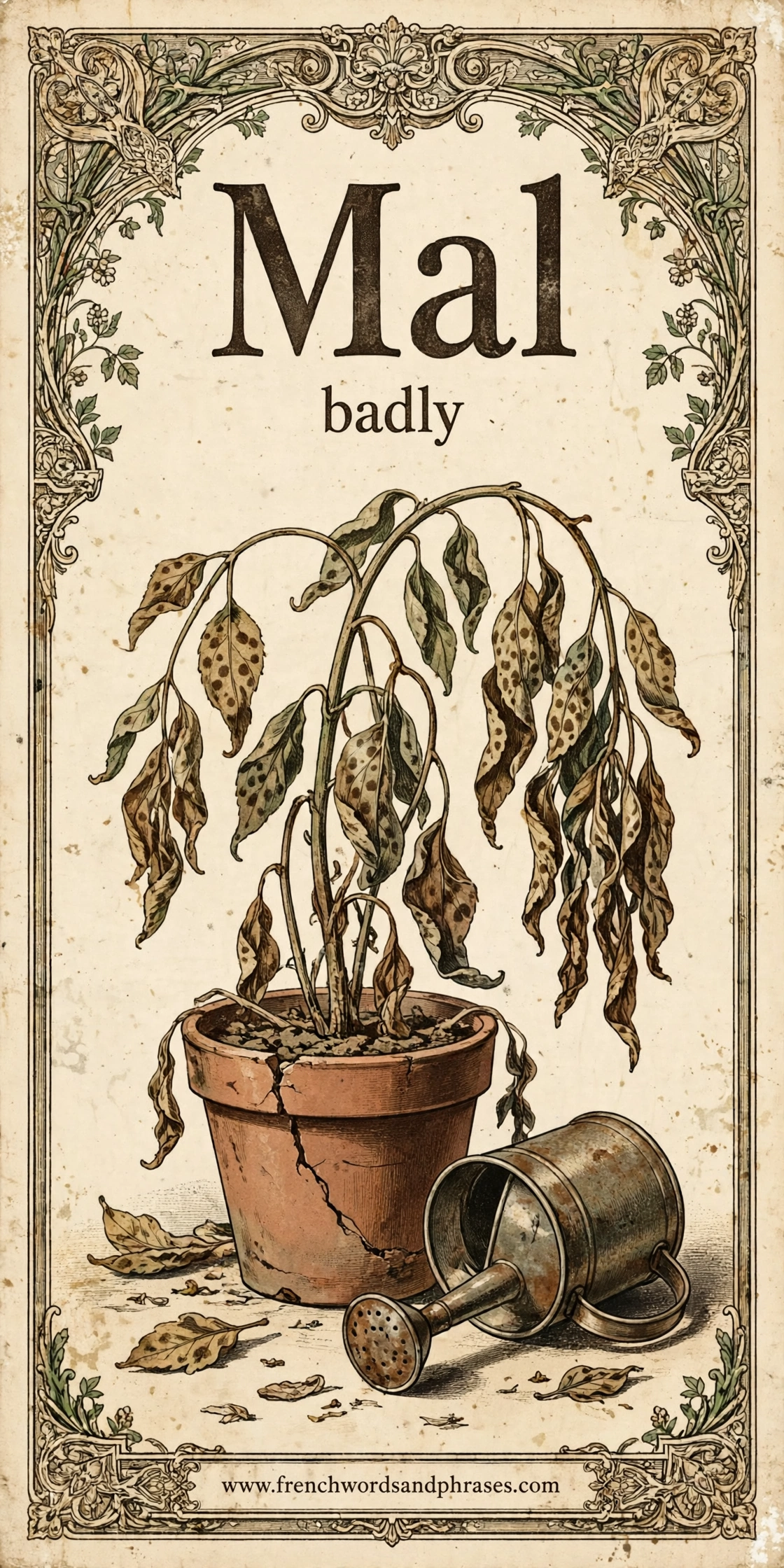
A French Word to Live By
Translate Mal to English
/mal/
Mal means badly.
The young pianist reaches the difficult passage, fumbles, stops, and shakes her head at the keys. « Ça sonne mal », she sighs — it sounds wrong, it sounds bad. Tomorrow, with practice, it will sound bien.
In this guide, you’ll learn what mal means in English, where it stands after verbs and inside the perfect tense, how avoir mal à names every ache, and how pas mal turns a shrug into praise. Explore French examples, English translations, and practice quizzes.
Understanding the French Adverb Mal
Mal is a French adverb of manner — the negative pole of the manner family, the exact opposite of bien. Its comparative is plus mal or pire, worse. It says how a thing is done: badly, wrongly, poorly.
It means badly. Il chante mal — he sings badly. J’ai mal dormi — I slept badly. Mal also carries the idea of wrongness and discomfort: mal comprendre, to misunderstand; se sentir mal, to feel unwell; and in avoir mal à la tête it names the ache itself.
Type: Adverb of manner — poor quality of an action
Answers the question: How? — in a bad way, badly
Changes form: Never — mal is invariable; comparative: plus mal, pire
English equivalents: Badly; poorly; wrongly; (avoir mal à) to ache.
One important usage detail: mal follows its verb closely, exactly like bien — and in the perfect tense it slips between the auxiliary and the participle: j’ai mal dormi, I slept badly. For the adjective bad, French uses mauvais: un mauvais livre, a bad book — never « un mal livre ».
Experience the Word
Mal is the adverb of the wince — of the note missed, the word misheard, the night spent tossing under a too-thin blanket.
Imagine the little theatre on a bad evening: the lights flicker, an actor forgets his line, the rain drums on the roof — tout va mal, and yet the audience stays, hoping for the second act.
You have not just reported a failure. You have marked the action with its honest, low grade.
How to Use Mal in French: Complete Guide
Let’s explore how mal works in French, beginning with the whole word on one card.
Mal at a Glance
Before the details, here is the whole word on one card.
The Whole Word on One Card
Meaning, type, position and form — mal in four lines.
| Point | Mal |
|---|---|
| Meaning | badly, poorly, wrongly |
| Type | adverb of manner |
| Usual position | immediately after the verb; between auxiliary and participle in the perfect |
| Form | invariable — never changes; comparative: plus mal / pire |
Example
Il a mal compris la question.
He misunderstood the question.
Where Mal Goes in the Sentence
Mal mirrors bien exactly: glued to its verb in the present, and tucked inside the perfect tense between the auxiliary and the participle.
| Situation | Pattern |
|---|---|
| Present tense | verb + mal — il chante mal |
| Perfect tense | avoir/être + mal + participle — j’ai mal dormi |
| With a past participle as adjective | mal + participle — mal fait, badly done |
| Feeling unwell | se sentir mal — to feel ill |
Example
Nous avons mal dormi à cause du bruit.
We slept badly because of the noise.
Quick Quiz 1
True or false: « j’ai mal dormi » means I slept badly.
Reveal the answer
True
J’ai mal dormi. — I slept badly.
Mal sits inside the perfect tense, between ai and dormi, just like bien.
Avoir Mal À: The Map of Aches
Mal’s most famous job: with avoir and à, it names every pain in the body — head, tooth, back, throat. The body part takes le, la or les.
| French | In English |
|---|---|
| avoir mal à la tête | to have a headache |
| avoir mal aux dents | to have toothache |
| avoir mal au dos | to have backache |
| avoir mal à la gorge | to have a sore throat |
| avoir mal au ventre | to have stomach ache |
Example
Les enfants ont mal aux dents après les bonbons.
The children have toothache after the sweets.
Mal with Everyday Verbs: Doing Things Badly
Mal grades the ordinary actions of life down — hearing, understanding, ending, turning out — often with the sense of wrongly rather than poorly.
| French | In English |
|---|---|
| mal entendre | to mishear |
| mal comprendre | to misunderstand |
| mal finir | to end badly |
| mal tourner | to turn out badly |
| mal écrire | to write badly, to misspell |
Example
Pardon, j’ai mal entendu votre nom.
Sorry, I misheard your name.
Quick Quiz 2
Complete the sentence:
J’ai ______ à la tête depuis ce matin. (a headache — avoir mal à)
Reveal the answer
mal
J’ai mal à la tête depuis ce matin.
I have had a headache since this morning.
Pas Mal: The Shrug That Praises
The great surprise of spoken French: pas mal, literally not bad, ranges from a shrug of approval to a genuine compliment — and pas mal de means quite a lot of.
| Expression | In English |
|---|---|
| pas mal ! | not bad! (approval, sometimes warm praise) |
| pas mal du tout | not bad at all (warmer) |
| pas mal de monde | quite a lot of people |
| pas mal de temps | quite a lot of time |
| se porter pas mal | to be not too bad (health) |
Example
Il y avait pas mal de monde à la fête.
There were quite a lot of people at the fête.
Mal or Mauvais? The Adverb and the Adjective
The mirror of the bien/bon lesson: mal grades actions, mauvais grades things. Mixing them is the classic learner’s slip.
| Situation | Correct French |
|---|---|
| An action done badly | mal — il joue mal, he plays badly |
| A thing that is bad | mauvais — un mauvais joueur, a bad player |
| Bad weather | mauvais temps (an adjective’s job) |
| A badly made thing | mal fait — c’est mal fait, it is badly done |
Example
C’est un mauvais film, et les acteurs jouent mal.
It is a bad film, and the actors act badly.
Quick Quiz 3
What does « pas mal de monde » mean?
Reveal the answer
Quite a lot of people
Il y avait pas mal de monde.
Pas mal de turns the shrug into a quantity: quite a lot of.
Expressions with Mal: Wrong, Ill and Awkward
Mal runs through the phrases of discomfort — physical, social and moral — a whole vocabulary of things going wrong.
| Expression | In English |
|---|---|
| se sentir mal | to feel ill, to feel unwell |
| être mal à l’aise | to feel uncomfortable, ill at ease |
| prendre mal quelque chose | to take something badly, the wrong way |
| malheureusement | unfortunately (mal’s long cousin) |
| tant bien que mal | somehow or other |
Example
Elle se sent mal, elle va rentrer.
She feels unwell, she is going home.
Watch Out: C’est Mal and the Moral Mal
Standing with être, mal can judge an act morally: c’est mal, that is wrong. And as a noun — le mal — it means evil, harm or pain, a different word wearing the same coat.
| Form | The Difference |
|---|---|
| il chante mal | he sings badly — adverb |
| c’est mal de mentir | it is wrong to lie — a moral judgement |
| le mal | evil, harm — noun: le bien et le mal |
| faire mal | to hurt — ça fait mal, that hurts |
Example
Attention, ça fait mal !
Careful, that hurts!
Quick Quiz 4
Choose: « il joue ______ » — mal or mauvais?
Reveal the answer
Mal
Il joue mal. — He plays badly.
Jouer is an action, so the adverb mal does the work; mauvais belongs to things.
Mal in Everyday French: Real-Life Examples
Now that you know the word, let’s see how mal appears in everyday French.
Example 1 — Health
J’ai mal à la gorge ce matin.
I have a sore throat this morning.
Example 2 — At home
Nous avons mal dormi à cause de la chaleur.
We slept badly because of the heat.
Example 3 — Apologies
Pardon, j’ai mal compris.
Sorry, I misunderstood.
Example 4 — Opinions
Pas mal, ce petit restaurant !
Not bad, this little restaurant!
Example 5 — Feelings
Il se sent mal, il va se coucher.
He feels unwell, he is going to bed.
Example 6 — At work
Ce rapport est mal écrit, il faut le refaire.
This report is badly written, it has to be redone.
Beyond Translation: The Meaning of Mal
Every bien needs its shadow, and French gives the shadow the shorter word: mal, three letters that carry the missed note, the bad night, the aching head.
To say mal is to grade honestly — and then, in pas mal, to forgive with a shrug.
It is a very French journey: from il chante mal, he sings badly, to pas mal !, not bad at all — the same small word, travelling from the wince to the compliment.
How to Remember the French Adverb Mal
Remember it this way: Mal means badly — the shadow of bien; it hugs its verb, and in avoir mal à it names every ache in the body.
- You grade down — il chante mal, j’ai mal dormi.
- You locate the pain — avoir mal à la tête, avoir mal aux dents.
- You shrug into praise — pas mal ! Not bad at all.
The key idea is badly — verb + mal, j’ai mal dormi; avoir mal à = to ache; pas mal = not bad, pas mal de = quite a lot of.
Test Your Knowledge of Mal
Let’s see how much you’ve learned. Try answering these questions before revealing the answers.
Question 1
What does mal mean?
Reveal the answer
Badly — poorly, wrongly; the opposite of bien.
Question 2
How do you say I have a headache in French?
Reveal the answer
J’ai mal à la tête — avoir mal à plus the body part.
Question 3
Translate: We slept badly.
Reveal the answer
Nous avons mal dormi.
Question 4
What does « pas mal » mean as a reaction?
Reveal the answer
Not bad — a shrug of approval that can warm into praise.
Question 5
Complete the sentence:
Pardon, j’ai ______ entendu votre nom. (misheard)
Reveal the answer
mal
Pardon, j’ai mal entendu votre nom.
Sorry, I misheard your name.
Your Final Challenge
Can You Use It?
How would you say this in French?
“I slept badly and I have a headache.”
Reveal the answer
J’ai mal dormi et j’ai mal à la tête.
I slept badly and I have a headache.
A little French. A little curiosity. A richer everyday life.
LEARN FRENCH ONE WORD AT A TIME