A French Word to Live By
Translate Être entre deux airs to English
/ɛtʁ ɑ̃tʁ dø zɛʁ/
Être entre deux airs means to be in a draught — to be sitting or standing where two currents of air meet (a dated phrase; today: être dans un courant d’air).
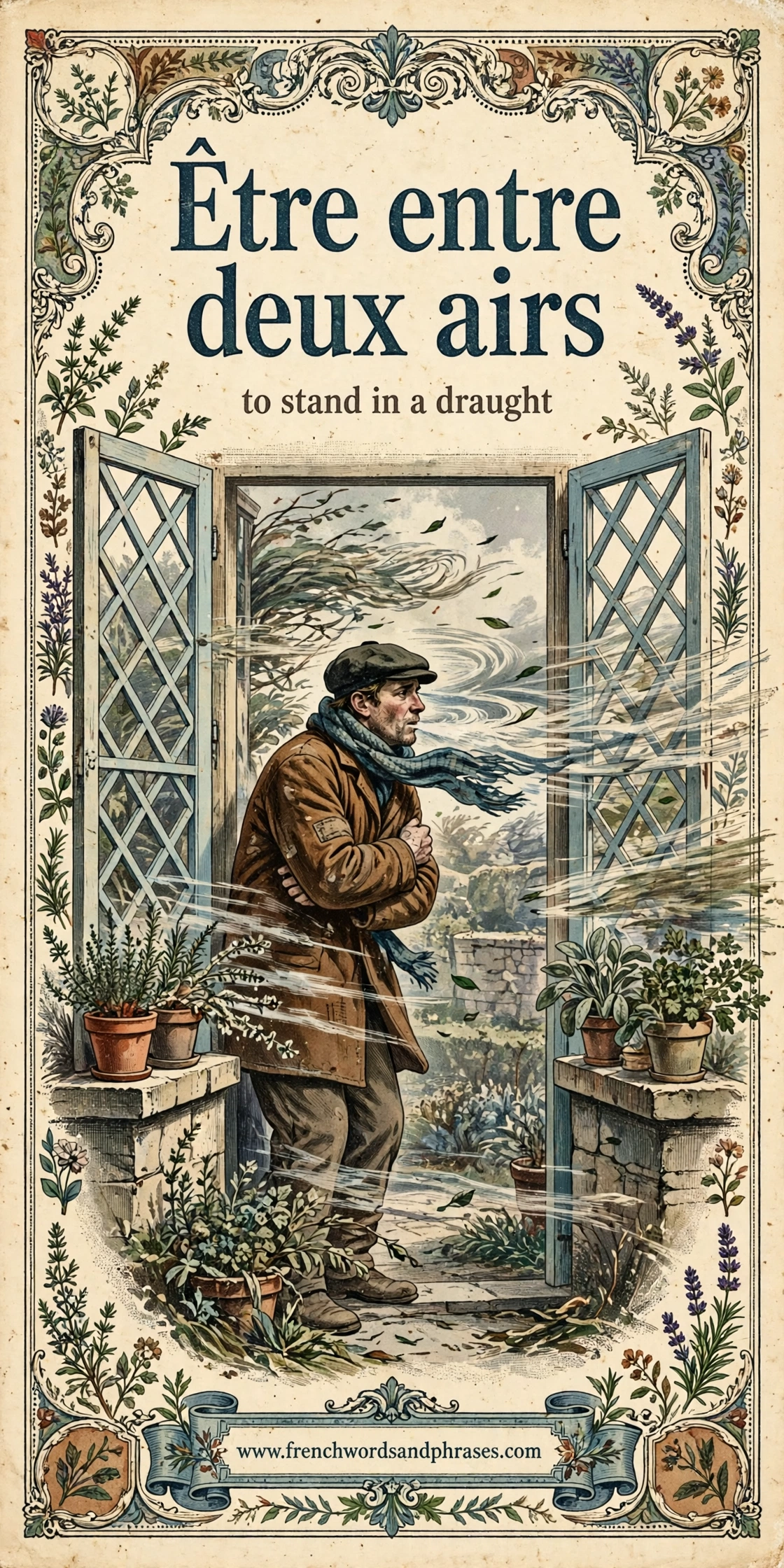
The old farmhouse kitchen has a door to the yard and a window to the lane, and between them runs an invisible river of cold air. Grandmother settles her chair anywhere but there, and warns every visitor who takes the seat: « Ne reste pas là, tu es entre deux airs. » Don’t stay there — you’re sitting in a draught, and in her book of wisdom, a draught is a cold waiting to happen.
Let’s explore how être entre deux airs works in French, beginning with the whole phrase on one card.
Understanding the French Phrase Être entre deux airs
Être entre deux airs is an old French expression built from être (to be), entre deux (between two) and airs (currents of air). It describes the unlucky spot where two draughts cross — between a door and a window, say — a place French grandmothers have warned against for centuries. Today the idea lives on as être dans un courant d’air.
It means to be in a draught — to sit or stand where currents of air meet and blow on you from two sides. The old spelling of the gloss, ‘draught’, suits the phrase: both are from another century. Modern French keeps the fear and changes the words — être dans un courant d’air, to be in a draught, is what people say now, usually while moving a chair or closing a window with great decision.
Type: Idiomatic expression — health and the house (être + entre deux + airs)
Answers the need: Warning someone that they are sitting in a draught
Register: Dated and old-fashioned — grandparents, old novels; today’s phrase is être dans un courant d’air
Strength: A household warning — in the old belief, a draught brings a cold, a stiff neck, or worse
One important usage detail: learn this phrase to recognise it, and use être dans un courant d’air to say it. The modern form keeps the same household scene — ferme la fenêtre, je suis dans un courant d’air, close the window, I’m in a draught. The old entre deux airs survives in classic books and in the speech of the very old, and quoting it today sounds charmingly antique, like wearing your grandfather’s hat.
Experience the Word
Être entre deux airs is a whole philosophy of the French house in five words: air is good in the garden and dangerous in the corridor.
Imagine the winter kitchen, the stove roaring, and the one chair nobody takes — the chair in the invisible river between door and window. A guest sits down, pleased with himself; three generations exchange a look, and the eldest speaks for all: tu es entre deux airs. He moves. In that house, he would always move.
Modern French has central heating and new words for the draught. But the chair between the door and the window is still, somehow, never the one anyone chooses.
How to Use Être entre deux airs in French: Complete Guide
Let’s explore how être entre deux airs works in French, beginning with the whole phrase on one card.
Être entre deux airs at a Glance
The Whole Phrase on One Card
Real meaning, literal picture, English twin and register — être entre deux airs in five lines.
| Point | Être entre deux airs |
|---|---|
| What it really means | to be in a draught — sitting where two currents of air meet |
| Word for word | to be between two airs — caught between two moving currents |
| English equivalent | to be in a draught / to sit in a draught |
| Register | dated — grandparents and old books; today: être dans un courant d’air |
| Use it for | the cold chair between door and window, and recognising the phrase in classic French |
Ne t’assieds pas là, tu es entre deux airs.
Don’t sit there, you’re in a draught.
Word by Word: Building the Draught
Four small pieces — take them one by one and the cold river starts to flow.
| Word | Literal meaning | Its job in the phrase |
|---|---|---|
| être | to be | the state verb — you find yourself in the spot, innocently |
| entre | between | the trap’s geometry — one current in front, one behind |
| deux | two | a single draught is a breeze; two crossing make the danger |
| airs | currents of air | air on the move — in this phrase, air is weather indoors |
Example
Entre la porte et la fenêtre, on est entre deux airs.
Between the door and the window, you’re in a draught.
Quick Quiz 1
How would a French speaker say ‘I’m in a draught’ today?
Reveal the answer
Je suis dans un courant d’air — the modern form. Être entre deux airs is the dated original, kept for recognition and charm.
Ferme la porte, je suis dans un courant d’air.
Close the door, I’m in a draught.
When You Say It: The Draughty Moments
Être entre deux airs fires at moments like these — a chair, a draught, and an elder who sees both.
| Situation | Example |
|---|---|
| The warning | ne reste pas là, tu es entre deux airs — don’t stay there, you’re in a draught |
| Moving the chair | il a déplacé sa chaise pour ne pas être entre deux airs — he moved his chair so as not to be in a draught |
| In an old novel | elle s’assit, sans le savoir, entre deux airs — she sat down, without knowing it, in a draught |
| The consequence feared | entre deux airs, on attrape froid — in a draught, you catch cold |
| Today’s version | ferme la fenêtre, je suis dans un courant d’air — close the window, I’m in a draught |
Example
Grand-mère a fermé la fenêtre : personne ne reste entre deux airs chez elle.
Grandmother closed the window: nobody sits in a draught in her house.
Make It Yours: Old Form, Modern Form
Learn the pair together — the antique to recognise, the modern to use.
| Form | French | In English |
|---|---|---|
| The old phrase | être entre deux airs | to be in a draught (dated) |
| The modern phrase | être dans un courant d’air | to be in a draught |
| A draught, the noun | un courant d’air | a draught |
| To catch cold | attraper froid | to catch cold |
| Close the window! | ferme la fenêtre ! | close the window! |
| Move over | déplace-toi, tu es dans le courant d’air | move, you’re in the draught |
Example
Déplace-toi, tu es dans le courant d’air.
Move over, you’re in the draught.
Quick Quiz 2
What is un courant d’air?
Reveal the answer
A draught — a current of air moving through a room, the modern name for what deux airs used to make together.
Il y a un courant d’air dans le couloir.
There’s a draught in the corridor.
Everyday Expressions: Building on the Draught
Être entre deux airs slots into these everyday frames — each one ready to use as it stands.
| Frame | In English |
|---|---|
| être entre deux airs | to be in a draught (dated) |
| être dans un courant d’air | to be in a draught (modern) |
| il y a un courant d’air ici | there’s a draught in here |
| tu vas attraper froid entre deux airs | you’ll catch cold sitting in a draught |
| cette chaise est toujours entre deux airs | that chair is always in a draught |
Example
Il y a un courant d’air ici, fermons la porte.
There’s a draught in here, let’s close the door.
Close Cousins: The Other Airs of the House
French keeps a shelf of household air phrases — entre deux airs is the dangerous seat; its cousins open windows and clear heads.
| Expression | The difference |
|---|---|
| être entre deux airs | to be in a draught — the dated warning |
| être dans un courant d’air | to be in a draught — the same warning, in today’s French |
| prendre l’air | to get some fresh air — air as a pleasure, outdoors |
| aérer la pièce | to air the room — opening the windows on purpose, healthily |
| avoir besoin d’air | to need some air — feeling shut in, asking for the window or the door |
Example
Après le repas, ils sont sortis prendre l’air.
After the meal, they went out to get some fresh air.
Quick Quiz 3
Which cousin means stepping outside for fresh air on purpose — prendre l’air or être entre deux airs?
Reveal the answer
Prendre l’air — air chosen, outdoors and pleasant. Être entre deux airs is air suffered, indoors and cold.
Viens prendre l’air sur le balcon.
Come and get some fresh air on the balcony.
Être entre deux airs and Its Neighbours
The household shelf around the phrase — doors, windows and the colds that guard them.
| French | In English |
|---|---|
| un courant d’air | a draught |
| une fenêtre | a window |
| une porte | a door |
| attraper froid | to catch cold |
| un torticolis | a stiff neck — the draught’s famous souvenir |
| fermer | to close — the eternal remedy |
Example
Un courant d’air, et voilà le torticolis du lendemain.
One draught, and there’s the next day’s stiff neck.
Watch Out: The Traps Around Être entre deux airs
The traps: a dated phrase used as a modern one, airs that are manners, and a between that is not this between.
| Trap | The truth |
|---|---|
| dated, not dead | use être dans un courant d’air in your own speech; keep entre deux airs for reading old books and quoting grandmothers with love |
| not about manners | these airs are currents of air, not the airs of prendre des airs — nobody is being pretentious in the draught |
| not entre deux feux | être entre deux feux means caught between two fires, in crossfire — a battlefield, not a kitchen |
| the belief inside it | the warning rests on the old belief that draughts cause colds and stiff necks — the phrase carries the belief with it, fondly |
Example
Il n’est pas entre deux airs, il est entre deux feux : deux patrons en colère.
He isn’t in a draught, he’s in the crossfire: two angry bosses.
Quick Quiz 4
True or false: être entre deux airs is the phrase a young Parisian would use today to complain about a draught.
Reveal the answer
False — today she would say je suis dans un courant d’air. Entre deux airs is the dated, grandparent form.
Pardon, je change de place : je suis dans un courant d’air.
Sorry, I’m changing seats: I’m in a draught.
Être entre deux airs in Everyday French: Real-Life Examples
Now that you know the word, let’s see how être entre deux airs appears in everyday French.
Ne reste pas là, tu es entre deux airs.
Don’t stay there, you’re in a draught.
Example 2 — The moved chair
Il a déplacé sa chaise pour ne pas être entre deux airs.
He moved his chair so as not to sit in a draught.
Example 3 — The modern version
Ferme la fenêtre, je suis dans un courant d’air.
Close the window, I’m in a draught.
Example 4 — The feared cold
Entre deux airs, on attrape froid vite.
In a draught, you catch cold quickly.
Example 5 — In the old novel
Elle s’assit entre deux airs, et le lendemain, elle était au lit.
She sat in a draught, and the next day she was in bed.
Example 6 — Grandmother’s rule
Chez grand-mère, personne ne s’assied entre deux airs.
At grandmother’s, nobody sits in a draught.
Beyond Translation: The Meaning of Être entre deux airs
English fears the draught too, but keeps its fear plain and modern — close the door, you’re letting the draught in. French once built the danger a small architecture: entre deux airs, between two airs, as if the sitter were besieged by weather from both sides. The old phrase maps a whole vanished house — doors that never quite shut, windows that sang in winter, and a grandmother presiding over the currents like a harbourmaster.
Être entre deux airs is a warning from a colder century, kept warm by affection.
Say the modern words for your own chair; save the old ones for the pleasure of hearing your grandmother say them.
How to Remember the French Phrase Être entre deux airs
Remember it this way: Être entre deux airs is the chair nobody takes — the invisible cold river between the door and the window, where grandmother says the colds are caught.
- You picture the chair — door behind, window ahead, and the sitter entre deux airs, caught between two currents.
- You say it the modern way — être dans un courant d’air is today’s phrase; the old one is for reading and quoting.
- You mind the false friend — entre deux feux is crossfire, not a draught; these airs are weather, not manners.
The key idea is être entre deux airs means to be in a draught — a dated phrase; today French says être dans un courant d’air.
Test Your Knowledge of Être entre deux airs
Let’s see how much you’ve learned. Try answering these questions before revealing the answers.
Question 1
What does être entre deux airs mean?
Reveal the answer
To be in a draught — to sit or stand where two currents of air meet, between a door and a window.
Question 2
How do you say it in modern French?
Reveal the answer
Être dans un courant d’air — un courant d’air is a draught, and it is the form everyone uses today.
Question 3
How do you say ‘don’t stay there, you’re in a draught’ — old style?
Reveal the answer
Ne reste pas là, tu es entre deux airs — the grandmother’s warning, in the dated form.
Question 4
What is the difference between entre deux airs and entre deux feux?
Reveal the answer
Entre deux feux is crossfire — caught between two fires, two angry sides. Entre deux airs is only air: a draught.
Question 5
Complete the sentence:
Ferme la fenêtre, je suis dans un ______ d’air. (Close the window, I’m in a draught.)
Reveal the answer
courant
Ferme la fenêtre, je suis dans un courant d’air.
Close the window, I’m in a draught.
Your Final Challenge
Can You Use It?
How would you say this in French?
“Don’t sit there, you’re in a draught.”
Reveal the answer
Ne t’assieds pas là, tu es entre deux airs.
Don’t sit there, you’re in a draught.
A little French. A little curiosity. A richer everyday life.
LEARN FRENCH ONE WORD AT A TIME