A French Word to Live By
Translate Vivre de l’air du temps to English
/vivʁ də lɛʁ dy tɑ̃/
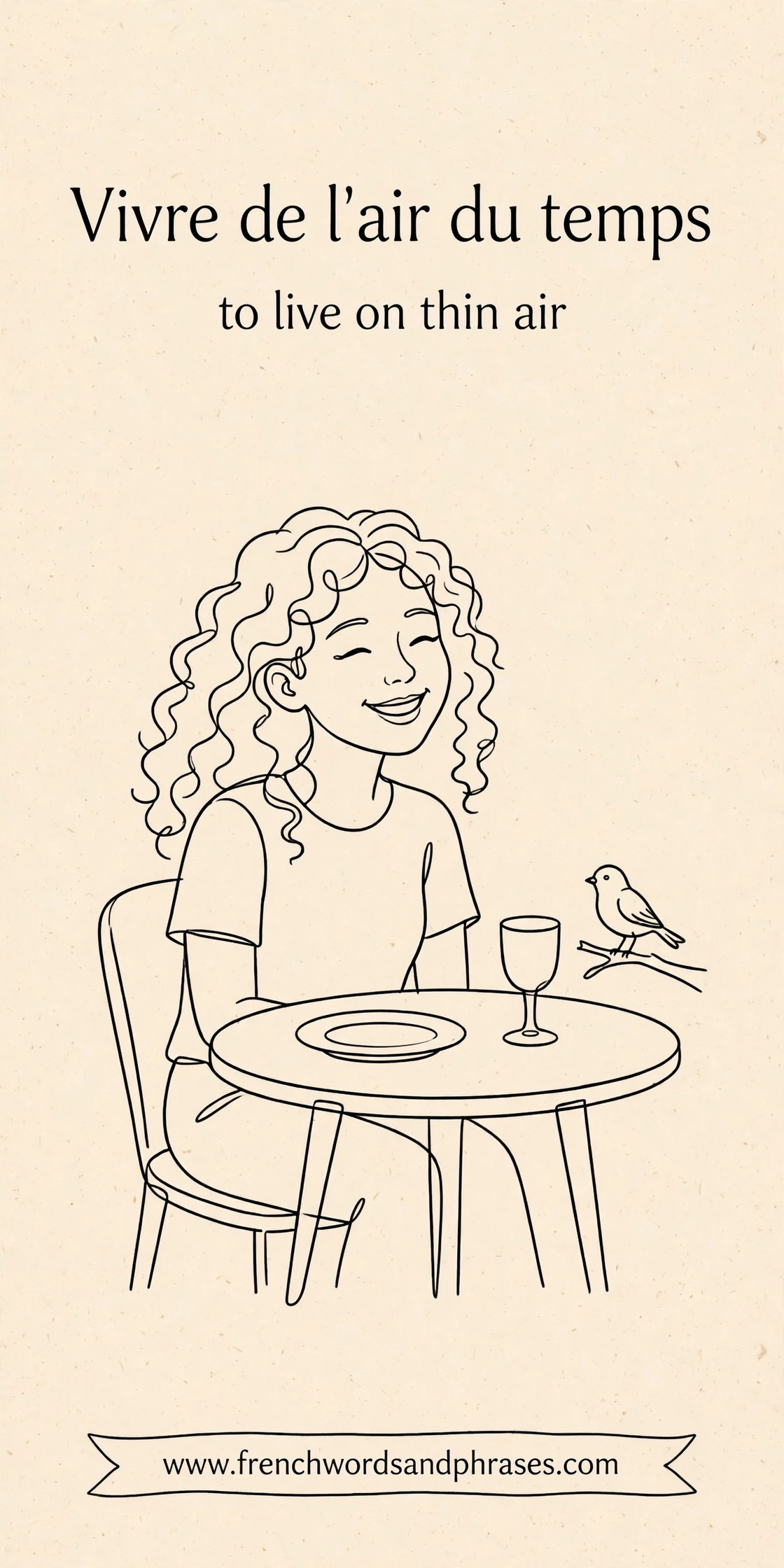
Vivre de l’air du temps means to live on thin air — to get by with almost nothing to live on.
The young painter at the top of the building has no job, no savings and a landlord who asks questions every Friday. Yet every morning he whistles on the stairs, paints all day, and eats — somehow — almost nothing. The concierge shakes her head in admiration and despair: « Celui-là, il vit de l’air du temps. » He lives on thin air.
Let’s explore how vivre de l’air du temps works in French, beginning with the whole phrase on one card.
Understanding the French Phrase Vivre de l’air du temps
Vivre de l’air du temps is a French idiomatic expression built from vivre de (to live on, to feed oneself on), l’air (the air) and du temps (of the time, of the weather). It describes someone who survives on practically nothing — no salary, no stores, no visible means of support, as if the passing air itself were food.
It means to live on thin air — to get by with almost no income and almost no food, seemingly nourished by the atmosphere alone. Nobody’s lungs are that generous: the phrase marvels at the mystery of people — students, artists, dreamers, the cheerfully broke — who keep living brightly on resources nobody can find. It is said with wonder as often as with pity.
Type: Idiomatic expression — poverty and survival (vivre de + noun)
Answers the need: Saying someone gets by on almost nothing, with no visible means
Register: Neutral — literary in flavour, understood everywhere, often affectionate
Strength: Poetic exaggeration — not literally starving, but living on next to nothing
One important usage detail: vivre de is the pattern for naming what sustains you — vivre de son travail, to live from one’s work; vivre d’amour et d’eau fraîche, to live on love and fresh water, the romantic twin of this phrase. L’air du temps also lives a second life in modern French: the spirit of the age, the mood of the moment — un parfum dans l’air du temps, a perfume in tune with the times.
Experience the Word
Vivre de l’air du temps is the phrase for the friend whose finances are a mystery the whole street has given up solving.
Imagine the student in the attic room: no job, a bicycle with one brake, dinners of soup and other people’s invitations — and yet the happiest tenant in the building. Ask the landlady how he manages and she will spread her hands to the sky itself: il vit de l’air du temps.
The phrase never sneers. It treats living on nothing as a kind of magic trick, and the survivor as the magician.
How to Use Vivre de l’air du temps in French: Complete Guide
Let’s explore how vivre de l’air du temps works in French, beginning with the whole phrase on one card.
Vivre de l’air du temps at a Glance
The Whole Phrase on One Card
Real meaning, literal picture, English twin and register — vivre de l’air du temps in five lines.
| Point | Vivre de l’air du temps |
|---|---|
| What it really means | to live on thin air — to survive with almost nothing |
| Word for word | to live on the air of the time — the passing air as your only food |
| English equivalent | to live on thin air / to live on next to nothing |
| Register | neutral, a little literary — wondering, often affectionate |
| Use it for | broke students, artists, dreamers, anyone with invisible resources |
Sans travail depuis un an, il vit de l’air du temps.
Out of work for a year, he’s living on thin air.
Word by Word: Building the Thin Air
Four small pieces — take them one by one and the empty larder fills with weather.
| Word | Literal meaning | Its job in the phrase |
|---|---|---|
| vivre de | to live on, to live from | the feeding pattern — vivre de son travail, to live from one’s work |
| l’air | the air | the impossible food — free, invisible, and not very filling |
| du temps | of the time, of the weather | temps is both time and weather — the air of the passing moment |
Example
Elle vit de l’air du temps depuis qu’elle a quitté son emploi.
She’s been living on thin air since she left her job.
Quick Quiz 1
What are the two meanings of temps hiding in l’air du temps?
Reveal the answer
Time and weather — the air of the passing moment, in every sense. Modern French also uses l’air du temps for the spirit of the age.
Cette chanson est bien dans l’air du temps.
This song is very much in tune with the times.
When You Say It: The Thin-Air Moments
Vivre de l’air du temps fires at moments like these — someone survives, and nobody can see on what.
| Situation | Example |
|---|---|
| The broke student | étudiant, il vivait de l’air du temps — as a student, he lived on thin air |
| The artist | le peintre vit de l’air du temps et de quelques leçons — the painter lives on thin air and a few lessons |
| The mystery neighbour | on ne sait pas de quoi il vit : de l’air du temps — nobody knows what he lives on: thin air |
| A confession | en ce moment, je vis de l’air du temps — at the moment, I’m living on thin air |
| Wondering aloud | comment fait-elle ? elle vit de l’air du temps — how does she manage? she lives on thin air |
Example
Personne ne sait de quoi il vit — de l’air du temps, sans doute.
Nobody knows what he lives on — thin air, probably.
Make It Yours: The Vivre de Family
Vivre de names whatever keeps you alive — swap the food and the life changes.
| Form | French | In English |
|---|---|---|
| On thin air | vivre de l’air du temps | to live on thin air |
| On your work | vivre de son travail | to live from your work |
| On love alone | vivre d’amour et d’eau fraîche | to live on love and fresh water — the romantic twin |
| On little jobs | vivre de petits boulots | to live from odd jobs |
| On your pension | vivre de sa retraite | to live on your pension |
| Barely getting by | vivre chichement | to live frugally, on very little |
Example
Ils vivent d’amour et d’eau fraîche, comme dans les chansons.
They live on love and fresh water, like in the songs.
Quick Quiz 2
Which twin phrase describes young lovers living happily on nothing — d’amour et d’eau fraîche or de pain et de fromage?
Reveal the answer
D’amour et d’eau fraîche — to live on love and fresh water. Bread and cheese would be a real dinner.
À vingt ans, ils vivaient d’amour et d’eau fraîche.
At twenty, they lived on love and fresh water.
Everyday Expressions: Building on the Thin Air
Vivre de l’air du temps slots into these everyday frames — each one ready to use as it stands.
| Frame | In English |
|---|---|
| vivre de l’air du temps | to live on thin air |
| on ne peut pas vivre de l’air du temps | you can’t live on thin air — the landlord’s reply |
| il vit de l’air du temps et de petits boulots | he lives on thin air and odd jobs |
| elle a vécu de l’air du temps pendant ses études | she lived on thin air during her studies |
| vivre de l’air du temps ne paie pas le loyer | living on thin air doesn’t pay the rent |
Example
On ne peut pas vivre de l’air du temps éternellement.
You can’t live on thin air for ever.
Close Cousins: The Other Empty Larders
French has a shelf of phrases for living on little — l’air du temps is the poetic one; its cousins count coins or tighten belts.
| Expression | The difference |
|---|---|
| vivre de l’air du temps | to live on thin air — poetic, wondering, almost admiring |
| vivre d’amour et d’eau fraîche | to live on love and fresh water — the romantic twin, for young lovers |
| tirer le diable par la queue | to struggle to make ends meet — the hard, everyday fight |
| vivre chichement | to live frugally — plain and factual, no poetry |
| ne pas avoir un sou | to not have a penny — the empty pocket, stated flatly |
Example
Il tire le diable par la queue, mais il garde le sourire.
He struggles to make ends meet, but he keeps smiling.
Quick Quiz 3
Which cousin describes the hard daily struggle to make ends meet — tirer le diable par la queue or planer dans les airs?
Reveal the answer
Tirer le diable par la queue — pulling the devil by the tail, the old picture of poverty fought hand to hand.
Avec trois enfants, ils tirent le diable par la queue.
With three children, they struggle to make ends meet.
Vivre de l’air du temps and Its Neighbours
The survival shelf around the phrase — rent, soup and the small jobs that keep the wolf away.
| French | In English |
|---|---|
| le loyer | the rent — what thin air never pays |
| un petit boulot | an odd job, a bit of work |
| les fins de mois | the ends of the month — the difficult stretch |
| se débrouiller | to manage, to get by |
| un sou | a penny, a cent — in ne pas avoir un sou |
| la débrouille | resourcefulness, making do |
Example
Sans un sou, il se débrouille et paie son loyer.
Without a penny, he manages and pays his rent.
Watch Out: The Traps Around Vivre de l’air du temps
The traps: a temps that is weather, an air du temps that changed jobs, and wonder that can sound like mockery.
| Trap | The truth |
|---|---|
| temps is two words in one | temps means both time and weather — il fait beau temps is about the sky, le temps passe is about the clock |
| the modern second life | today l’air du temps usually means the spirit of the age — dans l’air du temps, in tune with the times; the thin-air sense lives inside vivre de |
| not literal starvation | the phrase is an affectionate exaggeration — for real hardship, French speaks plainly of la pauvreté |
| aim the wonder kindly | said of a friend it admires; said of a debtor by his landlord, it accuses — the smile decides |
Example
Il est dans l’air du temps, mais il ne vit pas de l’air du temps : il travaille.
He’s in tune with the times, but he doesn’t live on thin air: he works.
Quick Quiz 4
True or false: in today’s French, l’air du temps most often means the spirit of the age.
Reveal the answer
True — dans l’air du temps means in tune with the times. Inside vivre de l’air du temps, the older picture of eating the air survives.
Ce café est tout à fait dans l’air du temps.
This café is completely in tune with the times.
Vivre de l’air du temps in Everyday French: Real-Life Examples
Now that you know the word, let’s see how vivre de l’air du temps appears in everyday French.
Le peintre du dernier étage vit de l’air du temps.
The painter on the top floor lives on thin air.
Example 2 — The student years
Pendant mes études, je vivais de l’air du temps.
During my studies, I lived on thin air.
Example 3 — The mystery
Personne ne sait de quoi elle vit — de l’air du temps.
Nobody knows what she lives on — thin air.
Example 4 — The landlord’s reply
On ne peut pas vivre de l’air du temps, monsieur.
You can’t live on thin air, sir.
Example 5 — The confession
En ce moment, je vis de l’air du temps et de petits boulots.
At the moment, I’m living on thin air and odd jobs.
Example 6 — The wonder
Comment fait-il ? Il vit de l’air du temps depuis des années.
How does he manage? He’s lived on thin air for years.
Beyond Translation: The Meaning of Vivre de l’air du temps
English lives on thin air too — the two languages share this one almost word for word, a small miracle of agreement. Both picture the same impossible diet, and both say it with the same wondering shake of the head. Perhaps every culture that has students and painters needs the phrase.
Vivre de l’air du temps is poverty described by a poet: the larder is empty, but the sky is full.
And the phrase hides a compliment in its folds — whoever lives on air must be made of something lighter and tougher than the rest of us.
How to Remember the French Phrase Vivre de l’air du temps
Remember it this way: Vivre de l’air du temps is the attic painter’s diet — no salary, no stores, just the passing air, and somehow he whistles on the stairs.
- You picture the empty larder — vivre de names your food, and here the food is l’air du temps, the air itself.
- You keep both temps — time and weather at once; the phrase feeds on the whole passing moment.
- You separate the modern cousin — dans l’air du temps is the spirit of the age; eating the air is only inside vivre de.
The key idea is vivre de l’air du temps means to live on thin air — to get by with almost nothing to live on.
Test Your Knowledge of Vivre de l’air du temps
Let’s see how much you’ve learned. Try answering these questions before revealing the answers.
Question 1
What does vivre de l’air du temps mean?
Reveal the answer
To live on thin air — to survive with almost no income and no visible means of support.
Question 2
What is the literal, word-for-word meaning?
Reveal the answer
To live on the air of the time — vivre de names what feeds you, and here it is the passing air itself.
Question 3
How do you say ‘during my studies, I lived on thin air’?
Reveal the answer
Pendant mes études, je vivais de l’air du temps — the imperfect vivais carries the long student years.
Question 4
What does l’air du temps usually mean in modern French, outside this phrase?
Reveal the answer
The spirit of the age — dans l’air du temps means in tune with the times.
Question 5
Complete the sentence:
Sans travail, il vit de l’______ du temps. (Out of work, he’s living on thin air.)
Reveal the answer
air
Sans travail, il vit de l’air du temps.
Out of work, he’s living on thin air.
Your Final Challenge
Can You Use It?
How would you say this in French?
“During my studies, I lived on thin air.”
Reveal the answer
Pendant mes études, je vivais de l’air du temps.
During my studies, I lived on thin air.
A little French. A little curiosity. A richer everyday life.
LEARN FRENCH ONE WORD AT A TIME