A French Word to Live By
Translate Avoir affaire à forte partie to English
/a.vwaʁ a.fɛʁ a fɔʁt paʁ.ti/
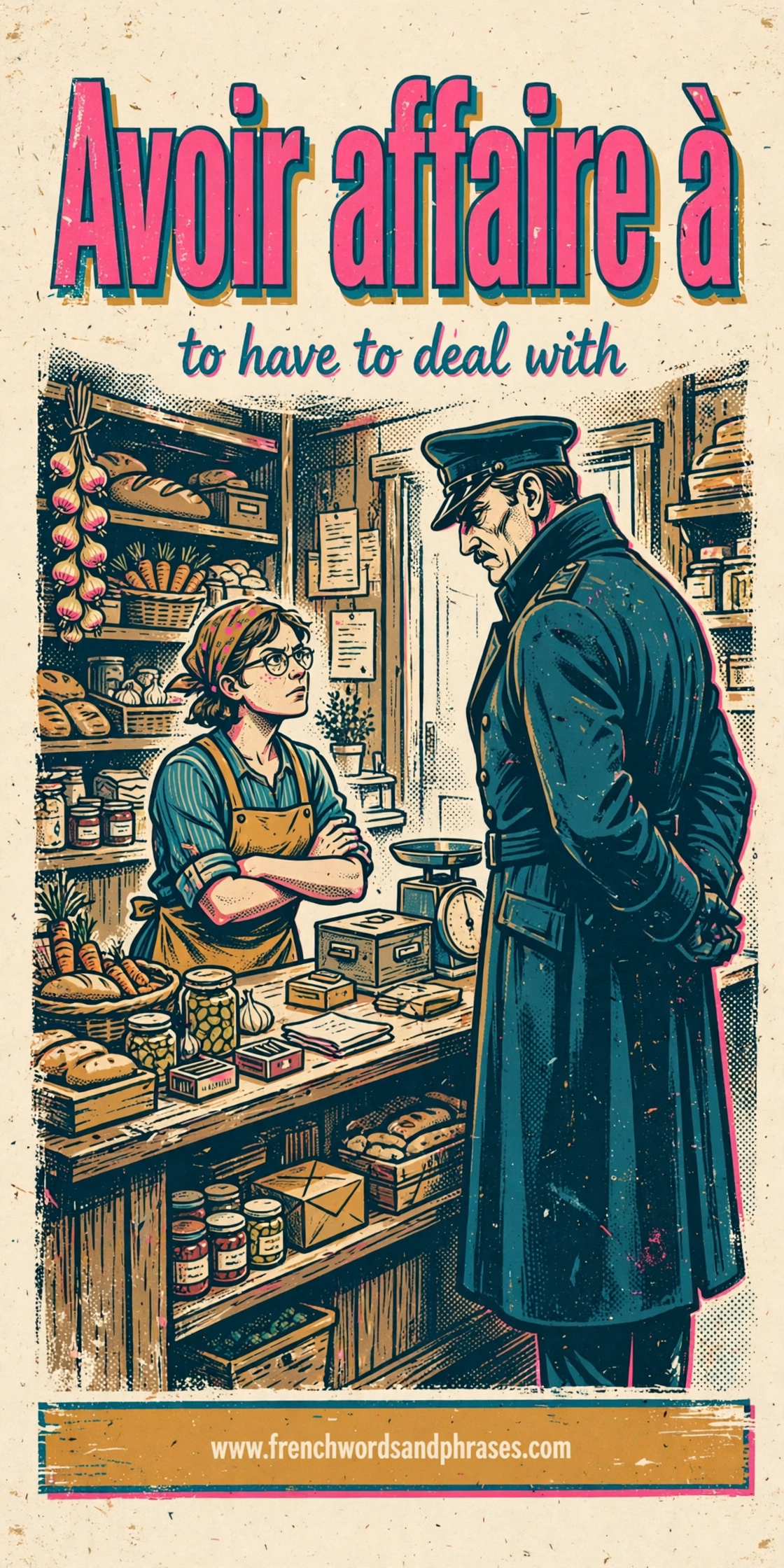
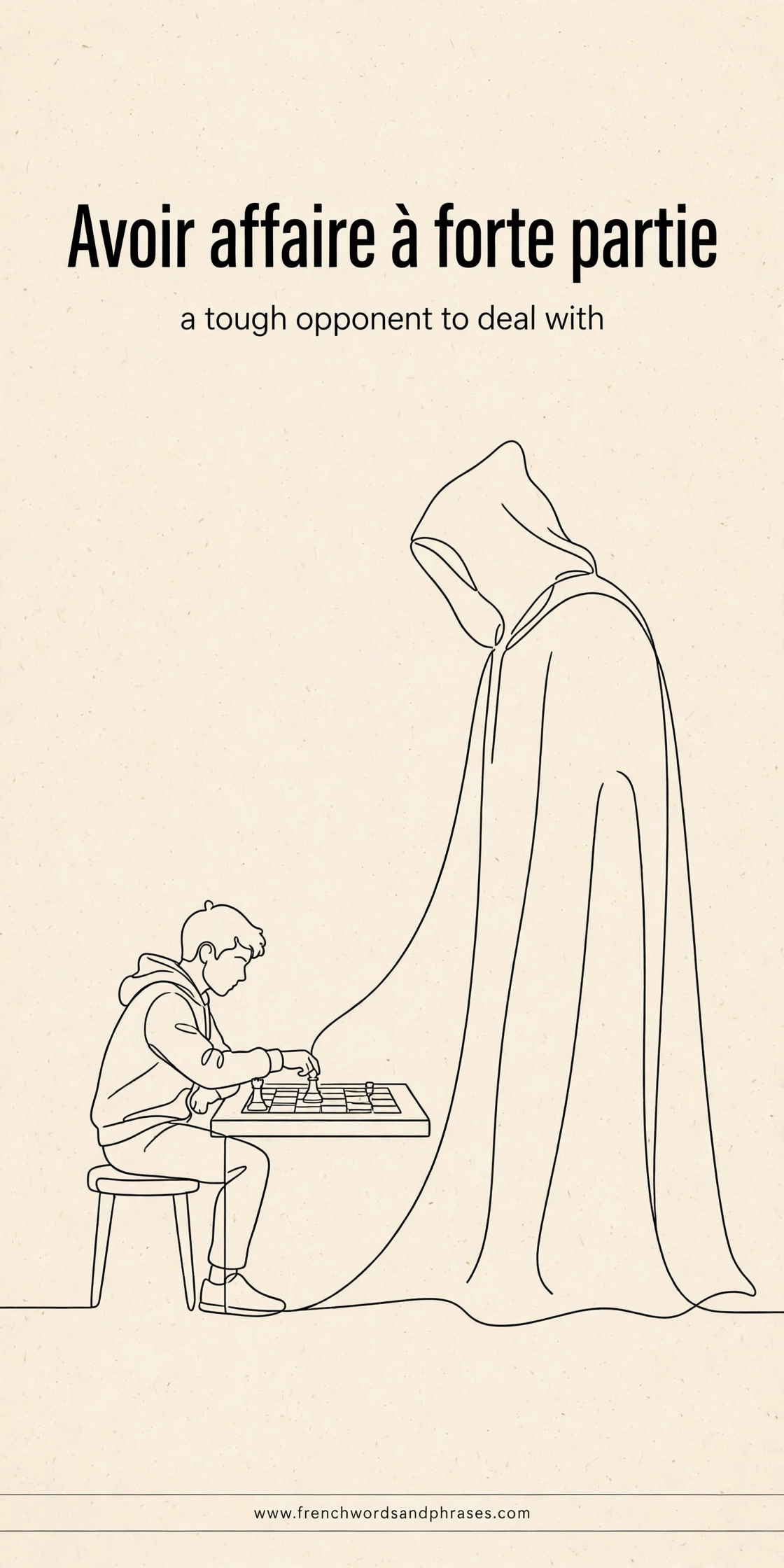
Avoir affaire à forte partie means to have a tough opponent to deal with — to have met your match.
The young chess champion of the village has beaten everyone at the café for a year, and he plays with a smile that says he is bored. Tonight, a quiet grandfather sits down opposite him, sets up his pieces slowly — and the smile fades. The café owner whispers: « Cette fois, il a affaire à forte partie. »
Let’s explore how avoir affaire à forte partie works in French, beginning with the whole phrase on one card.
Understanding the French Phrase Avoir affaire à forte partie
Avoir affaire à forte partie is a French idiomatic expression built on the pattern avoir affaire à (to have to deal with), strengthened by forte partie — a strong side, a formidable opposing party. Partie here is the old word for a side in a contest or a cause, the same partie as in prendre parti, to take sides.
It means to have a tough opponent to deal with — to be up against someone strong, skilled or dangerous, and to know it. The book’s gloss is blunt: ‘he has a dangerous opponent’. Use it whenever the person across the table is no pushover: a champion at chess, a lawyer in a dispute, a rival in business or in love.
Type: Idiomatic expression — confrontation (avoir affaire à + forte partie)
Answers the need: Saying the opponent you face is formidable — you have met your match
Register: Neutral to literary — understood everywhere, with a classic flavour
Strength: High — this is respect for the other side, and a warning to your own
One important usage detail: forte partie is invariable in the phrase — always forte, always singular, whatever the opponent. The expression often arrives as a warning or a piece of commentary about someone else: il a affaire à forte partie, cette fois. For the plain pattern without the danger, drop back to avoir affaire à quelqu’un.
Experience the Word
Avoir affaire à forte partie is the moment confidence meets its limit — the smile fades, the sleeves come down, and the real contest begins.
Imagine the small-town lawyer who has won every case for a decade, opening a file and finding the name of the most feared advocate in Paris on the other side. He does not panic. He simply works later, reads more carefully, and tells his clerk the truth: cette fois, nous avons affaire à forte partie.
The phrase carries respect inside the warning. To name the other side forte is to admit, before the contest, that it deserves to win if you are careless.
How to Use Avoir affaire à forte partie in French: Complete Guide
Let’s explore how avoir affaire à forte partie works in French, beginning with the whole phrase on one card.
Avoir affaire à forte partie at a Glance
The Whole Phrase on One Card
Real meaning, literal picture, English twin and register — avoir affaire à forte partie in five lines.
| Point | Avoir affaire à forte partie |
|---|---|
| What it really means | to have a tough, formidable opponent to deal with |
| Word for word | to have business with a strong side |
| English equivalent | to have met your match / to be up against a tough opponent |
| Register | neutral to literary — a classic flavour, understood by all |
| Use it for | champions, lawyers, rivals — anyone across the table who is genuinely strong |
Example
Cette fois, il a affaire à forte partie.
This time, he has a tough opponent to deal with.
Word by Word: Building the Strong Side
Five small pieces — take them one by one and the opponent grows more formidable.
| Word | Literal meaning | Its job in the phrase |
|---|---|---|
| avoir affaire à | to have to deal with | the base pattern — someone stands across from you |
| forte | strong | the judgement: this side is powerful, skilled, dangerous |
| partie | a side, a party | the opposing side in a contest or a cause — the partie of prendre parti, to take sides |
Example
Elle croyait gagner facilement, mais elle avait affaire à forte partie.
She thought she would win easily, but she had a tough opponent to deal with.
Quick Quiz 1
What is a partie in forte partie?
Reveal the answer
A side — the opposing party in a contest or a cause, as in prendre parti, to take sides. Not a party with cake.
Les deux parties ont signé l’accord.
The two sides signed the agreement.
When You Say It: The Formidable Moments
Avoir affaire à forte partie fires at moments like these — the contest begins, and the other side is strong.
| Situation | Example |
|---|---|
| At chess or sport | il a affaire à forte partie ce soir — he has a tough opponent tonight |
| In a legal dispute | leur avocat a affaire à forte partie — their lawyer is up against a formidable opponent |
| In business rivalry | le nouveau magasin a affaire à forte partie — the new shop faces a strong rival |
| As a warning | attention, tu as affaire à forte partie — careful, you’ve met your match |
| About a negotiator | c’est un négociateur redoutable, on a affaire à forte partie — he is a fearsome negotiator, a tough opponent |
Example
Le champion a enfin trouvé un rival : il a affaire à forte partie.
The champion has finally found a rival: he has a tough opponent to deal with.
Make It Yours: The Strong Side for Every Person
The phrase rides on avoir affaire à — only the warning about the opponent’s strength is added.
| Form | French | In English |
|---|---|---|
| I face a tough opponent | j’ai affaire à forte partie | I have a tough opponent to deal with |
| He has met his match | il a affaire à forte partie | he has a tough opponent to deal with |
| We are up against it | nous avons affaire à forte partie | we face a formidable opponent |
| You will struggle | tu auras affaire à forte partie | you’ll have a tough opponent to deal with |
| The plain version | avoir affaire à quelqu’un | to have someone to deal with — strength unstated |
| Question | tu as affaire à forte partie ? | have you met your match? |
Example
Nous avons affaire à forte partie, alors préparons-nous bien.
We face a formidable opponent, so let’s prepare well.
Quick Quiz 2
Does forte partie change if the opponent is a woman or a whole team?
Reveal the answer
No — forte partie is fixed and invariable in the expression, whoever stands opposite.
Face à cette équipe, elle a affaire à forte partie.
Against this team, she has a tough opponent to deal with.
Everyday Expressions: Building on the Strong Side
Avoir affaire à forte partie slots into these everyday frames — each one ready to use as it stands.
| Frame | In English |
|---|---|
| avoir affaire à forte partie | to have a tough opponent to deal with |
| trouver à qui parler | to meet your match — informal, ‘to find someone who answers back’ |
| tomber sur un os | to come up against a snag, a real difficulty |
| avoir du fil à retordre | to have your work cut out for you |
| être de taille à lutter | to be strong enough to compete, to be up to the fight |
Example
Avec ce dossier, l’avocate va avoir du fil à retordre.
With this case, the lawyer will have her work cut out for her.
Close Cousins: The Other Ways to Meet Your Match
French has a whole shelf of strong-opponent phrases — forte partie is the classic; its cousins are slangier, blunter or more resigned.
| Expression | The difference |
|---|---|
| avoir affaire à forte partie | to face a formidable opponent — classic, respectful, a warning |
| trouver son maître | to meet your master — someone has finally outclassed you |
| tomber sur un os | to hit a snag — the difficulty is a thing or a situation, not a person |
| avoir du fil à retordre | to have your work cut out — the effort ahead, whoever causes it |
| être tombé sur plus fort que soi | to have run into someone stronger — the result stated plainly |
Example
Le champion invaincu a enfin trouvé son maître.
The unbeaten champion has finally met his master.
Quick Quiz 3
The difficulty is a broken machine, not a person. Forte partie or tomber sur un os?
Reveal the answer
Tomber sur un os — to come up against a snag. Forte partie needs a living opponent across the table.
En réparant le toit, ils sont tombés sur un os.
While repairing the roof, they came up against a snag.
Avoir affaire à forte partie and Its Neighbours
The contest shelf around the phrase — opponents, sides and the fight itself.
| French | In English |
|---|---|
| un adversaire | an opponent |
| un rival | a rival |
| prendre parti | to take sides |
| un défi | a challenge |
| redoutable | formidable, fearsome |
| l’emporter | to win, to carry the day |
Example
C’est un adversaire redoutable, mais elle peut l’emporter.
He is a formidable opponent, but she can carry the day.
Watch Out: The Traps Around Avoir affaire à forte partie
The traps: a partie that is not a party, a strength that belongs to the opponent, and a compliment hidden in the warning.
| Trap | The truth |
|---|---|
| partie is not a party | une partie here is a side in a contest — une partie d’échecs is a game of chess, and les parties are the sides in a dispute |
| the strength is theirs | forte describes the opponent, never you — the phrase warns your side, it does not praise it |
| it is partly a compliment | to say it is to respect the other side: journalists use it of champions precisely because it honours both players |
| do not drop the à | the pattern is avoir affaire À forte partie — the à of the base pattern stays in place |
Example
Après une longue partie d’échecs, il a admis avoir eu affaire à forte partie.
After a long game of chess, he admitted he had faced a tough opponent.
Quick Quiz 4
True or false: avoir affaire à forte partie boasts about your own strength.
Reveal the answer
False — forte partie is the other side’s strength. The phrase is a warning to your own camp, and a compliment to the opponent.
Il souriait, mais il savait qu’il avait affaire à forte partie.
He smiled, but he knew he had a tough opponent to deal with.
Avoir affaire à forte partie in Everyday French: Real-Life Examples
Now that you know the word, let’s see how avoir affaire à forte partie appears in everyday French.
Example 1 — At the chess café
Ce soir, le champion a affaire à forte partie.
Tonight, the champion has a tough opponent to deal with.
Example 2 — The lawyer
Leur avocat a affaire à forte partie dans ce procès.
Their lawyer is up against a formidable opponent in this trial.
Example 3 — The new shop
Le petit magasin a affaire à forte partie avec la grande surface voisine.
The little shop faces a strong rival in the neighbouring supermarket.
Example 4 — A warning
Attention, cette fois tu as affaire à forte partie.
Careful, this time you’ve met your match.
Example 5 — Preparing well
Nous avons affaire à forte partie, alors travaillons.
We face a tough opponent, so let’s get to work.
Example 6 — Respect after defeat
Il a perdu, mais il avait affaire à forte partie.
He lost, but he had been up against a formidable opponent.
Beyond Translation: The Meaning of Avoir affaire à forte partie
English ‘to meet your match’ borrows the language of matches and marriages — someone equal has arrived. French forte partie borrows the language of causes and contests: the other side is a partie, organised, represented, strong.
Avoir affaire à forte partie is the phrase of honest competitors — it measures the opponent before the contest, and finds the measurement sobering.
Keep it for the moments when respect is the truth: the champion across the board, the advocate across the courtroom, the rival across the street.
How to Remember the French Phrase Avoir affaire à forte partie
Remember it this way: Avoir affaire à forte partie is the fading smile at the chessboard — the other side of the table is strong, and everyone can see it.
- You read partie as a side — the opposing party in the contest, as in prendre parti, never a celebration.
- You aim the strength correctly — forte belongs to the opponent; the phrase warns you, it does not flatter you.
- You keep it invariable — forte partie, always, whoever or however many stand opposite.
The key idea is avoir affaire à forte partie means to have a tough opponent to deal with — to have met your match.
Test Your Knowledge of Avoir affaire à forte partie
Let’s see how much you’ve learned. Try answering these questions before revealing the answers.
Question 1
What does avoir affaire à forte partie mean?
Reveal the answer
To have a tough, formidable opponent to deal with — to have met your match.
Question 2
What does partie mean in this phrase?
Reveal the answer
A side — the opposing party in a contest or a cause, as in prendre parti, to take sides.
Question 3
Whose strength does forte describe?
Reveal the answer
The opponent’s — the phrase is a warning to your own side and a compliment to the other.
Question 4
What is the difference between tomber sur un os and avoir affaire à forte partie?
Reveal the answer
Tomber sur un os is hitting a snag — a thing or situation. Forte partie requires a living, formidable opponent.
Question 5
Complete the sentence:
Cette fois, nous avons affaire à ______ partie. (This time, we face a tough opponent.)
Reveal the answer
forte
Cette fois, nous avons affaire à forte partie.
This time, we face a tough opponent.
Your Final Challenge
Can You Use It?
How would you say this in French?
“This time, he has a tough opponent to deal with.”
Reveal the answer
Cette fois, il a affaire à forte partie.
This time, he has a tough opponent to deal with.
A little French. A little curiosity. A richer everyday life.
LEARN FRENCH ONE WORD AT A TIME