A French Word to Live By
Translate Avoir affaire à to English
/a.vwaʁ a.fɛʁ a/
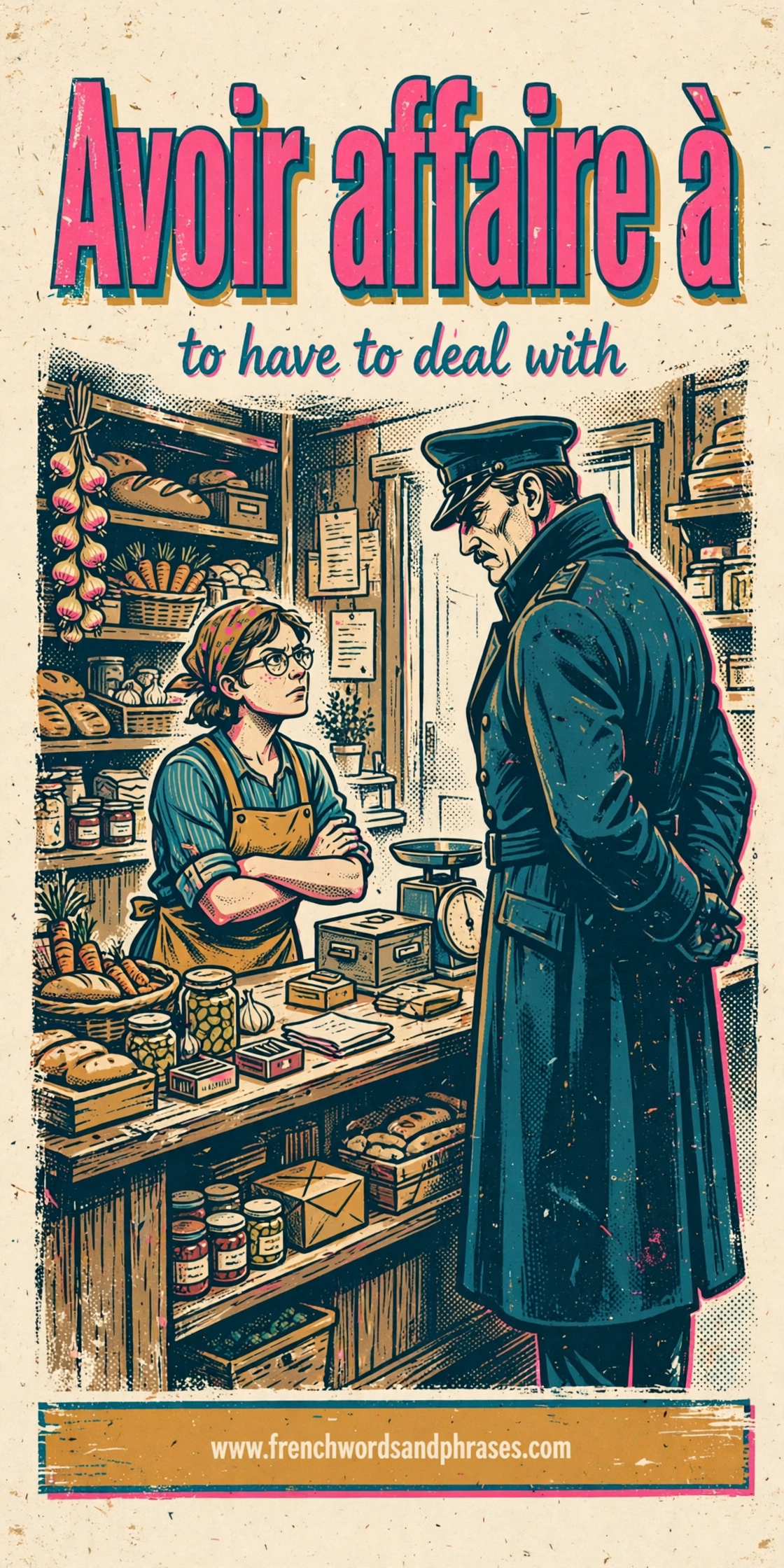
Avoir affaire à means to have to deal with — to have business with someone, or someone to answer to.
A knock at the door of the little flat in Marseille. The landlord’s agent is there about the rent, polite but firm, and he asks for the tenant by name. From the kitchen, a voice answers for her: « Dites-lui qu’elle a affaire à moi, maintenant. » From that moment, he is no longer dealing with her — he has someone else to answer to.
Let’s explore how avoir affaire à works in French, beginning with the whole phrase on one card.
Understanding the French Phrase Avoir affaire à
Avoir affaire à is a French idiomatic expression built from avoir (to have), affaire (business, a matter) and à (to, with). It is a pattern, not a fixed sentence: avoir affaire à quelqu’un means to have to deal with that person — for business, for a conversation, or, with a certain tone, in a reckoning.
It means to have to deal with someone. The book shows its two faces. The neutral face: j’ai affaire à vous, I have business with you, I need to speak to you. The firm face: il aura affaire à moi, he will have me to deal with — a warning that a reckoning is coming. Context and tone decide which face the phrase wears.
Type: Idiomatic expression — dealings (avoir + affaire + à + person)
Answers the need: Saying who you must deal with, speak to, or answer to
Register: Neutral to firm — the future tense version is a classic warning
Strength: Sliding — a polite request for a word, or a promise of consequences
One important usage detail: the person always comes after à — avoir affaire à un expert, à la police, à moi. Watch the famous telephone formula built on the same frame: à qui ai-je affaire ? — literally ‘with whom do I have business?’, the formal French way to ask who is speaking. And never confuse affaire here with the English ‘affair’: no romance is involved, only dealings.
Experience the Word
Avoir affaire à is the doorway phrase of French life — every negotiation, complaint and confrontation begins by establishing who has affaire to whom.
Picture the village mayor’s office on a Monday morning. A queue of citizens, each with a folder, each waiting to avoir affaire à the secretary before anyone has affaire au maire. French administration runs on this phrase: there is always a person, behind a desk, who is the one you have to deal with.
And when the tone drops and the future tense appears — il aura affaire à moi — the doorway becomes a courtroom. The same three words can open a conversation or announce a reckoning.
How to Use Avoir affaire à in French: Complete Guide
Let’s explore how avoir affaire à works in French, beginning with the whole phrase on one card.
Avoir affaire à at a Glance
The Whole Phrase on One Card
Real meaning, literal picture, English twin and register — avoir affaire à in five lines.
| Point | Avoir affaire à |
|---|---|
| What it really means | to have to deal with someone — for business, a talk, or a reckoning |
| Word for word | to have business to (someone) |
| English equivalent | to have to deal with / to have business with |
| Register | neutral to firm — the warning use is classic, almost ceremonial |
| Use it for | appointments, negotiations, complaints — and the famous warning il aura affaire à moi |
Example
Si tu continues, tu auras affaire à moi.
If you carry on, you’ll have me to deal with.
Word by Word: Building the Dealing
Three small pieces — take them one by one and the person across the desk appears.
| Word | Literal meaning | Its job in the phrase |
|---|---|---|
| avoir | to have | the verb that assigns the dealing — it is yours, whether you chose it or not |
| affaire | business, a matter | the business between you: a question, a debt, a dispute |
| à | to, with | the arrow of the phrase — it points at the person you must deal with |
Example
Pour ce dossier, vous avez affaire au service des impôts.
For this file, you have to deal with the tax office.
Quick Quiz 1
What does il aura affaire à moi really announce?
Reveal the answer
A reckoning — ‘he will have me to deal with’. The future tense turns the neutral pattern into a warning.
S’il touche à mon vélo, il aura affaire à moi.
If he touches my bike, he’ll have me to deal with.
When You Say It: The Dealing Moments
Avoir affaire à fires at moments like these — wherever one person must face another to get something settled.
| Situation | Example |
|---|---|
| Needing a word with someone | j’ai affaire à vous — I have business with you, I need to speak to you |
| Dealing with an office | avoir affaire à l’administration — to have to deal with the authorities |
| The warning | il aura affaire à moi — he’ll have me to deal with |
| A difficult opponent | vous avez affaire à un homme obstiné — you are dealing with a stubborn man |
| On the telephone | à qui ai-je affaire ? — who am I speaking to? (formal) |
Example
Pour un remboursement, vous aurez affaire au service client.
For a refund, you’ll have to deal with customer service.
Make It Yours: The Dealing for Every Person
Avoir conjugates as usual, and the person after à can be anyone — a neighbour, an office, or justice itself.
| Form | French | In English |
|---|---|---|
| I have business with you | j’ai affaire à vous | I have to speak with you |
| You are dealing with an expert | tu as affaire à un expert | you’re dealing with an expert |
| He’ll have me to deal with | il aura affaire à moi | he’ll have me to deal with |
| We deal with the town hall | nous avons affaire à la mairie | we have to deal with the town hall |
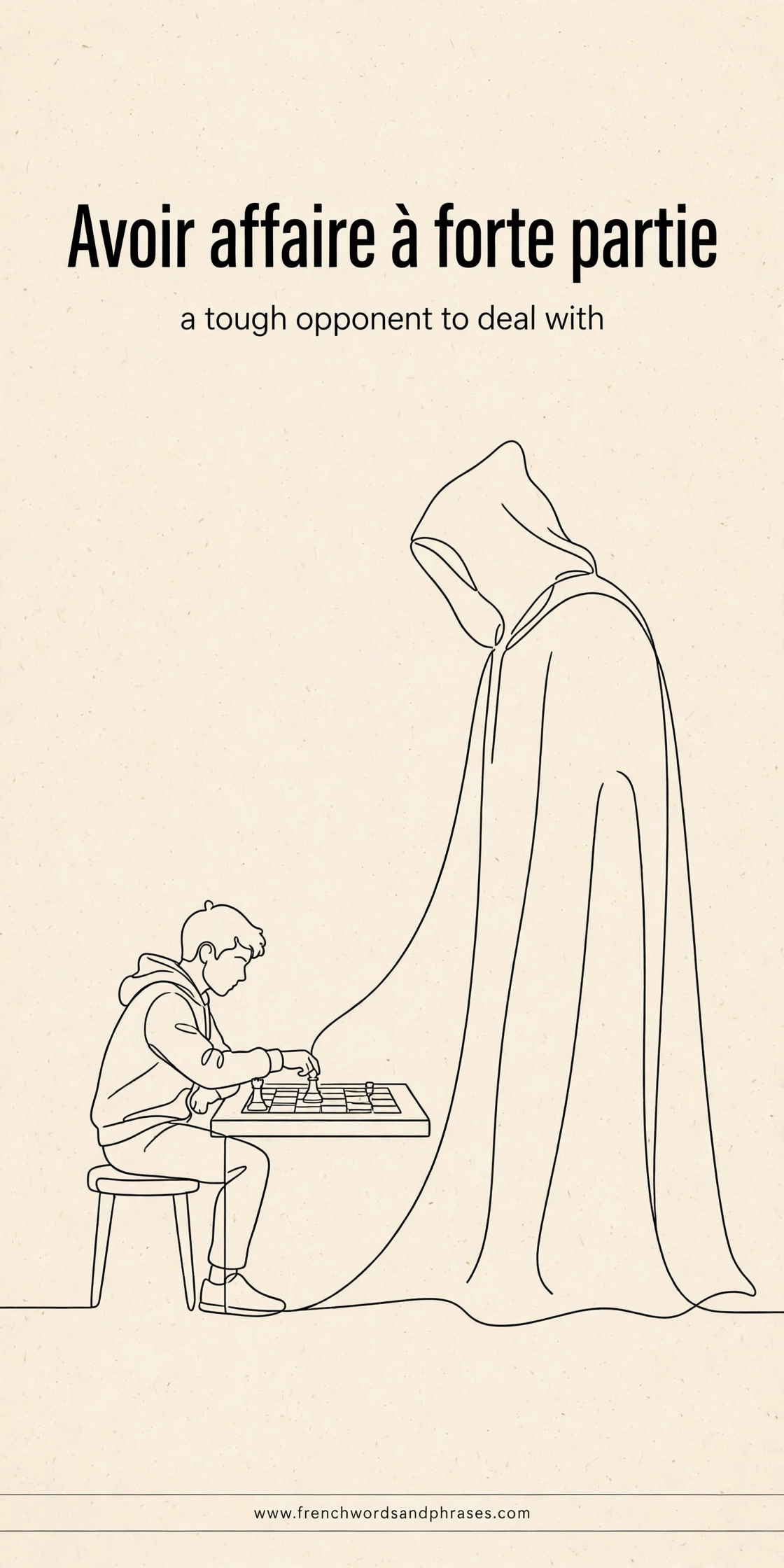
| A tough opponent | avoir affaire à forte partie | to have a formidable opponent to deal with |
| Question | à qui ai-je affaire ? | who am I speaking to? (formal) |
Example
Attention, là, tu as affaire à forte partie.
Careful — there, you have a tough opponent to deal with.
Quick Quiz 2
On the telephone, a formal voice asks à qui ai-je affaire ? What does he want to know?
Reveal the answer
Who he is speaking to — it is the formal French way to ask for your name and identity.
— À qui ai-je affaire ? — Madame Fabre, de la mairie.
— Who am I speaking to? — Mrs Fabre, from the town hall.
Everyday Expressions: Building on the Dealing
Avoir affaire à slots into these everyday frames — each one ready to use as it stands.
| Frame | In English |
|---|---|
| avoir affaire à quelqu’un | to have to deal with someone |
| avoir affaire à forte partie | to have a tough opponent to deal with |
| avoir affaire à la justice | to have dealings with the law, to be in trouble with justice |
| il aura affaire à moi | he’ll have me to deal with — the classic warning |
| à qui ai-je affaire ? | who am I speaking to? (formal, on the telephone) |
Example
Après l’accident, il a eu affaire à la justice.
After the accident, he had dealings with the law.
Close Cousins: The Other Ways to Face Someone
French has a whole shelf of facing phrases — avoir affaire à is the general pattern; its cousins negotiate, confront or settle scores.
| Expression | The difference |
|---|---|
| avoir affaire à | to have to deal with — the general pattern, neutral to firm |
| avoir affaire à forte partie | to face a formidable opponent — the pattern at full strength |
| traiter avec quelqu’un | to do business with someone, to negotiate — commerce in focus |
| s’adresser à quelqu’un | to approach someone, to apply to them — the polite first step |
| régler ses comptes avec quelqu’un | to settle scores with someone — the reckoning, fully spelled out |
Example
Avant de régler vos comptes, adressez-vous au responsable.
Before settling scores, approach the person in charge.
Quick Quiz 3
You want the polite first step — asking the right person for help. S’adresser à or avoir affaire à?
Reveal the answer
S’adresser à — to approach, to apply to. Avoir affaire à describes the dealing itself, once it exists.
Pour ce formulaire, adressez-vous au guichet deux.
For this form, go to window two.
Avoir affaire à and Its Neighbours
The dealings shelf around the phrase — the people and places you end up facing.
| French | In English |
|---|---|
| un interlocuteur | the person you are dealing or speaking with |
| la mairie | the town hall |
| l’administration | the authorities, officialdom |
| un adversaire | an opponent |
| la justice | the law, the courts |
| un rendez-vous | an appointment, a meeting |
Example
Son interlocuteur à la mairie a enfin approuvé le dossier.
His contact at the town hall finally approved the file.
Watch Out: The Traps Around Avoir affaire à
The traps: a false friend from English, a preposition that must not change, and a warning hidden in the future tense.
| Trap | The truth |
|---|---|
| the English ‘affair’ trap | affaire here is business, a matter — avoir affaire à quelqu’un involves no romance whatsoever |
| à, never de | the person follows à: avoir affaire à moi, à vous, à la police — de would break the pattern |
| the future is a threat | il aura affaire à moi is not a diary note; it is a warning — handle it like one |
| forte partie is stronger | avoir affaire à forte partie raises the stakes: the opponent is formidable, not merely present |
Example
Il croyait avoir affaire à un amateur, mais c’était un professionnel.
He thought he was dealing with an amateur, but it was a professional.
Quick Quiz 4
True or false: avoir affaire à quelqu’un suggests a love affair with that person.
Reveal the answer
False — affaire here means business, a matter to settle. The romance sense belongs to English, not to this phrase.
J’ai affaire au notaire demain matin.
I have business with the solicitor tomorrow morning.
Avoir affaire à in Everyday French: Real-Life Examples
Now that you know the word, let’s see how avoir affaire à appears in everyday French.
Example 1 — The knock at the door
Dites-lui qu’il a affaire à moi, maintenant.
Tell him he has me to deal with now.
Example 2 — Needing a word
J’ai affaire à vous pour une question de loyer.
I have business with you about a rent question.
Example 3 — The warning
S’il recommence, il aura affaire à moi.
If he does it again, he’ll have me to deal with.
Example 4 — At the town hall
Nous avons affaire à la mairie pour le permis.
We have to deal with the town hall for the permit.
Example 5 — On the telephone
Bonjour, à qui ai-je affaire ?
Hello, who am I speaking to?
Example 6 — With the law
Après cette histoire, il a eu affaire à la justice.
After that business, he had dealings with the law.
Beyond Translation: The Meaning of Avoir affaire à
English ‘to deal with’ is brisk and faintly annoyed — a problem to be processed. French avoir affaire à is older and more ceremonial: before anything is settled, the parties must be established. Who has affaire to whom? Everything else follows from that.
Avoir affaire à is the grammar of the face-to-face — it insists that behind every matter, there is a person.
That is why its warning form has survived unchanged for centuries. Il aura affaire à moi needs no raised voice. The pattern itself is the threat.
How to Remember the French Phrase Avoir affaire à
Remember it this way: Avoir affaire à is the desk between two people — you on one side, the person you must deal with on the other.
- You follow the arrow — the person you deal with always stands after à: affaire à moi, à vous, à la mairie.
- You watch the tense — the present is business; the future, il aura affaire à moi, is a warning.
- You banish the romance — this affaire is a matter to settle, never a love affair.
The key idea is avoir affaire à means to have to deal with — business with a person, or a reckoning.
Test Your Knowledge of Avoir affaire à
Let’s see how much you’ve learned. Try answering these questions before revealing the answers.
Question 1
What does avoir affaire à quelqu’un mean?
Reveal the answer
To have to deal with that person — for business, a conversation, or a reckoning.
Question 2
How do you say ‘he’ll have me to deal with’?
Reveal the answer
Il aura affaire à moi — the classic French warning, in the future tense.
Question 3
What does à qui ai-je affaire ? ask?
Reveal the answer
Who am I speaking to? — the formal telephone formula, literally ‘with whom do I have business?’
Question 4
What is the difference between avoir affaire à and s’adresser à?
Reveal the answer
S’adresser à is the polite first approach — going to the right person. Avoir affaire à is the dealing itself, once you are face to face.
Question 5
Complete the sentence:
Pour ce permis, vous avez affaire ______ la mairie. (For this permit, you have to deal with the town hall.)
Reveal the answer
à
Pour ce permis, vous avez affaire à la mairie.
For this permit, you have to deal with the town hall.
Your Final Challenge
Can You Use It?
How would you say this in French?
“If he starts again, he’ll have me to deal with.”
Reveal the answer
S’il recommence, il aura affaire à moi.
If he starts again, he’ll have me to deal with.
A little French. A little curiosity. A richer everyday life.
LEARN FRENCH ONE WORD AT A TIME