A French Word to Live By
Translate Grave to English
/ɡʁav/
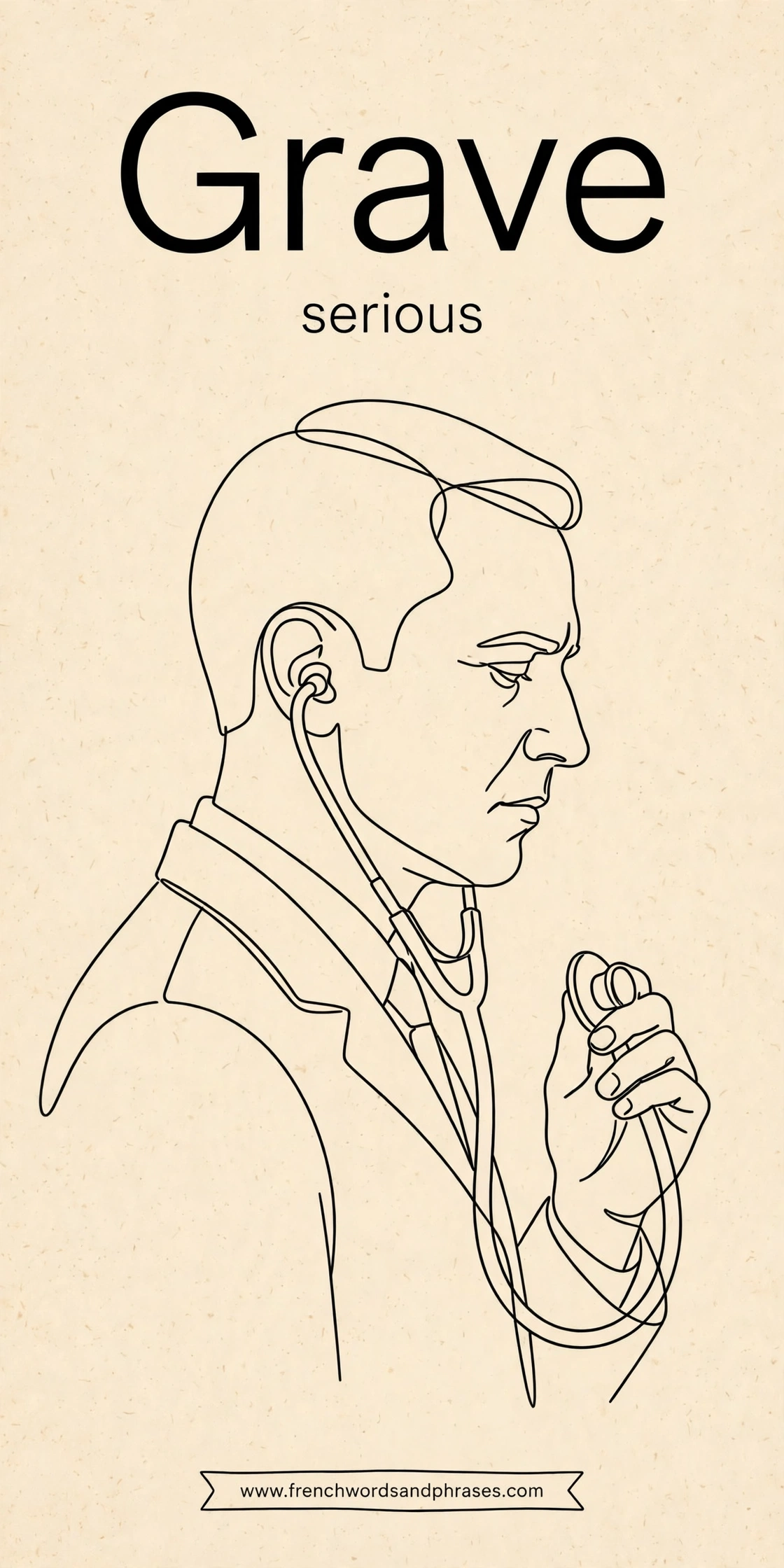
Grave means serious.
A hospital waiting room in Grenoble, three in the morning: a doctor comes through the double doors with a file in his hand, and the family stands before he has said a word. He chooses his first sentence the way a man crosses ice. « La situation est grave », he says, « mais nous avons encore des raisons d’espérer. » Serious — the word that lowers every voice in the room.
In this guide, you’ll learn what grave means in English, why it never changes between masculine and feminine, how it covers a serious problem, a low voice and an accent, and why it has nothing to do with the English word carved on a tombstone. Explore French examples, English translations, and practice quizzes.
Understanding the French Adjective Grave
Grave is a French adjective of quality — the adjective of weight and consequence. It already ends in -e, so masculine and feminine are identical: only the plural adds an s. Un problème grave, une maladie grave, des conséquences graves — one form does almost all the work.
It means serious — grave, weighty, giving cause for concern. It describes problems (un problème grave, a serious problem), illnesses (une maladie grave, a serious illness) and mistakes (une erreur grave, a grave error). The same word also means low and deep for a voice (une voix grave), and names the accent grave that leans over è, à and ù.
Type: Adjective of quality — seriousness and weight
Answers the question: What is it like? — serious
Changes form: Only in the plural — grave / graves, the same for masculine and feminine
English equivalents: Serious; grave; (of a voice) low, deep.
One important usage detail: grave stands AFTER the noun — un problème grave — and in everyday speech it softens the blow with a famous cushion: ce n’est pas grave, it’s not serious, never mind — the sentence France says a hundred times a day.
Experience the Word
Grave is the adjective of the lowered voice — of the doctor’s first sentence, the judge’s pause, the father who stops joking and sits down at the kitchen table.
Imagine a lighthouse keeper receiving, in the middle of a storm, the news that a ship has missed the channel. He does not panic; he lights the second lamp and notes the hour in the logbook, in the steady hand of a man who knows the difference between danger and drama. What he is facing is grave — and grave things, he knows, are met with calm, not noise.
You have not just described something important. You have said the consequences are real, and they are heavy.
How to Use Grave in French: Complete Guide
Let’s explore how grave works in French, beginning with the whole word on one card.
Grave at a Glance
Before the details, here is the whole word on one card.
The Whole Word on One Card
Meaning, type, position and forms — grave in four lines.
| Point | Grave |
|---|---|
| Meaning | serious |
| Type | adjective of quality — weight and consequence |
| Usual position | after the noun — un problème grave |
| Form | grave for everyone — graves in the plural |
Example
C’est un problème grave.
It’s a serious problem.
The Four Forms of Grave
Here is one of the easiest agreements in French: grave already ends in -e, so the feminine changes nothing. Only the plural adds an s.
| Form | Grave | Example |
|---|---|---|
| Masculine singular | grave | un problème grave — a serious problem |
| Feminine singular | grave | une maladie grave — a serious illness |
| Masculine plural | graves | des problèmes graves — serious problems |
| Feminine plural | graves | des maladies graves — serious illnesses |
Example
C’est un problème grave, pas une maladie grave.
It’s a serious problem, not a serious illness.
Quick Quiz 1
Does grave change for a feminine noun?
Reveal the answer
No
Un problème grave, une maladie grave — the form is identical.
A serious problem, a serious illness.
The Feminine of Grave: Nothing Changes
Most adjectives build their feminine by adding an e. Grave was born with one, so the feminine has nothing to add — a small holiday for learners.
| Situation | Example |
|---|---|
| Masculine | un accident grave — a serious accident |
| Feminine | une erreur grave — identical |
| Why | grave already ends in -e, so the feminine adds nothing |
| The plural | add s — des erreurs graves, serious mistakes |
Example
Cette erreur est grave pour l’entreprise.
This mistake is serious for the company.
Where Grave Goes: After the Noun
Grave follows the noun it describes, like most French adjectives, and it is perfectly at home after être — above all in its famous softening: ce n’est pas grave.
| Pattern | Example |
|---|---|
| After the noun | une blessure grave — a serious injury |
| After être | la situation est grave — the situation is serious |
| The cushion | ce n’est pas grave — it’s not serious, never mind |
| Before the noun | une grave blessure — literary emphasis, not everyday |
Example
Ne t’inquiète pas, ce n’est pas grave.
Don’t worry, it’s not serious.
Quick Quiz 2
How do you say ‘it’s not serious, never mind’?
Reveal the answer
ce n’est pas grave
Tu as cassé un verre ? Ce n’est pas grave.
You broke a glass? It’s not serious, never mind.
More Serious: Comparing with Grave
Grave compares the regular way, with plus, moins and aussi — and the superlative keeps the same single form: le plus grave, la plus grave.
| Degree | Example |
|---|---|
| As serious as | aussi grave que — as serious as |
| More serious | plus grave — more serious |
| Less serious | moins grave — less serious |
| The most serious (masc.) | le plus grave — le plus grave des problèmes |
| The most serious (fem.) | la plus grave — la plus grave des erreurs |
Example
Ce problème est plus grave que prévu.
This problem is more serious than expected.
Everyday Expressions with Grave
Grave moves between the hospital, the concert hall and the spelling lesson — one word for consequence, for low notes and for a little leaning accent.
| Expression | In English |
|---|---|
| ce n’est pas grave | it’s not serious, never mind — the everyday cushion |
| un problème grave | a serious problem |
| une voix grave | a low, deep voice |
| l’accent grave | the grave accent — è, à, ù |
| une maladie grave | a serious illness |
| d’une voix grave | in a grave, solemn voice |
Example
Il a annoncé la nouvelle d’une voix grave.
He announced the news in a grave voice.
Quick Quiz 3
What does une voix grave mean?
Reveal the answer
A low, deep voice
Le chanteur a une voix grave.
The singer has a deep voice — grave also means low for sounds.
Grave and Its Neighbours
Grave shares its heavy bench with sérieux and préoccupant; across the room, léger floats free of all consequence.
| French | In English |
|---|---|
| sérieux | serious — of people, work and matters |
| préoccupant | concerning, worrying — of situations |
| alarmant | alarming — a step beyond grave |
| dramatique | dramatic, dire — of consequences |
| léger | light, minor — the opposite, une blessure légère |
| sans gravité | not serious — literally, without gravity |
Example
Une situation préoccupante mais pas encore grave.
A concerning situation, but not yet serious.
Watch Out: The Traps Around Grave
The traps here are a tombstone in English, and a little accent that carries the same name.
| Trap | The truth |
|---|---|
| The English twin | English ‘a grave’ is a tomb — French grave is an adjective meaning serious or low; a tomb is une tombe |
| Three senses | grave means serious (un problème grave), low (une voix grave) and names l’accent grave — context decides |
| Agreement | do not add a second e — une maladie grave, never ‘gravée’ (that is engraved, from graver) |
| The cushion | ce n’est pas grave is the standard way to say ‘never mind’ — learn it as one block |
Example
Il parle d’une voix grave près de la tombe de son grand-père.
He speaks in a grave voice near his grandfather’s tomb.
Quick Quiz 4
How do you say ‘a tomb’ in French?
Reveal the answer
une tombe
Grave is the adjective — serious, low.
Un problème grave — a serious problem.
Grave in Everyday French: Real-Life Examples
Now that you know the word, let’s see how grave appears in everyday French.
Example 1 — Health
Le médecin dit que ce n’est pas grave.
The doctor says it isn’t serious.
Example 2 — A problem
Nous avons un problème grave au travail.
We have a serious problem at work.
Example 3 — Comfort
Tu as oublié ? Ce n’est pas grave.
You forgot? Never mind, it’s not serious.
Example 4 — Music
Il a une voix grave et douce.
He has a deep, soft voice.
Example 5 — News
L’accident était grave, heureusement sans victime.
The accident was serious, fortunately with no victim.
Example 6 — Spelling
Le è porte un accent grave.
The è carries a grave accent.
Beyond Translation: The Meaning of Grave
English says serious for the meaning of grave — and hides its own cousin in plain sight, since English ‘grave’ the adjective, a grave matter, is this very word. French simply kept it busier: grave weighs the problem, lowers the voice and leans, as an accent, over the letters è, à and ù, all with the same Latin root of heaviness — gravis, heavy, the root of gravity itself.
To call something grave is to say it has weight — and that the weight must be carried, not joked away.
And yet the word’s most frequent French sentence is its own antidote: ce n’est pas grave, said over broken glasses and missed trains, lifting the weight back off a hundred times a day.
How to Remember the French Adjective Grave
Remember it this way: Grave is the heavy adjective — one form for him and her, an s for the plural, and a famous cushion for when things are not grave at all.
- You see one form for everyone — un problème grave, une maladie grave.
- You learn the cushion as one block — ce n’est pas grave, never mind.
- You count the three lives — serious problem, low voice, and the accent grave on è.
The key idea is grave never changes except in the plural — serious, low-voiced, and not a tomb.
Test Your Knowledge of Grave
Let’s see how much you’ve learned. Try answering these questions before revealing the answers.
Question 1
What does grave mean?
Reveal the answer
Serious — grave, weighty, giving cause for concern; also low, of a voice.
Question 2
What is the feminine of grave?
Reveal the answer
grave — identical. The word already ends in -e.
Question 3
Translate: a serious problem.
Reveal the answer
Un problème grave.
Question 4
Complete the sentence:
Tu as cassé un verre ? Ce n’est pas ______ .
Reveal the answer
grave
Ce n’est pas grave.
It’s not serious — never mind.
Question 5
How do you say ‘a tomb’ in French?
Reveal the answer
une tombe — grave is the adjective, not the noun.
Your Final Challenge
Can You Use It?
How would you say this in French?
“Don’t worry, it’s not serious.”
Reveal the answer
Ne t’inquiète pas, ce n’est pas grave.
Don’t worry, it’s not serious.
A little French. A little curiosity. A richer everyday life.
LEARN FRENCH ONE WORD AT A TIME