A French Word to Live By
Translate Insolite to English
/ɛ̃sɔlit/
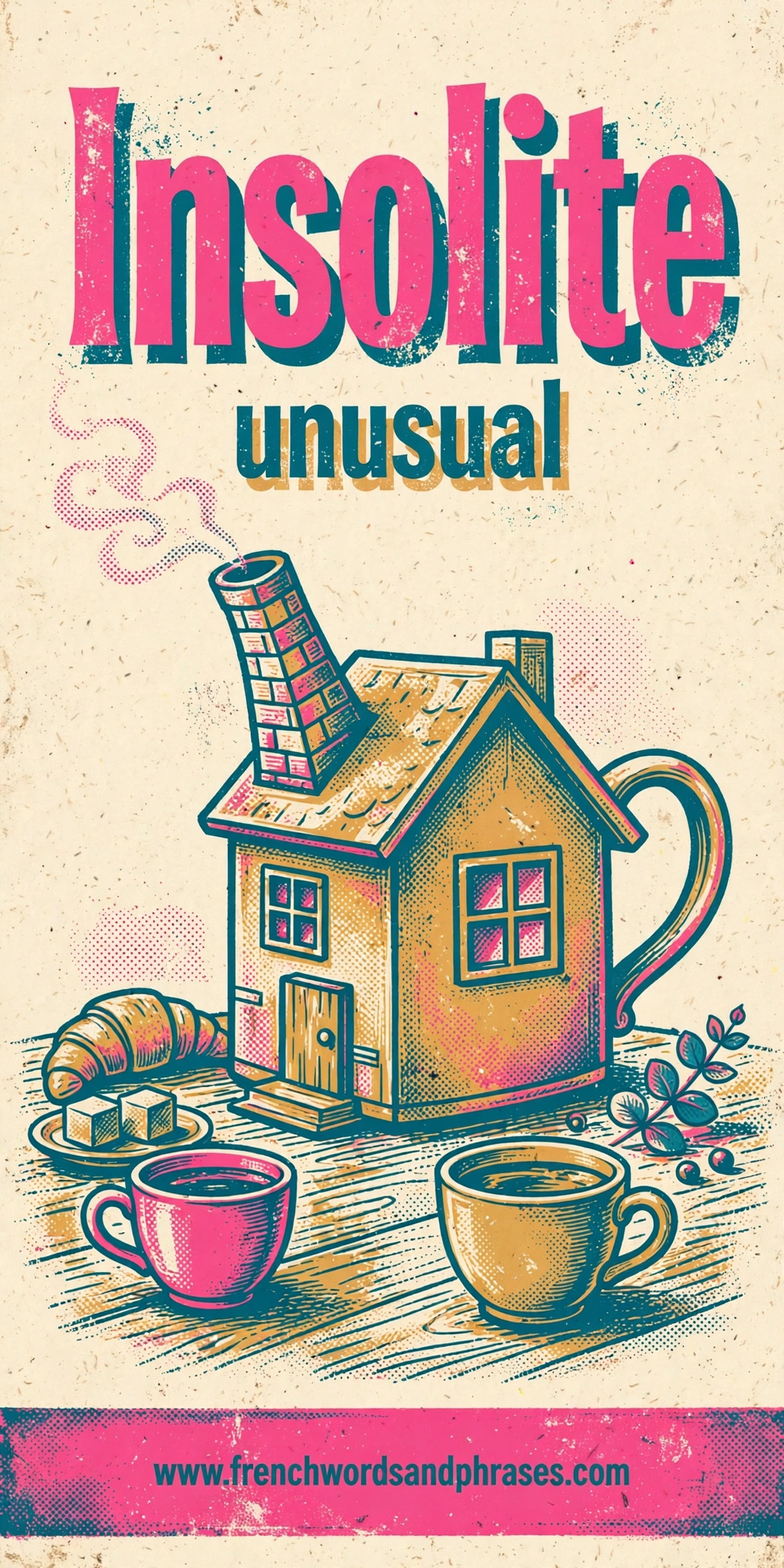
Insolite means unusual.
A railway station in the Massif Central, midwinter, and on the departures board between the trains for Clermont and Lyon there is one entry the stationmaster cannot explain: a sleigh, drawn by two white horses, waiting on platform three for passengers to the moon. He removes his cap, scratches his head, and writes in the logbook the only honest word available: insolite. Unusual. Profoundly unusual.
In this guide, you’ll learn what insolite means in English, why it never changes between masculine and feminine, how it differs from bizarre, and why travel writers and hoteliers have made it their favourite word of praise. Explore French examples, English translations, and practice quizzes.
Understanding the French Adjective Insolite
Insolite is a French adjective of quality — the adjective of the out-of-the-ordinary. It already ends in -e, so masculine and feminine are identical: only the plural adds an s. Un lieu insolite, une histoire insolite, des rencontres insolites — one form does almost all the work.
It means unusual — out of the ordinary, unexpected, not met with every day. It describes places (un lieu insolite, an unusual place), objects, experiences and encounters. Where bizarre tilts its head in puzzlement, insolite more often smiles: in modern French it is frequently a compliment, the word of guides to hidden places and remarkable stays.
Type: Adjective of quality — the out-of-the-ordinary
Answers the question: What is it like? — unusual
Changes form: Only in the plural — insolite / insolites, the same for masculine and feminine
English equivalents: Unusual; out of the ordinary; offbeat.
One important usage detail: insolite stands AFTER the noun — un lieu insolite — and it often carries approval: un hôtel insolite is not a complaint but an advertisement, a hotel in a lighthouse, a tree house, a converted chapel.
Experience the Word
Insolite is the adjective of the detour — of the museum in a water tower, the bookshop in a barge, the restaurant with four tables and no sign, that travellers cross a city to find.
Imagine a lighthouse keeper’s cottage turned into a tiny hotel, where the guests fall asleep to the turning of the light and wake to the gulls. Nothing about it is luxurious. Everything about it is insolite — and it is booked, every night, a year ahead.
You have not just described something strange. You have described something the ordinary world forgot to make — and that is why people seek it.
How to Use Insolite in French: Complete Guide
Let’s explore how insolite works in French, beginning with the whole word on one card.
Insolite at a Glance
Before the details, here is the whole word on one card.
The Whole Word on One Card
Meaning, type, position and forms — insolite in four lines.
| Point | Insolite |
|---|---|
| Meaning | unusual |
| Type | adjective of quality — out of the ordinary |
| Usual position | after the noun — un lieu insolite |
| Form | insolite for everyone — insolites in the plural |
Example
C’est un lieu insolite.
It’s an unusual place.
The Four Forms of Insolite
Here is one of the easiest agreements in French: insolite already ends in -e, so the feminine changes nothing. Only the plural adds an s.
| Form | Insolite | Example |
|---|---|---|
| Masculine singular | insolite | un lieu insolite — an unusual place |
| Feminine singular | insolite | une histoire insolite — an unusual story |
| Masculine plural | insolites | des lieux insolites — unusual places |
| Feminine plural | insolites | des histoires insolites — unusual stories |
Example
C’est un lieu insolite, plein d’histoires insolites.
It’s an unusual place, full of unusual stories.
Quick Quiz 1
Does insolite change for a feminine noun?
Reveal the answer
No
Un lieu insolite, une histoire insolite — the form is identical.
An unusual place, an unusual story.
The Feminine of Insolite: Nothing Changes
Most adjectives build their feminine by adding an e. Insolite was born with one, so the feminine has nothing to add — a small holiday for learners.
| Situation | Example |
|---|---|
| Masculine | un objet insolite — an unusual object |
| Feminine | une rencontre insolite — identical |
| Why | insolite already ends in -e, so the feminine adds nothing |
| The plural | add s — des rencontres insolites, unusual encounters |
Example
Cette rencontre insolite a changé son voyage.
This unusual encounter changed his trip.
Where Insolite Goes: After the Noun
Insolite follows the noun it describes, like most French adjectives, and it sits comfortably after être with an adverb in front of it.
| Pattern | Example |
|---|---|
| After the noun | un hôtel insolite — an unusual hotel |
| After être | ce quartier est insolite — this district is unusual |
| With an adverb | vraiment insolite — truly unusual |
| Before the noun | un insolite lieu — not in everyday French |
Example
Ils ont dormi dans un hôtel insolite, un ancien phare.
They slept in an unusual hotel, a former lighthouse.
Quick Quiz 2
How do you say ‘an unusual place’ — un insolite lieu or un lieu insolite?
Reveal the answer
un lieu insolite
Insolite stands after the noun.
An unusual place.
More Unusual: Comparing with Insolite
Insolite compares the regular way, with plus, moins and aussi — and the superlative keeps the same single form: le plus insolite, la plus insolite.
| Degree | Example |
|---|---|
| As unusual as | aussi insolite que — as unusual as |
| More unusual | plus insolite — more unusual |
| Less unusual | moins insolite — less unusual |
| The most unusual (masc.) | le plus insolite — le plus insolite des lieux |
| The most unusual (fem.) | la plus insolite — la plus insolite des histoires |
Example
Ce lieu est plus insolite que l’autre.
This place is more unusual than the other one.
Everyday Expressions with Insolite
Insolite is the travel writer’s darling — it fills guides to secret gardens, lighthouse hotels and restaurants without signs.
| Expression | In English |
|---|---|
| un lieu insolite | an unusual place — a hidden gem |
| un hôtel insolite | an unusual hotel — a lighthouse, a tree house |
| une expérience insolite | an unusual experience |
| une histoire insolite | an unusual story |
| un objet insolite | an unusual, curious object |
| une visite insolite | an offbeat visit, an unusual tour |
Example
Nous cherchons une visite insolite de Paris.
We’re looking for an offbeat tour of Paris.
Quick Quiz 3
Is un hôtel insolite a complaint or an advertisement?
Reveal the answer
An advertisement
It promises a night out of the ordinary.
Un hôtel insolite — a hotel in a lighthouse or a tree house.
Insolite and Its Neighbours
Insolite shares its hidden corner with bizarre and singulier; across the square, banal keeps everything reassuringly predictable.
| French | In English |
|---|---|
| bizarre | strange, odd — with a puzzled frown |
| singulier | distinctive, peculiar — the formal cousin |
| original | original, offbeat — praise for character |
| rare | rare — uncommon, the simpler neighbour |
| banal | banal, ordinary — the opposite |
| habituel | usual — the far opposite |
Example
Un lieu original et insolite, jamais banal.
An original, unusual place, never banal.
Watch Out: The Traps Around Insolite
The traps here are a smiling tone learners miss, and a sunburnt neighbour with a similar silhouette.
| Trap | The truth |
|---|---|
| Often praise | insolite frequently approves — un lieu insolite is a discovery, where bizarre would be a puzzle |
| insolation | une insolation is sunstroke — a different word that shares only the sun |
| Agreement | do not add a second e — une histoire insolite, never ‘insolitée’ |
| Strength | insolite says out of the ordinary; for the downright weird, French reaches for bizarre or étrange |
Example
Après cette visite insolite, attention à l’insolation !
After this unusual visit, watch out for sunstroke!
Quick Quiz 4
Which word means sunstroke — insolite or insolation?
Reveal the answer
insolation
Insolite means unusual.
Un lieu insolite — an unusual place.
Insolite in Everyday French: Real-Life Examples
Now that you know the word, let’s see how insolite appears in everyday French.
Example 1 — Travel
Nous avons trouvé un lieu insolite près du lac.
We found an unusual place near the lake.
Example 2 — A hotel
Ils dorment dans un hôtel insolite ce soir.
They’re sleeping in an unusual hotel tonight.
Example 3 — A story
Il m’a raconté une histoire insolite.
He told me an unusual story.
Example 4 — An object
Quel objet insolite sur cette étagère !
What an unusual object on this shelf!
Example 5 — An experience
C’était une expérience insolite et joyeuse.
It was an unusual and joyful experience.
Example 6 — A visit
La visite insolite commence à minuit.
The offbeat tour starts at midnight.
Beyond Translation: The Meaning of Insolite
English says unusual for the meaning of insolite — a plain, serviceable translation that misses the word’s modern French career. Insolite has become the badge of the anti-guidebook: the place that is not in the top ten, the hotel that is a lighthouse, the dinner served in the dark. It promises not luxury but singularity.
To call a place insolite is to recommend it precisely because it is like nowhere else.
That smile of approval separates it from bizarre, its puzzled neighbour: bizarre asks what on earth is happening, insolite books a table for it.
How to Remember the French Adjective Insolite
Remember it this way: Insolite is the out-of-the-ordinary adjective — one form for him and her, an s for the plural, and very often a smile of approval.
- You see one form for everyone — un lieu insolite, une histoire insolite.
- You hear the compliment — un hôtel insolite is an advertisement, not a warning.
- You keep the sun out of it — insolation is sunstroke, a different word entirely.
The key idea is insolite never changes except in the plural, and it often praises the unusual.
Test Your Knowledge of Insolite
Let’s see how much you’ve learned. Try answering these questions before revealing the answers.
Question 1
What does insolite mean?
Reveal the answer
Unusual — out of the ordinary, unexpected.
Question 2
What is the feminine of insolite?
Reveal the answer
insolite — identical. The word already ends in -e.
Question 3
Translate: an unusual place.
Reveal the answer
Un lieu insolite.
Question 4
Complete the sentence:
Nous avons dormi dans un hôtel ______ .
Reveal the answer
insolite
Nous avons dormi dans un hôtel insolite.
We slept in an unusual hotel.
Question 5
Is insolite usually praise or criticism?
Reveal the answer
Often praise — un lieu insolite is a hidden gem, a discovery.
Your Final Challenge
Can You Use It?
How would you say this in French?
“We found an unusual place near the lake.”
Reveal the answer
Nous avons trouvé un lieu insolite près du lac.
We found an unusual place near the lake.
A little French. A little curiosity. A richer everyday life.
LEARN FRENCH ONE WORD AT A TIME