A French Word to Live By
Translate Bizarre to English
/bizaʁ/
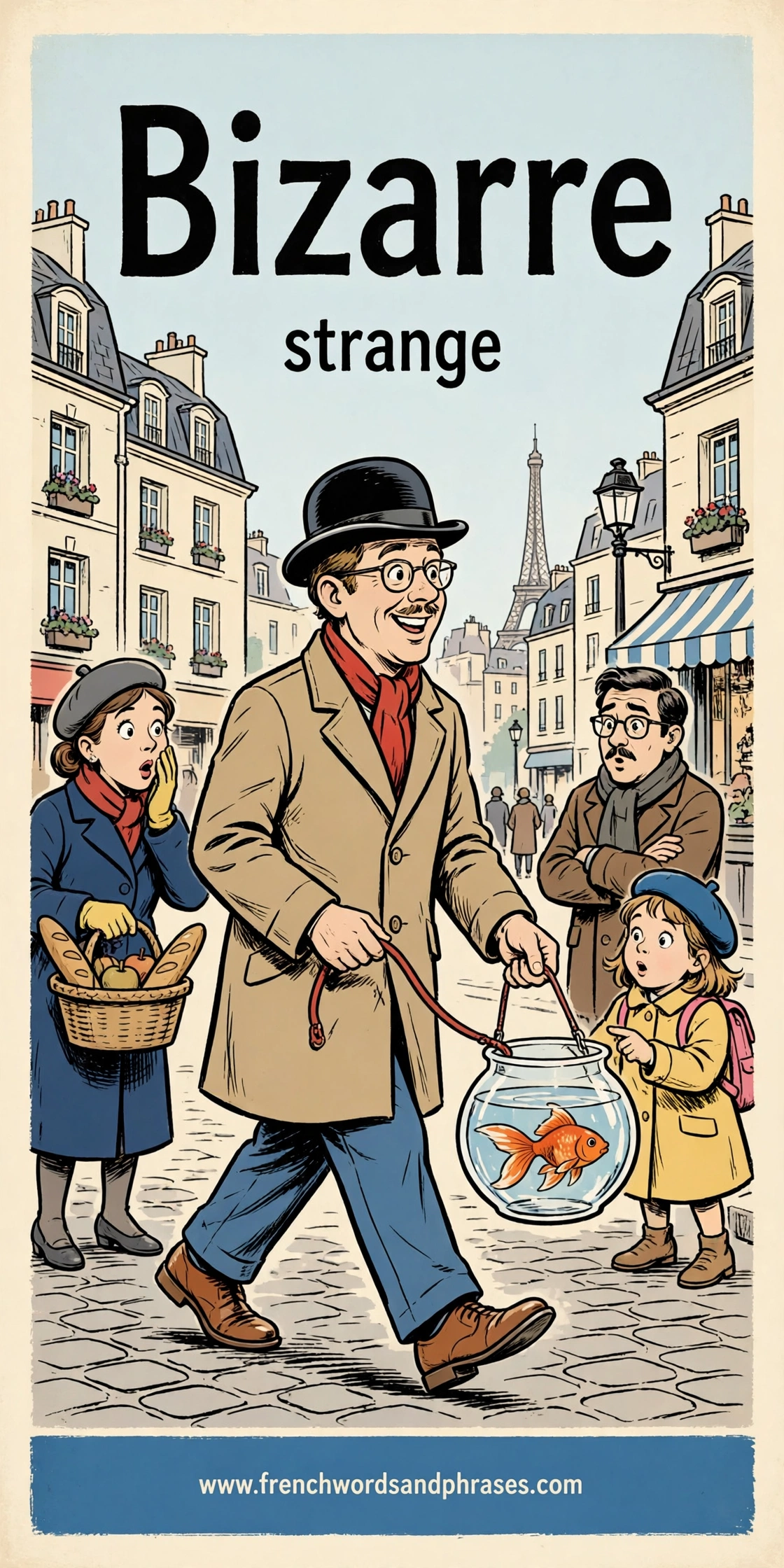
Bizarre means strange.
A village fête in August, the brass band resting between tunes, and a small crowd gathered around a travelling magician’s empty hat — from which, a moment ago, a live goldfish appeared in a glass of lemonade. The mayor’s wife leans towards her neighbour and delivers the verdict of the whole village in one soft word: « Bizarre… » Strange. Very strange indeed.
In this guide, you’ll learn what bizarre means in English, why it never changes between masculine and feminine, how the French word is gentler than its English cousin, and why a raised eyebrow so often says it before the mouth does. Explore French examples, English translations, and practice quizzes.
Understanding the French Adjective Bizarre
Bizarre is a French adjective of quality — the adjective of the odd and the unexpected. It already ends in -e, so masculine and feminine are identical: only the plural adds an s. Un bruit bizarre, une histoire bizarre, des coïncidences bizarres — one form does almost all the work.
It means strange — odd, peculiar, not quite as things should be. It describes noises (un bruit bizarre, a strange noise), behaviour (un comportement bizarre), stories and feelings (une sensation bizarre, a strange feeling). It is the everyday French word for oddity — curious and mildly puzzled, where English ‘bizarre’ sounds far more extreme.
Type: Adjective of quality — oddity and surprise
Answers the question: What is it like? — strange
Changes form: Only in the plural — bizarre / bizarres, the same for masculine and feminine
English equivalents: Strange; odd; peculiar.
One important usage detail: bizarre stands AFTER the noun — un bruit bizarre — and after être: c’est bizarre, it’s strange, is one of the most useful sentences in spoken French. Note the strength: French bizarre is an everyday ‘that’s odd’, much gentler than the English word.
Experience the Word
Bizarre is the adjective of the raised eyebrow — of the door found open that you closed, the song playing in an empty house, the cat watching a corner of the ceiling with total concentration.
Imagine a postman who has delivered to the same street for thirty years, stopping one morning outside number twelve, where a full-grown peacock is standing on the doorstep ringing, apparently, for admission. He looks at the bird. The bird looks at him. There is only one word for the whole encounter, and he says it to the empty street: bizarre.
You have not just described something unusual. You have said the world has tilted, just slightly, off its axis.
How to Use Bizarre in French: Complete Guide
Let’s explore how bizarre works in French, beginning with the whole word on one card.
Bizarre at a Glance
Before the details, here is the whole word on one card.
The Whole Word on One Card
Meaning, type, position and forms — bizarre in four lines.
| Point | Bizarre |
|---|---|
| Meaning | strange |
| Type | adjective of quality — oddity |
| Usual position | after the noun — un bruit bizarre |
| Form | bizarre for everyone — bizarres in the plural |
Example
C’est bizarre, cette histoire.
It’s strange, this story.
The Four Forms of Bizarre
Here is one of the easiest agreements in French: bizarre already ends in -e, so the feminine changes nothing. Only the plural adds an s.
| Form | Bizarre | Example |
|---|---|---|
| Masculine singular | bizarre | un bruit bizarre — a strange noise |
| Feminine singular | bizarre | une histoire bizarre — a strange story |
| Masculine plural | bizarres | des bruits bizarres — strange noises |
| Feminine plural | bizarres | des histoires bizarres — strange stories |
Example
C’est un bruit bizarre, dans une histoire bizarre.
It’s a strange noise, in a strange story.
Quick Quiz 1
Does bizarre change for a feminine noun?
Reveal the answer
No
Un bruit bizarre, une histoire bizarre — the form is identical.
A strange noise, a strange story.
The Feminine of Bizarre: Nothing Changes
Most adjectives build their feminine by adding an e. Bizarre was born with one, so the feminine has nothing to add — a small holiday for learners.
| Situation | Example |
|---|---|
| Masculine | un homme bizarre — a strange man |
| Feminine | une femme bizarre — identical |
| Why | bizarre already ends in -e, so the feminine adds nothing |
| The plural | add s — des coïncidences bizarres, strange coincidences |
Example
Elle a une façon bizarre de répondre.
She has a strange way of answering.
Where Bizarre Goes: After the Noun
Bizarre follows the noun it describes, like most French adjectives, and its favourite home of all is the little sentence c’est bizarre, it’s strange.
| Pattern | Example |
|---|---|
| After the noun | un bruit bizarre — a strange noise |
| After être | c’est bizarre — it’s strange |
| With an adverb | vraiment bizarre — really strange |
| Before the noun | un bizarre bruit — not in everyday French |
Example
C’est bizarre, je ne trouve plus mes clés.
It’s strange, I can’t find my keys any more.
Quick Quiz 2
How do you say ‘it’s strange’ in French?
Reveal the answer
c’est bizarre
C’est bizarre, cette porte est ouverte.
It’s strange, this door is open.
More Strange: Comparing with Bizarre
Bizarre compares the regular way, with plus, moins and aussi — and the superlative keeps the same single form: le plus bizarre, la plus bizarre.
| Degree | Example |
|---|---|
| As strange as | aussi bizarre que — as strange as |
| More strange | plus bizarre — stranger |
| Less strange | moins bizarre — less strange |
| The most strange (masc.) | le plus bizarre — le plus bizarre des bruits |
| The most strange (fem.) | la plus bizarre — la plus bizarre des histoires |
Example
Cette histoire est plus bizarre que l’autre.
This story is stranger than the other one.
Everyday Expressions with Bizarre
Bizarre is the word French reaches for a dozen times a day — for noises, coincidences, dreams and people who march to an unheard drum.
| Expression | In English |
|---|---|
| c’est bizarre | it’s strange, that’s odd — the everyday reaction |
| un bruit bizarre | a strange noise |
| une sensation bizarre | a strange feeling |
| un type bizarre | a strange fellow, an odd character |
| bizarre, bizarre | strange, strange — repeated, with a raised eyebrow |
| comme c’est bizarre | how strange, how odd |
Example
Comme c’est bizarre, il ne répond pas.
How strange, he isn’t answering.
Quick Quiz 3
What does un bruit bizarre mean?
Reveal the answer
A strange noise
J’ai entendu un bruit bizarre dans le jardin.
I heard a strange noise in the garden.
Bizarre and Its Neighbours
Bizarre shares its odd corner with étrange and curieux; across the room, normal leads its quiet, unexamined life.
| French | In English |
|---|---|
| étrange | strange — a touch more mysterious |
| curieux | curious, odd — un curieux personnage |
| singulier | distinctive, peculiar — the formal cousin |
| insolite | unusual — out of the ordinary |
| normal | normal — the opposite |
| ordinaire | ordinary — the far opposite |
Example
Un personnage curieux, vraiment bizarre.
A curious character, truly strange.
Watch Out: The Traps Around Bizarre
The traps here are the strength of the English cousin, and a market that shares the name.
| Trap | The truth |
|---|---|
| Stronger in English | English ‘bizarre’ suggests the wildly strange; French bizarre is the everyday word for ‘odd’ — do not over-translate it |
| Un bazar | un bazar is a bazaar, a market — and in slang, a mess; bizarre with two r’s is the adjective |
| Agreement | do not add a second e — une histoire bizarre, never ‘bizarrée’ |
| Spelling | two r’s — bizarre, in every form |
Example
Quel bazar ! Et ce bruit bizarre, tu l’entends ?
What a mess! And that strange noise, do you hear it?
Quick Quiz 4
Is French bizarre as strong as English ‘bizarre’?
Reveal the answer
No — it is gentler
C’est bizarre usually just means ‘that’s odd’.
It’s strange, this door is open — an everyday remark, not a sensation.
Bizarre in Everyday French: Real-Life Examples
Now that you know the word, let’s see how bizarre appears in everyday French.
Example 1 — At home
C’est bizarre, la porte est ouverte.
It’s strange, the door is open.
Example 2 — A noise
J’ai entendu un bruit bizarre cette nuit.
I heard a strange noise last night.
Example 3 — A feeling
J’ai une sensation bizarre ce matin.
I have a strange feeling this morning.
Example 4 — People
Notre nouveau voisin est un peu bizarre.
Our new neighbour is a bit strange.
Example 5 — A coincidence
Quelle coïncidence bizarre !
What a strange coincidence!
Example 6 — A story
Elle m’a raconté une histoire bizarre.
She told me a strange story.
Beyond Translation: The Meaning of Bizarre
English says strange for the meaning of bizarre — but learners should handle the two languages’ versions with different gloves. English ‘bizarre’ is a headline word, kept for the truly outlandish; French bizarre is a kitchen word, said over the fence, at the market, into the telephone, whenever the day produces something mildly inexplicable.
To say c’est bizarre is to tilt your head at the world, not to accuse it.
Noises, dreams, neighbours and goldfish in lemonade all receive the word with the same gentle puzzlement — and that mildness is exactly what makes it one of the most useful adjectives in spoken French.
How to Remember the French Adjective Bizarre
Remember it this way: Bizarre is the raised-eyebrow adjective — one form for him and her, an s for the plural, and a gentleness its English cousin does not share.
- You see one form for everyone — un bruit bizarre, une histoire bizarre.
- You tilt your head, not more — c’est bizarre means ‘that’s odd’, said softly.
- You spell the double r — bizarre, and keep un bazar, the market, next door.
The key idea is bizarre never changes except in the plural, and in French it is a gentle word.
Test Your Knowledge of Bizarre
Let’s see how much you’ve learned. Try answering these questions before revealing the answers.
Question 1
What does bizarre mean?
Reveal the answer
Strange — odd, peculiar, not as things should be.
Question 2
What is the feminine of bizarre?
Reveal the answer
bizarre — identical. The word already ends in -e.
Question 3
Translate: a strange noise.
Reveal the answer
Un bruit bizarre.
Question 4
Complete the sentence:
C’est ______ , je ne trouve plus mon téléphone.
Reveal the answer
bizarre
C’est bizarre, je ne trouve plus mon téléphone.
It’s strange, I can’t find my phone any more.
Question 5
How strong is French bizarre compared with English ‘bizarre’?
Reveal the answer
Gentler — it is the everyday word for ‘odd’, where English ‘bizarre’ suggests the wildly strange.
Your Final Challenge
Can You Use It?
How would you say this in French?
“It’s strange, I can’t find my keys any more.”
Reveal the answer
C’est bizarre, je ne trouve plus mes clés.
It’s strange, I can’t find my keys any more.
A little French. A little curiosity. A richer everyday life.
LEARN FRENCH ONE WORD AT A TIME