A French Word to Live By
Translate Fromage to English
/fʁɔ.maʒ/
Le fromage means the cheese.
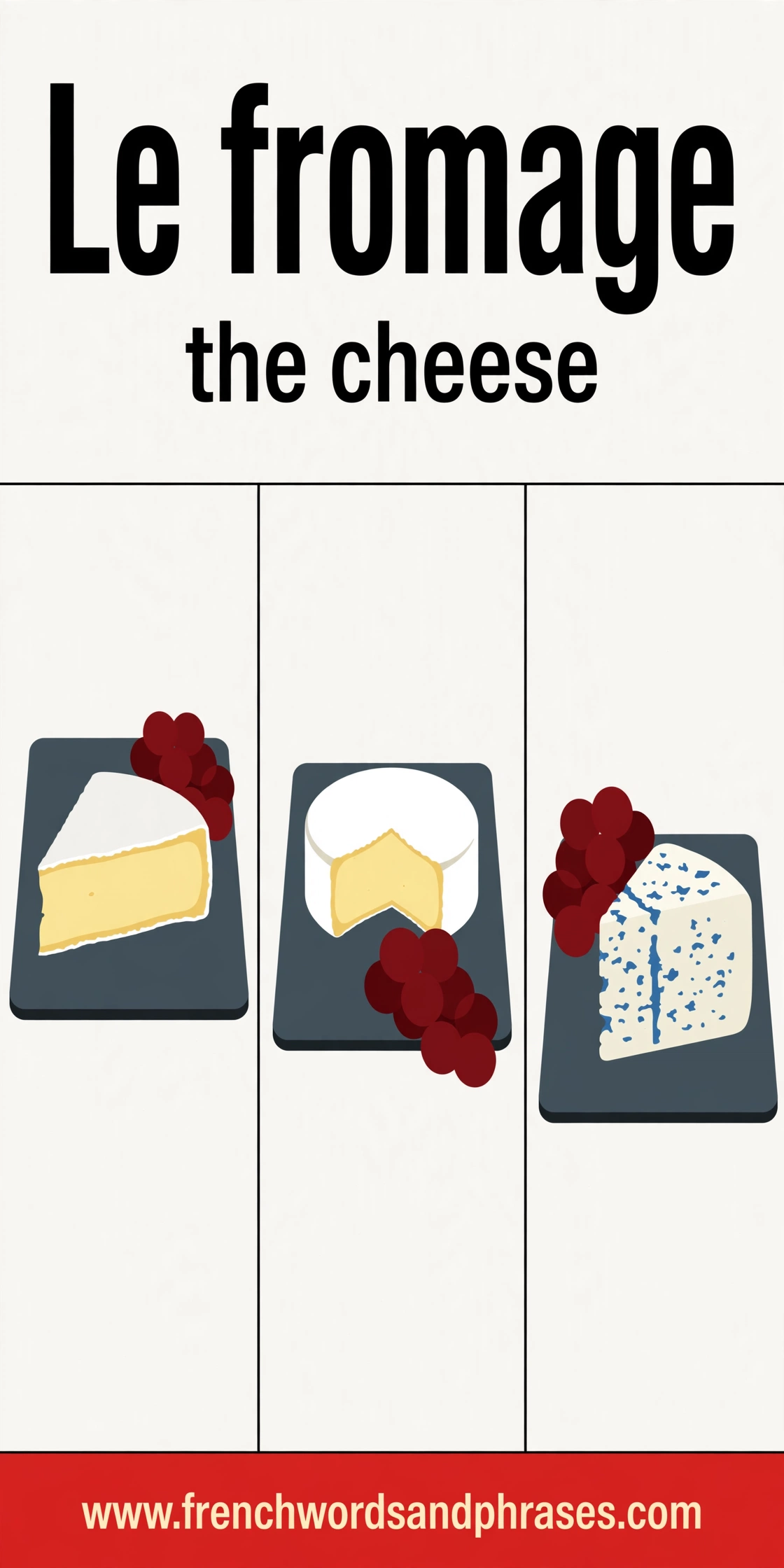
The main course is finished, the plates are cleared, and out comes the wooden board — a runny camembert, a wedge of blue, a golden slice of comté. The table falls quiet with respect: le fromage has arrived.
In this guide, you’ll learn what fromage means in English, how to use it with its articles, how to form its plural, and how it appears in everyday French. Explore French examples, English translations, and practice quizzes.
Understanding the French Noun Fromage
Fromage is a masculine French noun, learned with its article: le fromage, un fromage. Like pain, it is a mass noun at the table — for « some cheese », French uses the partitive du fromage — while un fromage is one whole cheese or one kind of cheese.
It means the cheese — the food France is proudest of, made from cow’s, goat’s or sheep’s milk and aged in a thousand ways. A French meal traditionally serves fromage between the main course and the dessert, and the choice is a serious matter: un fromage de chèvre (goat’s cheese), un fromage à pâte dure (a hard cheese), un fromage qui pue (a cheese that stinks — often a compliment).
Gender: Masculine
Definite article: le — le fromage (the cheese)
Indefinite article: un — un fromage (a cheese, one kind of cheese)
Partitive: du fromage — some cheese
Plural: les fromages — the cheeses, the kinds of cheese
English equivalents: The cheese.
One important usage detail: at the table, ask for du fromage (some cheese), but when you count kinds, use un: « il y a trois fromages sur le plateau », there are three cheeses on the board. And remember the French order of battle — the fromage comes before the dessert, never with it.
Experience the Word
Fromage is more than a food. It is a geography lesson you can eat — every region of France on one board, each village defending its own cheese as fiercely as its football team.
Imagine the fromagerie: rows of golden wheels and white pyramids, the rich smell of the cellar, and the fromager cutting you a sliver to taste before you choose.
You have not just eaten cheese. You have travelled — un tour de France on a wooden board.
How to Use Fromage in French: Complete Guide
Let’s explore how fromage works in French, beginning with its articles — du fromage for some, un fromage for a kind.
Fromage with the Definite Article (Le, Les)
Used for the cheese everyone means — the one on the board in front of you.
| Form | French |
|---|---|
| Masculine singular | le fromage |
| Plural | les fromages |
Example
Le fromage est servi avant le dessert.
The cheese is served before the dessert.
Fromage with the Indefinite Article (Un, Des)
Un fromage is one whole cheese, or one kind — the unit of the fromagerie’s shelf.
| Form | French |
|---|---|
| Masculine singular | un fromage |
| Plural | des fromages |
Example
Ce magasin vend un fromage de chèvre délicieux.
This shop sells a delicious goat’s cheese.
Fromage with the Partitive Article (Du)
For cheese as a substance — some cheese with your bread — French uses du fromage.
| Form | French |
|---|---|
| Some cheese | du fromage |
| No cheese (after a negative) | pas de fromage |
| A little cheese | un peu de fromage |
Example
Tu veux du fromage avec ton pain ?
Do you want some cheese with your bread?
Quick Quiz 1
At the table, you want some cheese. Complete the sentence:
Je prends ______, merci.
Reveal the answer
du fromage
Je prends du fromage, merci.
I’ll have some cheese, thanks — du, the partitive, for a portion.
The Plural of Fromage
Fromage adds an -s in the plural — les fromages, usually the different kinds on the board.
| Number | French |
|---|---|
| Singular | le fromage / un fromage |
| Plural | les fromages / des fromages |
Example
Les fromages de cette région sont célèbres.
The cheeses of this region are famous.
Fromage with Possessive Adjectives (Mon, Ton, Son…)
Possessives agree with the noun: fromage is masculine, so it takes mon, ton, son.
| Owner | French |
|---|---|
| my | mon fromage |
| your (tu) | ton fromage |
| his / her | son fromage |
| our | notre fromage |
| your (vous) | votre fromage |
| their | leur fromage |
Example
Mon fromage préféré est le comté.
My favourite cheese is Comté.
Quick Quiz 2
Complete the sentence:
Elle garde ______ fromage au réfrigérateur. (her)
Reveal the answer
son
Elle garde son fromage au réfrigérateur.
She keeps her cheese in the fridge.
Fromage with Demonstrative Adjectives (Ce, Ces)
Used to point: ce fromage, this cheese — the one you are tasting.
| Form | French |
|---|---|
| Masculine singular | ce fromage |
| Plural | ces fromages |
Example
Ce fromage est fort mais délicieux.
This cheese is strong but delicious.
Fromage with Adjectives
Adjectives agree with fromage: fort, doux, affiné — cheese talk is a whole vocabulary.
| Adjective | With Fromage |
|---|---|
| fort (strong) | un fromage fort |
| doux (mild) | un fromage doux |
| frais (fresh) | un fromage frais |
| affiné (matured, aged) | un fromage affiné |
| coulant (runny) | un fromage coulant |
Example
J’aime le fromage doux, pas trop fort.
I like mild cheese, not too strong.
Quick Quiz 3
Complete the sentence:
Ce camembert est un fromage très ______. (runny)
Reveal the answer
coulant
Ce camembert est un fromage très coulant.
This camembert is a very runny cheese — just as it should be.
Everyday Expressions with Fromage
Cheese boards and cheese courses — the fromage phrases of daily life.
| Expression | In English |
|---|---|
| le plateau de fromages | the cheese board |
| un morceau de fromage | a piece of cheese |
| du fromage râpé | grated cheese |
| le fromage blanc | a fresh white cheese, like a soft curd cheese |
| en faire tout un fromage | to make a huge fuss about nothing (informal) |
| entre la poire et le fromage | at the relaxed end of a meal, in casual chat |
Example
Le plateau de fromages arrive avant le dessert.
The cheese board arrives before the dessert.
Words from the Same Family as Fromage
Dairies, makers and milk — the words that travel with fromage.
| French | In English |
|---|---|
| la fromagerie | the cheese shop, the dairy |
| le fromager | the cheesemaker, the cheese seller (a man) |
| fromager (adjective) | cheese-making, dairy |
| le lait | the milk |
| le beurre | the butter |
| la crème | the cream |
Example
Le fromager nous fait goûter trois fromages.
The cheese seller lets us taste three cheeses.
Quick Quiz 4
What does « en faire tout un fromage » mean?
Reveal the answer
To make a huge fuss about nothing — literally, to make a whole cheese out of it.
Ce n’est pas grave, n’en fais pas tout un fromage !
It’s not serious, don’t make such a fuss about it!
Fromage in Everyday French: Real-Life Examples
Now that you know the word, let’s see how fromage appears in everyday French.
Example 1 — At the cheese shop
Je voudrais un morceau de ce fromage, s’il vous plaît.
I would like a piece of this cheese, please.
Example 2 — At the table
Tu reprends du fromage ?
Would you like some more cheese?
Example 3 — Talking about tastes
Mon fromage préféré est le roquefort.
My favourite cheese is Roquefort.
Example 4 — At the market
Ce fromage de chèvre vient d’une ferme voisine.
This goat’s cheese comes from a neighbouring farm.
Example 5 — Cooking
Mets du fromage râpé sur les pâtes.
Put some grated cheese on the pasta.
Example 6 — A strong smell
Ce fromage sent fort, mais il est excellent.
This cheese smells strong, but it is excellent.
Beyond Translation: The Meaning of Fromage
General de Gaulle is said to have despaired: « How can you govern a country that has two hundred and forty-six varieties of cheese? » The number has only grown — France counts hundreds upon hundreds of fromages, dozens protected by law, each tied to its village, its breed of cow or goat, its cellar. Cheese is not a food category in France; it is a map of the country itself.
To say fromage is to name France’s tastiest argument for diversity.
It evokes the hushed moment when the board arrives, the runny heart of a perfect camembert — and the national conviction that a meal without cheese is a meal unfinished.
How to Remember the French Noun Fromage
Remember it this way: Fromage is the cheese — masculine, counted by kinds (un fromage) and eaten by portions (du fromage).
- You point at a kind — un fromage de chèvre, un fromage fort.
- You take a portion — du fromage avec du pain.
- You keep calm — n’en fais pas tout un fromage, don’t make a fuss.
The key idea is le fromage, du fromage — the cheese, some cheese.
Test Your Knowledge of Fromage
Let’s see how much you’ve learned. Try answering these questions before revealing the answers.
Question 1
How do you ask for some cheese at the table?
Reveal the answer
Du fromage — the partitive: « Je prends du fromage, merci. »
Question 2
Is fromage masculine or feminine?
Reveal the answer
Masculine — le fromage, un fromage.
Question 3
Translate: My favourite cheese is Comté.
Reveal the answer
Mon fromage préféré est le comté.
Question 4
When is cheese served in a traditional French meal?
Reveal the answer
Before the dessert — the fromage course follows the main course.
Question 5
Complete the sentence:
Il y a trois ______ sur le plateau. (cheeses)
Reveal the answer
fromages
Il y a trois fromages sur le plateau.
There are three cheeses on the board.
Your Final Challenge
Can You Use It?
How would you say this in French?
“I would like some cheese with my bread.”
Reveal the answer
Je voudrais du fromage avec mon pain.
I would like some cheese with my bread.
A little French. A little curiosity. A richer everyday life.
LEARN FRENCH ONE WORD AT A TIME