A French Word to Live By
Translate Orange to English
/ɔʁɑ̃ʒ/
Orange means orange.
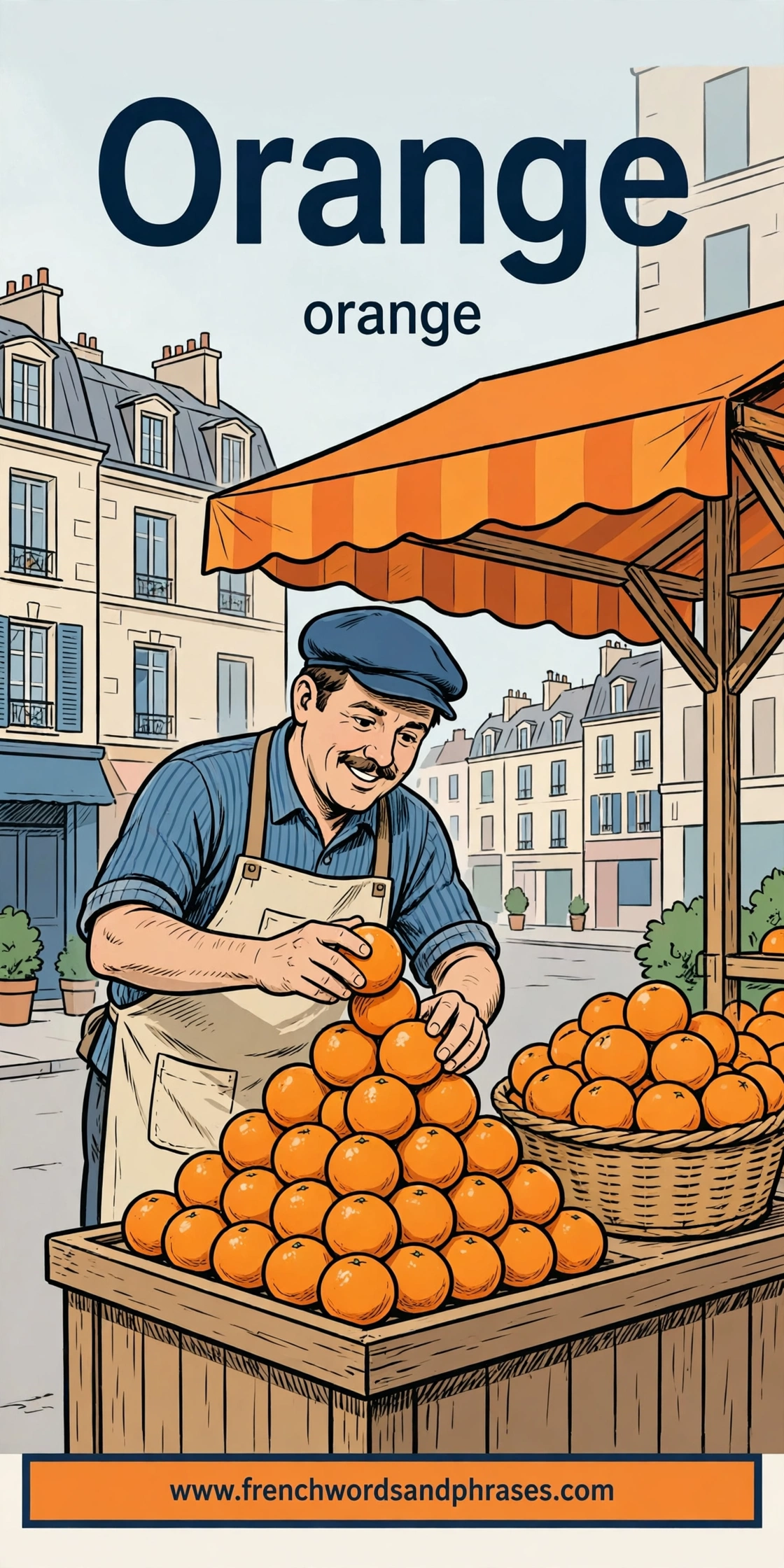
A market stall in the south in December: pyramids of oranges catching the winter sun, crates of carrots, a pot of marigolds by the till. One colour glows from every corner of the stall — the colour that, in French as in English, simply stole the fruit’s name: orange.
In this guide, you’ll learn what orange means in English, why this colour adjective never changes its form — not for feminine, not for plural — where it stands in the sentence, and how it travelled from a fruit to a colour. Explore French examples, English translations, and practice quizzes.
Understanding the French Adjective Orange
Orange is a French colour adjective — orange. It is INVARIABLE: it never changes its form. There is no feminine orange with an extra e and no plural oranges for the colour — un pull orange, une écharpe orange, des jupes orange, des rubans orange. One form does everything, because orange is really the name of a thing — the fruit — borrowed as a colour.
It means orange — the colour between red and yellow. It describes clothes (une robe orange, an orange dress), animals and flowers (un poisson orange, an orange fish; des fleurs orange, orange flowers) and warning signs across France, where orange is the colour of roadworks and high-visibility jackets (un gilet orange).
Type: Colour adjective — borrowed from a noun (the fruit)
Answers the question: What colour is it? — orange
Changes form: Never — orange is invariable: no feminine, no plural change
English equivalents: Orange.
One important usage detail: orange NEVER agrees — des robes orange, une écharpe orange, always orange, never oranges or orangée for the colour. It stands AFTER the noun. Colour adjectives taken from things (a fruit, a chestnut) keep the thing’s name unchanged, and orange is the classic example, alongside marron.
Experience the Word
Orange is the adjective of winter sun and market stalls — the loudest of the quiet colours, the one that glows at dawn, at dusk and on every roadworks sign in France.
Imagine a little goldfish circling a bowl on a child’s windowsill, catching the morning light each time it turns. The child has named it simply by its colour, and in French the name could dress a coat, a car or a sunset without changing a single letter.
You have not just named a colour. You have named the colour that refuses all grammar — one word, unchanged, for everything orange.
How to Use Orange in French: Complete Guide
Let’s explore how orange works in French, beginning with the whole word on one card.
Orange at a Glance
Before the details, here is the whole word on one card.
The Whole Word on One Card
Meaning, type, position and forms — orange in four lines.
| Point | Orange |
|---|---|
| Meaning | orange |
| Type | colour adjective — invariable |
| Usual position | after the noun — une robe orange |
| Form | orange — always, for every noun |
Example
Elle porte une robe orange.
She is wearing an orange dress.
The Four Forms of Orange: One Form for All
Here is the whole point of orange: there are not four forms. Masculine, feminine, singular, plural — the word stays exactly the same, because it is the name of a fruit doing duty as a colour.
| Form | Orange | Example |
|---|---|---|
| Masculine singular | orange | un pull orange — an orange jumper |
| Feminine singular | orange | une écharpe orange — an orange scarf |
| Masculine plural | orange | des pulls orange — orange jumpers |
| Feminine plural | orange | des robes orange — orange dresses |
Example
Il a un pull orange et elle a une écharpe orange.
He has an orange jumper and she has an orange scarf.
Quick Quiz 1
What is the feminine plural of orange?
Reveal the answer
orange
Des robes orange — orange never changes.
Orange dresses.
Orange Never Changes: The Invariable Colour
Say it plainly, because every learner tries to change it: orange has no feminine and no plural. Not oranges, not orangées — just orange, every time, for every noun.
| Situation | Example |
|---|---|
| The rule | orange is invariable — it never agrees |
| Not this | des robes oranges — wrong for the colour, no s |
| Not that either | une écharpe orangée — orangé exists but means ‘orangey-tinted’, not the plain colour |
| Why | orange is a noun (the fruit) used as a colour — borrowed words keep their form |
Example
Elle a une jupe orange et des rubans orange.
She has an orange skirt and orange ribbons.
Where Orange Goes: After the Noun
Orange follows the noun it describes, like most colour adjectives, and it sits comfortably after être. Shade words like clair and vif can follow it — and they do not make it agree either.
| Pattern | Example |
|---|---|
| After the noun | une robe orange — an orange dress |
| After être | ce poisson est orange — this fish is orange |
| With a shade | orange vif — bright orange |
| Before the noun | une orange robe — not in everyday French |
Example
Le poisson est orange et très rapide.
The fish is orange and very fast.
Quick Quiz 2
How do you say ‘orange dresses’ (robes is feminine plural)?
Reveal the answer
des robes orange
Orange is invariable — no s, no feminine, ever.
Orange dresses.
More Orange: Comparing with Orange
Orange compares with plus, moins and aussi like other adjectives — but even in the superlative it keeps its single form: le plus orange, la plus orange, les plus orange.
| Degree | Example |
|---|---|
| As orange as | aussi orange que — as orange as |
| More orange | plus orange — plus orange que l’autre |
| Less orange | moins orange — moins orange qu’avant |
| The most orange (masc.) | le plus orange — le plus orange des pulls |
| The most orange (fem.) | la plus orange — la plus orange des robes |
Example
Cette robe est plus orange que l’autre.
This dress is more orange than the other one.
Everyday Expressions with Orange
Orange begins life as a fruit, and the fruit is still there behind the colour — in juice, in marmalade and on the traffic lights of every French town.
| Expression | In English |
|---|---|
| une orange | an orange — the fruit behind the colour |
| un jus d’orange | an orange juice |
| le feu orange | the amber traffic light |
| un gilet orange | an orange high-visibility vest |
| orange vif | bright orange |
| la marmelade d’oranges | orange marmalade |
Example
Le feu orange arrive avant le feu rouge.
The amber light comes before the red light.
Quick Quiz 3
What is le feu orange?
Reveal the answer
The amber traffic light
Attention, le feu est orange !
Careful, the light is amber!
Orange and Its Neighbours
Orange sits between rouge and jaune, with marron — its fellow invariable — waiting at the earthy end of the family.
| French | In English |
|---|---|
| orange clair | light orange |
| orange vif | bright orange, vivid orange |
| abricot | apricot (colour) |
| corail | coral |
| marron | brown — the other famous invariable colour |
| jaune | yellow — the lighter neighbour |
Example
Elle hésite entre l’orange vif et le corail.
She is hesitating between bright orange and coral.
Watch Out: The Traps Around Orange
One trap towers over the others: the urge to make orange agree. Resist it — and keep the fruit and the colour in their own sentences.
| Trap | The truth |
|---|---|
| Agreement | orange never changes — des robes orange, une écharpe orange; ‘oranges’ belongs to the fruit, not the colour |
| The fruit | une orange is the fruit; the colour is the same word with no article trick — context decides |
| orangé | orangé means tinged with orange — un ciel orangé, an orange-tinted sky; it is not the plain colour word |
| Compounds | orange vif and orange clair stay invariable too |
Example
Elle mange une orange en portant une robe orange.
She is eating an orange while wearing an orange dress.
Quick Quiz 4
Which is correct — des robes oranges or des robes orange?
Reveal the answer
des robes orange
Orange is invariable — it never takes an s.
Orange dresses.
Orange in Everyday French: Real-Life Examples
Now that you know the word, let’s see how orange appears in everyday French.
Example 1 — Shopping
Je cherche un pull orange pour l’automne.
I’m looking for an orange jumper for the autumn.
Example 2 — A goldfish
Le poisson orange tourne dans son bocal.
The orange fish is circling in its bowl.
Example 3 — Breakfast
Elle boit un jus d’orange et mange une orange.
She drinks an orange juice and eats an orange.
Example 4 — On the road
Les ouvriers portent des gilets orange.
The workers are wearing orange vests.
Example 5 — Flowers
Ces fleurs orange sont magnifiques en été.
These orange flowers are magnificent in summer.
Example 6 — Sunset
Le ciel devient orange le soir sur la mer.
The sky turns orange in the evening over the sea.
Beyond Translation: The Meaning of Orange
English and French share a secret here: neither language had a word for this colour until the fruit arrived from Asia — both simply stole its name. Orange is a fruit first and a colour second, in Paris exactly as in London.
And that borrowed birth is exactly why orange never agrees in French.
French borrows colours from things more often than English does, and the borrowed ones — orange, marron — stand still while all the native adjectives around them change. Learn to spot them, and a whole corner of French grammar goes quiet.
How to Remember the French Adjective Orange
Remember it this way: Orange is the fruit-brown’s brighter cousin — invariable, always after the noun, always exactly the same word.
- You never change it — un pull orange, une robe orange, des robes orange.
- You remember why — orange is a fruit, a thing borrowed as a colour, and borrowed colours keep their form.
- You pair it with marron — the two famous invariables: des chaussures marron, des robes orange.
The key idea is orange is invariable — no feminine, no plural, ever.
Test Your Knowledge of Orange
Let’s see how much you’ve learned. Try answering these questions before revealing the answers.
Question 1
What does orange mean?
Reveal the answer
Orange — the colour between red and yellow.
Question 2
What is the feminine plural of orange?
Reveal the answer
orange — it is invariable; it never changes.
Question 3
Translate: orange dresses.
Reveal the answer
Des robes orange.
Question 4
Complete the sentence:
Elle porte une écharpe ______ .
Reveal the answer
orange
Elle porte une écharpe orange.
She is wearing an orange scarf.
Question 5
Why does orange never change?
Reveal the answer
Because it is a noun — the fruit — borrowed as a colour, and borrowed colour words keep their form.
Your Final Challenge
Can You Use It?
How would you say this in French?
“She is wearing an orange dress and orange ribbons.”
Reveal the answer
Elle porte une robe orange et des rubans orange.
She is wearing an orange dress and orange ribbons.
A little French. A little curiosity. A richer everyday life.
LEARN FRENCH ONE WORD AT A TIME