A French Word to Live By
Translate Printemps to English
/pʁɛ̃.tɑ̃/
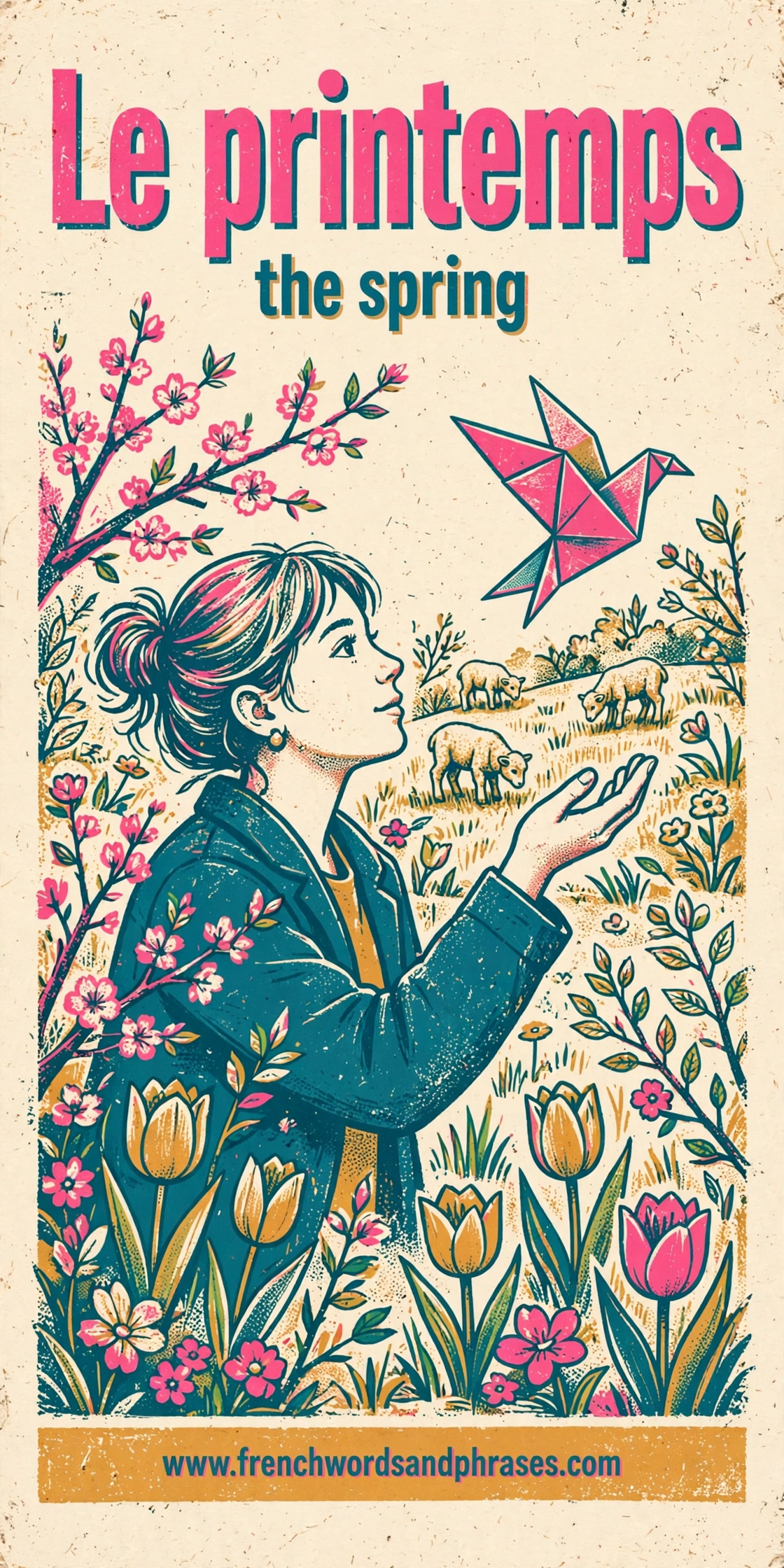
Le printemps means the spring.
The café terraces are filling up, the cherry trees along the avenue are white with blossom, and the market stalls smell of strawberries for the first time since last year. In France, this can only mean one thing — le printemps is here.
In this guide, you’ll learn what printemps means in English, how to use it with its articles, how to form its plural, and how it appears in everyday French. Explore French examples, English translations, and practice quizzes.
Understanding the French Noun Printemps
Printemps is a masculine French noun, learned with its article: le printemps, un printemps. The final -s is part of the word itself and is never pronounced — you say « prin-tan ». It comes from Latin primus tempus, « the first season », and it keeps that -s in the singular and the plural alike.
It means the spring — the season between l’hiver (winter) and l’été (summer), running from March to June. In France, printemps brings les fleurs (flowers), longer evenings, the first asparagus and strawberries at the market, and the great spring clean, le ménage de printemps.
Gender: Masculine
Definite article: le — le printemps (the spring)
Indefinite article: un — un printemps (a spring)
Plural: les printemps — the word already ends in -s and does not change
Key phrase: au printemps — in spring (never « en printemps »)
English equivalents: The spring; springtime.
One important usage detail: seasons take different little words. You say au printemps (in spring) but en été, en automne and en hiver. Printemps is the odd one out — learn « au printemps » as a single chunk and you will never hesitate.
Experience the Word
Printemps is more than a season. It is the moment France wakes up: shutters thrown open, gardens dug over, the first lunch eaten outside with your coat still on, just in case.
Imagine the countryside in April: lambs in the fields, swallows back under the eaves, and the light staying a little longer every single evening.
You have not just changed season. You have come back to life — le renouveau, the great renewal.
How to Use Printemps in French: Complete Guide
Let’s explore how printemps works in French, beginning with its articles — and its famous little phrase, au printemps.
Printemps with the Definite Article (Le, Les)
Used for the spring everyone is talking about — this year’s, last year’s.
| Form | French |
|---|---|
| Masculine singular | le printemps |
| Plural | les printemps |
Example
Le printemps arrive tôt cette année.
Spring is arriving early this year.
Printemps with the Indefinite Article (Un, Des)
Used for a spring in general — un printemps doux, a mild spring.
| Form | French |
|---|---|
| Masculine singular | un printemps |
| Plural | des printemps |
Example
Nous avons eu un printemps très pluvieux.
We had a very rainy spring.
The Four Seasons
Printemps and its three companions — learn the set together and the year is yours.
| French | In English |
|---|---|
| le printemps | the spring |
| l’été | the summer |
| l’automne | the autumn |
| l’hiver | the winter |
| la saison | the season |
| au printemps | in spring |
Example
Après l’hiver, le printemps est ma saison préférée.
After winter, spring is my favourite season.
Quick Quiz 1
Complete the sentence:
Les fleurs ouvrent ______ printemps.
Reveal the answer
au
Les fleurs ouvrent au printemps.
The flowers open in spring — au printemps, never « en printemps ».
The Plural of Printemps
Printemps already ends in -s, so the plural looks exactly the same — only the article changes.
| Number | French |
|---|---|
| Singular | le printemps |
| Plural | les printemps |
Example
Les printemps sont de plus en plus chauds.
Springs are getting hotter and hotter.
Printemps with Possessive Adjectives (Mon, Ton, Son…)
Possessives agree with the noun: printemps is masculine, so it takes mon, ton, son.
| Owner | French |
|---|---|
| my | mon printemps |
| your (tu) | ton printemps |
| his / her | son printemps |
| our | notre printemps |
| your (vous) | votre printemps |
| their | leur printemps |
Example
C’est mon premier printemps à Paris.
It is my first spring in Paris.
Quick Quiz 2
Complete the sentence:
______ printemps préféré est celui de l’année dernière. (My)
Reveal the answer
Mon
Mon printemps préféré est celui de l’année dernière.
My favourite spring is last year’s.
Printemps with Demonstrative Adjectives (Ce, Ces)
Used to point at a particular spring: ce printemps, this spring.
| Form | French |
|---|---|
| Masculine singular | ce printemps |
| Plural | ces printemps |
Example
Ce printemps, nous plantons des tomates au jardin.
This spring, we are planting tomatoes in the garden.
Printemps with Adjectives
Adjectives agree with printemps: doux, pluvieux, ensoleillé — springs have moods.
| Adjective | With Printemps |
|---|---|
| doux (mild) | un printemps doux |
| pluvieux (rainy) | un printemps pluvieux |
| ensoleillé (sunny) | un printemps ensoleillé |
| froid (cold) | un printemps froid |
| précoce (early) | un printemps précoce |
Example
Un printemps doux et ensoleillé commence cette semaine.
A mild, sunny spring begins this week.
Quick Quiz 3
Complete the sentence:
Nous avons un printemps très ______ cette année. (rainy)
Reveal the answer
pluvieux
Nous avons un printemps très pluvieux cette année.
We are having a very rainy spring this year.
Everyday Expressions with Printemps
Spring cleaning and spring fever — the printemps phrases of daily life.
| Expression | In English |
|---|---|
| au printemps | in spring |
| le ménage de printemps | the spring clean |
| les légumes de printemps | spring vegetables |
| un temps de printemps | spring-like weather |
| le printemps arrive | spring is coming |
| en plein printemps | in the middle of spring |
Example
Ce week-end, nous faisons le ménage de printemps.
This weekend, we are doing the spring clean.
Words from the Same Family as Printemps
Seasons, weather and new beginnings — the words that travel with printemps.
| French | In English |
|---|---|
| printanier | spring-like, of spring (an adjective) |
| la saison | the season |
| la fleur | the flower |
| fleurir | to flower, to bloom |
| le renouveau | the renewal |
| le temps | the weather; time |
Example
Une douceur printanière réchauffe la ville.
A spring-like mildness is warming the town.
Quick Quiz 4
What is le ménage de printemps?
Reveal the answer
The spring clean — the great annual tidy-up when the days get longer.
Le ménage de printemps commence samedi matin.
The spring clean starts on Saturday morning.
Printemps in Everyday French: Real-Life Examples
Now that you know the word, let’s see how printemps appears in everyday French.
Example 1 — At the market
Au printemps, les fraises arrivent sur les marchés.
In spring, strawberries arrive at the markets.
Example 2 — In the garden
Ce printemps, je plante des fleurs partout.
This spring, I am planting flowers everywhere.
Example 3 — Talking about the weather
Le printemps est doux cette année.
Spring is mild this year.
Example 4 — Making plans
Nous partons en vacances au printemps.
We are going on holiday in spring.
Example 5 — In the countryside
Les agneaux naissent au printemps.
The lambs are born in spring.
Example 6 — A fresh start
Au printemps, elle change de travail.
In spring, she is changing jobs.
Beyond Translation: The Meaning of Printemps
Printemps carries its history inside it: from Latin primus tempus, the first season, because the Roman year once began in March. The French kept the idea — spring as the true start of the year — and the language adds a poetic bonus: a person’s age can be counted in springs. « Elle a vingt printemps » — she has twenty springs — she is twenty years old.
To say printemps is to count life in flowers, not in winters.
It evokes the first terrace lunch and the open windows, the swallows returning and the light coming back — the season France greets like an old friend.
How to Remember the French Noun Printemps
Remember it this way: Printemps is the spring — masculine, with a silent final -s, and it pairs with au: au printemps, in spring.
- You name the season — le printemps, between l’hiver and l’été.
- You say when — au printemps, never « en printemps ».
- You count birthdays — vingt printemps, twenty springs, twenty years.
The key idea is le printemps — au printemps, in spring.
Test Your Knowledge of Printemps
Let’s see how much you’ve learned. Try answering these questions before revealing the answers.
Question 1
How do you say in spring in French?
Reveal the answer
Au printemps — printemps is the exception; the other seasons take en.
Question 2
Is printemps masculine or feminine?
Reveal the answer
Masculine — le printemps, un printemps.
Question 3
Translate: Spring is my favourite season.
Reveal the answer
Le printemps est ma saison préférée.
Question 4
What does « elle a vingt printemps » mean?
Reveal the answer
She is twenty years old — French can count a life in springs.
Question 5
Complete the sentence:
Les oiseaux reviennent ______ printemps.
Reveal the answer
au
Les oiseaux reviennent au printemps.
The birds come back in spring.
Your Final Challenge
Can You Use It?
How would you say this in French?
“The flowers open in spring.”
Reveal the answer
Les fleurs ouvrent au printemps.
The flowers open in spring.
A little French. A little curiosity. A richer everyday life.
LEARN FRENCH ONE WORD AT A TIME