
A French Word to Live By
How to Conjugate Zigzaguer in French
/ziɡ.za.ɡe/
Zigzaguer means to zigzag.
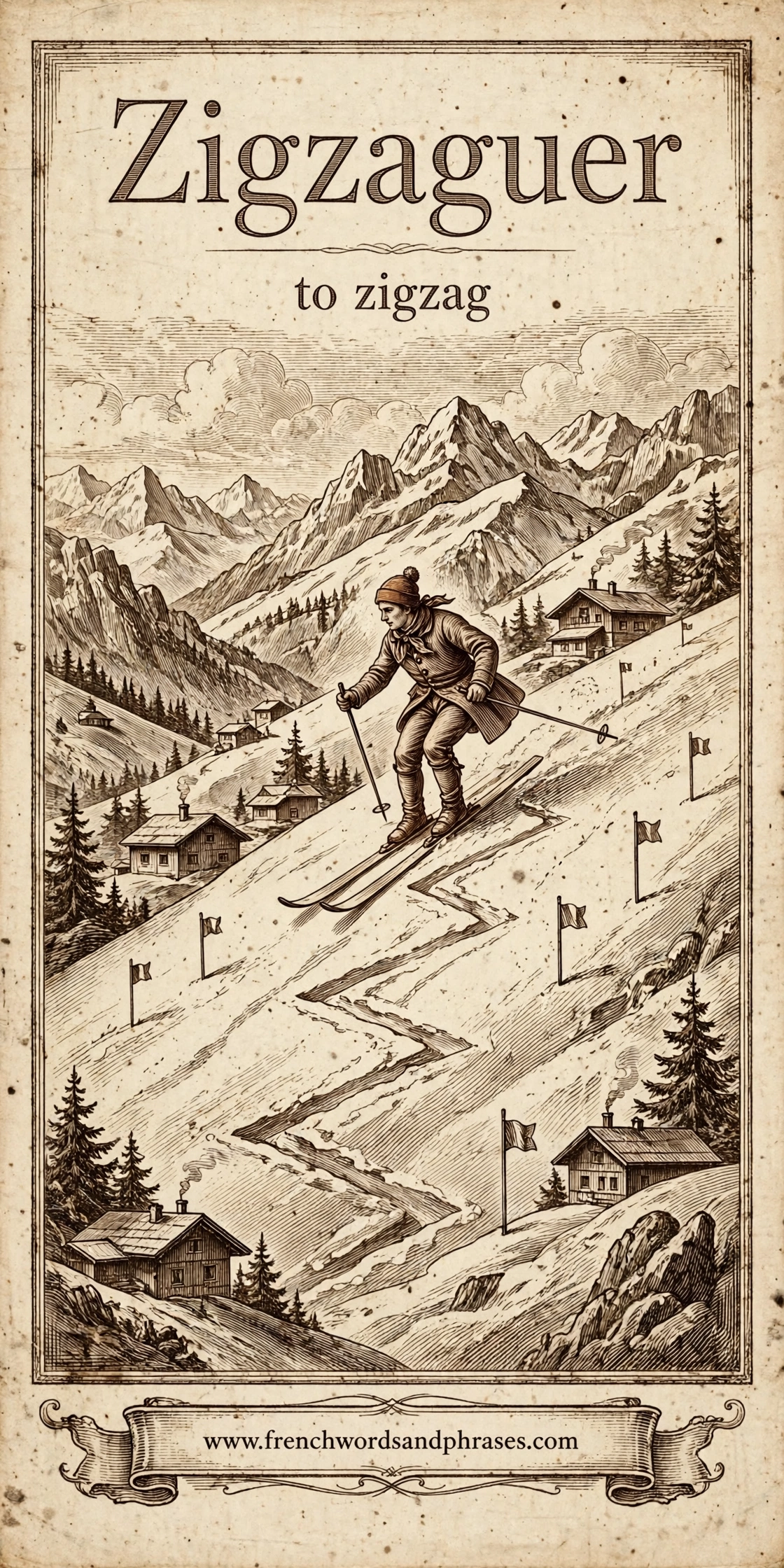
Down the slalom course, the skier snaps from gate to gate, never once travelling in a straight line. On the mountain road, the cyclist does the same around every hairpin bend, and in the field, the rabbit does it to stay alive. That sharp, back-and-forth movement is zigzaguer.
In this guide, you’ll learn how to conjugate zigzaguer in all the major French tenses and moods. Explore complete conjugation tables, French examples, English translations, and practice quizzes.
Understanding the French Verb Zigzaguer
Zigzaguer is a regular French verb belonging to the first group of verbs, those ending in -er.
It means to zigzag. It is commonly used for skiers weaving between the gates of a slalom, for cyclists climbing a road full of hairpin bends, for boats tacking against the wind, and for any animal — or person — dodging from side to side to escape or to avoid an obstacle.
Verb classification: First group (-er)
Auxiliary verb: Avoir
Past participle: zigzagué
Present participle: zigzaguant
English equivalents: To zigzag, to weave from side to side.
One important detail: zigzaguer keeps its u in every form. The stem is zigzagu-, and the u is there to keep the g hard before endings that begin with a or o: je zigzague, nous zigzaguons, ils zigzaguaient. Without the u, the g would soften. It takes avoir as its auxiliary verb in compound tenses: il a zigzagué (he zigzagged).
Experience the Word
Zigzaguer is more than changing direction. It is movement with a rhythm — left, right, left, right — a line that refuses to go straight.
Imagine the rabbit bursting out of the hedge with the fox a metre behind it. It does not run straight; it zigzags across the field, turning faster than its hunter, and every sharp turn buys it another second of life.
You have not just moved. You have dodged, woven, and escaped.
How to Conjugate Zigzaguer: Complete French Conjugation Guide
Let’s explore every major conjugation of zigzaguer, beginning with the indicative mood.
How to Conjugate Zigzaguer in the Indicative Mood
The indicative mood is used to express facts, observations, actions, and events.
How to Conjugate Zigzaguer in the Present Tense (Présent)
Used for actions happening now, habitual actions, and general truths.
| Subject | Conjugation |
|---|---|
| je | zigzague |
| tu | zigzagues |
| il / elle | zigzague |
| nous | zigzaguons |
| vous | zigzaguez |
| ils / elles | zigzaguent |
Example
Le skieur zigzague entre les portes du slalom.
The skier zigzags between the slalom gates.
Quick Quiz 1
Complete the sentence:
Nous ______ entre les cônes.
Reveal the answer
zigzaguons
Nous zigzaguons entre les cônes.
We are zigzagging between the cones.
How to Conjugate Zigzaguer in the Passé Composé
Used for completed actions in the past. Zigzaguer takes the auxiliary verb avoir.
| Subject | Conjugation |
|---|---|
| j’ | ai zigzagué |
| tu | as zigzagué |
| il / elle | a zigzagué |
| nous | avons zigzagué |
| vous | avez zigzagué |
| ils / elles | ont zigzagué |
Example
Le lapin a zigzagué à travers le champ pour échapper au renard.
The rabbit zigzagged across the field to escape the fox.
How to Conjugate Zigzaguer in the Imparfait (Imperfect Tense)
Used for habitual past actions, descriptions, and ongoing situations in the past.
| Subject | Conjugation |
|---|---|
| je | zigzaguais |
| tu | zigzaguais |
| il / elle | zigzaguait |
| nous | zigzaguions |
| vous | zigzaguiez |
| ils / elles | zigzaguaient |
Example
Le cycliste zigzaguait sur la route de montagne pour éviter les pierres.
The cyclist was zigzagging on the mountain road to avoid the stones.
Quick Quiz 2
Choose the correct form:
When we were children, we used to zigzag down the hill.
Quand nous étions enfants, nous ______ sur la colline.
Reveal the answer
zigzaguions
Quand nous étions enfants, nous zigzaguions sur la colline.
How to Conjugate Zigzaguer in the Plus-que-parfait
Used to describe an action that had already been completed before another past event.
| Subject | Conjugation |
|---|---|
| j’ | avais zigzagué |
| tu | avais zigzagué |
| il / elle | avait zigzagué |
| nous | avions zigzagué |
| vous | aviez zigzagué |
| ils / elles | avaient zigzagué |
Example
Le bateau avait zigzagué pendant une heure avant d’entrer dans le port.
The boat had zigzagged for an hour before entering the harbour.
How to Conjugate Zigzaguer in the Passé Simple
Primarily used in formal writing, literature, and historical narratives. It is rarely used in everyday conversation.
| Subject | Conjugation |
|---|---|
| je | zigzaguai |
| tu | zigzaguas |
| il / elle | zigzagua |
| nous | zigzaguâmes |
| vous | zigzaguâtes |
| ils / elles | zigzaguèrent |
Example
Le lièvre zigzagua entre les arbres et disparut.
The hare zigzagged between the trees and disappeared.
How to Conjugate Zigzaguer in the Passé Antérieur
A literary tense used to express an action completed immediately before another past action, generally in the passé simple.
| Subject | Conjugation |
|---|---|
| j’ | eus zigzagué |
| tu | eus zigzagué |
| il / elle | eut zigzagué |
| nous | eûmes zigzagué |
| vous | eûtes zigzagué |
| ils / elles | eurent zigzagué |
Example
Dès qu’il eut zigzagué derrière le rocher, le chasseur le perdit de vue.
As soon as it had zigzagged behind the rock, the hunter lost sight of it.
How to Conjugate Zigzaguer in the Future Tense (Futur Simple)
Used to describe actions that will take place in the future.
| Subject | Conjugation |
|---|---|
| je | zigzaguerai |
| tu | zigzagueras |
| il / elle | zigzaguera |
| nous | zigzaguerons |
| vous | zigzaguerez |
| ils / elles | zigzagueront |
Example
Demain, nous zigzaguerons sur les pistes dès l’ouverture.
Tomorrow, we will zigzag on the slopes as soon as they open.
How to Conjugate Zigzaguer in the Futur Antérieur (Future Perfect)
Used for an action that will have been completed before a particular point in the future.
| Subject | Conjugation |
|---|---|
| j’ | aurai zigzagué |
| tu | auras zigzagué |
| il / elle | aura zigzagué |
| nous | aurons zigzagué |
| vous | aurez zigzagué |
| ils / elles | auront zigzagué |
Example
À midi, elle aura déjà zigzagué sur toute la montagne.
By noon, she will already have zigzagged all over the mountain.
How to Conjugate Zigzaguer in the Near Future (Futur Proche)
Used to describe something that is going to happen soon. Formed with aller + infinitive.
| Subject | Conjugation |
|---|---|
| je | vais zigzaguer |
| tu | vas zigzaguer |
| il / elle | va zigzaguer |
| nous | allons zigzaguer |
| vous | allez zigzaguer |
| ils / elles | vont zigzaguer |
Example
Attention, le chien va zigzaguer entre les tables !
Watch out, the dog is going to zigzag between the tables!
How to Conjugate Zigzaguer in the Conditional Mood
The conditional mood expresses what would happen under certain circumstances. It is also frequently used to make polite requests or express wishes.
How to Conjugate Zigzaguer in the Present Conditional
| Subject | Conjugation |
|---|---|
| je | zigzaguerais |
| tu | zigzaguerais |
| il / elle | zigzaguerait |
| nous | zigzaguerions |
| vous | zigzagueriez |
| ils / elles | zigzagueraient |
Example
Je zigzaguerais plus vite si mes skis étaient neufs.
I would zigzag faster if my skis were new.
How to Conjugate Zigzaguer in the Past Conditional
| Subject | Conjugation |
|---|---|
| j’ | aurais zigzagué |
| tu | aurais zigzagué |
| il / elle | aurait zigzagué |
| nous | aurions zigzagué |
| vous | auriez zigzagué |
| ils / elles | auraient zigzagué |
Example
Le lapin aurait zigzagué plus tôt s’il avait vu le renard.
The rabbit would have zigzagged sooner if it had seen the fox.
Zigzaguer in the Literary Past Conditional Form
This less common literary form uses the imperfect subjunctive of avoir.
| Subject | Conjugation |
|---|---|
| j’ | eusse zigzagué |
| tu | eusses zigzagué |
| il / elle | eût zigzagué |
| nous | eussions zigzagué |
| vous | eussiez zigzagué |
| ils / elles | eussent zigzagué |
Example
Il eût zigzagué entre les rochers s’il avait osé.
He would have zigzagged between the rocks if he had dared.
How to Conjugate Zigzaguer in the Subjunctive Mood
The subjunctive is used to express wishes, emotions, doubts, necessity, and uncertainty. It frequently follows expressions such as il faut que (it is necessary that) or bien que (although).
How to Conjugate Zigzaguer in the Present Subjunctive
| Subject | Conjugation |
|---|---|
| que je | zigzague |
| que tu | zigzagues |
| qu’il / qu’elle | zigzague |
| que nous | zigzaguions |
| que vous | zigzaguiez |
| qu’ils / qu’elles | zigzaguent |
Example
Il faut que tu zigzagues entre les cônes pendant l’entraînement.
You need to zigzag between the cones during training.
Quick Quiz 3
Complete the sentence using the subjunctive:
Il faut que vous ______ entre les bouées.
Reveal the answer
zigzaguiez
Il faut que vous zigzaguiez entre les bouées.
You need to zigzag between the buoys.
How to Conjugate Zigzaguer in the Imperfect Subjunctive
A literary tense, rarely encountered in modern spoken French.
| Subject | Conjugation |
|---|---|
| que je | zigzaguasse |
| que tu | zigzaguasses |
| qu’il / qu’elle | zigzaguât |
| que nous | zigzaguassions |
| que vous | zigzaguassiez |
| qu’ils / qu’elles | zigzaguassent |
Example
Il voulait que le skieur zigzaguât plus près des portes.
He wanted the skier to zigzag closer to the gates.
How to Conjugate Zigzaguer in the Pluperfect Subjunctive
A literary construction used to express an action completed before another past action.
| Subject | Conjugation |
|---|---|
| que j’ | eusse zigzagué |
| que tu | eusses zigzagué |
| qu’il / qu’elle | eût zigzagué |
| que nous | eussions zigzagué |
| que vous | eussiez zigzagué |
| qu’ils / qu’elles | eussent zigzagué |
Example
Il regrettait que nous eussions zigzagué sur la route verglacée.
He regretted that we had zigzagged on the icy road.
How to Conjugate Zigzaguer in the Past Subjunctive
| Subject | Conjugation |
|---|---|
| que j’ | aie zigzagué |
| que tu | aies zigzagué |
| qu’il / qu’elle | ait zigzagué |
| que nous | ayons zigzagué |
| que vous | ayez zigzagué |
| qu’ils / qu’elles | aient zigzagué |
Example
Je suis content que tu aies zigzagué pour éviter le trou.
I am glad you zigzagged to avoid the hole.
How to Conjugate Zigzaguer in the Imperative
The imperative is used to give commands, instructions, invitations, or suggestions. Subject pronouns are omitted.
How to Conjugate Zigzaguer in the Present Imperative
| Person | Conjugation |
|---|---|
| (tu) | zigzague |
| (nous) | zigzaguons |
| (vous) | zigzaguez |
Example
Zigzague entre les plots, comme à l’entraînement !
Zigzag between the cones, just like in training!
Quick Quiz 4
How would you say Zigzag, using the tu form?
Reveal the answer
Zigzague !
French Participles of Zigzaguer
Participles are verb forms that can be used in compound tenses and other grammatical constructions.
Present Participle of Zigzaguer
zigzaguant
En zigzaguant, le cycliste a évité le nid-de-poule.
While zigzagging, the cyclist avoided the pothole.
Past Participle of Zigzaguer
zigzagué
Les enfants ont zigzagué dans la cour en criant.
The children zigzagged around the yard shouting.
Zigzaguer in Everyday French: Real-Life Examples
Now that you know the conjugations, let’s see how zigzaguer appears in everyday French.
Example 1 — Present
Le skieur zigzague entre les portes.
The skier zigzags between the gates.
Example 2 — Passé composé
Le lapin a zigzagué pour échapper au chien.
The rabbit zigzagged to escape the dog.
Example 3 — Imparfait
Nous zigzaguions sur la piste bleue.
We were zigzagging on the blue run.
Example 4 — Future
Le bateau zigzaguera entre les bouées.
The boat will zigzag between the buoys.
Example 5 — Conditional
Tu zigzaguerais sur cette pente raide ?
Would you zigzag on this steep slope?
Example 6 — Subjunctive
Bien qu’il zigzague vite, il reste prudent.
Although he zigzags fast, he stays careful.
Beyond Translation: The Meaning of Zigzaguer
English and French share this word almost unchanged, and it is easy to see why: zigzaguer looks like the thing it describes. The sharp z’s turn back on themselves, left, right, left, like the path of the skier or the fleeing rabbit.
A word shaped like its own meaning.
The noun came first — un zigzag, from the German Zickzack — and the verb followed: wherever a line refuses to go straight, French can say it zigzague. Roads, rivers, lightning and drunkards all zigzag in French, each in its own way.
How to Remember the French Verb Zigzaguer
Remember it this way: Zigzaguer is about moving in sharp turns, left then right, never in a straight line.
- You ski between the gates, turning left then right — you zigzaguez.
- You watch a rabbit flee across a field, changing direction at every bound — il zigzague.
- You ride down a mountain road full of hairpin bends — tu zigzagues.
The key idea is moving in sharp turns, left then right, never in a straight line.
Test Your Knowledge of Zigzaguer
Let’s see how much you’ve learned. Try answering these questions before revealing the answers.
Question 1
What auxiliary verb is used with zigzaguer in compound tenses?
Reveal the answer
Avoir
Question 2
How do you say I will zigzag in French?
Reveal the answer
Je zigzaguerai.
Question 3
Translate: The rabbit zigzagged across the field.
Reveal the answer
Le lapin a zigzagué à travers le champ.
Question 4
What is the past participle of zigzaguer?
Reveal the answer
Zigzagué.
Question 5
Complete the sentence:
Si la route était glissante, je ______ lentement.
Reveal the answer
zigzaguerais
Si la route était glissante, je zigzaguerais lentement.
If the road were slippery, I would zigzag slowly.
Your Final Challenge
Can You Use It?
How would you say this in French?
Tomorrow, I will zigzag between the slalom gates.
Reveal the answer
Demain, je zigzaguerai entre les portes du slalom.
Tomorrow, I will zigzag between the slalom gates.
A little French. A little curiosity. A richer everyday life.
LEARN FRENCH ONE WORD AT A TIME




