
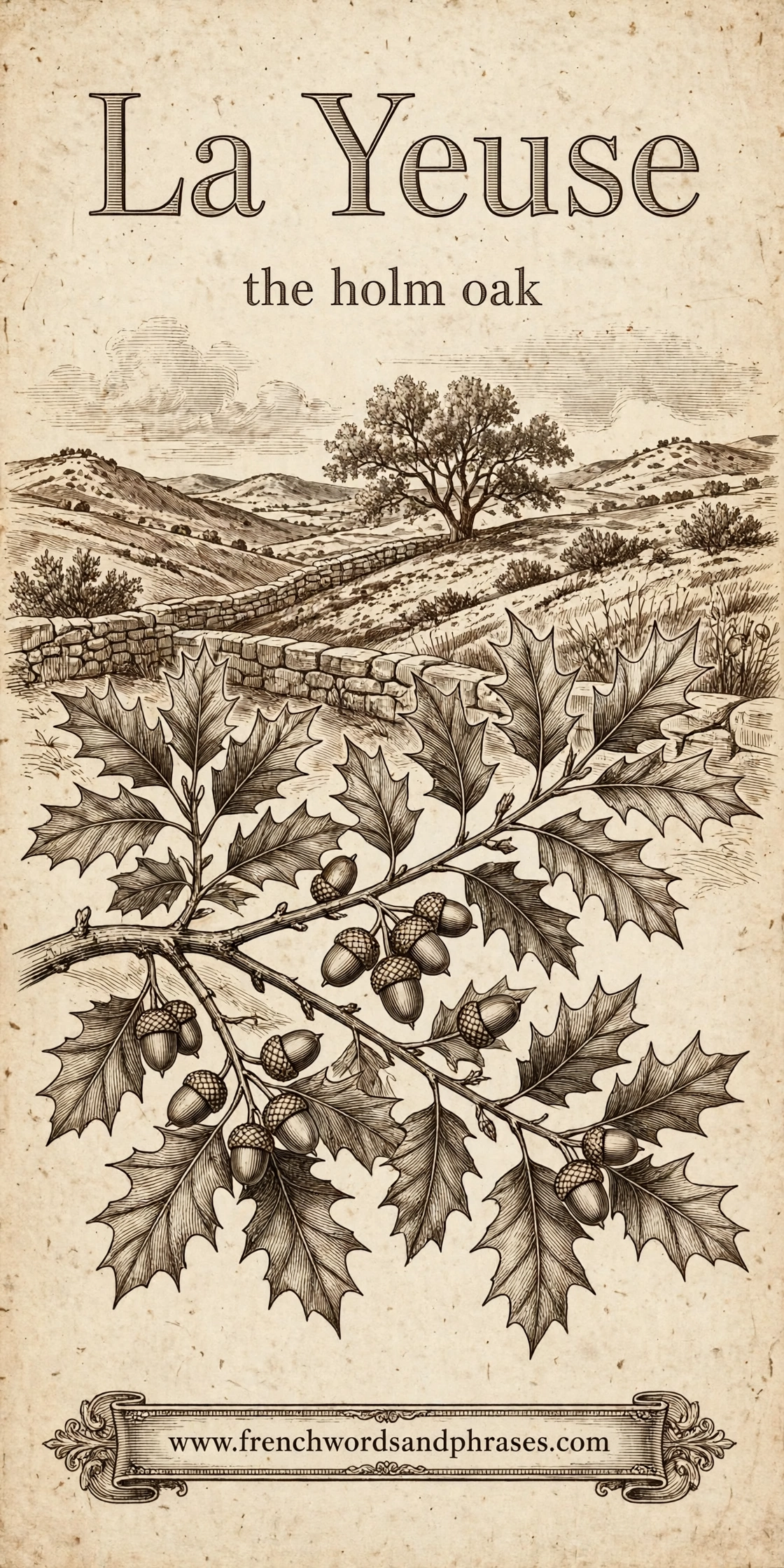
A French Word to Live By
Translate Yeuse to English
/jøz/
La yeuse means the holm oak.
On a white-hot afternoon in Provence, the square is empty except for one circle of deep, cool shade. Under the dark evergreen crown of la yeuse, the old men play pétanque as if the sun did not exist.
In this guide, you’ll learn what yeuse means in English, how to use it with its articles, how to form its plural, and how it appears in everyday French. Explore French examples, English translations, and practice quizzes.
Understanding the French Noun Yeuse
Yeuse is a feminine French noun. It is learned together with its article: la yeuse, une yeuse. It is the southern, botanical name of the tree most French speakers call le chêne vert.
It means the holm oak — the evergreen oak of the Mediterranean, better known to many as le chêne vert, and that synonym is the everyday name to learn alongside it. The yeuse keeps its dark leaves all year — les feuilles persistantes — drops its acorns, les glands, for pigs and wild boar, and stands in the dry scrub of le maquis and la garrigue, giving the shade every Provençal square depends on.
Gender: Feminine
Definite article: la — la yeuse (the holm oak)
Indefinite article: une — une yeuse (a holm oak)
Plural: les yeuses
English equivalents: The holm oak; the evergreen oak — usually le chêne vert.
One important usage detail: the tree has two names, and the gender changes with the name. Say la yeuse in the south and among botanists, but le chêne vert — masculine — almost everywhere else. Same tree, same shade: only the article tells you which name you are using.
Experience the Word
Yeuse is more than a tree. It is the roof of the Mediterranean summer — a dome of dark green that holds the cool of the morning until evening.
Imagine the garrigue at noon: cicadas shouting, stones white with heat, and under the yeuse a table, four chairs and a jug of water, all in a shade so deep it feels like a room.
You have not just named an oak. You have found the shade of Provence.
How to Use Yeuse in French: Complete Guide
Let’s explore how yeuse works in French, beginning with its articles.
Yeuse with the Definite Article (La, Les)
Used for the particular tree everyone knows — the one on the square, the one by the house.
| Number | French |
|---|---|
| Singular | la yeuse |
| Plural | les yeuses |
Example
La yeuse de la place a plus de cent ans.
The holm oak in the square is more than a hundred years old.
Yeuse with the Indefinite Article (Une, Des)
Used for one holm oak among others — planted, cut down or met on a walk.
| Number | French |
|---|---|
| Singular | une yeuse |
| Plural | des yeuses |
Example
Ils ont planté une yeuse devant la maison.
They planted a holm oak in front of the house.
The Yeuse in the Mediterranean Landscape
Evergreen leaves, acorns and scrub — the words of the dry southern hills.
| French | In English |
|---|---|
| le chêne vert | the holm oak (its everyday name) |
| les feuilles persistantes | the evergreen leaves |
| le gland | the acorn |
| le maquis | the maquis, dense Mediterranean scrub |
| l’ombre de la yeuse | the shade of the holm oak |
Example
Les glands tombent de la yeuse en automne.
The acorns fall from the holm oak in autumn.
Quick Quiz 1
What is the everyday name of la yeuse?
Reveal the answer
Le chêne vert — the name most French speakers use for the same tree.
Le chêne vert garde ses feuilles en hiver.
The holm oak keeps its leaves in winter.
The Plural of Yeuse
Yeuse adds an -s in the plural — les yeuses, the trees of a whole hillside.
| Number | French |
|---|---|
| Singular | la yeuse |
| Plural | les yeuses |
Example
Les yeuses couvrent les collines derrière le village.
The holm oaks cover the hills behind the village.
Yeuse with Possessive Adjectives (Ma, Ta, Sa…)
Possessives agree with the noun, not with the owner — and yeuse is feminine, so it takes ma, ta, sa.
| Owner | French |
|---|---|
| my | ma yeuse |
| your (tu) | ta yeuse |
| his / her | sa yeuse |
| our | notre yeuse |
| your (vous) | votre yeuse |
| their | leur yeuse |
Example
Sa yeuse donne de l’ombre à toute la terrasse.
Her holm oak shades the whole terrace.
Quick Quiz 2
Complete the sentence:
Nous déjeunons sous ______ yeuse, au frais.
Reveal the answer
notre
Nous déjeunons sous notre yeuse, au frais.
We have lunch under our holm oak, in the cool shade.
Yeuse with Demonstrative Adjectives (Cette, Ces)
Used to point: this holm oak here, those holm oaks there.
| Number | French |
|---|---|
| Singular | cette yeuse |
| Plural | ces yeuses |
Example
Cette yeuse est la plus vieille du village.
This holm oak is the oldest in the village.
Yeuse with Adjectives
Adjectives agree with yeuse, feminine — grande, vieille, touffue.
| Adjective | With Yeuse |
|---|---|
| grande (tall, big) | une grande yeuse |
| vieille (old) | une vieille yeuse |
| touffue (dense, bushy) | une yeuse touffue |
| méditerranéenne (Mediterranean) | la yeuse méditerranéenne |
| ombreuse (shady) | une yeuse ombreuse |
Example
Une vieille yeuse ombrage la fontaine.
An old holm oak shades the fountain.
Quick Quiz 3
Complete the sentence:
Une ______ yeuse se dresse devant l’église. (old)
Reveal the answer
vieille
Une vieille yeuse se dresse devant l’église.
An old holm oak stands in front of the church.
Everyday Expressions with Yeuse
Under the tree and on the hills, these are the yeuse phrases of the south.
| Expression | In English |
|---|---|
| à l’ombre de la yeuse | in the shade of the holm oak |
| planter une yeuse | to plant a holm oak |
| les glands de la yeuse | the acorns of the holm oak |
| une allée de yeuses | an avenue of holm oaks |
| le bois de yeuse | holm oak wood |
| sous la yeuse | under the holm oak |
Example
On se retrouve à l’ombre de la yeuse, comme toujours.
We meet in the shade of the holm oak, as always.
Words from the Same Family as Yeuse
Oaks, scrub and southern trees — the words that travel with yeuse in the landscape.
| French | In English |
|---|---|
| le chêne | the oak |
| le chêne vert | the holm oak |
| le gland | the acorn |
| la garrigue | the garrigue, dry scrubland |
| le maquis | the maquis |
| le pin | the pine |
Example
Le pin et la yeuse dominent la garrigue.
The pine and the holm oak dominate the garrigue.
Quick Quiz 4
Why is the yeuse also called le chêne vert, the green oak?
Reveal the answer
Because it keeps its green leaves all year — its leaves are persistantes, evergreen.
La yeuse ne perd pas ses feuilles en hiver.
The holm oak does not lose its leaves in winter.
Yeuse in Everyday French: Real-Life Examples
Now that you know the word, let’s see how yeuse appears in everyday French.
Example 1 — In the village
La yeuse de la place est le rendez-vous de tout le monde.
The holm oak in the square is everyone’s meeting place.
Example 2 — At lunch
Nous déjeunons à l’ombre de la yeuse.
We have lunch in the shade of the holm oak.
Example 3 — On a walk
Le sentier passe entre les yeuses et les pins.
The path runs between the holm oaks and the pines.
Example 4 — In autumn
Les cochons mangent les glands tombés des yeuses.
The pigs eat the acorns fallen from the holm oaks.
Example 5 — Talking trees
La yeuse pousse lentement mais vit très longtemps.
The holm oak grows slowly but lives a very long time.
Example 6 — At home
Devant la maison, une grande yeuse nous protège du soleil.
In front of the house, a big holm oak protects us from the sun.
Beyond Translation: The Meaning of Yeuse
The yeuse is the signature tree of the Mediterranean south — in the maquis of Corsica, the garrigue of Languedoc, the squares of Provence — and its hard, dense wood once made charcoal and tool handles for whole villages.
To say yeuse is to step out of the sun.
It evokes cicadas and white dust, pétanque under a green dome, the long patience of a tree that was old before the village fountain was built — and a name, yeuse, that carries the south in a single syllable.
How to Remember the French Noun Yeuse
Remember it this way: Yeuse is the holm oak — feminine, with la and une, and its everyday name is le chêne vert.
- You learn both names — la yeuse au sud, le chêne vert partout.
- You find the shade — on déjeune à l’ombre de la yeuse.
- You spot the leaves — les feuilles persistantes, vertes toute l’année.
The key idea is la yeuse is le chêne vert, the evergreen oak.
Test Your Knowledge of Yeuse
Let’s see how much you’ve learned. Try answering these questions before revealing the answers.
Question 1
Is yeuse masculine or feminine?
Reveal the answer
Feminine — la yeuse, une yeuse.
Question 2
What is the everyday name of la yeuse?
Reveal the answer
Le chêne vert — masculine, so the article changes with the name.
Question 3
Translate: We have lunch in the shade of the holm oak.
Reveal the answer
Nous déjeunons à l’ombre de la yeuse.
Question 4
What are les glands?
Reveal the answer
The acorns — the fruit of the oak, eaten by pigs and wild boar.
Question 5
Complete the sentence:
______ yeuse de la place a cent ans. (The)
Reveal the answer
La
La yeuse de la place a cent ans.
The holm oak in the square is a hundred years old.
Your Final Challenge
Can You Use It?
How would you say this in French?
“We have lunch in the shade of the holm oak.”
Reveal the answer
Nous déjeunons à l’ombre de la yeuse.
We have lunch in the shade of the holm oak.
A little French. A little curiosity. A richer everyday life.
LEARN FRENCH ONE WORD AT A TIME




