A French Word to Live By
Translate Voile to English
/vwal/
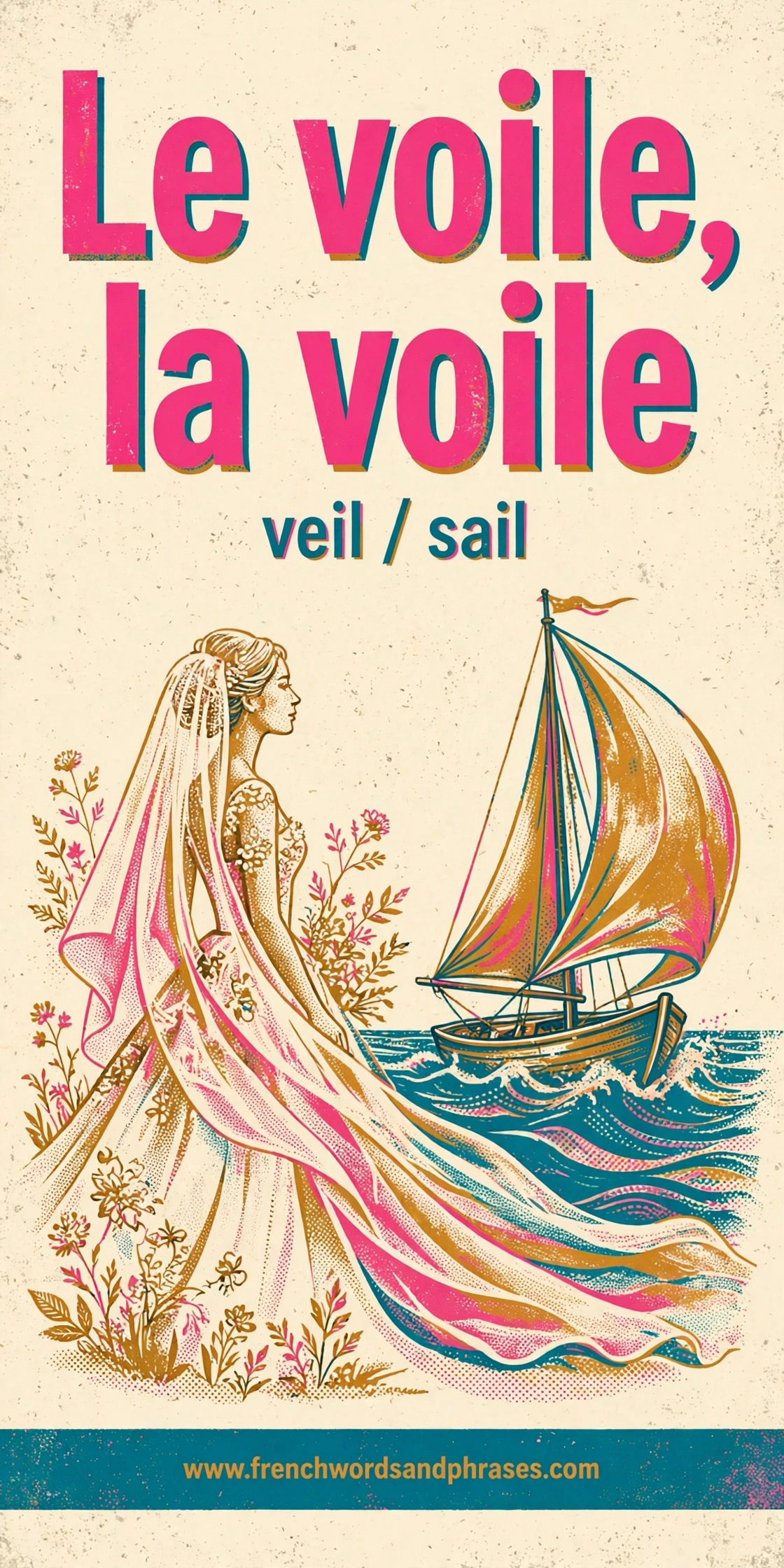
Le voile means veil — but la voile means sail.
Morning in a Breton harbour. A bride in a white veil walks past the quay on her way to the church, while behind her a dozen white sails are already filling with wind: le voile on her head, la voile on the water. One word, two worlds — and only the article tells them apart.
In this guide, you’ll learn what voile means in English, how to use it with its articles, how to form its plural, and how it appears in everyday French. Explore French examples, English translations, and practice quizzes.
Understanding the French Noun Voile
Voile is one of French’s famous two-gender nouns: it exists in both genders, and the article changes the meaning completely. Masculine, le voile is a veil — the cloth that covers a face or a head. Feminine, la voile is a sail — the canvas that catches the wind on a boat. Learn the article with the meaning, every time.
It means a veil when it is masculine: le voile de la mariée (the bride’s veil), a veil worn over the hair, or even a thin veil of mist over the fields. It means a sail when it is feminine: la voile du bateau (the boat’s sail), hisser la voile (to hoist the sail) — and the whole sport of sailing is simply la voile: faire de la voile, to go sailing.
Gender: Both — masculine and feminine, with different meanings
Definite article: le — le voile (the veil); la — la voile (the sail)
Indefinite article: un — un voile (a veil); une — une voile (a sail)
Plural: les voiles (the veils / the sails)
English equivalents: Masculine: the veil. Feminine: the sail; sailing.
One important usage detail: the feminine has a famous verb phrase — faire de la voile means to go sailing, and un bateau à voile is a sailing boat. The masculine has a detective’s phrase instead: lever le voile sur quelque chose, to lift the veil on something — to reveal a secret.
Experience the Word
Voile is a single cloth living two lives. On land it hides and protects; at sea it opens wide and pulls a boat across the water.
Imagine the same harbour at noon: the wedding is over, the veil is folded away, and the bride — still in her dress — is climbing into a little boat, hand on the rope, ready to hoist la voile and disappear towards the islands.
You have not just learned a word. You have learned to ask the article before you trust the meaning.
How to Use Voile in French: Complete Guide
Let’s explore how voile works in French — beginning with the article, because here the article is everything.
Voile with the Definite Article (Le, La, Les)
One word, two articles, two meanings: le for the veil, la for the sail.
| Gender | French |
|---|---|
| Masculine | le voile — the veil |
| Feminine | la voile — the sail |
| Plural | les voiles — the veils / the sails |
Example
La voile du petit bateau est rouge et blanche.
The sail of the little boat is red and white.
Voile with the Indefinite Article (Un, Une, Des)
Un voile is something you wear; une voile is something you hoist.
| Gender | French |
|---|---|
| Masculine | un voile — a veil |
| Feminine | une voile — a sail |
| Plural | des voiles — veils / sails |
Example
Elle porte un voile léger sur les cheveux.
She wears a light veil over her hair.
Le Voile or La Voile? The Two Meanings Side by Side
The same word in its two worlds — the wedding and the harbour.
| French | In English |
|---|---|
| le voile de la mariée | the bride’s veil |
| un voile de brume | a veil of mist |
| la voile du bateau | the boat’s sail |
| un bateau à voile | a sailing boat |
| faire de la voile | to go sailing |
| hisser la voile | to hoist the sail |
Example
Le dimanche, ils font de la voile près de l’île.
On Sundays, they go sailing near the island.
Quick Quiz 1
You are on a boat and the captain shouts: « Hissez ______ voile ! » Which article — le or la?
Reveal the answer
La — on a boat it is a sail, and the sail is feminine.
Hissez la voile !
Hoist the sail!
The Plural of Voile
Both genders share the same plural: les voiles — context tells you whether they are veils or sails.
| Number | French |
|---|---|
| Singular | le voile / la voile |
| Plural | les voiles |
Example
Les voiles blanches brillent au soleil sur le port.
The white sails shine in the sun over the harbour.
Voile with Possessive Adjectives (Mon, Ma…)
Possessives follow the gender of the meaning you want: mon voile for the veil, ma voile for the sail. Notre, votre and leur serve both senses.
| Owner | French |
|---|---|
| my | mon voile (veil) / ma voile (sail) |
| your (tu) | ton voile / ta voile |
| his / her | son voile / sa voile |
| our | notre voile (both senses) |
| your (vous) | votre voile (both senses) |
| their | leur voile (both senses) |
Example
Ma voile est déchirée, il faut la réparer.
My sail is torn, it needs repairing.
Quick Quiz 2
Complete the sentence:
La mariée ajuste ______ voile devant le miroir. (her)
Reveal the answer
son
La mariée ajuste son voile devant le miroir.
The bride adjusts her veil in front of the mirror — the veil is masculine, so son.
Voile with Demonstrative Adjectives (Ce, Cette, Ces)
Pointing works the same way: ce voile for this veil, cette voile for this sail.
| Gender | French |
|---|---|
| Masculine | ce voile — this veil |
| Feminine | cette voile — this sail |
| Plural | ces voiles — these veils / sails |
Example
Cette voile est neuve, nous l’avons achetée hier.
This sail is new, we bought it yesterday.
Voile with Adjectives
Adjectives agree with the gender of the sense — blanc for the veil, blanche for the sail.
| Adjective | Masculine sense | Feminine sense |
|---|---|---|
| blanc / blanche (white) | un voile blanc | une voile blanche |
| léger / légère (light) | un voile léger | une voile légère |
| grand / grande (big) | un grand voile | une grande voile |
| neuf / neuve (new) | un voile neuf | une voile neuve |
Example
Une grande voile blanche traverse la baie.
A big white sail crosses the bay.
Quick Quiz 3
Complete the sentence:
Elle porte une voile… non, pardon : elle porte un voile ______. (white)
Reveal the answer
blanc
Elle porte un voile blanc.
She is wearing a white veil — voile is masculine here, so blanc, not blanche.
Everyday Expressions with Voile
Weddings, secrets and sailing trips — the voile phrases of daily life.
| Expression | In English |
|---|---|
| faire de la voile | to go sailing |
| un bateau à voile | a sailing boat |
| lever le voile sur | to lift the veil on, to reveal |
| le voile de la mariée | the bride’s veil |
| mettre les voiles | to set sail; (familiar) to clear off |
| un voile de brume | a veil of mist |
Example
Cet été, nous allons faire de la voile en Bretagne.
This summer, we are going sailing in Brittany.
Words from the Same Family as Voile
Cloth, wind and water — the words that travel with voile in both its lives.
| French | In English |
|---|---|
| voiler | to veil, to cover |
| dévoiler | to unveil, to reveal |
| le voilier | the sailing boat |
| la voilure | the sails (of a boat, collectively) |
| le vent | the wind |
| naviguer | to sail, to navigate |
Example
Le voilier avance lentement, poussé par le vent.
The sailing boat moves slowly, pushed by the wind.
Quick Quiz 4
A friend says: « Samedi, on fait du voile ! » What is wrong with his sentence?
Reveal the answer
The article — sailing is la voile, feminine, so the partitive is de la voile, never du voile.
Samedi, on fait de la voile !
On Saturday, we’re going sailing!
Voile in Everyday French: Real-Life Examples
Now that you know the word, let’s see how voile appears in everyday French.
Example 1 — At a wedding
Le voile de la mariée est magnifique.
The bride’s veil is magnificent.
Example 2 — Booking a holiday
Nous voulons faire de la voile pendant les vacances.
We want to go sailing during the holidays.
Example 3 — Morning mist
Un léger voile de brume couvre les champs.
A light veil of mist covers the fields.
Example 4 — On the boat
Le vent gonfle la voile et le bateau avance.
The wind fills the sail and the boat moves forward.
Example 5 — A secret revealed
Le journaliste lève le voile sur cette affaire.
The journalist lifts the veil on this affair.
Example 6 — Leaving quickly
À minuit, les invités mettent les voiles.
At midnight, the guests slip away.
Beyond Translation: The Meaning of Voile
The two voiles are really one word with a double life: in Latin, velum meant a cloth, a curtain — and the sail of a ship, which is only a great cloth hung from a mast. French kept both children of that cloth and separated them by gender: the small, intimate cloth that covers a face became masculine, and the great working cloth of the sea became feminine.
To say voile is to hold a piece of cloth up to the light — and ask what it is for.
It evokes the bride at the church door and the white triangles on the bay, the mist over the fields at dawn and the detective lifting a corner of the truth — one cloth, hiding and revealing, resting and racing.
How to Remember the French Noun Voile
Remember it this way: Voile is two words in one: le voile, the veil you wear — la voile, the sail you hoist.
- You get married — le voile de la mariée, masculine, on the head.
- You go to sea — la voile du bateau, feminine, in the wind.
- You dodge the trap — faire de la voile, jamais du voile.
The key idea is le voile covers — la voile catches the wind.
Test Your Knowledge of Voile
Let’s see how much you’ve learned. Try answering these questions before revealing the answers.
Question 1
What does la voile mean?
Reveal the answer
The sail — feminine voile is the sail of a boat, and the sport of sailing.
Question 2
How do you say to go sailing in French?
Reveal the answer
Faire de la voile — with la, because the sail is feminine.
Question 3
Translate: The bride’s veil is white.
Reveal the answer
Le voile de la mariée est blanc.
Question 4
What does lever le voile sur quelque chose mean?
Reveal the answer
To lift the veil on something — to reveal a secret.
Question 5
Complete the sentence:
Le vent gonfle ______ voile du voilier.
Reveal the answer
la
Le vent gonfle la voile du voilier.
The wind fills the sail of the sailing boat.
Your Final Challenge
Can You Use It?
How would you say this in French?
“The boat’s sail is white.”
Reveal the answer
La voile du bateau est blanche.
The boat’s sail is white.
A little French. A little curiosity. A richer everyday life.
LEARN FRENCH ONE WORD AT A TIME