
A French Word to Live By
Translate Ventre to English
/vɑ̃tʁ/
Le ventre means a belly.
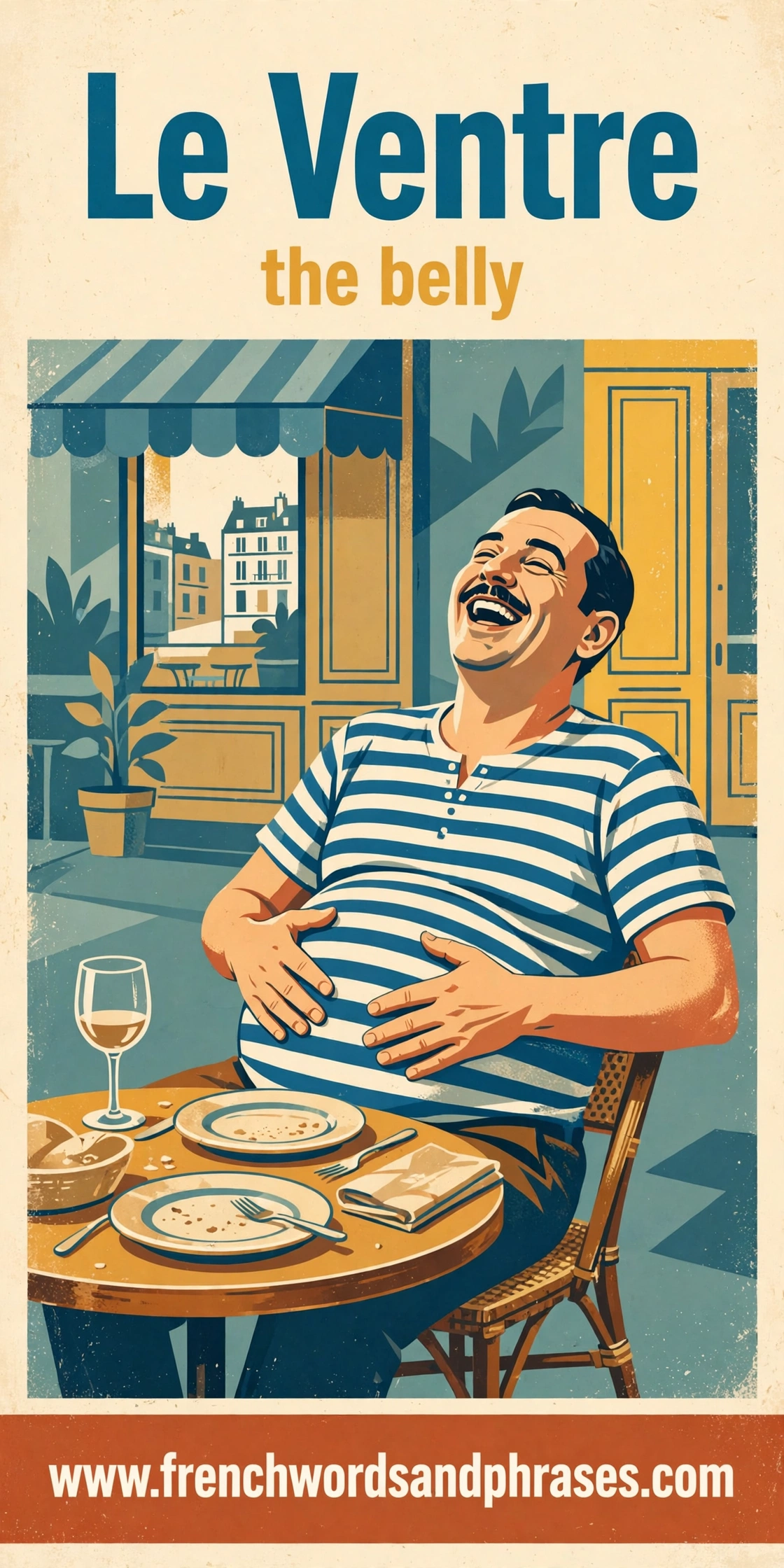
A Sunday lunch that goes on a little too long: one more helping of everything, a belt loosened by a single notch, and a hand resting happily on a full stomach — that is le ventre, the belly that keeps the score of every good meal.
In this guide, you’ll learn what ventre means in English, how to use it with its articles, how to form its plural, and how it appears in everyday French. Explore French examples, English translations, and practice quizzes.
Understanding the French Noun Ventre
Ventre is a masculine French noun. Like every French noun, it has a gender, and it is learned together with its article: le ventre.
It means belly, or stomach. It is the everyday, slightly affectionate word for the front of the body where meals end up — the word of children rubbing a full tummy, of doctors asking where it hurts, and of the famous pattern avoir mal au ventre, to have a stomach ache. For the organ itself in a medical sense, French also uses l’estomac, but ventre is the word of daily life.
Gender: Masculine
Definite article: le — le ventre (the belly)
Indefinite article: un — un ventre (a belly)
Plural: les ventres (the bellies)
English equivalents: Belly; stomach; tummy.
One important usage detail: to say your stomach hurts, French does not use a possessive adjective. You say j’ai mal au ventre — literally, I have pain at the stomach — with au (à + le) and the definite article, never mon ventre in this pattern. The same pattern runs over the whole body: j’ai mal à la tête (my head hurts), j’ai mal au dos (my back hurts), j’ai mal aux dents (my teeth hurt).
Experience the Word
Ventre is more than anatomy. It is where hunger announces itself, where laughter shakes you, and where a good meal comes to rest.
Imagine a child at a family feast, already full but eyeing the cheese. She pats her stomach like a small drum and announces, quite seriously, that there is always room for dessert — the ventre has its own logic.
You have not just eaten well. You have filled the belly that carries you through the day.
How to Use Ventre in French: Complete Guide
Let’s explore how ventre works in French, beginning with its articles.
Ventre and Its Articles
French nouns are almost never used alone. The small word in front of the noun — the article — does a great deal of work.
Ventre with the Definite Article (Le, Les)
Used for the belly in general, or for a particular stomach both speakers know about — above all in the pattern avoir mal au ventre.
| Number | French |
|---|---|
| Singular | le ventre |
| Plural | les ventres |
Example
J’ai mal au ventre depuis ce matin.
I have had a stomach ache since this morning.
Ventre with the Indefinite Article (Un, Des)
Used when the belly is one among others — in descriptions, comparisons and jokes.
| Number | French |
|---|---|
| Singular | un ventre |
| Plural | des ventres |
Example
Il a un ventre rond comme un ballon.
He has a round belly like a balloon.
Ventre When Something Hurts (Avoir Mal au Ventre)
Ventre is a body part, so instead of a partitive it gets something better: the pattern French uses for every ache in the body.
| Meaning | French |
|---|---|
| I have a stomach ache | j’ai mal au ventre |
| you have a stomach ache (tu) | tu as mal au ventre |
| he / she has a stomach ache | il / elle a mal au ventre |
| we have stomach aches | nous avons mal au ventre |
| you have a stomach ache (vous) | vous avez mal au ventre |
| they have stomach aches | ils / elles ont mal au ventre |
Example
Nous avons tous mal au ventre après ce repas énorme.
We all have stomach aches after that enormous meal.
Quick Quiz 1
Complete the sentence:
J’ai mal ______ ventre.
Reveal the answer
au
J’ai mal au ventre.
I have a stomach ache. (Au = à + le: body aches always take the definite article.)
The Plural of Ventre
Like most French nouns, ventre simply adds an -s in the plural — a letter you see but do not hear.
| Number | French |
|---|---|
| Singular | le ventre |
| Plural | les ventres |
Example
Les ventres gargouillent avant le déjeuner.
The stomachs are rumbling before lunch.
Ventre with Possessive Adjectives (Mon, Ton, Son…)
Possessives agree with the noun, not with the owner — and ventre is masculine, so it takes mon, ton, son. Note that for aches, French prefers the definite article instead of a possessive.
| Owner | French |
|---|---|
| my | mon ventre |
| your (tu) | ton ventre |
| his / her | son ventre |
| our | notre ventre |
| your (vous) | votre ventre |
| their | leur ventre |
Example
Elle pose une main sur son ventre.
She lays a hand on her stomach.
Quick Quiz 2
Complete the sentence:
Les enfants ont mal ______ ventre après le goûter.
Reveal the answer
au
Les enfants ont mal au ventre après le goûter.
The children have stomach aches after the snack. (Even for several children, ventre stays singular after mal.)
Ventre with Demonstrative Adjectives (Ce, Ces)
Used to point: this belly here, those bellies there.
| Number | French |
|---|---|
| Singular | ce ventre |
| Plural | ces ventres |
Example
Ce ventre gargouille, c’est l’heure de manger.
This stomach is rumbling — it is time to eat.
Ventre with Adjectives
Most French adjectives come after the noun — and they agree with it. Ventre is masculine, so: un ventre rond, un ventre plat.
| Adjective | With Ventre |
|---|---|
| rond (round) | un ventre rond |
| plat (flat) | un ventre plat |
| gros (big) | un gros ventre |
| vide (empty) | le ventre vide |
| plein (full) | le ventre plein |
| musclé (muscular) | un ventre musclé |
Example
Après le marathon, il avait le ventre vide.
After the marathon, his stomach was empty.
Quick Quiz 3
Complete the sentence:
Après le repas, j’ai le ventre ______ . (plein or vide, after a very big meal)
Reveal the answer
plein
Après le repas, j’ai le ventre plein.
After the meal, my stomach is full.
Everyday Expressions with Ventre
Ventre appears in expressions about hunger, fear, laughter and appetite.
| Expression | In English |
|---|---|
| avoir mal au ventre | to have a stomach ache |
| le ventre vide | on an empty stomach |
| rire à ventre déboutonné | to laugh one’s head off (lit. with belly unbuttoned) |
| avoir les yeux plus gros que le ventre | to have eyes bigger than one’s stomach |
| se mettre à plat ventre | to lie flat on one’s stomach |
| le ventre de la terre | the depths of the earth |
Example
Il a toujours les yeux plus gros que le ventre.
His eyes are always bigger than his stomach.
Words from the Same Family as Ventre
Learn these together and the whole body starts to make sense.
| French | In English |
|---|---|
| la tête | the head |
| le dos | the back |
| le bras | the arm |
| la jambe | the leg |
| l’estomac | the stomach (the organ) |
| la faim | hunger |
Example
Il a mal au dos et au ventre.
His back and his stomach hurt.
Quick Quiz 4
What does avoir les yeux plus gros que le ventre mean?
Reveal the answer
To have eyes bigger than one’s stomach
Il a les yeux plus gros que le ventre.
His eyes are bigger than his stomach.
Ventre in Everyday French: Real-Life Examples
Now that you know the word, let’s see how ventre appears in everyday French.
Example 1 — After the feast
Après le repas de Noël, tout le monde a mal au ventre.
After the Christmas meal, everyone has a stomach ache.
Example 2 — Before lunch
J’ai le ventre qui gargouille, je mangerais n’importe quoi.
My stomach is rumbling — I could eat anything.
Example 3 — At the doctor’s
Le médecin pose sa main sur mon ventre et écoute.
The doctor lays his hand on my stomach and listens.
Example 4 — After sport
Après un mois de sport, son ventre est plus plat.
After a month of exercise, his stomach is flatter.
Example 5 — A child speaking
Maman, mon ventre fait des bruits bizarres !
Mummy, my tummy is making funny noises!
Example 6 — An expression in real life
À midi, il court déjeuner : impossible de travailler le ventre vide.
At noon he rushes off to lunch: impossible to work on an empty stomach.
Beyond Translation: The Meaning of Ventre
English says belly or stomach for the meaning of ventre — but French gives the word a warmth English spreads over several words. The ventre is where feelings live: fear knots it, laughter shakes it, and a child grows in it, le ventre de sa mère.
To speak of the ventre is to speak of the body’s honest centre.
It is no accident that French measures appetite with it — avoir les yeux plus gros que le ventre — or comfort: there is no happiness quite like ending a meal le ventre plein, the belly full, among people you love.
How to Remember the French Noun Ventre
Remember it this way: Ventre is the belly — masculine — and above all it is the word of avoir mal au ventre.
- Your stomach hurts after a huge lunch — tu as mal au ventre.
- You are still hungry at noon — tu as le ventre vide.
- You took too much on your plate — tu as les yeux plus gros que le ventre.
The key idea is le ventre for the belly, and mal au ventre — never mon ventre — when it hurts.
Test Your Knowledge of Ventre
Let’s see how much you’ve learned. Try answering these questions before revealing the answers.
Question 1
Is ventre masculine or feminine?
Reveal the answer
Masculine — le ventre.
Question 2
How do you say I have a stomach ache in French?
Reveal the answer
J’ai mal au ventre.
Question 3
Translate: His stomach is empty.
Reveal the answer
Il a le ventre vide.
Question 4
What does avoir les yeux plus gros que le ventre mean?
Reveal the answer
To have eyes bigger than one’s stomach — to take more food than one can eat.
Question 5
Complete the sentence:
Elle a mal ______ ventre depuis ce matin.
Reveal the answer
au
Elle a mal au ventre depuis ce matin.
She has had a stomach ache since this morning.
Your Final Challenge
Can You Use It?
How would you say this in French?
“My stomach hurts and I cannot sleep.”
Reveal the answer
J’ai mal au ventre et je ne peux pas dormir.
My stomach hurts and I cannot sleep.
A little French. A little curiosity. A richer everyday life.
LEARN FRENCH ONE WORD AT A TIME




