A French Word to Live By
How to Conjugate Végéter in French
/ve.ʒe.te/
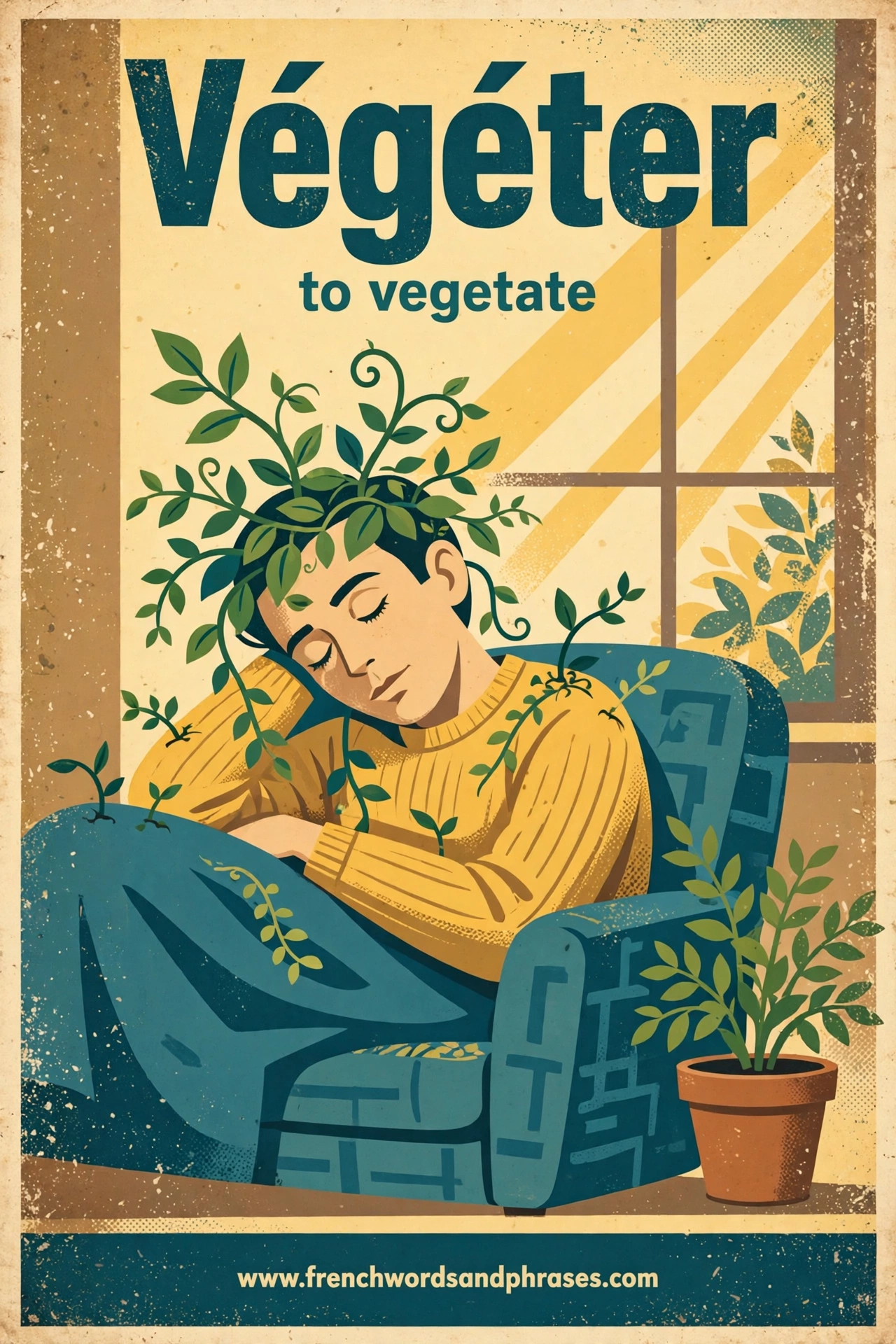
Végéter means to vegetate — to live like a plant, growing slowly or simply stagnating.
A plant on a windowsill doing nothing but survive, a talented graduate stuck for years in a job beneath him — végéter is the verb of living at the lowest speed: alive, rooted, and going nowhere.
In this guide, you’ll learn how to conjugate végéter in all the major French tenses and moods. Explore complete conjugation tables, French examples, English translations, and practice quizzes.
Understanding the French Verb Végéter
Végéter is a regular French verb belonging to the first group of verbs, those ending in -er.
It means to vegetate. It is commonly used in gardening and botany for plants that survive without thriving, and far more often, figuratively, for people stuck in jobs, towns or routines where nothing grows — végéter dans un petit emploi is the standard French way to describe a career that has stopped moving.
Verb classification: First group (-er)
Auxiliary verb: Avoir
Past participle: végété
Present participle: végétant
English equivalents: To vegetate; (of a plant) to grow feebly, to barely survive; (of a person) to stagnate, to mark time — végéter dans un petit emploi, to stagnate in a dead-end job; végéter devant la télé, to vegetate in front of the TV.
One important detail: végéter is a céder-type verb — the é of the stem opens to è wherever the next syllable is mute: je végète, tu végètes, il végète, ils végètent, and all through the future and conditional: je végèterai, je végèterais. The é survives wherever the ending is sounded: nous végétons, vous végétez, je végétais, en végétant, and in the infinitive and the participle, végéter, végété. The subjunctive splits along the same line: que je végète, but que nous végétions.
Experience the Word
Végéter is the verb of life on standby — fed, watered, alive, and going nowhere.
Imagine a young graduate in a small-town office. The real work takes an hour a day; the rest is waiting. Months become years, the plant on his desk grows faster than his career — il végète, and everyone can see it except his employer.
He is not failing or falling. He is vegetating — alive, rooted, and waiting for a season that never comes.
How to Conjugate Végéter: Complete French Conjugation Guide
Let’s explore every major conjugation of végéter, beginning with the indicative mood.
How to Conjugate Végéter in the Indicative Mood
The indicative mood is used to express facts, observations, actions, and events.
How to Conjugate Végéter in the Present Tense (Présent)
Used for actions happening now, habitual actions, and general truths.
| Subject | Conjugation |
|---|---|
| je | végète |
| tu | végètes |
| il / elle | végète |
| nous | végétons |
| vous | végétez |
| ils / elles | végètent |
Example
Cette plante végète dans un coin sans lumière.
This plant is vegetating in a corner without light.
Quick Quiz 1
Complete the sentence:
Nous ______ dans un petit bureau sans fenêtre.
Reveal the answer
végétons
Nous végétons dans un petit bureau sans fenêtre.
We are vegetating in a small office with no window.
How to Conjugate Végéter in the Passé Composé
Used for completed actions in the past. Végéter takes the auxiliary verb avoir.
| Subject | Conjugation |
|---|---|
| j’ | ai végété |
| tu | as végété |
| il / elle | a végété |
| nous | avons végété |
| vous | avez végété |
| ils / elles | ont végété |
Example
Il a végété dix ans dans ce bureau.
He vegetated for ten years in that office.
How to Conjugate Végéter in the Imparfait (Imperfect Tense)
Used for habitual past actions, descriptions, and ongoing situations in the past.
| Subject | Conjugation |
|---|---|
| je | végétais |
| tu | végétais |
| il / elle | végétait |
| nous | végétions |
| vous | végétiez |
| ils / elles | végétaient |
Example
Nous végétions dans un petit village sans avenir.
We were stagnating in a small village with no future.
Quick Quiz 2
Choose the correct form:
He vegetated there for years.
Il ______ là des années. (a végété / est végété)
Reveal the answer
a végété
Il a végété là des années.
Végéter takes avoir.
How to Conjugate Végéter in the Plus-que-parfait
Used to describe an action that had already been completed before another past event.
| Subject | Conjugation |
|---|---|
| j’ | avais végété |
| tu | avais végété |
| il / elle | avait végété |
| nous | avions végété |
| vous | aviez végété |
| ils / elles | avaient végété |
Example
Elle avait végété des années avant de changer de vie.
She had vegetated for years before changing her life.
How to Conjugate Végéter in the Passé Simple
Primarily used in formal writing, literature, and historical narratives. It is rarely used in everyday conversation.
| Subject | Conjugation |
|---|---|
| je | végétai |
| tu | végétas |
| il / elle | végéta |
| nous | végétâmes |
| vous | végétâtes |
| ils / elles | végétèrent |
Example
Le rosier végéta tout l’hiver au fond du jardin.
The rose bush barely survived the whole winter at the bottom of the garden.
How to Conjugate Végéter in the Passé Antérieur
A literary tense used to express an action completed immediately before another past action, generally in the passé simple.
| Subject | Conjugation |
|---|---|
| j’ | eus végété |
| tu | eus végété |
| il / elle | eut végété |
| nous | eûmes végété |
| vous | eûtes végété |
| ils / elles | eurent végété |
Example
Quand il eut végété cinq ans dans ce poste, il démissionna.
When he had stagnated five years in that job, he resigned.
How to Conjugate Végéter in the Future Tense (Futur Simple)
Used to describe actions that will take place in the future.
| Subject | Conjugation |
|---|---|
| je | végèterai |
| tu | végèteras |
| il / elle | végètera |
| nous | végèterons |
| vous | végèterez |
| ils / elles | végèteront |
Example
Sans soleil, ces tomates végèteront tout l’été.
Without sun, these tomatoes will barely grow all summer.
How to Conjugate Végéter in the Futur Antérieur (Future Perfect)
Used for an action that will have been completed before a particular point in the future.
| Subject | Conjugation |
|---|---|
| j’ | aurai végété |
| tu | auras végété |
| il / elle | aura végété |
| nous | aurons végété |
| vous | aurez végété |
| ils / elles | auront végété |
Example
À la retraite, il aura végété quarante ans au même guichet.
By retirement, he will have vegetated forty years at the same counter.
How to Conjugate Végéter in the Near Future (Futur Proche)
Used to describe something that is going to happen soon. Formed with aller + infinitive.
| Subject | Conjugation |
|---|---|
| je | vais végéter |
| tu | vas végéter |
| il / elle | va végéter |
| nous | allons végéter |
| vous | allez végéter |
| ils / elles | vont végéter |
Example
Je ne vais pas végéter ici toute ma vie !
I am not going to vegetate here all my life!
How to Conjugate Végéter in the Conditional Mood
The conditional mood expresses what would happen under certain circumstances. It is also frequently used to make polite requests or express wishes.
How to Conjugate Végéter in the Present Conditional
| Subject | Conjugation |
|---|---|
| je | végèterais |
| tu | végèterais |
| il / elle | végèterait |
| nous | végèterions |
| vous | végèteriez |
| ils / elles | végèteraient |
Example
Avec plus de lumière, la plante végèterait moins.
With more light, the plant would vegetate less.
How to Conjugate Végéter in the Past Conditional
| Subject | Conjugation |
|---|---|
| j’ | aurais végété |
| tu | aurais végété |
| il / elle | aurait végété |
| nous | aurions végété |
| vous | auriez végété |
| ils / elles | auraient végété |
Example
Elle aurait végété dans ce village si elle n’était pas partie.
She would have stagnated in that village if she had not left.
Végéter in the Literary Past Conditional Form
This less common literary form uses the imperfect subjunctive of avoir.
| Subject | Conjugation |
|---|---|
| j’ | eusse végété |
| tu | eusses végété |
| il / elle | eût végété |
| nous | eussions végété |
| vous | eussiez végété |
| ils / elles | eussent végété |
Example
Il eût végété toute sa vie dans ce bureau sans la guerre.
He would have vegetated all his life in that office without the war.
How to Conjugate Végéter in the Subjunctive Mood
The subjunctive is used to express wishes, emotions, doubts, necessity, and uncertainty. It frequently follows expressions such as il faut que (it is necessary that) or bien que (although).
How to Conjugate Végéter in the Present Subjunctive
| Subject | Conjugation |
|---|---|
| que je | végète |
| que tu | végètes |
| qu’il / qu’elle | végète |
| que nous | végétions |
| que vous | végétiez |
| qu’ils / qu’elles | végètent |
Example
Il est triste qu’elle végète dans un travail sans avenir.
It is sad that she is stagnating in a job with no future.
Quick Quiz 3
Complete the sentence using the subjunctive:
Il est triste que tu ______ dans ce poste.
Reveal the answer
végètes
Il est triste que tu végètes dans ce poste.
It is sad that you are stagnating in that job.
How to Conjugate Végéter in the Imperfect Subjunctive
A literary tense, rarely encountered in modern spoken French.
| Subject | Conjugation |
|---|---|
| que je | végétasse |
| que tu | végétasses |
| qu’il / qu’elle | végétât |
| que nous | végétassions |
| que vous | végétassiez |
| qu’ils / qu’elles | végétassent |
Example
Je ne pensais pas qu’il végétât si longtemps au même poste.
I did not think he would stagnate so long in the same job.
How to Conjugate Végéter in the Pluperfect Subjunctive
A literary construction used to express an action completed before another past action.
| Subject | Conjugation |
|---|---|
| que j’ | eusse végété |
| que tu | eusses végété |
| qu’il / qu’elle | eût végété |
| que nous | eussions végété |
| que vous | eussiez végété |
| qu’ils / qu’elles | eussent végété |
Example
On craignait qu’ils eussent végété des années dans l’attente.
People feared they had vegetated for years in waiting.
How to Conjugate Végéter in the Past Subjunctive
| Subject | Conjugation |
|---|---|
| que j’ | aie végété |
| que tu | aies végété |
| qu’il / qu’elle | ait végété |
| que nous | ayons végété |
| que vous | ayez végété |
| qu’ils / qu’elles | aient végété |
Example
Je regrette qu’elle ait végété si longtemps avant de partir.
I regret that she vegetated so long before leaving.
How to Conjugate Végéter in the Imperative
The imperative is used to give commands, instructions, invitations, or suggestions. Subject pronouns are omitted.
How to Conjugate Végéter in the Present Imperative
| Person | Conjugation |
|---|---|
| (tu) | végète |
| (nous) | végétons |
| (vous) | végétez |
Example
Ne végète pas dans ce fauteuil, sors prendre l’air !
Do not vegetate in that armchair, go out and get some air!
Quick Quiz 4
How would you say Do not vegetate in front of the TV (tu form)?
Reveal the answer
Ne végète pas devant la télé !
French Participles of Végéter
Participles are verb forms that can be used in compound tenses and other grammatical constructions.
Present Participle of Végéter
végétant
En végétant dans ce petit emploi, il a perdu ses ambitions.
By vegetating in that little job, he lost his ambitions.
Past Participle of Végéter
végété
Longtemps végétée à l’ombre, la vigne a fini par mourir.
Left vegetating in the shade for a long time, the vine ended up dying.
Végéter in Everyday French: Real-Life Examples
Now that you know the conjugations, let’s see how végéter appears in everyday French.
Example 1 — Present
Cette plante végète sans lumière.
This plant is vegetating without light.
Example 2 — Passé composé
Il a végété dix ans dans ce poste.
He vegetated for ten years in that job.
Example 3 — Imparfait
Nous végétions dans un petit village.
We were stagnating in a small village.
Example 4 — Future
Sans changement, tu végèteras ici des années.
Without a change, you will vegetate here for years.
Example 5 — Conditional
Elle végèterait dans ce village sans son travail à Paris.
She would vegetate in this village without her job in Paris.
Example 6 — Imperative
Ne végète pas devant la télé !
Do not vegetate in front of the TV!
Beyond Translation: The Meaning of Végéter
English vegetate exists, but it sounds medical or comic; French végéter is the everyday word for a stalled life, and it is quietly devastating.
Nothing dramatic happens to someone who végète.
That is exactly the tragedy: no growth, no change, just seasons passing over a life on standby. Its family tells the story — la végétation is plant life, un végétal is a plant, and the person who végète has simply joined them.
How to Remember the French Verb Végéter
Remember it this way: Végéter is about the plant on the windowsill — alive, rooted, going nowhere.
- Céder-type spelling: je végète with è, but nous végétons with é.
- Two lives: a plant that barely grows, and a person stuck in a dead-end job — végéter dans un petit emploi.
- Regular endings otherwise: je végète, nous végétons, past participle végété.
The key idea is the plant on the windowsill — alive, rooted, going nowhere.
Test Your Knowledge of Végéter
Let’s see how much you’ve learned. Try answering these questions before revealing the answers.
Question 1
Why does je végète have a grave accent but nous végétons an acute one?
Reveal the answer
The céder-type rule — é becomes è before a mute syllable (je végète), and stays é where the ending is sounded (nous végétons).
Question 2
How do you say He vegetated for ten years in that job in French?
Reveal the answer
Il a végété dix ans dans ce poste.
Question 3
Translate: This plant is vegetating without light.
Reveal the answer
Cette plante végète sans lumière.
Question 4
What is the past participle of végéter?
Reveal the answer
Végété.
Question 5
Complete the sentence:
Il est triste qu’elle ______ dans un travail sans avenir.
Reveal the answer
végète
Il est triste qu’elle végète dans un travail sans avenir.
It is sad that she is stagnating in a job with no future.
Your Final Challenge
Can You Use It?
How would you say this in French?
He has been vegetating at the same counter for ten years, but this morning he brought his CV.
Reveal the answer
Il végète depuis dix ans au même guichet, mais ce matin, il a apporté son curriculum vitae.
He has been vegetating at the same counter for ten years, but this morning he brought his CV.
A little French. A little curiosity. A richer everyday life.
LEARN FRENCH ONE WORD AT A TIME