A French Word to Live By
How to Conjugate Se vautrer in French
/sə vo.tʁe/
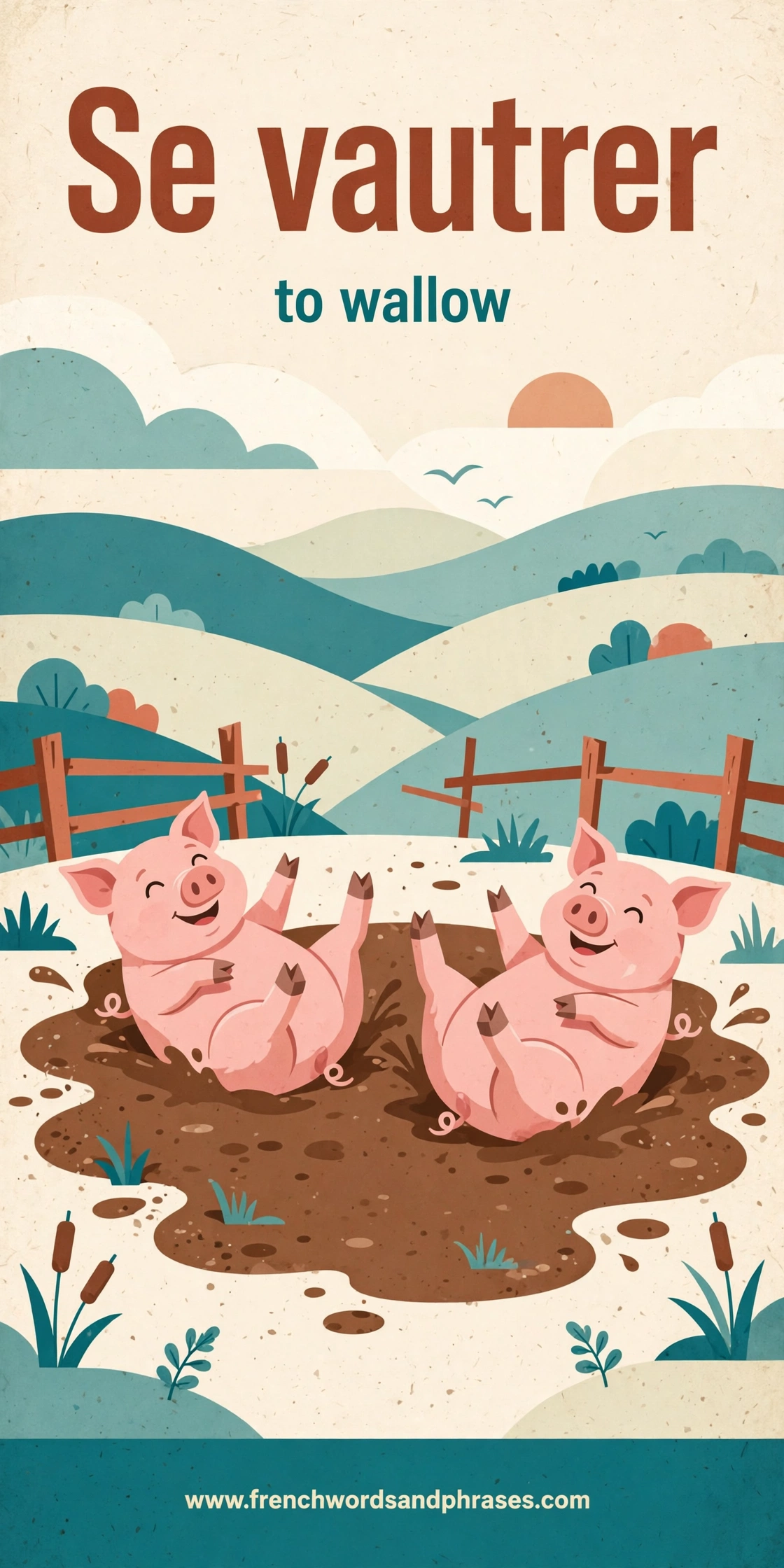
Se vautrer means to wallow — to roll about in mud, in hay or in luxury with complete abandon.
A sow lowering herself into the farmyard puddle with a long sigh, a dog flipping onto his back in the dust, a lottery winner sinking into silk sheets — se vautrer is the verb of wallowing: rolling, sprawling and sinking into something soft, wet or shameful, and loving it.
In this guide, you’ll learn how to conjugate se vautrer in all the major French tenses and moods. Explore complete conjugation tables, French examples, English translations, and practice quizzes.
Understanding the French Verb Se vautrer
Se vautrer is a regular French verb belonging to the first group of verbs, those ending in -er.
It means to wallow. It is commonly used for animals rolling in mud, dust or hay, for people sprawling across sofas and beds with no dignity at all, and figuratively for sinking into luxury, debauchery or self-pity — se vautrer dans le luxe, dans la débauche, dans l’apitoiement — nearly always followed by dans.
Verb classification: First group (-er), reflexive
Auxiliary verb: Être
Past participle: vautré
Present participle: vautrant
English equivalents: To wallow, to roll about, to sprawl; se vautrer dans la boue — to wallow in the mud; se vautrer dans le luxe — to wallow in luxury; se vautrer dans la débauche — to wallow in debauchery; se vautrer sur un canapé — to sprawl all over a sofa.
One important detail: se vautrer is a reflexive-only verb in everyday French — the plain vautrer (to roll something) barely exists outside dictionaries, and nobody ever says it. Being reflexive, it takes être in every compound tense and the past participle agrees with the subject: elle s’est vautrée dans la boue, ils se sont vautrés dans le foin. The tu imperative tucks the pronoun behind the verb: vautre-toi ! And its inseparable partner is the preposition dans — one always wallows dans something: mud, hay, luxury or disgrace.
Experience the Word
Se vautrer is the verb of giving in to gravity — no posture, no dignity, just the pleasure of sinking into something soft, wet or shameful.
Imagine a farmyard in July. The sow crosses the yard with purpose, chooses the muddiest corner of the puddle, folds her legs and se vautre — once to the left, once to the right — until only her snout and a look of pure contentment remain above the mud.
She has not fallen or slipped. She has wallowed — vautrée, deliberately, gloriously, in the mud.
How to Conjugate Se vautrer: Complete French Conjugation Guide
Let’s explore every major conjugation of se vautrer, beginning with the indicative mood.
How to Conjugate Se vautrer in the Indicative Mood
The indicative mood is used to express facts, observations, actions, and events.
How to Conjugate Se vautrer in the Present Tense (Présent)
Used for actions happening now, habitual actions, and general truths.
| Subject | Conjugation |
|---|---|
| je | me vautre |
| tu | te vautres |
| il / elle | se vautre |
| nous | nous vautrons |
| vous | vous vautrez |
| ils / elles | se vautrent |
Example
Les cochons se vautrent dans la boue avec bonheur.
The pigs wallow in the mud with delight.
Quick Quiz 1
Complete the sentence:
Nous nous ______ dans le foin.
Reveal the answer
vautrons
Nous nous vautrons dans le foin.
We roll about in the hay.
How to Conjugate Se vautrer in the Passé Composé
Used for completed actions in the past. Se vautrer takes the auxiliary verb être.
| Subject | Conjugation |
|---|---|
| je | me suis vautré / me suis vautrée |
| tu | t’es vautré / t’es vautrée |
| il / elle | s’est vautré / s’est vautrée |
| nous | nous sommes vautrés / nous sommes vautrées |
| vous | vous êtes vautrés / vous êtes vautrées / vous êtes vautré / vous êtes vautrée |
| ils / elles | se sont vautrés / se sont vautrées |
Example
Elle s’est vautrée dans la boue jusqu’aux oreilles.
She wallowed in the mud up to her ears.
How to Conjugate Se vautrer in the Imparfait (Imperfect Tense)
Used for habitual past actions, descriptions, and ongoing situations in the past.
| Subject | Conjugation |
|---|---|
| je | me vautrais |
| tu | te vautrais |
| il / elle | se vautrait |
| nous | nous vautrions |
| vous | vous vautriez |
| ils / elles | se vautraient |
Example
Le chien se vautrait dans l’herbe après chaque bain.
The dog used to roll around in the grass after every bath.
Quick Quiz 2
Choose the correct form:
She wallowed in the mud.
Elle ______ dans la boue. (s’est vautrée / a vautré)
Reveal the answer
s’est vautrée
Elle s’est vautrée dans la boue.
Se vautrer is reflexive, takes être, and the participle agrees: vautrée.
How to Conjugate Se vautrer in the Plus-que-parfait
Used to describe an action that had already been completed before another past event.
| Subject | Conjugation |
|---|---|
| je | m’étais vautré / m’étais vautrée |
| tu | t’étais vautré / t’étais vautrée |
| il / elle | s’était vautré / s’était vautrée |
| nous | nous étions vautrés / nous étions vautrées |
| vous | vous étiez vautrés / vous étiez vautrées / vous étiez vautré / vous étiez vautrée |
| ils / elles | s’étaient vautrés / s’étaient vautrées |
Example
Ils s’étaient vautrés dans le foin avant l’orage.
They had rolled about in the hay before the storm.
How to Conjugate Se vautrer in the Passé Simple
Primarily used in formal writing, literature, and historical narratives. It is rarely used in everyday conversation.
| Subject | Conjugation |
|---|---|
| je | me vautrai |
| tu | te vautras |
| il / elle | se vautra |
| nous | nous vautrâmes |
| vous | vous vautrâtes |
| ils / elles | se vautrèrent |
Example
Le sanglier se vautra dans la mare boueuse.
The boar wallowed in the muddy pond.
How to Conjugate Se vautrer in the Passé Antérieur
A literary tense used to express an action completed immediately before another past action, generally in the passé simple.
| Subject | Conjugation |
|---|---|
| je | me fus vautré / me fus vautrée |
| tu | te fus vautré / te fus vautrée |
| il / elle | se fut vautré / se fut vautrée |
| nous | nous fûmes vautrés / nous fûmes vautrées |
| vous | vous fûtes vautrés / vous fûtes vautrées / vous fûtes vautré / vous fûtes vautrée |
| ils / elles | se furent vautrés / se furent vautrées |
Example
Dès qu’elle se fut vautrée dans la boue, la truie soupira d’aise.
As soon as she had wallowed in the mud, the sow sighed with contentment.
How to Conjugate Se vautrer in the Future Tense (Futur Simple)
Used to describe actions that will take place in the future.
| Subject | Conjugation |
|---|---|
| je | me vautrerai |
| tu | te vautreras |
| il / elle | se vautrera |
| nous | nous vautrerons |
| vous | vous vautrerez |
| ils / elles | se vautreront |
Example
Demain, les enfants se vautreront dans les feuilles mortes.
Tomorrow, the children will roll about in the dead leaves.
How to Conjugate Se vautrer in the Futur Antérieur (Future Perfect)
Used for an action that will have been completed before a particular point in the future.
| Subject | Conjugation |
|---|---|
| je | me serai vautré / me serai vautrée |
| tu | te seras vautré / te seras vautrée |
| il / elle | se sera vautré / se sera vautrée |
| nous | nous serons vautrés / nous serons vautrées |
| vous | vous serez vautrés / vous serez vautrées / vous serez vautré / vous serez vautrée |
| ils / elles | se seront vautrés / se seront vautrées |
Example
À midi, les cochons se seront vautrés trois fois dans la boue.
By noon, the pigs will have wallowed three times in the mud.
How to Conjugate Se vautrer in the Near Future (Futur Proche)
Used to describe something that is going to happen soon. Formed with aller + infinitive.
| Subject | Conjugation |
|---|---|
| je | vais me vautrer |
| tu | vas te vautrer |
| il / elle | va se vautrer |
| nous | allons nous vautrer |
| vous | allez vous vautrer |
| ils / elles | vont se vautrer |
Example
Regarde-le, il va se vautrer dans la boue !
Look at him, he is going to wallow in the mud!
How to Conjugate Se vautrer in the Conditional Mood
The conditional mood expresses what would happen under certain circumstances. It is also frequently used to make polite requests or express wishes.
How to Conjugate Se vautrer in the Present Conditional
| Subject | Conjugation |
|---|---|
| je | me vautrerais |
| tu | te vautrerais |
| il / elle | se vautrerait |
| nous | nous vautrerions |
| vous | vous vautreriez |
| ils / elles | se vautreraient |
Example
Sans la clôture, le chien se vautrerait dans les plates-bandes.
Without the fence, the dog would roll about in the flower beds.
How to Conjugate Se vautrer in the Past Conditional
| Subject | Conjugation |
|---|---|
| j’ | me serais vautré / me serais vautrée |
| tu | te serais vautré / te serais vautrée |
| il / elle | se serait vautré / se serait vautrée |
| nous | nous serions vautrés / nous serions vautrées |
| vous | vous seriez vautrés / vous seriez vautrées / vous seriez vautré / vous seriez vautrée |
| ils / elles | se seraient vautrés / se seraient vautrées |
Example
Elle se serait vautrée dans le luxe si elle avait gagné au loto.
She would have wallowed in luxury if she had won the lottery.
Se vautrer in the Literary Past Conditional Form
This less common literary form uses the imperfect subjunctive of être.
| Subject | Conjugation |
|---|---|
| je | me fusse vautré / me fusse vautrée |
| tu | te fusses vautré / te fusses vautrée |
| il / elle | se fût vautré / se fût vautrée |
| nous | nous fussions vautrés / nous fussions vautrées |
| vous | vous fussiez vautrés / vous fussiez vautrées / vous fussiez vautré / vous fussiez vautrée |
| ils / elles | se fussent vautrés / se fussent vautrées |
Example
Il se fût vautré dans la débauche sans sa famille.
He would have wallowed in debauchery without his family.
How to Conjugate Se vautrer in the Subjunctive Mood
The subjunctive is used to express wishes, emotions, doubts, necessity, and uncertainty. It frequently follows expressions such as il faut que (it is necessary that) or bien que (although).
How to Conjugate Se vautrer in the Present Subjunctive
| Subject | Conjugation |
|---|---|
| que je | me vautre |
| que tu | te vautres |
| qu’il / qu’elle | se vautre |
| que nous | nous vautrions |
| que vous | vous vautriez |
| qu’ils / qu’elles | se vautrent |
Example
Je ne veux pas que les enfants se vautrent dans la boue.
I do not want the children to wallow in the mud.
Quick Quiz 3
Complete the sentence using the subjunctive:
Il faut que tu te ______ dans l’herbe, pas dans la boue.
Reveal the answer
vautres
Il faut que tu te vautres dans l’herbe, pas dans la boue.
You must roll in the grass, not in the mud.
How to Conjugate Se vautrer in the Imperfect Subjunctive
A literary tense, rarely encountered in modern spoken French.
| Subject | Conjugation |
|---|---|
| que je | me vautrasse |
| que tu | te vautrasses |
| qu’il / qu’elle | se vautrât |
| que nous | nous vautrassions |
| que vous | vous vautrassiez |
| qu’ils / qu’elles | se vautrassent |
Example
Elle craignait que les invités se vautrassent sur son canapé neuf.
She feared the guests might sprawl all over her new sofa.
How to Conjugate Se vautrer in the Pluperfect Subjunctive
A literary construction used to express an action completed before another past action.
| Subject | Conjugation |
|---|---|
| que je | me fusse vautré / me fusse vautrée |
| que tu | te fusses vautré / te fusses vautrée |
| qu’il / qu’elle | se fût vautré / se fût vautrée |
| que nous | nous fussions vautrés / nous fussions vautrées |
| que vous | vous fussiez vautrés / vous fussiez vautrées / vous fussiez vautré / vous fussiez vautrée |
| qu’ils / qu’elles | se fussent vautrés / se fussent vautrées |
Example
On racontait qu’ils se fussent vautrés dans le luxe pendant des années.
People said they had wallowed in luxury for years.
How to Conjugate Se vautrer in the Past Subjunctive
| Subject | Conjugation |
|---|---|
| que je | me sois vautré / me sois vautrée |
| que tu | te sois vautré / te sois vautrée |
| qu’il / qu’elle | se soit vautré / se soit vautrée |
| que nous | nous soyons vautrés / nous soyons vautrées |
| que vous | vous soyez vautrés / vous soyez vautrées / vous soyez vautré / vous soyez vautrée |
| qu’ils / qu’elles | se soient vautrés / se soient vautrées |
Example
Je suis étonné qu’il se soit vautré dans la boue exprès.
I am amazed he wallowed in the mud on purpose.
How to Conjugate Se vautrer in the Imperative
The imperative is used to give commands, instructions, invitations, or suggestions. Subject pronouns are omitted.
How to Conjugate Se vautrer in the Present Imperative
| Person | Conjugation |
|---|---|
| (tu) | vautre-toi |
| (nous) | vautrons-nous |
| (vous) | vautrez-vous |
Example
Vautre-toi dans l’herbe, elle est douce !
Roll about in the grass, it is soft!
Quick Quiz 4
How would you say Roll in the mud (tu form)?
Reveal the answer
Vautre-toi dans la boue !
French Participles of Se vautrer
Participles are verb forms that can be used in compound tenses and other grammatical constructions.
Present Participle of Se vautrer
vautrant
En se vautrant dans la boue, le cochon se rafraîchit.
By wallowing in the mud, the pig cools itself down.
Past Participle of Se vautrer
vautré
Vautrée dans la boue, la truie refusait de bouger.
Wallowed deep in the mud, the sow refused to move.
Se vautrer in Everyday French: Real-Life Examples
Now that you know the conjugations, let’s see how se vautrer appears in everyday French.
Example 1 — Present
Les cochons se vautrent dans la boue.
The pigs wallow in the mud.
Example 2 — Passé composé
Elle s’est vautrée dans le foin.
She rolled about in the hay.
Example 3 — Imparfait
Le chien se vautrait dans l’herbe.
The dog used to roll in the grass.
Example 4 — Future
Ils se vautreront dans les feuilles mortes.
They will roll about in the dead leaves.
Example 5 — Conditional
Il se vautrerait dans le luxe, s’il pouvait.
He would wallow in luxury if he could.
Example 6 — Imperative
Vautrez-vous dans la boue, les enfants !
Wallow in the mud, children!
Beyond Translation: The Meaning of Se vautrer
English wallow is a close cousin — pigs wallow, and so do people, in self-pity; French se vautrer covers all of that and then stretches out on the furniture.
It is also the verb of the graceless sprawl.
Someone collapsed across an armchair, taking up the whole sofa, is vautré sur le canapé — and the moral sense is never far away: se vautrer dans la débauche is to sink, rolling, into disgrace.
How to Remember the French Verb Se vautrer
Remember it this way: Se vautrer is about pigs in the mud — and people sinking happily into luxury.
- Always reflexive in real life: je me vautre, elle s’est vautrée — être, and the participle agrees.
- Dans is its favourite preposition: se vautrer dans la boue, dans le luxe, dans la débauche.
- Regular -er underneath: je me vautre, nous nous vautrons, past participle vautré.
The key idea is pigs in the mud — and people sinking happily into luxury.
Test Your Knowledge of Se vautrer
Let’s see how much you’ve learned. Try answering these questions before revealing the answers.
Question 1
Which auxiliary does se vautrer use, and why?
Reveal the answer
Être — it is a reflexive verb: elle s’est vautrée dans la boue.
Question 2
How do you say The pigs wallow in the mud in French?
Reveal the answer
Les cochons se vautrent dans la boue.
Question 3
Translate: She wallowed in luxury.
Reveal the answer
Elle s’est vautrée dans le luxe.
Question 4
What is the past participle of se vautrer?
Reveal the answer
Vautré — agreeing: vautrée, vautrés, vautrées.
Question 5
Complete the sentence:
Je ne veux pas que les enfants se ______ dans la boue.
Reveal the answer
vautrent
Je ne veux pas que les enfants se vautrent dans la boue.
I do not want the children to wallow in the mud.
Your Final Challenge
Can You Use It?
How would you say this in French?
The pig wallows in the cool mud, and happiness fits inside a puddle.
Reveal the answer
Le cochon se vautre dans la boue fraîche, et le bonheur tient en une mare.
The pig wallows in the cool mud, and happiness fits inside a puddle.
A little French. A little curiosity. A richer everyday life.
LEARN FRENCH ONE WORD AT A TIME