
A French Word to Live By
Translate Trou to English
/tʁu/
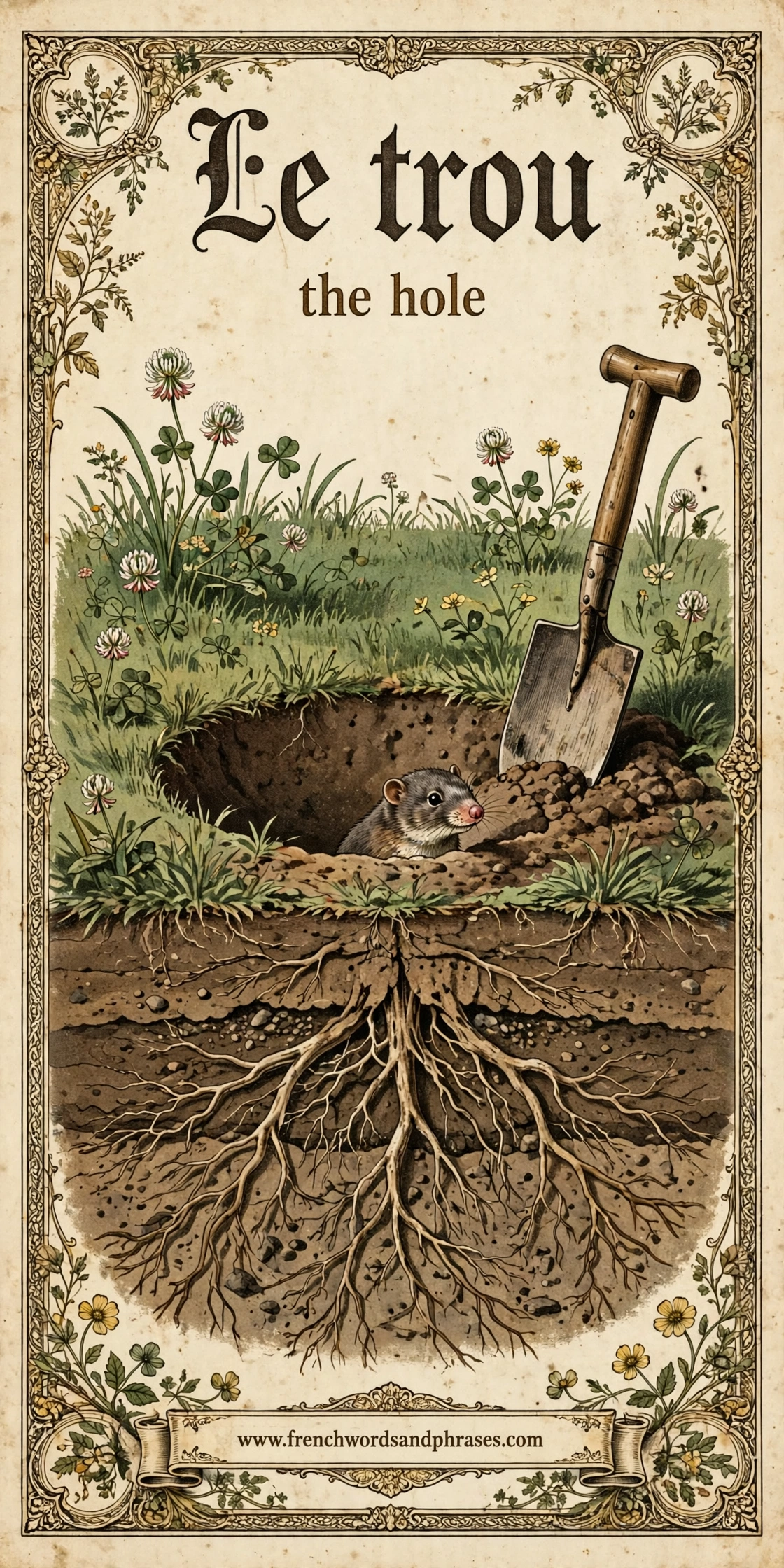
Le trou means the hole.
A sock with a toe escaping, a road full of surprises for the bicycle, a key looking for its other half: le trou, the hole — the absence with edges, the nothing that French names as carefully as any something.
In this guide, you’ll learn what trou means in English, how to use it with its articles, how to form its plural, and how it appears in everyday French. Explore French examples, English translations, and practice quizzes.
Understanding the French Noun Trou
Trou is a masculine French noun, learned with its article: le trou, un trou. It is an old word of the language, of uncertain Germanic ancestry, and one of the hardest-working small nouns in French: holes in socks, in roads, in cheese, in memory, in budgets — and, in familiar speech, the tiny village in the middle of nowhere: un trou perdu.
It means a hole: un trou dans la chaussette, a hole in the sock, un trou dans la route, a hole in the road, les trous du fromage, the holes in the cheese. You dig one with faire un trou or creuser un trou, and you fill one with boucher un trou. The figurative holes are everywhere: un trou de mémoire, a memory blank, un trou dans le budget, a hole in the budget, and the keyhole that every key seeks: le trou de la serrure.
Gender: Masculine — le trou
Definite article: le — le trou (the hole)
Indefinite article: un — un trou (a hole)
Plural: les trous — regular, with a simple -s
Spelling note: one syllable, all roundness: trou rhymes with roue’s cousin mou, doux
Key verbs: faire un trou (to make a hole), boucher un trou (to fill a hole), creuser un trou (to dig a hole)
English equivalents: The hole.
Holes are made and filled with set verbs: faire un trou, boucher un trou — and a budget gap is bouched the same way. In familiar French, a remote little place is un trou or un trou perdu, a godforsaken hole — affectionate or rude depending on the smile. On the golf course and the billiard table, holes keep their literal name; in the theatre, le trou du souffleur is the prompter’s box.
Experience the Word
Trou is the noun of the missing piece — a nothing you can point at, measure, and fall into.
Imagine the cyclist at dusk on a country road, swerving round the same trou he swerves round every evening, known to him like a landmark: in France, even the holes in the road get local knowledge and local names.
You have not just named an absence. You have named the edge around it — le trou, the hole, nothing with a shape.
How to Use Trou in French: Complete Guide
Let’s explore how trou works in French, beginning with its articles — le trou, un trou, boucher un trou.
Trou with the Definite Article (Le, Les)
Used for a specific hole — the one in this sock, the one in that road.
| Form | French |
|---|---|
| Masculine singular | le trou |
| Plural | les trous |
Example
Le trou dans la route a crevé le pneu.
The hole in the road burst the tyre.
Trou with the Indefinite Article (Un, Des)
Used for a hole in general — any gap, anywhere.
| Form | French |
|---|---|
| Masculine singular | un trou |
| Plural | des trous |
Example
Il y a un trou dans ta chaussette.
There is a hole in your sock.
Trou with Where It Is (Dans la route, De mémoire…)
French locates its holes with dans — in the sock, in the road, in the memory.
| Quantity | French |
|---|---|
| a hole in the sock | un trou dans la chaussette |
| the keyhole | le trou de la serrure |
| a memory blank | un trou de mémoire |
| a hole in the budget | un trou dans le budget |
| a godforsaken place (familiar) | un trou perdu |
Example
Après la question, j’ai eu un trou de mémoire.
After the question, my mind went blank — a memory hole.
Quick Quiz 1
Complete the sentence:
______ trou de la serrure est trop petit pour cette clé. (the)
Reveal the answer
Le
Le trou de la serrure est trop petit pour cette clé.
The keyhole is too small for this key — trou is masculine, so le.
The Plural of Trou
Trou takes a regular plural in -s — cheese is famous for them.
| Number | French |
|---|---|
| Singular | le trou |
| Plural | les trous |
Example
Les trous de ce fromage sont énormes.
The holes in this cheese are enormous.
Trou with Possessive Adjectives (Mon, Ton, Son…)
Possessives agree with the noun: trou is masculine, so mon, ton, son in the singular.
| Owner | French |
|---|---|
| my | mon trou |
| your (tu) | ton trou |
| his / her | son trou |
| our | notre trou |
| your (vous) | votre trou |
| their | leur trou |
Example
Le lapin retourne toujours dans son trou.
The rabbit always goes back to its hole.
Quick Quiz 2
Complete the sentence:
La souris a fait ______ trou derrière le placard. (her/its)
Reveal the answer
son
La souris a fait son trou derrière le placard.
The mouse made its hole behind the cupboard — son, because trou is masculine.
Trou with Demonstrative Adjectives (Ce, Ces)
Used to point: ce trou, this hole — the one that just appeared.
| Form | French |
|---|---|
| Masculine singular | ce trou |
| Plural | ces trous |
Example
Ce trou dans le mur cache un tuyau cassé.
This hole in the wall hides a broken pipe.
Trou with Adjectives
Adjectives agree with trou — masculine singular: un trou profond, un petit trou.
| Adjective | With Trou |
|---|---|
| profond (deep) | un trou profond |
| petit (small) | un petit trou |
| grand (big) | un grand trou |
| noir (black) | un trou noir |
| rond (round) | un trou rond |
Example
Les astronomes photographient un trou noir lointain.
Astronomers are photographing a distant black hole.
Quick Quiz 3
Complete the sentence:
Ils ont creusé un trou très ______. (deep)
Reveal the answer
profond
Ils ont creusé un trou très profond.
They dug a very deep hole — profond, masculine, to agree with trou.
Everyday Expressions with Trou
Socks, budgets and black holes — the trou phrases of daily life.
| Expression | In English |
|---|---|
| boucher un trou | to fill a hole; to plug a gap (in a budget) |
| un trou de mémoire | a memory blank, a lapse |
| le trou de la serrure | the keyhole |
| un trou noir | a black hole (astronomy) |
| un trou perdu | a godforsaken place (familiar) |
Example
Il faut boucher le trou dans le budget avant décembre.
We must plug the hole in the budget before December.
Words from the Same Family as Trou
Digging and filling — the words that travel with trou.
| French | In English |
|---|---|
| creuser | to dig (the verb) |
| trouer | to make a hole in, to pierce |
| une fissure | a crack |
| un vide | a void, an emptiness |
| remplir | to fill (the verb) |
Example
Le jardinier creuse un trou pour planter l’arbre.
The gardener is digging a hole to plant the tree.
Quick Quiz 4
What does boucher un trou mean?
Reveal the answer
To fill a hole, to plug a gap — in a wall, and in a budget too.
Elle a bouché le trou avec du ciment.
She filled the hole with cement.
Trou in Everyday French: Real-Life Examples
Now that you know the word, let’s see how trou appears in everyday French.
Example 1 — Socks
Tu as un trou dans ta chaussette gauche.
You have a hole in your left sock.
Example 2 — Roads
Attention, il y a un gros trou sur la route.
Careful, there is a big hole in the road.
Example 3 — Memory
Pendant l’examen, j’ai eu un trou de mémoire.
During the exam, my mind went blank.
Example 4 — Gardening
Creuse un trou assez profond pour le rosier.
Dig a hole deep enough for the rose bush.
Example 5 — Cheese
Les enfants comptent les trous du fromage.
The children count the holes in the cheese.
Example 6 — Villages
Il habite dans un trou perdu, à dix kilomètres du premier village.
He lives in a godforsaken spot, ten kilometres from the nearest village.
Beyond Translation: The Meaning of Trou
Trou is the humblest of nouns and one of the busiest: it digs gardens, bursts tyres, blanks memories, sinks budgets and swallows starlight as un trou noir. French even measures provincial remoteness with it — un trou perdu — and hides its theatre prompter in le trou du souffleur. Few languages give an absence so much employment.
To say trou is to give nothing a name, an edge and a use.
It evokes the escaping toe, the swerving bicycle, and the key turning in le trou de la serrure — the small round door every home has.
How to Remember the French Noun Trou
Remember it this way: Trou is the hole — masculine: le trou, and boucher un trou is to fill one, in a wall or a budget.
- Always masculine — le trou, un trou, mon trou.
- The making and filling pair — faire un trou, boucher un trou.
- The memory phrase — un trou de mémoire, a mind gone blank.
The key idea is le trou — the hole, masculine; boucher un trou = to fill a hole.
Test Your Knowledge of Trou
Let’s see how much you’ve learned. Try answering these questions before revealing the answers.
Question 1
Is trou masculine or feminine?
Reveal the answer
Masculine — le trou, un trou.
Question 2
How do you say a memory blank?
Reveal the answer
Un trou de mémoire.
Question 3
Translate: There is a hole in your sock.
Reveal the answer
Il y a un trou dans ta chaussette.
Question 4
What is le trou de la serrure?
Reveal the answer
The keyhole — literally, the hole of the lock.
Question 5
Complete the sentence:
______ trous de ce fromage sont énormes. (the)
Reveal the answer
Les
Les trous de ce fromage sont énormes.
The holes in this cheese are enormous.
Your Final Challenge
Can You Use It?
How would you say this in French?
“During the exam, my mind went blank.”
Reveal the answer
Pendant l’examen, j’ai eu un trou de mémoire.
During the exam, my mind went blank.
A little French. A little curiosity. A richer everyday life.
LEARN FRENCH ONE WORD AT A TIME




