A French Word to Live By
Translate Trottoir to English
/tʁɔ.twaʁ/
Le trottoir means the sidewalk.
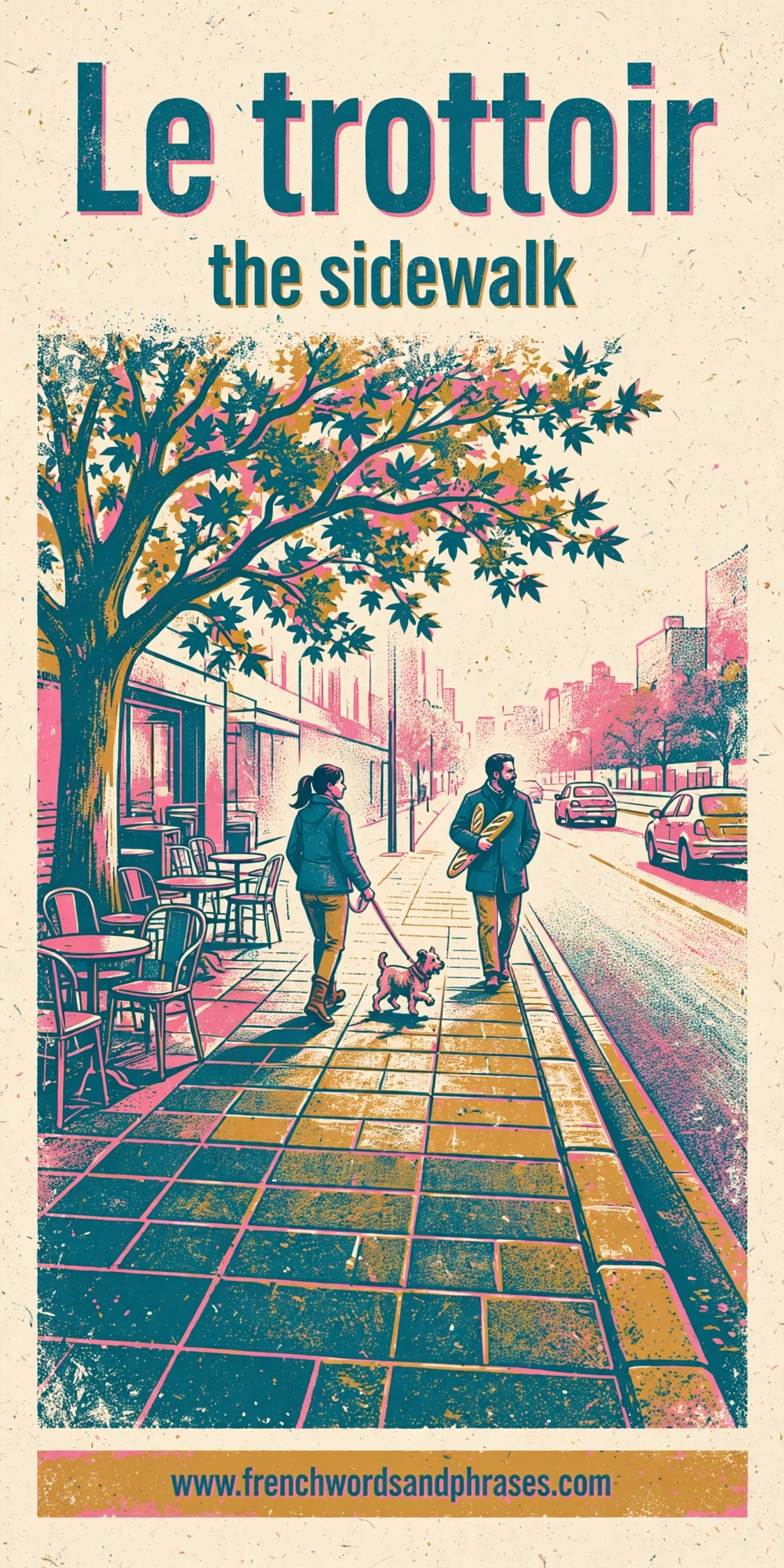
A raised stone ribbon between the café terraces and the traffic, where the whole town walks its dogs, its shopping and its thoughts: le trottoir, the sidewalk — the pedestrian’s own strip of the city, one step above the road and a whole world apart from it.
In this guide, you’ll learn what trottoir means in English, how to use it with its articles, how to form its plural, and how it appears in everyday French. Explore French examples, English translations, and practice quizzes.
Understanding the French Noun Trottoir
Trottoir is a masculine French noun, learned with its article: le trottoir, un trottoir. It is built on trotter, to trot — the pavement is the trotting-place, the strip where feet go at their walking pace, safely above the roadway, la chaussée, which belongs to wheels. In Paris the trottoirs are famously wide enough to hold the café terraces that spill across them every summer.
It means the sidewalk, the pavement — the raised walkway along a street: marcher sur le trottoir, to walk on the pavement, le trottoir d’en face, the pavement opposite, descendre du trottoir, to step off the kerb. Its furniture is the street’s: le bord du trottoir, the kerb itself, and its modern dramas are shared space — terraces, scooters and prams negotiating the same stone ribbon. A very wide one, planted with trees, becomes une allée or un mail.
Gender: Masculine — le trottoir
Definite article: le — le trottoir (the sidewalk)
Indefinite article: un — un trottoir (a sidewalk)
Plural: les trottoirs — regular, with a simple -s
Spelling note: built on trotter, to trot — the trotting-place for feet
Its opposite number: la chaussée — the roadway, for wheels
English equivalents: The sidewalk, the pavement.
Children are drilled in its border: reste sur le trottoir, stay on the pavement, and descendre du trottoir only at the passage piétons. Crossing the street can be measured in trottoirs: c’est sur le trottoir d’en face, it’s on the opposite pavement. And the word keeps one disreputable idiom in reserve: faire le trottoir, literally to walk the pavement, is the set phrase for street prostitution — recognise it, and let context warn you.
Experience the Word
Trottoir is the city’s catwalk and corridor at once: everyone performs their errands on it, one step above the river of cars.
Imagine the boulevard at six in the evening — terraces spilling over the stones, dogs on leads, a child on a scooter threading the crowd, the whole town walking home along its raised ribbon.
You have not just named pavement. You have named the walker’s territory — le trottoir, the sidewalk, the city’s stage at ankle height.
How to Use Trottoir in French: Complete Guide
Let’s explore how trottoir works in French, beginning with its articles — le trottoir, un trottoir, marcher sur le trottoir.
Trottoir with the Definite Article (Le, Les)
Used for a specific sidewalk — this side’s, the one opposite.
| Form | French |
|---|---|
| Masculine singular | le trottoir |
| Plural | les trottoirs |
Example
Le trottoir est large devant la mairie.
The sidewalk is wide in front of the town hall.
Trottoir with the Indefinite Article (Un, Des)
Used for a sidewalk in general — any raised ribbon along a road.
| Form | French |
|---|---|
| Masculine singular | un trottoir |
| Plural | des trottoirs |
Example
Cette petite rue n’a pas de trottoir.
This little street has no sidewalk.
Trottoir in the Street (D’en face, Bord, Descendre…)
The pavement’s working phrases — opposite sides, kerbs and stepping down.
| Expression | French |
|---|---|
| the opposite sidewalk | le trottoir d’en face |
| the edge of the kerb | le bord du trottoir |
| to step off the kerb | descendre du trottoir |
| to walk on the pavement | marcher sur le trottoir |
| to stay on the pavement | rester sur le trottoir |
Example
La boulangerie est sur le trottoir d’en face.
The bakery is on the opposite sidewalk.
Quick Quiz 1
Complete the sentence:
______ trottoir est couvert de feuilles en automne. (the)
Reveal the answer
Le
Le trottoir est couvert de feuilles en automne.
The sidewalk is covered with leaves in autumn — trottoir is masculine, so le.
The Plural of Trottoir
Trottoir takes a regular plural in -s — every street offers two of them.
| Number | French |
|---|---|
| Singular | le trottoir |
| Plural | les trottoirs |
Example
Les trottoirs de Paris sont célèbres pour leurs terrasses.
The sidewalks of Paris are famous for their café terraces.
Trottoir with Possessive Adjectives (Notre, Votre…)
A street claims its side: notre trottoir — possessives agree with trottoir, masculine singular.
| Owner | French |
|---|---|
| our | notre trottoir |
| your (vous) | votre trottoir |
| their | leur trottoir |
| the opposite one | le trottoir d’en face |
| this side’s | le trottoir de ce côté |
Example
Notre trottoir est toujours à l’ombre le matin.
Our sidewalk is always in the shade in the morning.
Quick Quiz 2
Complete the sentence:
Les enfants restent sur ______ trottoir. (their)
Reveal the answer
leur
Les enfants restent sur leur trottoir.
The children stay on their sidewalk — leur, agreeing with the singular trottoir.
Trottoir with Demonstrative Adjectives (Ce, Ces)
Used to point: ce trottoir, this sidewalk — this side, not the sunny one opposite.
| Form | French |
|---|---|
| Masculine singular | ce trottoir |
| Plural | ces trottoirs |
Example
Ce trottoir est trop étroit pour les poussettes.
This sidewalk is too narrow for pushchairs.
Trottoir with Adjectives
Adjectives agree with trottoir — masculine singular: un trottoir large, un trottoir étroit.
| Adjective | With Trottoir |
|---|---|
| large (wide) | un trottoir large |
| étroit (narrow) | un trottoir étroit |
| d’en face (opposite) | le trottoir d’en face |
| propre (clean) | un trottoir propre |
| glissant (slippery) | un trottoir glissant |
Example
Un trottoir large accueille les terrasses des cafés.
A wide sidewalk welcomes the café terraces.
Quick Quiz 3
Complete the sentence:
Attention, le trottoir est ______ ce matin. (slippery)
Reveal the answer
glissant
Attention, le trottoir est glissant ce matin.
Careful, the sidewalk is slippery this morning — glissant, masculine, to agree with trottoir.
Everyday Expressions with Trottoir
Kerbs, terraces and opposite sides — the trottoir phrases of daily life.
| Expression | In English |
|---|---|
| le trottoir d’en face | the opposite sidewalk |
| le bord du trottoir | the kerb, the edge of the pavement |
| descendre du trottoir | to step off the kerb |
| rester sur le trottoir | to stay on the pavement (the child’s rule) |
| marcher sur le trottoir | to walk on the sidewalk |
Example
Reste sur le trottoir et attends le bonhomme vert.
Stay on the pavement and wait for the green man.
Words from the Same Family as Trottoir
Streets and walking — the words that travel with trottoir.
| French | In English |
|---|---|
| la chaussée | the roadway — the wheels’ territory |
| un piéton | a pedestrian — the trottoir’s citizen |
| le passage piétons | the pedestrian crossing |
| la rue | the street as a whole |
| marcher | to walk (the verb) |
Example
Les piétons marchent sur le trottoir, les voitures sur la chaussée.
Pedestrians walk on the sidewalk, cars drive on the roadway.
Quick Quiz 4
What is the opposite of le trottoir in the street’s geography?
Reveal the answer
La chaussée — the roadway, the territory of wheels.
Ne marche pas sur la chaussée, reste sur le trottoir.
Don’t walk on the roadway, stay on the sidewalk.
Trottoir in Everyday French: Real-Life Examples
Now that you know the word, let’s see how trottoir appears in everyday French.
Example 1 — The rule
Les enfants marchent sur le trottoir, jamais sur la route.
The children walk on the sidewalk, never on the road.
Example 2 — Opposite
Le café est sur le trottoir d’en face.
The café is on the opposite sidewalk.
Example 3 — The kerb
Elle descend du trottoir au passage piétons.
She steps off the kerb at the pedestrian crossing.
Example 4 — Terraces
Les terrasses occupent la moitié du trottoir.
The terraces take up half the sidewalk.
Example 5 — Rain
Le trottoir brille sous la pluie.
The sidewalk shines in the rain.
Example 6 — Too narrow
Ce trottoir est trop étroit, marchons sur l’autre.
This sidewalk is too narrow, let’s walk on the other one.
Beyond Translation: The Meaning of Trottoir
The trottoir is a small constitution in stone: raised one step above the chaussée, it declares that the walker, the slowest and smallest citizen of the street, has a territory the traffic may not annex. Paris turned it into a way of life — the wide Haussmann trottoirs became the city’s outdoor salons, holding its cafés, its kiosks and its flâneurs. Even its verb remembers the body: trotter, to trot, the pace of feet that have somewhere to be and all the time in the world to get there.
To say trottoir is to walk the city at human pace.
It evokes café terraces, kerbs at dusk and the opposite pavement waving back — the street, from the walker’s side.
How to Remember the French Noun Trottoir
Remember it this way: Trottoir is the sidewalk — masculine: le trottoir, un trottoir, opposite the chaussée where the cars go.
- Always masculine — le trottoir, un trottoir, notre trottoir.
- The pair — feet on le trottoir, wheels on la chaussée.
- The crossing phrase — le trottoir d’en face, the opposite sidewalk.
The key idea is le trottoir — the sidewalk, masculine; built on trotter, to trot.
Test Your Knowledge of Trottoir
Let’s see how much you’ve learned. Try answering these questions before revealing the answers.
Question 1
Is trottoir masculine or feminine?
Reveal the answer
Masculine — le trottoir, un trottoir.
Question 2
What is the roadway called, opposite the trottoir?
Reveal the answer
La chaussée — the territory of wheels.
Question 3
Translate: The bakery is on the opposite sidewalk.
Reveal the answer
La boulangerie est sur le trottoir d’en face.
Question 4
What verb is trottoir built on?
Reveal the answer
Trotter — to trot; the pavement is the trotting-place.
Question 5
Complete the sentence:
______ trottoirs de Paris sont larges. (the)
Reveal the answer
Les
Les trottoirs de Paris sont larges.
The sidewalks of Paris are wide.
Your Final Challenge
Can You Use It?
How would you say this in French?
“Stay on the pavement and wait for the green man.”
Reveal the answer
Reste sur le trottoir et attends le bonhomme vert.
Stay on the pavement and wait for the green man.
A little French. A little curiosity. A richer everyday life.
LEARN FRENCH ONE WORD AT A TIME