
A French Word to Live By
How to Conjugate Trompéter in French
/tʁɔ̃.pe.te/
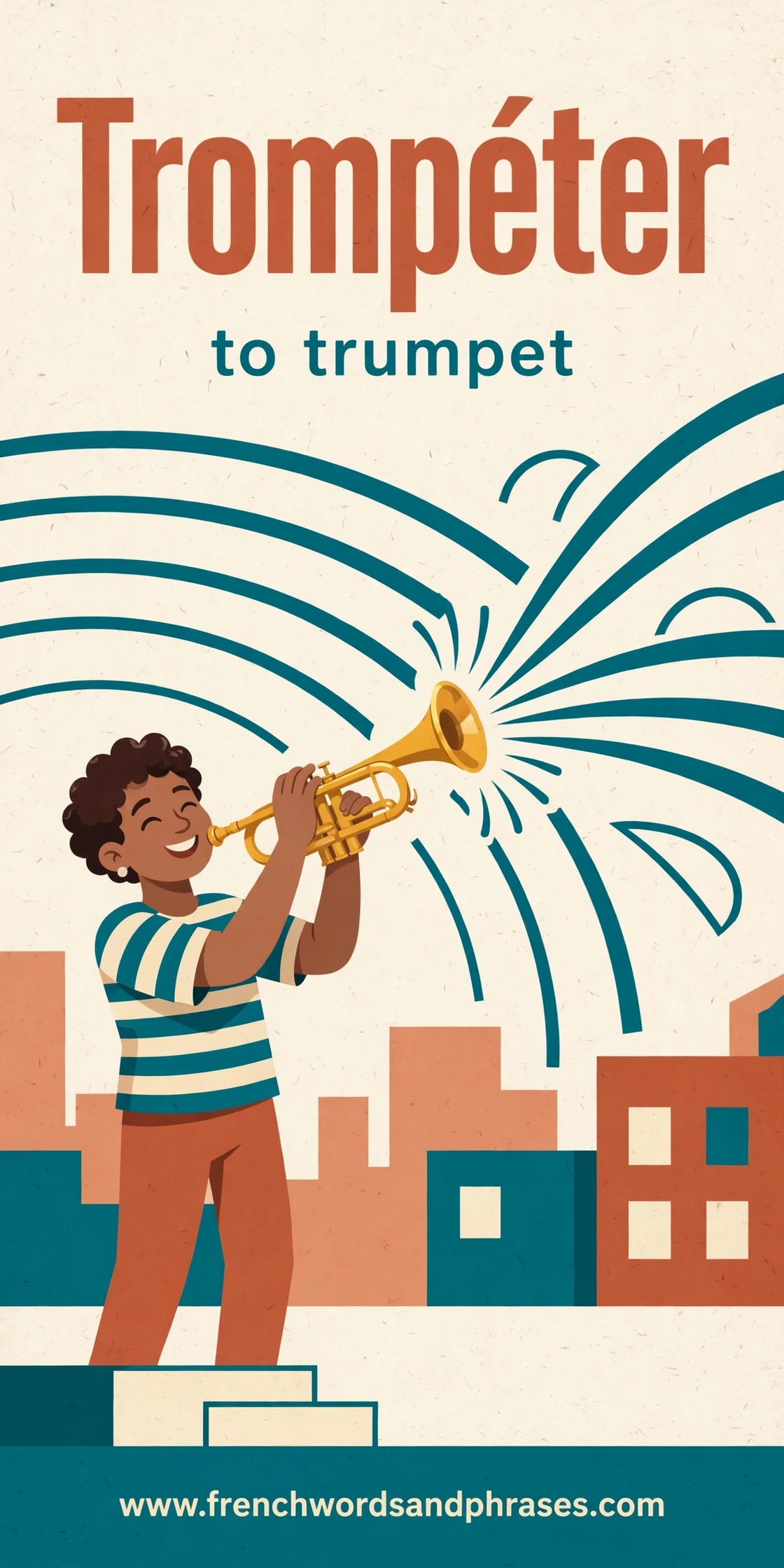
Trompéter means to trumpet — to blare out like a trumpet, and to proclaim something loudly so that nobody can miss it.
Dawn at the waterhole: the old elephant lifts her trunk high and trompète — a blast that rolls across the plain and sends the birds up in a white swirl. Trompéter is the verb of the trumpet itself: to blare, and, figuratively, to announce something at full volume to the whole world.
In this guide, you’ll learn how to conjugate trompéter in all the major French tenses and moods. Explore complete conjugation tables, French examples, English translations, and practice quizzes.
Understanding the French Verb Trompéter
Trompéter is a regular French verb belonging to the first group of verbs, those ending in -er.
It means to trumpet. It is commonly used for the cry of elephants and trumpeter swans, for heralds and town criers of old, and above all figuratively: to trumpet news, a victory or one’s own success, loudly and in public, sometimes with a hint of showing off.
Verb classification: First group (-er)
Auxiliary verb: Avoir
Past participle: trompété
Present participle: trompétant
English equivalents: To trumpet, to blare out; trompéter une nouvelle — to trumpet the news, to proclaim it everywhere; un cygne trompette — a trumpeter swan; annoncer à cor et à cri — to announce with horn and cry, from the rooftops.
One important detail: trompéter doubles its t wherever the ending that follows begins with a mute e: je trompette, tu trompettes, il trompette, ils trompettent, and the doubling runs through the future and conditional — je trompetterai, je trompetterais. But where the ending is fully sounded, the t stays single and the é keeps its accent: nous trompétons, vous trompétez, je trompétais, que nous trompétions, past participle trompété. It behaves exactly like jeter: throw the ending down to a whisper and the consonant doubles to hold the sound up.
Experience the Word
Trompéter is the verb of the public blast — nothing about it is quiet, private or discreet.
Imagine a medieval square at dawn. The herald climbs the steps of the church, raises his long trumpet, and announces the king’s decree while the market stalls are still being set up. Nobody within the walls can pretend not to have heard: the news has been trompétée.
The secret is a secret no longer. It has been trumpeted — trompété — to the four corners of the town.
How to Conjugate Trompéter: Complete French Conjugation Guide
Let’s explore every major conjugation of trompéter, beginning with the indicative mood.
How to Conjugate Trompéter in the Indicative Mood
The indicative mood is used to express facts, observations, actions, and events.
How to Conjugate Trompéter in the Present Tense (Présent)
Used for actions happening now, habitual actions, and general truths.
| Subject | Conjugation |
|---|---|
| je | trompette |
| tu | trompettes |
| il / elle | trompette |
| nous | trompétons |
| vous | trompétez |
| ils / elles | trompettent |
Example
Au lever du jour, l’éléphant trompette et réveille toute la savane.
At daybreak, the elephant trumpets and wakes the whole savanna.
Quick Quiz 1
Complete the sentence:
Nous ______ les annonces du roi sur la place.
Reveal the answer
trompétons
Nous trompétons les annonces du roi sur la place.
We trumpet the king’s announcements in the square. (Single t: the ending is fully sounded.)
How to Conjugate Trompéter in the Passé Composé
Used for completed actions in the past. Trompéter takes the auxiliary verb avoir.
| Subject | Conjugation |
|---|---|
| j’ | ai trompété |
| tu | as trompété |
| il / elle | a trompété |
| nous | avons trompété |
| vous | avez trompété |
| ils / elles | ont trompété |
Example
Il a trompété la nouvelle dans tout le village.
He trumpeted the news all over the village.
How to Conjugate Trompéter in the Imparfait (Imperfect Tense)
Used for habitual past actions, descriptions, and ongoing situations in the past.
| Subject | Conjugation |
|---|---|
| je | trompétais |
| tu | trompétais |
| il / elle | trompétait |
| nous | trompétions |
| vous | trompétiez |
| ils / elles | trompétaient |
Example
Les hérauts trompétaient l’arrivée du roi sur la place du marché.
The heralds used to trumpet the king’s arrival in the market square.
Quick Quiz 2
Choose the correct form:
Il ______ la nouvelle dans tout le village. (trompette / trompète)
Reveal the answer
trompette
Il trompette la nouvelle dans tout le village.
He trumpets the news all over the village.
How to Conjugate Trompéter in the Plus-que-parfait
Used to describe an action that had already been completed before another past event.
| Subject | Conjugation |
|---|---|
| j’ | avais trompété |
| tu | avais trompété |
| il / elle | avait trompété |
| nous | avions trompété |
| vous | aviez trompété |
| ils / elles | avaient trompété |
Example
Elle avait trompété son succès avant même la signature du contrat.
She had trumpeted her success before the contract was even signed.
How to Conjugate Trompéter in the Passé Simple
Primarily used in formal writing, literature, and historical narratives. It is rarely used in everyday conversation.
| Subject | Conjugation |
|---|---|
| je | trompétai |
| tu | trompétas |
| il / elle | trompéta |
| nous | trompétâmes |
| vous | trompétâtes |
| ils / elles | trompétèrent |
Example
Le cygne trompéta au-dessus de l’étang brumeux.
The swan trumpeted over the misty pond.
How to Conjugate Trompéter in the Passé Antérieur
A literary tense used to express an action completed immediately before another past action, generally in the passé simple.
| Subject | Conjugation |
|---|---|
| j’ | eus trompété |
| tu | eus trompété |
| il / elle | eut trompété |
| nous | eûmes trompété |
| vous | eûtes trompété |
| ils / elles | eurent trompété |
Example
Quand il eut trompété la victoire, la foule éclata en cris de joie.
When he had trumpeted the victory, the crowd burst into cheers.
How to Conjugate Trompéter in the Future Tense (Futur Simple)
Used to describe actions that will take place in the future.
| Subject | Conjugation |
|---|---|
| je | trompetterai |
| tu | trompetteras |
| il / elle | trompettera |
| nous | trompetterons |
| vous | trompetterez |
| ils / elles | trompetteront |
Example
Demain, les journaux trompetteront la nouvelle en première page.
Tomorrow, the newspapers will trumpet the news on the front page.
How to Conjugate Trompéter in the Futur Antérieur (Future Perfect)
Used for an action that will have been completed before a particular point in the future.
| Subject | Conjugation |
|---|---|
| j’ | aurai trompété |
| tu | auras trompété |
| il / elle | aura trompété |
| nous | aurons trompété |
| vous | aurez trompété |
| ils / elles | auront trompété |
Example
À midi, il aura trompété son départ à tout le bureau.
By noon, he will have trumpeted his departure to the whole office.
How to Conjugate Trompéter in the Near Future (Futur Proche)
Used to describe something that is going to happen soon. Formed with aller + infinitive.
| Subject | Conjugation |
|---|---|
| je | vais trompéter |
| tu | vas trompéter |
| il / elle | va trompéter |
| nous | allons trompéter |
| vous | allez trompéter |
| ils / elles | vont trompéter |
Example
Je vais trompéter la bonne nouvelle, préparez le champagne !
I am going to trumpet the good news, get the champagne ready!
How to Conjugate Trompéter in the Conditional Mood
The conditional mood expresses what would happen under certain circumstances. It is also frequently used to make polite requests or express wishes.
How to Conjugate Trompéter in the Present Conditional
| Subject | Conjugation |
|---|---|
| je | trompetterais |
| tu | trompetterais |
| il / elle | trompetterait |
| nous | trompetterions |
| vous | trompetteriez |
| ils / elles | trompetteraient |
Example
Tu trompetterais cette rumeur dans tout le quartier si on te laissait faire.
You would trumpet this rumour all over the neighbourhood if you were allowed to.
How to Conjugate Trompéter in the Past Conditional
| Subject | Conjugation |
|---|---|
| j’ | aurais trompété |
| tu | aurais trompété |
| il / elle | aurait trompété |
| nous | aurions trompété |
| vous | auriez trompété |
| ils / elles | auraient trompété |
Example
Il aurait trompété la nouvelle si elle avait été vraie.
He would have trumpeted the news if it had been true.
Trompéter in the Literary Past Conditional Form
This less common literary form uses the imperfect subjunctive of avoir.
| Subject | Conjugation |
|---|---|
| j’ | eusse trompété |
| tu | eusses trompété |
| il / elle | eût trompété |
| nous | eussions trompété |
| vous | eussiez trompété |
| ils / elles | eussent trompété |
Example
Le héraut eût trompété l’annonce dès l’aube.
The herald would have trumpeted the announcement at dawn.
How to Conjugate Trompéter in the Subjunctive Mood
The subjunctive is used to express wishes, emotions, doubts, necessity, and uncertainty. It frequently follows expressions such as il faut que (it is necessary that) or bien que (although).
How to Conjugate Trompéter in the Present Subjunctive
| Subject | Conjugation |
|---|---|
| que je | trompette |
| que tu | trompettes |
| qu’il / qu’elle | trompette |
| que nous | trompétions |
| que vous | trompétiez |
| qu’ils / qu’elles | trompettent |
Example
Il faut que tu trompettes la nouvelle, tout le monde doit l’entendre !
You must trumpet the news, everyone must hear it!
Quick Quiz 3
Complete the sentence using the subjunctive:
Il faut que vous ______ moins fort.
Reveal the answer
trompétiez
Il faut que vous trompétiez moins fort.
You must trumpet less loudly.
How to Conjugate Trompéter in the Imperfect Subjunctive
A literary tense, rarely encountered in modern spoken French.
| Subject | Conjugation |
|---|---|
| que je | trompétasse |
| que tu | trompétasses |
| qu’il / qu’elle | trompétât |
| que nous | trompétassions |
| que vous | trompétassiez |
| qu’ils / qu’elles | trompétassent |
Example
Le roi exigeait que le héraut trompétât devant la cour assemblée.
The king demanded that the herald trumpet before the assembled court.
How to Conjugate Trompéter in the Pluperfect Subjunctive
A literary construction used to express an action completed before another past action.
| Subject | Conjugation |
|---|---|
| que j’ | eusse trompété |
| que tu | eusses trompété |
| qu’il / qu’elle | eût trompété |
| que nous | eussions trompété |
| que vous | eussiez trompété |
| qu’ils / qu’elles | eussent trompété |
Example
On racontait qu’il eût trompété sa victoire avant même la bataille.
People told how he had trumpeted his victory before the battle had even begun.
How to Conjugate Trompéter in the Past Subjunctive
| Subject | Conjugation |
|---|---|
| que j’ | aie trompété |
| que tu | aies trompété |
| qu’il / qu’elle | ait trompété |
| que nous | ayons trompété |
| que vous | ayez trompété |
| qu’ils / qu’elles | aient trompété |
Example
Je suis étonné qu’elle ait trompété ce secret à tout le monde.
I am amazed that she trumpeted this secret to everyone.
How to Conjugate Trompéter in the Imperative
The imperative is used to give commands, instructions, invitations, or suggestions. Subject pronouns are omitted.
How to Conjugate Trompéter in the Present Imperative
| Person | Conjugation |
|---|---|
| (tu) | trompette |
| (nous) | trompétons |
| (vous) | trompétez |
Example
Trompette la nouvelle, que tout le village l’entende !
Trumpet the news, let the whole village hear it!
Quick Quiz 4
How would you say Trumpet the news (tu form)?
Reveal the answer
Trompette la nouvelle !
French Participles of Trompéter
Participles are verb forms that can be used in compound tenses and other grammatical constructions.
Present Participle of Trompéter
trompétant
En trompétant sa réussite, il a fini par agacer ses collègues.
By trumpeting his success, he ended up annoying his colleagues.
Past Participle of Trompéter
trompété
Trompétée dans tous les journaux, la nouvelle a fait le tour du pays.
Trumpeted in every newspaper, the news went around the country.
Trompéter in Everyday French: Real-Life Examples
Now that you know the conjugations, let’s see how trompéter appears in everyday French.
Example 1 — Present
L’éléphant trompette au bord du point d’eau.
The elephant trumpets by the waterhole.
Example 2 — Passé composé
Elle a trompété la bonne nouvelle partout.
She trumpeted the good news everywhere.
Example 3 — Imparfait
Les hérauts trompétaient les annonces du roi.
The heralds used to trumpet the king’s announcements.
Example 4 — Future
Les journaux trompetteront l’événement demain.
The newspapers will trumpet the event tomorrow.
Example 5 — Conditional
Tu trompetterais ce secret si tu le connaissais.
You would trumpet this secret if you knew it.
Example 6 — Imperative
Trompétez l’annonce, faites-la entendre partout !
Trumpet the announcement, make it heard everywhere!
Beyond Translation: The Meaning of Trompéter
The elephant’s official cry in French is barrir, but storytellers reach for trompéter whenever the trunk goes up like a trumpet — and the instrument is right there in the verb: la trompette.
To trumpet is to make it public.
French even keeps the old hunting cry for it: annoncer à cor et à cri, to announce with horn and shout. If someone trompette a piece of news, discretion is over — the whole town is meant to hear.
How to Remember the French Verb Trompéter
Remember it this way: Trompéter is about the elephant’s blast and the town crier’s announcement — loud, public, impossible to miss.
- From la trompette, the trumpet — trompéter is to blare like one, and to announce at full blast.
- Double t before a mute ending: je trompette, ils trompettent, je trompetterai — but nous trompétons keeps a single t and its é.
- Regular -er pattern with avoir: j’ai trompété la nouvelle — I trumpeted the news.
The key idea is the elephant’s blast and the town crier’s announcement — loud, public, impossible to miss.
Test Your Knowledge of Trompéter
Let’s see how much you’ve learned. Try answering these questions before revealing the answers.
Question 1
How do you say to trumpet the news in French?
Reveal the answer
Trompéter la nouvelle.
Question 2
How do you say The elephant trumpets at dawn in French?
Reveal the answer
L’éléphant trompette à l’aube.
Question 3
Translate: She trumpeted the good news everywhere.
Reveal the answer
Elle a trompété la bonne nouvelle partout.
Question 4
What is the past participle of trompéter?
Reveal the answer
Trompété.
Question 5
Complete the sentence:
Il faut que tu ______ la nouvelle, tout le monde doit l’entendre.
Reveal the answer
trompettes
Il faut que tu trompettes la nouvelle, tout le monde doit l’entendre.
You must trumpet the news, everyone must hear it.
Your Final Challenge
Can You Use It?
How would you say this in French?
The elephant trumpets at daybreak, and the whole savanna wakes up.
Reveal the answer
L’éléphant trompette au lever du jour, et toute la savane se réveille.
The elephant trumpets at daybreak, and the whole savanna wakes up.
A little French. A little curiosity. A richer everyday life.
LEARN FRENCH ONE WORD AT A TIME




