
A French Word to Live By
Translate Travail to English
/tʁa.vaj/
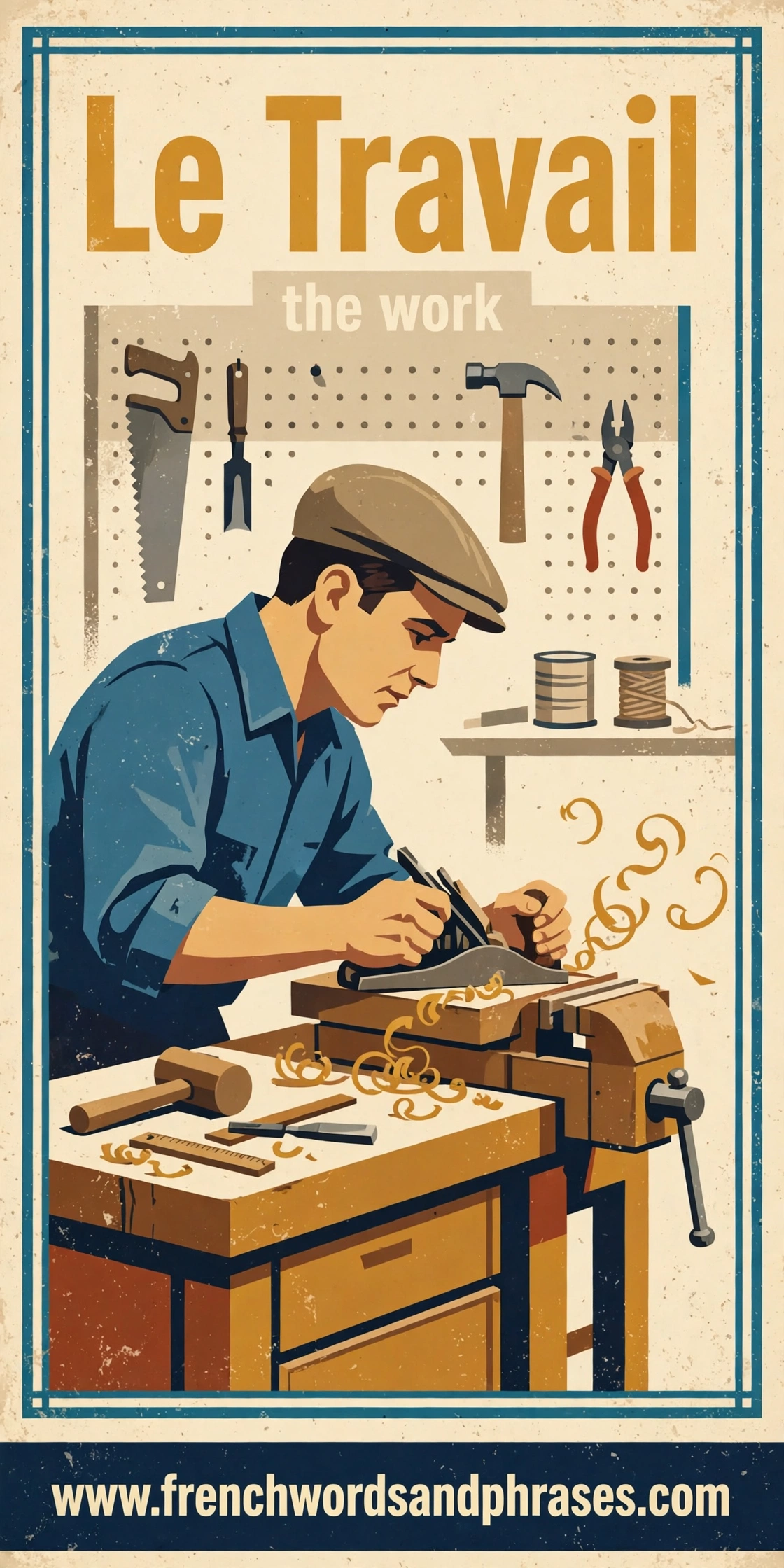
Le Travail means work, a job.
At eight in the morning the trains fill, the cafés empty, and a whole country goes to its travail — the work that builds the day, the job that pays for the bread, the task that waits on the desk.
In this guide, you’ll learn what travail means in English, how to use it with its articles, how to form its plural, and how it appears in everyday French. Explore French examples, English translations, and practice quizzes.
Understanding the French Noun Travail
Travail is a masculine French noun. Like every French noun, it has a gender, and it is learned together with its article: le travail.
It means work — and a job, a piece of work, a task. It is the effort itself and the shape it gives to the day: aller au travail, to go to work. Watch its plural: one travail, but les travaux — the ending changes completely, and in the plural the word often means works: roadworks, building works.
Gender: Masculine
Definite article: le — le travail (the work)
Indefinite article: un — un travail (a job, a piece of work)
Partitive article: du — du travail (some work)
Plural: les travaux (irregular — never ‘travails’)
English equivalents: Work; a job.
One important detail, and it catches everyone: the plural of travail is not travails but travaux — un travail, des travaux. In the plural, travaux often means works in progress: les travaux dans la rue, the roadworks in the street. Remember: that -aux ending is the mark of an old word being gloriously irregular.
Experience the Word
Travail is more than a job. It is the architecture of the French day: the train taken, the desk reached, the task finished well before the evening opens.
Imagine a baker in Bordeaux at four in the morning, alone with the ovens while the town sleeps. His travail will be on a hundred tables by eight — work you can taste.
You have not just earned a living. You have built the day with your own hands.
How to Use Travail in French: Complete Guide
Let’s explore how travail works in French, beginning with its articles.
Travail with the Definite Article (Le, Les)
Used for work in general, or for the job both speakers know.
| Number | French |
|---|---|
| Singular | le travail |
| Plural | les travaux |
Example
Le travail commence à huit heures.
Work starts at eight o’clock.
Travail with the Indefinite Article (Un, Des)
Used for a job, a post, a piece of work: chercher un travail, to look for a job.
| Number | French |
|---|---|
| Singular | un travail |
| Plural | des travaux |
Example
Il cherche un travail à Paris.
He is looking for a job in Paris.
Travail with the Partitive Article (Du — Some Work)
Used for work as a substance, the amount waiting on your desk: some work, more work.
| Meaning | French |
|---|---|
| some work | du travail |
| no work (after a negative) | de travail |
Example
J’ai du travail à finir ce soir.
I have work to finish this evening.
Quick Quiz 1
How do you say some work in French?
Reveal the answer
du travail
J’ai du travail à finir.
I have some work to finish.
The Plural of Travail
Here is the famous exception: travail does not add an -s. Its plural is travaux — the whole ending changes, a souvenir of old French.
| Number | French |
|---|---|
| Singular | le travail |
| Plural | les travaux |
Example
Les travaux dans la rue durent un mois.
The roadworks in the street will last a month.
Travail with Possessive Adjectives (Mon, Ton, Son…)
Possessives agree with the noun, not with the owner — and travail is masculine, so it takes mon, ton, son.
| Owner | French |
|---|---|
| my | mon travail |
| your (tu) | ton travail |
| his / her | son travail |
| our | notre travail |
| your (vous) | votre travail |
| their | leur travail |
Example
Nous aimons notre travail.
We love our work.
Quick Quiz 2
Complete the sentence:
Elle adore ______ travail. (her)
Reveal the answer
son
Elle adore son travail.
She loves her job. (Travail is masculine, so son — even for a female owner.)
Travail with Demonstrative Adjectives (Ce, Ces)
Used to point at the work in front of you: this job, these works.
| Number | French |
|---|---|
| Singular | ce travail |
| Plural | ces travaux |
Example
Ce travail est difficile.
This work is difficult.
Travail with Adjectives
Nouveau, bon and premier come before travail; most other adjectives follow it. All agree with a masculine noun.
| Adjective | With Travail |
|---|---|
| nouveau (new) | un nouveau travail |
| bon (good) | un bon travail |
| premier (first) | mon premier travail |
| dur (hard) | un travail dur |
| gros (big) | un gros travail |
| beau (fine) | un beau travail |
Example
Bon travail, tout le monde !
Good work, everyone!
Quick Quiz 3
Complete the sentence:
Elle a trouvé un ______ travail à Paris. (new)
Reveal the answer
nouveau
Elle a trouvé un nouveau travail à Paris.
She found a new job in Paris. (Nouveau comes before the noun.)
Everyday Expressions with Travail
Work shapes the day, and these phrases shape how the French talk about it.
| Expression | In English |
|---|---|
| aller au travail | to go to work |
| être au travail | to be at work |
| le travail d’équipe | teamwork |
| sans travail | out of work, unemployed |
| un travail de titan | a mammoth task |
| le marché du travail | the job market |
Example
Il est sans travail depuis le mois de mars.
He has been out of work since March.
Words from the Same Family as Travail
Learn these together and the whole world of work falls into place.
| French | In English |
|---|---|
| travailler | to work |
| un travailleur / une travailleuse | a worker |
| un collègue | a colleague |
| un employeur | an employer |
| un emploi | a job, employment |
| un métier | a trade, a profession |
Example
Mes collègues de travail sont très sympathiques.
My work colleagues are very nice.
Quick Quiz 4
What are les travaux?
Reveal the answer
Works — roadworks, construction work
Les travaux durent un mois.
The roadworks will last a month. (Travaux is the irregular plural of travail.)
Travail in Everyday French: Real-Life Examples
Now that you know the word, let’s see how travail appears in everyday French.
Example 1 — A new job
Son nouveau travail lui plaît beaucoup.
She really likes her new job.
Example 2 — Going to work
Elle va au travail en train.
She goes to work by train.
Example 3 — Looking for work
Il cherche un travail depuis juin.
He has been looking for a job since June.
Example 4 — Teamwork
Le travail d’équipe est essentiel ici.
Teamwork is essential here.
Example 5 — Roadworks
Les travaux rendent la rue très bruyante.
The roadworks make the street very noisy.
Example 6 — Out of work
Mon oncle est sans travail en ce moment.
My uncle is out of work at the moment.
Beyond Translation: The Meaning of Travail
English work is a plain word; travail carries a heavier past. It is often traced to the Latin tripalium, an instrument of torture — work, the word remembers, was once suffering. Two thousand years later, travail is simply the shape of the day: the job, the task, the effort done properly.
Travail is where France puts its pride: le travail bien fait, work well done.
The old saying runs ‘le travail, c’est la santé’ — work is health. And its unruly plural, les travaux, spills out of the office into the street: the roadworks, the renovations, the great works that are always, somewhere in France, en cours.
How to Remember the French Noun Travail
Remember it this way: Travail is work and a job in one word — masculine, with a plural that breaks the rule: les travaux.
- Monday morning, the alarm rings — c’est l’heure du travail.
- Your street is dug up all month — ce sont les travaux.
- A friend lands her dream job — elle a trouvé un travail.
The key idea is un travail for a job, du travail for work to do, les travaux — never travails — for the plural.
Test Your Knowledge of Travail
Let’s see how much you’ve learned. Try answering these questions before revealing the answers.
Question 1
Is travail masculine or feminine?
Reveal the answer
Masculine — le travail.
Question 2
What is the plural of travail?
Reveal the answer
Les travaux.
Question 3
Translate: He is looking for a job.
Reveal the answer
Il cherche un travail.
Question 4
What does sans travail mean?
Reveal the answer
Out of work, unemployed.
Question 5
Complete the sentence:
Je vais ______ travail en métro. (to work — à + le)
Reveal the answer
au
Je vais au travail en métro.
I go to work by metro.
Your Final Challenge
Can You Use It?
How would you say this in French?
“Tomorrow, I start a new job.”
Reveal the answer
Demain, je commence un nouveau travail.
Tomorrow, I start a new job.
A little French. A little curiosity. A richer everyday life.
LEARN FRENCH ONE WORD AT A TIME




