A French Word to Live By
Translate Tourner au vinaigre to English
/tuʁ.ne o vi.nɛɡʁ/
Tourner au vinaigre means to turn nasty, to turn sour and get out of hand (of a situation).
The neighbourhood meeting was calm for twenty minutes — until someone mentioned the new parking charges. Voices rose, chairs scraped, and the mayor closed her notebook with a sigh. Everyone in the room could feel it: « Ça tourne au vinaigre. »
Let’s explore how tourner au vinaigre works in French, beginning with the whole phrase on one card.
Understanding the French Phrase Tourner au vinaigre
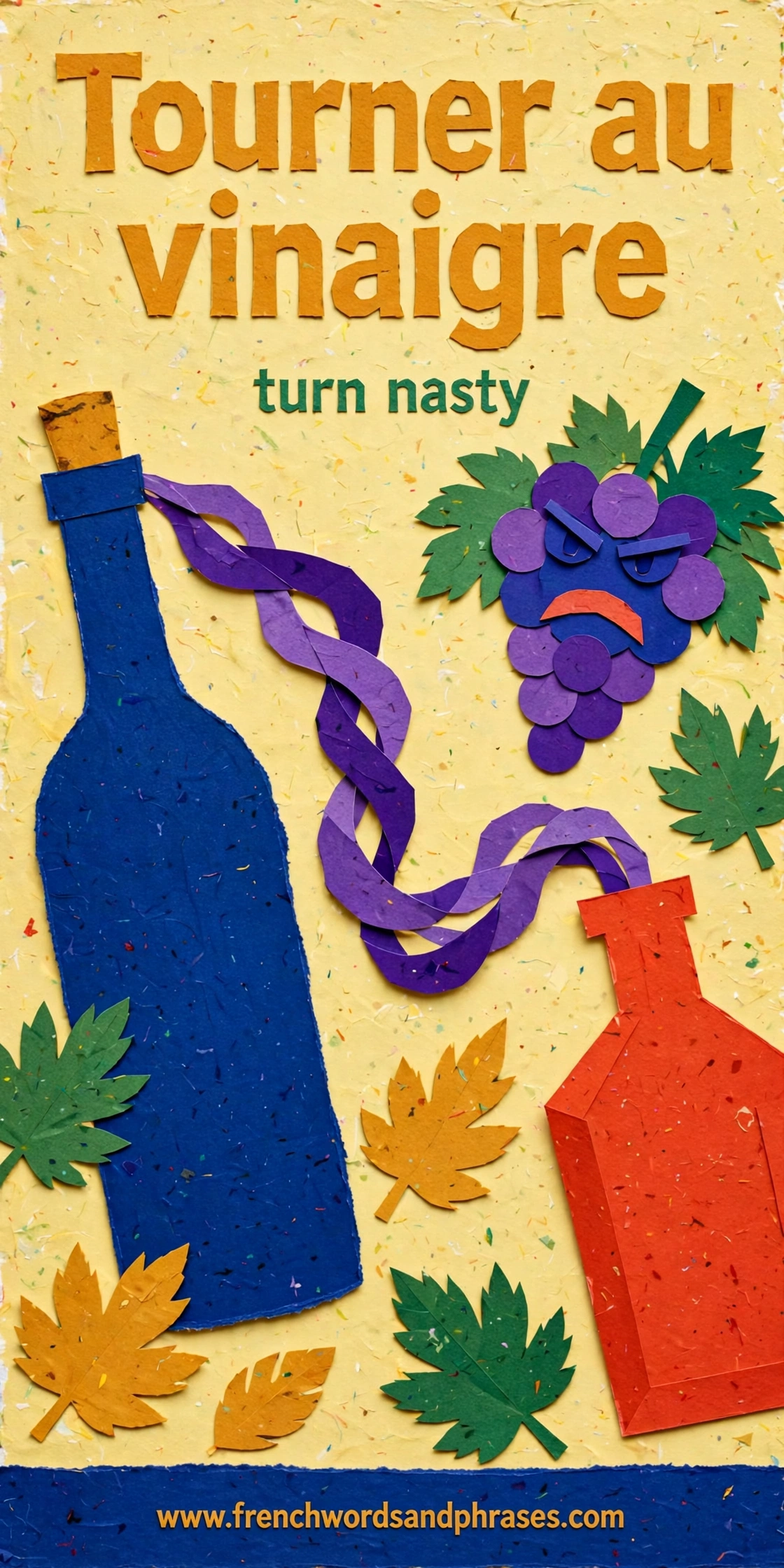
Tourner au vinaigre is a French idiomatic expression built from the verb tourner (to turn, to become) and le vinaigre (vinegar). The picture comes from the wine cellar: a good wine, left badly, turns — and becomes vinegar. What was pleasant is now sharp, sour and spoiled.
It means (of a situation) to turn nasty — to go sour and get out of hand. An evening, a discussion, a meeting, a family meal: things start well enough, then the mood curdles. The subject is almost always the situation, never a person — people lose their tempers, situations tournent au vinaigre.
Type: Idiomatic expression — a situation worsening (tourner + au vinaigre)
Answers the need: Saying a pleasant situation is turning sour, tense or nasty
Register: Neutral to informal — speech, stories and lively reporting
Strength: Serious — not a small awkwardness, but a real turn for the worse
One important usage detail: the subject is the situation — la soirée, la discussion, l’ambiance, les choses, or simply ça. You warn with ça va tourner au vinaigre (it’s going to turn nasty) and report with ça a tourné au vinaigre. For a person turning nasty, French chooses other tools: s’énerver, perdre son calme, devenir agressif.
Experience the Word
Tourner au vinaigre is the moment a room changes temperature — everyone feels it before anyone says it.
Imagine a wedding dinner where two uncles, three tables apart, begin an old argument about an inheritance. The music keeps playing, the dessert arrives, but the evening has turned, quietly and completely.
French borrowed its warning from the cellar, where a barrel can be lost in a week of carelessness. A situation, like a wine, turns — and once turned, it rarely turns back.
How to Use Tourner au vinaigre in French: Complete Guide
Let’s explore how tourner au vinaigre works in French, beginning with the whole phrase on one card.
Tourner au vinaigre at a Glance
The Whole Phrase on One Card
Real meaning, literal picture, English twin and register — tourner au vinaigre in five lines.
| Point | Tourner au vinaigre |
|---|---|
| What it really means | to turn nasty — a situation goes sour and gets out of hand |
| Word for word | to turn to vinegar |
| English equivalent | to turn nasty / to turn sour / to get out of hand |
| Register | neutral to informal — speech and lively writing |
| Use it for | evenings, discussions, meetings, family meals — situations with a mood |
Example
Quand ils ont parlé d’argent, la discussion a tourné au vinaigre.
When they started talking about money, the discussion turned nasty.
Word by Word: Building the Picture
Three small pieces — take them one by one and the wine sours.
| Word | Literal meaning | Its job in the phrase |
|---|---|---|
| tourner | to turn, to become | the change of state — the same tourner as wine turning in the barrel |
| au | to (the) | the destination of the change: towards the sour state |
| vinaigre | vinegar | what good wine becomes when it spoils — sharp, sour, undrinkable |
Example
Attention, l’ambiance tourne au vinaigre dans la salle.
Careful, the mood in the room is turning sour.
Quick Quiz 1
Where does the picture come from — what turns into vinegar?
Reveal the answer
Wine — a good wine, badly kept, turns and becomes vinegar; the situation spoils the same way.
Le vin a tourné au vinaigre, et la soirée aussi.
The wine turned to vinegar, and so did the evening.
When You Say It: The Souring Moments
Tourner au vinaigre fires at moments like these — a good start, then the turn.
| Situation | Example |
|---|---|
| A party | la fête tournait au vinaigre, alors je suis parti — the party was turning nasty, so I left |
| A discussion | la discussion a tourné au vinaigre dès qu’on a parlé d’argent — the discussion turned nasty as soon as money came up |
| A warning | si personne ne dit rien, ça va tourner au vinaigre — if nobody says anything, it’s going to turn nasty |
| A family meal | le repas de famille a tourné au vinaigre à cause d’une vieille histoire — the family meal turned nasty over an old story |
| A debate | le débat a vite tourné au vinaigre entre les deux voisins — the argument quickly turned nasty between the two neighbours |
Example
Dès qu’on a parlé de politique, la soirée a tourné au vinaigre.
As soon as politics came up, the evening turned nasty.
Make It Yours: Tenses of a Turning Mood
The subject is the situation; tourner gives you the warning, the moment and the report.
| Form | French | In English |
|---|---|---|
| Happening now | ça tourne au vinaigre | it’s turning nasty |
| Warning | ça va tourner au vinaigre | it’s going to turn nasty |
| Past report | ça a tourné au vinaigre | it turned nasty |
| A named subject | la réunion a tourné au vinaigre | the meeting turned nasty |
| Condition | si ça tourne au vinaigre, on part | if it turns nasty, we’re leaving |
| Habit | chez eux, les repas tournent souvent au vinaigre | at their house, meals often turn nasty |
Example
Si la discussion tourne au vinaigre, change de sujet.
If the discussion turns nasty, change the subject.
Quick Quiz 2
How do you warn “it’s going to turn nasty” with this idiom?
Reveal the answer
Ça va tourner au vinaigre — the near future: va + infinitive, with ça as the subject.
Reste calme, sinon ça va tourner au vinaigre.
Stay calm, or it’s going to turn nasty.
Everyday Expressions: Building on the Phrase
Tourner au vinaigre slots into these everyday frames — each one ready to use as it stands.
| Frame | In English |
|---|---|
| tourner au vinaigre dès que + event | to turn nasty as soon as money / politics comes up |
| l’ambiance tourne au vinaigre | the mood is turning sour |
| tout a tourné au vinaigre | everything turned nasty |
| éviter que ça tourne au vinaigre | to stop things turning nasty |
| avant que ça tourne au vinaigre | before it turns nasty |
Example
Il a raconté une blague pour éviter que ça tourne au vinaigre.
He told a joke to stop things turning nasty.
Close Cousins: The Other Downhill Phrases
French has a whole shelf of going-wrong phrases — tourner au vinaigre is the mood one; its cousins escalate, poison or spin.
| Expression | The difference |
|---|---|
| tourner au vinaigre | to turn nasty — the mood of a situation sours |
| dégénérer | to degenerate, to escalate — the neutral reporter’s word |
| s’envenimer | to become poisoned — for relations and arguments that fester; a fine cousin image |
| mal tourner | to turn out badly — about outcomes, not atmospheres |
| partir en vrille | to spiral out of control — informal, faster and wilder |
Example
La dispute s’est envenimée et la soirée a tourné au vinaigre.
The quarrel festered and the evening turned nasty.
Quick Quiz 3
Which cousin is about a bad outcome rather than a sour mood — mal tourner or s’envenimer?
Reveal the answer
Mal tourner — things turn out badly; s’envenimer is about relations turning poisonous.
L’opération a mal tourné, malheureusement.
The operation turned out badly, unfortunately.
Tourner au vinaigre and Its Neighbours
The atmosphere shelf around the phrase — and the rescue at the far end.
| French | In English |
|---|---|
| une ambiance détendue | a relaxed atmosphere — the before picture |
| échauffer les esprits | to heat up tempers — the warning sign |
| tourner au vinaigre | to turn nasty |
| s’apaiser | to calm down — the rescue |
| s’arranger | to work out, to settle — the happy ending |
Example
Après une heure, les esprits se sont apaisés et tout s’est arrangé.
After an hour, tempers calmed down and everything worked out.
Watch Out: The Traps Around the Vinegar
The traps: a person who cannot be the subject, and a salad that is innocent.
| Trap | The truth |
|---|---|
| giving it a human subject | situations tournent au vinaigre, people don’t — for a person, say il s’énerve or il devient agressif |
| a salad reading | the vinaigre here is spoiled wine, not a dressing — context is a mood, not a meal |
| tourner’s other lives | tourner also means to turn a corner and to shoot a film — the au vinaigre ending pins down this meaning |
| word for word in English | ‘to turn to vinegar’ is understood by no one — say turn nasty or turn sour |
Example
Il s’est énervé, et la réunion a tourné au vinaigre.
He lost his temper, and the meeting turned nasty.
Quick Quiz 4
True or false: il tourne au vinaigre is the way to say a man is turning nasty.
Reveal the answer
False — the idiom takes a situation as its subject; for the man, say il s’énerve.
Il s’énerve, et la discussion tourne au vinaigre.
He’s losing his temper, and the discussion is turning nasty.
Tourner au vinaigre in Everyday French: Real-Life Examples
Now that you know the word, let’s see how tourner au vinaigre appears in everyday French.
Example 1 — The party
La fête tournait au vinaigre, alors je suis parti.
The party was turning nasty, so I left.
Example 2 — Money talk
Quand ils ont parlé d’argent, la discussion a tourné au vinaigre.
When they started talking about money, the discussion turned nasty.
Example 3 — The mood
Attention, l’ambiance tourne au vinaigre dans la salle.
Careful, the mood in the room is turning sour.
Example 4 — The neighbours
Le débat a vite tourné au vinaigre entre les deux voisins.
The argument quickly turned nasty between the two neighbours.
Example 5 — The warning
Si personne ne dit rien, ça va tourner au vinaigre.
If nobody says anything, it’s going to turn nasty.
Example 6 — The family meal
Le repas de famille a tourné au vinaigre à cause d’une vieille histoire.
The family meal turned nasty because of an old story.
Beyond Translation: The Meaning of Tourner au vinaigre
A barrel of wine is a promise that takes years to keep — and one careless week to break. French, a wine civilisation, naturally keeps its sharpest picture of social failure in the cellar: what was made with patience and hope has turned, and no one can drink it now.
To tourner au vinaigre is to watch something good become undrinkable.
The phrase also carries the cellar’s wisdom: turning is a process, not an instant. There is usually a moment — a word, a silence, a joke too far — when someone in the room could still have saved the barrel.
How to Remember the French Phrase Tourner au vinaigre
Remember it this way: Tourner au vinaigre is wine gone wrong — the subject is always the situation, never the person.
- You picture the barrel — good wine, badly kept, tourne: turns. Situations spoil exactly the same way.
- You give it a situation for a subject — la soirée, la discussion, ça — never a person.
- You keep the three tenses ready — ça tourne, ça va tourner, ça a tourné au vinaigre.
The key idea is tourner au vinaigre means to turn nasty — a situation going sour, like wine becoming vinegar.
Test Your Knowledge of Tourner au vinaigre
Let’s see how much you’ve learned. Try answering these questions before revealing the answers.
Question 1
What does tourner au vinaigre mean?
Reveal the answer
To turn nasty — a situation goes sour and gets out of hand.
Question 2
What is the literal, word-for-word meaning?
Reveal the answer
To turn to vinegar — the picture of good wine spoiling in the barrel.
Question 3
Can a person be the subject — il tourne au vinaigre?
Reveal the answer
No. The subject is the situation: la soirée tourne au vinaigre. For a person, use s’énerver.
Question 4
How do you say ‘it turned nasty’?
Reveal the answer
Ça a tourné au vinaigre — the passé composé of tourner.
Question 5
Complete the sentence:
Si personne ne dit rien, ça va tourner au ______. (If nobody says anything, it’s going to turn nasty.)
Reveal the answer
vinaigre
Si personne ne dit rien, ça va tourner au vinaigre.
If nobody says anything, it’s going to turn nasty.
Your Final Challenge
Can You Use It?
How would you say this in French?
“As soon as politics came up, the evening turned nasty.”
Reveal the answer
Dès qu’on a parlé de politique, la soirée a tourné au vinaigre.
As soon as politics came up, the evening turned nasty.
A little French. A little curiosity. A richer everyday life.
LEARN FRENCH ONE WORD AT A TIME