A French Word to Live By
Translate Timbre to English
/tɛ̃bʁ/
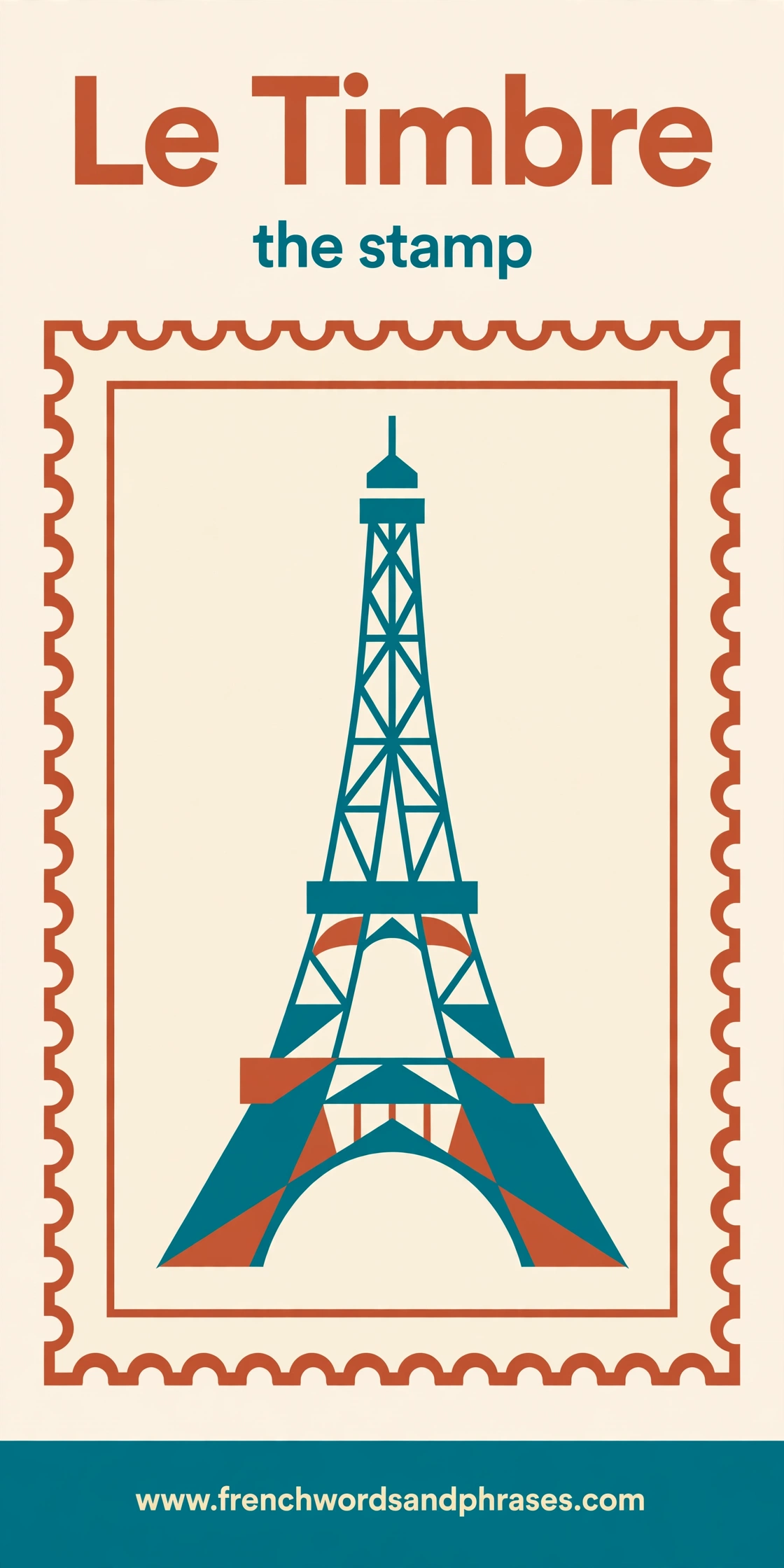
Le timbre means the stamp.
Top right corner of the envelope, a tiny red square with a famous profile — Marianne herself, smaller than a thumbnail. The letter can travel the whole country on this little piece of paper: le timbre.
In this guide, you’ll learn what timbre means in English, how to use it with its articles, how to form its plural, and how it appears in everyday French. Explore French examples, English translations, and practice quizzes.
Understanding the French Noun Timbre
Timbre is a masculine French noun, learned with its article: le timbre, un timbre. Its plural is regular — les timbres. On an envelope, the full name is le timbre-poste; in everyday speech, timbre alone does the job.
It means the stamp — the little printed square you stick on l’enveloppe to pay for its journey. French stamps carry Marianne, monuments, artists and anniversaries, and collectors hunt them in des albums de timbres. But timbre has a second life: it is also the tone colour of a voice or an instrument — le timbre de sa voix is the unique sound that makes her voice hers.
Gender: Masculine — le timbre, un timbre
Plural: les timbres — a regular -s plural
Definite article: le — le timbre (the stamp)
Indefinite article: un — un timbre (a stamp)
Full name: le timbre-poste — the postage stamp
Second sense: le timbre de la voix — the tone, the sound quality of a voice
English equivalents: The stamp; the tone (of a voice or instrument).
One important usage detail: English ‘timbre’ exists too, but only for the sound sense — the tone of a voice. For the thing on the envelope, English says ‘stamp’, and French timbre covers both worlds. Collecting them is la philatélie, and a collector is un philatéliste.
Experience the Word
Timbre is more than a postage fee. It is the smallest picture gallery in the country — art, history and Marianne herself, crossing France for the price of a coffee’s sip.
Imagine the collector’s album: page after page of tiny coloured squares, each one a journey somebody’s letter once made, kept safe under plastic for a hundred years.
You have not just paid for a letter. You have sent a miniature — collé, stuck, the timbre’s way.
How to Use Timbre in French: Complete Guide
Let’s explore how timbre works in French, beginning with its articles — a masculine noun that lives both on envelopes and in voices.
Timbre with the Definite Article (Le, Les)
Used for the stamp you mean — the one in the corner of the envelope.
| Form | French |
|---|---|
| Masculine singular | le timbre |
| Plural | les timbres |
Example
Le timbre représente la tour Eiffel sous la neige.
The stamp shows the Eiffel Tower in the snow.
Timbre with the Indefinite Article (Un, Des)
Used for a stamp in general — un timbre, des timbres.
| Form | French |
|---|---|
| Masculine singular | un timbre |
| Plural | des timbres |
Example
Il faut un timbre pour envoyer cette carte postale.
You need a stamp to send this postcard.
Some, a Sheet, an Album: Timbre with Quantities
Timbre is countable, and collectors count it with quantity words — after them, French uses de (d’ before a vowel).
| Quantity | French |
|---|---|
| one stamp | un timbre |
| several stamps | plusieurs timbres |
| a sheet of stamps | une planche de timbres |
| an album of stamps | un album de timbres |
| lots of stamps | beaucoup de timbres |
Example
Mon grand-père possède un album de timbres anciens.
My grandfather owns an album of old stamps.
Quick Quiz 1
Complete the sentence:
Colle ______ timbre dans le coin de l’enveloppe.
Reveal the answer
le
Colle le timbre dans le coin de l’enveloppe.
Stick the stamp in the corner of the envelope — le, because timbre is masculine.
The Plural of Timbre
Timbre adds a simple -s in the plural — les timbres.
| Number | French |
|---|---|
| Singular | le timbre |
| Plural | les timbres |
Example
Les timbres de ce pays changent de dessin chaque année.
This country’s stamps change design every year.
Timbre with Possessive Adjectives (Mon, Ton, Son…)
Possessives agree with the noun: timbre is masculine, so it takes mon, ton, son.
| Owner | French |
|---|---|
| my | mon timbre |
| your (tu) | ton timbre |
| his / her | son timbre |
| our | notre timbre |
| your (vous) | votre timbre |
| their | leur timbre |
Example
Son timbre préféré date de 1936 et vaut une petite fortune.
His favourite stamp dates from 1936 and is worth a small fortune.
Quick Quiz 2
Complete the sentence:
Elle range ______ timbres dans un grand album. (her)
Reveal the answer
ses
Elle range ses timbres dans un grand album.
She keeps her stamps in a big album — ses for a plural possession.
Timbre with Demonstrative Adjectives (Ce, Ces)
Used to point: ce timbre — this stamp, the rare red one.
| Form | French |
|---|---|
| Masculine singular | ce timbre |
| Plural | ces timbres |
Example
Ce timbre rouge est le plus rare de ma collection.
This red stamp is the rarest in my collection.
Timbre with Adjectives
Adjectives agree with the masculine noun: un timbre rare, un timbre ancien.
| Adjective | With Timbre |
|---|---|
| rare (rare) | un timbre rare |
| ancien (old) | un timbre ancien |
| beau (beautiful) | un beau timbre |
| nouveau (new) | un nouveau timbre |
| rouge (red) | un timbre rouge |
Example
Un timbre ancien peut valoir très cher aux enchères.
An old stamp can be worth a great deal at auction.
Quick Quiz 3
Complete the sentence:
C’est un timbre très ______. (rare)
Reveal the answer
rare
C’est un timbre très rare.
It’s a very rare stamp — rare keeps the same form for masculine and feminine.
Everyday Expressions with Timbre
Stuck, collected and heard — the timbre expressions of daily life.
| Expression | In English |
|---|---|
| coller un timbre | to stick a stamp |
| collectionner les timbres | to collect stamps |
| un carnet de timbres | a book of stamps |
| le timbre de la voix | the tone of someone’s voice |
| un timbre fiscal | a revenue stamp (for official fees) |
Example
J’achète un carnet de timbres au bureau de poste.
I buy a book of stamps at the post office.
Words from the Same Family as Timbre
Post offices, collections and sounds — the words that travel with timbre.
| French | In English |
|---|---|
| timbrer | to stamp, to frank |
| la philatélie | stamp collecting, philately |
| un philatéliste | a stamp collector |
| l’enveloppe | the envelope |
| la poste | the post, the post office |
| affranchir | to put a stamp on, to frank |
Example
Le facteur timbre le courrier avant la distribution.
The postman date-stamps the mail before delivery.
Quick Quiz 4
What is la philatélie?
Reveal the answer
Stamp collecting — the hobby of collecting and studying timbres.
La philatélie est le passe-temps de mon oncle depuis cinquante ans.
Stamp collecting has been my uncle’s hobby for fifty years.
Timbre in Everyday French: Real-Life Examples
Now that you know the word, let’s see how timbre appears in everyday French.
Example 1 — At the post office
Je voudrais un carnet de timbres, s’il vous plaît.
I’d like a book of stamps, please.
Example 2 — Before posting
Il colle un timbre sur l’enveloppe et la met dans la boîte aux lettres.
He sticks a stamp on the envelope and puts it in the letterbox.
Example 3 — A collection
Sa collection de timbres anciens vaut une petite fortune.
His collection of old stamps is worth a small fortune.
Example 4 — A new issue
Ce nouveau timbre montre un paysage de Provence.
This new stamp shows a landscape of Provence.
Example 5 — Not enough postage
Il manque un timbre sur ce paquet, il faut en ajouter un.
This parcel is short of a stamp; another one must be added.
Example 6 — The other timbre
Je reconnais sa voix au téléphone grâce à son timbre doux.
I recognise her voice on the phone by its gentle tone.
Beyond Translation: The Meaning of Timbre
France takes its stamps personally: since 1849 the timbre has carried the face of the Republic — Marianne, the sower, the rooster — and every French citizen handles her portrait daily without thinking twice. The first French stamp, the Cérès of 1849, is now a treasure; the one-centime black of that issue is among the most hunted pieces of paper on earth. A stamp is a receipt, a portrait and a promise, all in one square centimetre.
To say timbre is to name the smallest ambassador of France.
It evokes the collector’s tweezers and the album’s quiet pages, the red Marianne in the corner of a love letter — and a voice’s own timbre, the sound no one else can copy.
How to Remember the French Noun Timbre
Remember it this way: Timbre is the stamp — masculine, le timbre — and the same word names the tone of a voice, le timbre de la voix.
- You see the corner — le timbre, en haut à droite de l’enveloppe.
- You collect them — des timbres anciens, la philatélie commence.
- You hear the voice — le timbre de sa voix, doux et reconnaissable.
The key idea is le timbre — the stamp, and the tone of a voice.
Test Your Knowledge of Timbre
Let’s see how much you’ve learned. Try answering these questions before revealing the answers.
Question 1
Is timbre masculine or feminine?
Reveal the answer
Masculine — le timbre, un timbre.
Question 2
How do you say a book of stamps?
Reveal the answer
Un carnet de timbres — the little booklet sold at the post office.
Question 3
Translate: He sticks a stamp on the envelope.
Reveal the answer
Il colle un timbre sur l’enveloppe.
Question 4
What is le timbre de la voix?
Reveal the answer
The tone of the voice — the unique sound quality that makes a voice recognisable.
Question 5
Complete the sentence:
______ timbres sont très anciens. (These)
Reveal the answer
Ces
Ces timbres sont très anciens.
These stamps are very old.
Your Final Challenge
Can You Use It?
How would you say this in French?
“He sticks a stamp on the envelope.”
Reveal the answer
Il colle un timbre sur l’enveloppe.
He sticks a stamp on the envelope.
A little French. A little curiosity. A richer everyday life.
LEARN FRENCH ONE WORD AT A TIME