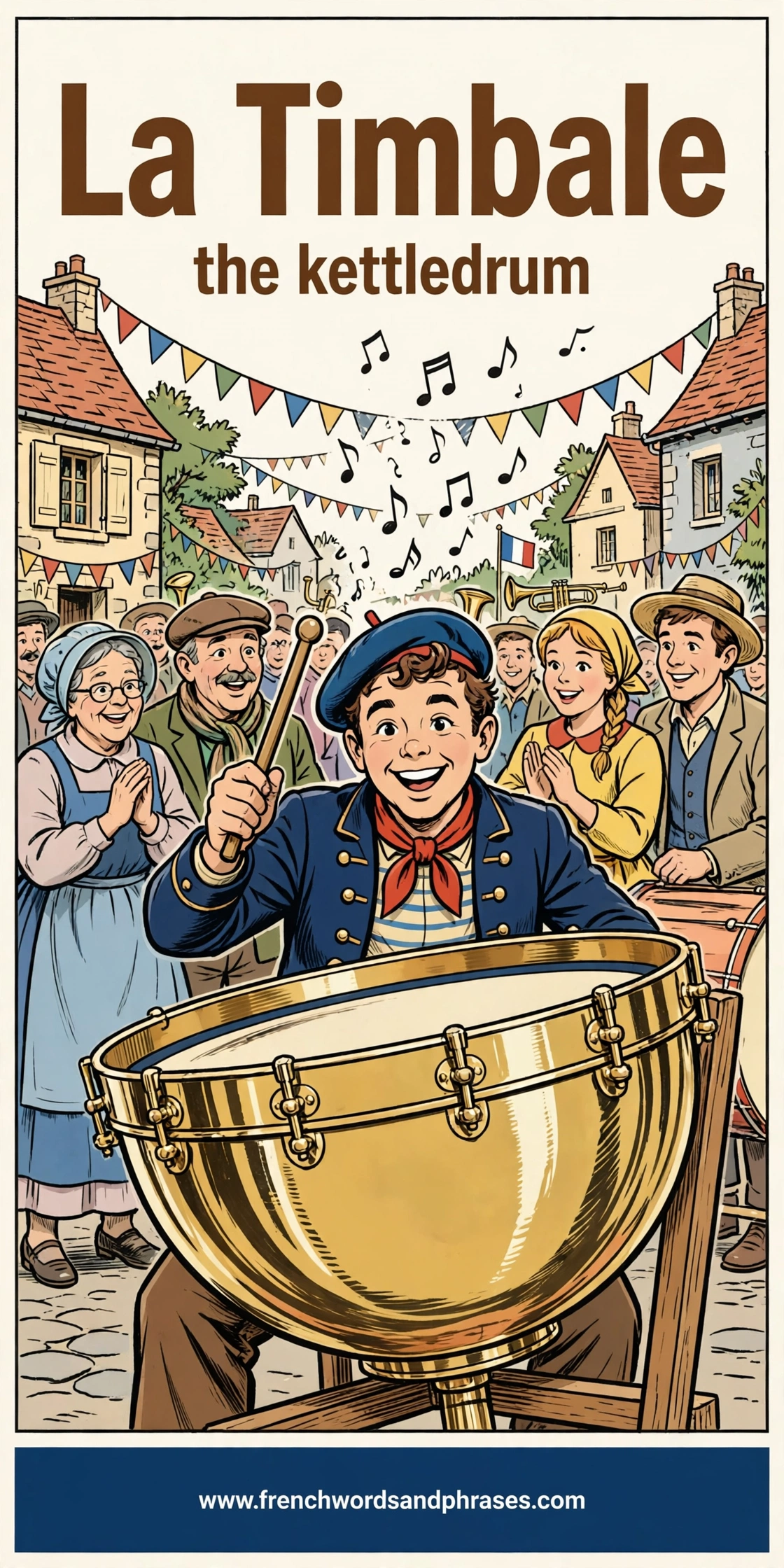
A French Word to Live By
Translate Timbale to English
/tɛ̃.bal/
La timbale means the kettledrum.
At the village fête, the lucky-dip stall has one prize everyone wants — a shining cup on a stem, held high by the mayor: « Et maintenant, la timbale pour le gagnant ! » A drum, a cup, a prize — la timbale is all three.
In this guide, you’ll learn what timbale means in English, how to use it with its articles, how to form its plural, and how it appears in everyday French. Explore French examples, English translations, and practice quizzes.
Understanding the French Noun Timbale
Timbale is a feminine French noun, learned with its article: la timbale, une timbale. It has two main lives: in the orchestra it is a kettledrum (usually plural, les timbales), and on the table it is a metal drinking cup — the cup you win, which is why it means the prize itself in the idiom décrocher la timbale.
It means first the kettledrum — the great copper drum of the orchestra, played with padded sticks and tuned to a note. It also means a small metal beaker or goblet, the kind once given as a prize at fairs and sports days; and in the kitchen, une timbale de riz is a moulded dome of rice shaped in just such a cup.
Gender: Feminine — la timbale, une timbale
Plural: les timbales — the usual form for the orchestral drums
The player: le timbalier — the kettledrummer
On the table: a metal beaker or goblet, often a prize cup
In the kitchen: une timbale de riz — rice moulded into a dome
English equivalents: The kettledrum; a metal cup, a goblet.
One idiom unlocks this word: décrocher la timbale — literally to unhook the cup, the prize hanging above the fairground stall — means to win the prize, to hit the jackpot. Once you picture the shining cup dangling over the fête, both the drum and the jackpot fall into place.
Experience the Word
Timbale has a double music to it. In the concert hall it is the deep heartbeat under the orchestra, tuned and thunderous; at the village fair it is the gleam of the prize everyone is stretching to reach.
Imagine the percussionist at the back of the orchestra, mallets raised, counting forty bars of silence for one perfect, rolling boom — the timbale speaks rarely, and everyone listens.
You have not just heard a drum. You have felt the timbale in your ribs — and reached for the prize.
How to Use Timbale in French: Complete Guide
Let’s explore how timbale works in French, beginning with its articles — a feminine noun that drums, shines and wins prizes.
Timbale with the Definite Article (La, Les)
La timbale for one drum or cup; les timbales for the orchestral set.
| Form | French |
|---|---|
| Feminine singular | la timbale |
| Plural | les timbales |
Example
La timbale résonne dans toute la salle de concert.
The kettledrum resounds through the whole concert hall.
Timbale with the Indefinite Article (Une, Des)
Used for a drum or a cup in general — une timbale, des timbales.
| Form | French |
|---|---|
| Feminine singular | une timbale |
| Plural | des timbales |
Example
Le musée expose une timbale en argent du dix-huitième siècle.
The museum displays a silver goblet from the eighteenth century.
Timbale with Quantities (Une paire de…)
Drums come in pairs and sets, so French counts and pairs them rather than taking « some » of them.
| Quantity | French |
|---|---|
| some kettledrums | des timbales |
| a pair of kettledrums | une paire de timbales |
| a set of kettledrums | un jeu de timbales |
| several kettledrums | plusieurs timbales |
| just one kettledrum | une seule timbale |
Example
L’orchestre a acheté une paire de timbales anciennes.
The orchestra bought a pair of antique kettledrums.
Quick Quiz 1
Complete the sentence:
______ timbales ouvrent le dernier mouvement de la symphonie. (The)
Reveal the answer
Les
Les timbales ouvrent le dernier mouvement de la symphonie.
The kettledrums open the last movement of the symphony.
The Plural of Timbale
Timbale adds an -s — and for the drums, the plural is the form you will meet most often.
| Number | French |
|---|---|
| Singular | la timbale |
| Plural | les timbales |
Example
Les timbales donnent à l’orchestre sa profondeur.
The kettledrums give the orchestra its depth.
Timbale with Possessive Adjectives (Ma, Ta, Sa…)
Possessives agree with the noun — timbale is feminine, so it takes ma, ta, sa.
| Owner | French |
|---|---|
| my | ma timbale |
| your (tu) | ta timbale |
| his / her | sa timbale |
| our | notre timbale |
| your (vous) | votre timbale |
| their | leur timbale |
Example
Le musicien accorde sa timbale avant chaque concert.
The musician tunes his kettledrum before every concert.
Quick Quiz 2
Complete the sentence:
______ timbale en argent est le premier prix du concours. (His / her — the prize cup)
Reveal the answer
Sa
Sa timbale en argent est le premier prix du concours.
His silver cup is the first prize in the competition.
Timbale with Demonstrative Adjectives (Cette, Ces)
Used to point: cette timbale, this drum, this cup — the one within reach.
| Form | French |
|---|---|
| Feminine singular | cette timbale |
| Plural | ces timbales |
Example
Cette timbale est le prix que tout le monde veut décrocher.
This cup is the prize everyone wants to win.
Timbale with Adjectives
Adjectives agree with timbale — feminine, and mostly placed after the noun.
| Adjective | With Timbale |
|---|---|
| ancienne (old, antique) | une timbale ancienne |
| grande (big) | une grande timbale |
| en argent (silver) | une timbale en argent |
| en cuivre (copper) | une timbale en cuivre |
| brillante (shining) | une timbale brillante |
Example
Une grande timbale en cuivre trône au fond de l’orchestre.
A large copper kettledrum sits enthroned at the back of the orchestra.
Quick Quiz 3
Complete the sentence:
Il a gagné une timbale ______. (silver)
Reveal the answer
en argent
Il a gagné une timbale en argent.
He won a silver cup — en argent, « made of silver ».
Everyday Expressions with Timbale
Prizes, drums and moulded rice — the timbale phrases of daily life.
| Expression | In English |
|---|---|
| décrocher la timbale | to win the prize, to hit the jackpot |
| les timbales de l’orchestre | the kettledrums of the orchestra |
| une timbale de riz | a moulded dome of rice |
| boire dans une timbale | to drink from a metal cup |
| le coup de timbale | the kettledrum stroke |
| remporter la timbale | to carry off the prize |
Example
Avec ce contrat, l’entreprise a décroché la timbale !
With this contract, the company has hit the jackpot!
Words from the Same Family as Timbale
Drummers, drums and deep sounds — the words that travel with timbale.
| French | In English |
|---|---|
| le timbalier | the kettledrummer |
| le tambour | the drum |
| la percussion | percussion |
| la baguette | the drumstick |
| le cuivre | copper; brass (the material) |
| résonner | to resound, to boom |
Example
Le timbalier frappe le tambour avec ses baguettes feutrées.
The kettledrummer strikes the drum with his felted sticks.
Quick Quiz 4
What does « décrocher la timbale » mean?
Reveal the answer
To win the prize, to hit the jackpot — from the cup hanging as the prize above the fairground stall.
Elle a décroché la timbale au concours de pâtisserie.
She won first prize at the baking competition.
Timbale in Everyday French: Real-Life Examples
Now that you know the word, let’s see how timbale appears in everyday French.
Example 1 — At the concert
Les timbales annoncent la fin de la symphonie.
The kettledrums announce the end of the symphony.
Example 2 — At the fair
Le gagnant du tir décroche la timbale en argent.
The winner of the shooting game wins the silver cup.
Example 3 — In the kitchen
Le chef présente une timbale de riz aux légumes.
The chef serves a moulded dome of rice with vegetables.
Example 4 — Big news
Notre équipe a décroché la timbale cette année !
Our team hit the jackpot this year!
Example 5 — In a museum
Cette timbale en cuivre date du dix-septième siècle.
This copper goblet dates from the seventeenth century.
Example 6 — Tuning up
Le timbalier écoute sa timbale et l’accorde lentement.
The kettledrummer listens to his drum and tunes it slowly.
Beyond Translation: The Meaning of Timbale
The timbale travelled a long road: its name came from Arabic drums through Spain into French, shrinking from a war drum into the orchestra’s noblest percussion — and then, by a second life, into the prize cup of the fairground. That is why one word can boom in a Mahler symphony and shine above a coconut shy: the cup you drank from became the cup you won.
To say timbale is to hear the drum roll that announces a winner.
It evokes copper and silver, drumrolls and fêtes — and the universal human hope of reaching up and décrocher la timbale, carrying the prize away.
How to Remember the French Noun Timbale
Remember it this way: Timbale is feminine — the kettledrum in the orchestra, the metal cup on the table, and the prize in décrocher la timbale.
- You hear the orchestra — les timbales, the kettledrums.
- You win the prize — décrocher la timbale, hit the jackpot.
- You eat the rice — une timbale de riz, a moulded dome.
The key idea is la timbale — drum, cup and jackpot in one.
Test Your Knowledge of Timbale
Let’s see how much you’ve learned. Try answering these questions before revealing the answers.
Question 1
Is timbale masculine or feminine?
Reveal the answer
Feminine — la timbale, une timbale.
Question 2
What are les timbales in an orchestra?
Reveal the answer
The kettledrums — the large tuned copper drums at the back of the orchestra.
Question 3
Translate: She won the prize at the competition.
Reveal the answer
Elle a décroché la timbale au concours.
Question 4
Who is le timbalier?
Reveal the answer
The kettledrummer — the musician who plays les timbales.
Question 5
Complete the sentence:
______ timbale en argent brille sur l’étagère. (This)
Reveal the answer
Cette
Cette timbale en argent brille sur l’étagère.
This silver cup is shining on the shelf.
Your Final Challenge
Can You Use It?
How would you say this in French?
“The kettledrums announce the end of the concert.”
Reveal the answer
Les timbales annoncent la fin du concert.
The kettledrums announce the end of the concert.
A little French. A little curiosity. A richer everyday life.
LEARN FRENCH ONE WORD AT A TIME