A French Word to Live By
Translate Sûr to English
/syʁ/
Sûr means safe.
A mother walking her daughter home through the evening streets takes the long way without thinking — past the lit bakery, along the avenue where the cafés are still open, across the square where everyone knows her. She could not explain the route. She just knows: this way is sûr.
In this guide, you’ll learn what sûr means in English when it describes a place, how its feminine adds a single e under the circumflex, where it stands in the sentence, and why it must never be confused with the little word sur, meaning on. Explore French examples, English translations, and practice quizzes.
Understanding the French Adjective Sûr
Sûr is a French adjective of quality — the adjective of safety and certainty. It agrees in the regular way: sûr, sûre, sûrs, sûres. Describing places, it means safe; describing people and their knowledge, it means sure, certain — one word for the two kinds of security.
It means safe — free from danger. It describes places (un quartier sûr, a safe neighbourhood; une rue sûre, a safe street; une ville sûre, a safe town) and journeys (un itinéraire sûr, a safe route). It also means sure, certain, when the subject is a person: je suis sûr, I am sure. On this page the place sense leads: a sûr street is one you can walk without worry.
Type: Adjective of quality — safety (and certainty)
Answers the question: What is it like? — safe
Changes form: Yes — sûr, sûre, sûrs, sûres
Feminine: sûre
English equivalents: Safe; secure; (of people) sure, certain.
One important usage detail: sûr stands AFTER the noun for places — un quartier sûr — and after être for people: je suis sûr de moi, I am sure of myself. Keep it apart from sur without the accent: that is the preposition meaning on, and it is pronounced exactly the same.
Experience the Word
Sûr is the adjective of the walk home — the lit street, the open-late café, the square where the benches are full at ten in the evening.
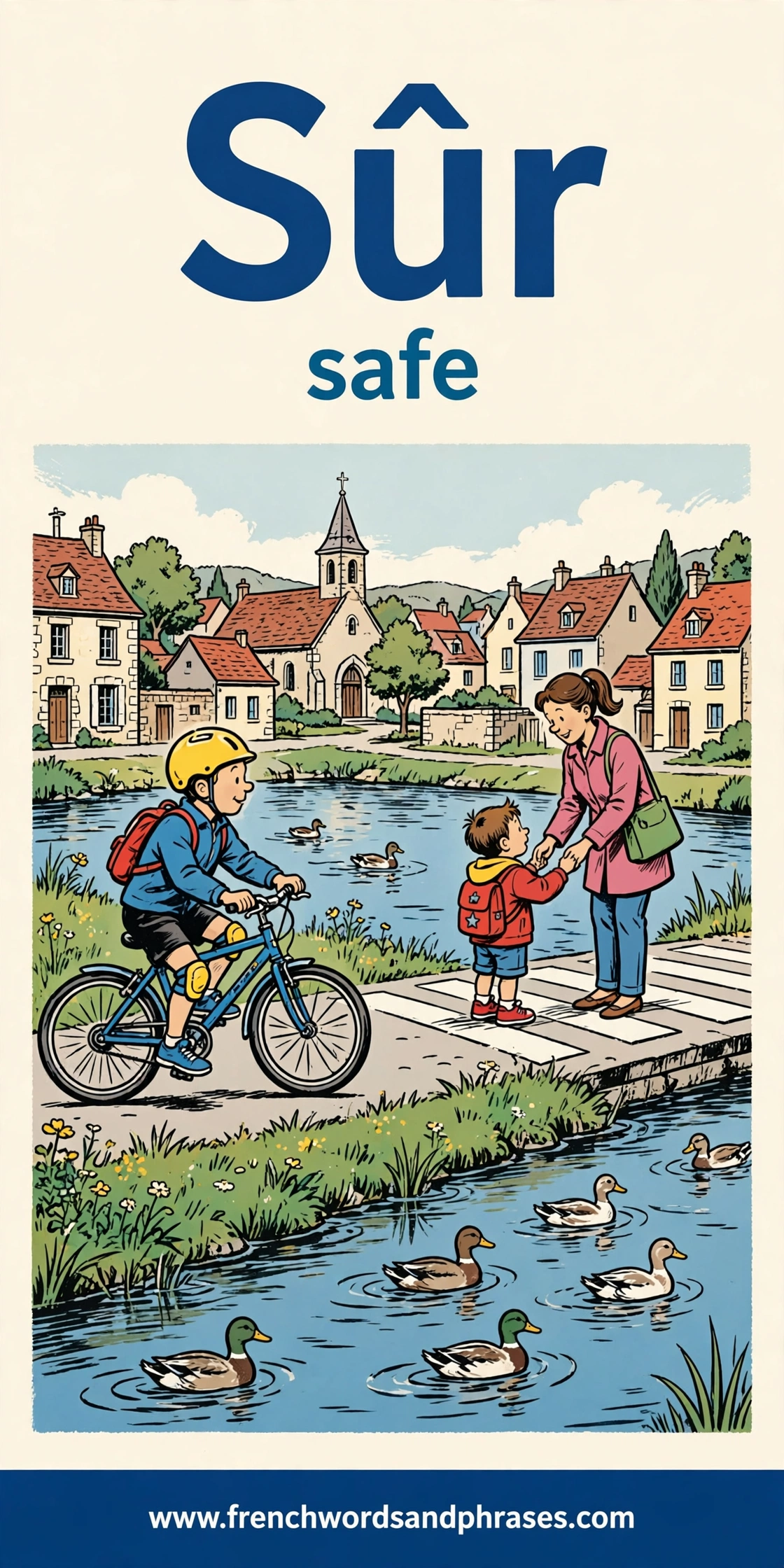
Imagine a small town where children cycle to school alone and front doors stay unlocked through the summer. Nothing dramatic protects it. It is simply sûr, and everyone who lives there knows the feeling in their shoulders: relaxed.
You have not just described the absence of danger. You have described the presence of trust.
How to Use Sûr in French: Complete Guide
Let’s explore how sûr works in French, beginning with the whole word on one card.
Sûr at a Glance
Before the details, here is the whole word on one card.
The Whole Word on One Card
Meaning, type, position and forms — sûr in four lines.
| Point | Sûr |
|---|---|
| Meaning | safe |
| Type | adjective of quality — safety and certainty |
| Usual position | after the noun — un quartier sûr |
| Form | sûr / sûre / sûrs / sûres |
Example
C’est un quartier sûr.
It’s a safe neighbourhood.
The Four Forms of Sûr
Sûr agrees with the noun it describes. The feminine adds an e — and the circumflex, the little hat on the û, stays in every form.
| Form | Sûr | Example |
|---|---|---|
| Masculine singular | sûr | un quartier sûr — a safe neighbourhood |
| Feminine singular | sûre | une rue sûre — a safe street |
| Masculine plural | sûrs | des quartiers sûrs — safe neighbourhoods |
| Feminine plural | sûres | des rues sûres — safe streets |
Example
Ce quartier est sûr et ses rues sont sûres.
This neighbourhood is safe and its streets are safe.
Quick Quiz 1
Which form of sûr goes with rue (feminine)?
Reveal the answer
sûre
Une rue sûre.
A safe street.
Sûre: The Feminine Keeps the Circumflex
The feminine of sûr is formed by adding an e: sûre. The circumflex on the û never leaves, and sûr and sûre sound exactly alike — only the spelling changes.
| Situation | Example |
|---|---|
| The rule | just add -e — sûr → sûre |
| The accent | the circumflex stays — sûre, sûrs, sûres |
| The sound | sûr and sûre sound exactly the same: /syʁ/ |
| Feminine plural | sûres — des villes sûres |
Example
C’est une petite ville sûre, même la nuit.
It’s a small, safe town, even at night.
Where Sûr Goes: After the Noun
For places, sûr follows the noun, like most adjectives of quality. For people, it follows être, often with de: sûr de + noun, sure of something.
| Pattern | Example |
|---|---|
| After the noun | un itinéraire sûr — a safe route |
| After être (place) | ce quartier est sûr — this neighbourhood is safe |
| After être (person) | je suis sûr — I am sure |
| Before the noun | un sûr quartier — not in everyday French |
Example
Choisis un itinéraire sûr pour rentrer.
Choose a safe route home.
Quick Quiz 2
How do you say ‘a safe street’ — une sûre rue or une rue sûre?
Reveal the answer
une rue sûre
Sûr stands after the noun.
A safe street.
More Safe: Comparing with Sûr
Sûr compares the regular way, with plus, moins and aussi — and the superlative agrees as usual: le plus sûr, la plus sûre.
| Degree | Example |
|---|---|
| As safe as | aussi sûr que — as safe as |
| Safer | plus sûr — safer |
| Less safe | moins sûr — less safe |
| The safest (masc.) | le plus sûr — le plus sûr des quartiers |
| The safest (fem.) | la plus sûre — la plus sûre des villes |
Example
Cette ville est plus sûre que la capitale.
This town is safer than the capital.
Everyday Expressions with Sûr
Sûr lives in the language of reassurance — estate agents, parents and guidebooks all reach for it when a place needs a clean bill of health.
| Expression | In English |
|---|---|
| un quartier sûr | a safe neighbourhood |
| une valeur sûre | a safe bet, a sure thing — of investments and classics |
| sûr et certain | sure and certain — the emphatic pair |
| bien sûr | of course — the everyday exclamation |
| être sûr de soi | to be self-confident — sure of oneself |
| pas sûr | not safe / not sure — the everyday opposite |
Example
Ce quartier est une valeur sûre pour les familles.
This neighbourhood is a safe bet for families.
Quick Quiz 3
What does bien sûr mean?
Reveal the answer
Of course
Bien sûr, le quartier est sûr !
Of course, the neighbourhood is safe!
Sûr and Its Neighbours
Sûr shares the field of security with sans danger and fiable; at the other end, dangereux is the word it exists to cancel.
| French | In English |
|---|---|
| sans danger | safe, harmless — literally, without danger |
| fiable | reliable — un itinéraire fiable, a reliable route |
| certain | certain — of facts and people, not places |
| dangereux | dangerous — the direct opposite |
| à risque | at-risk — un quartier à risque |
| protégé | protected, sheltered — un passage protégé |
Example
Un passage protégé, un quartier sûr : les enfants sont sans danger.
A protected crossing, a safe neighbourhood: the children are out of danger.
Watch Out: The Traps Around Sûr
One trap towers over the others here: sûr with its little hat is an adjective; sur without it is the preposition ‘on’ — and your ear cannot tell them apart.
| Trap | The truth |
|---|---|
| sur | sur (no accent) means on — le livre est sur la table; sûr (with accent) means safe or sure |
| Two meanings | places are safe, people are sure — je suis sûr (person), le quartier est sûr (place) |
| The accent | the circumflex never leaves — sûr, sûre, sûrs, sûres |
| bien sûr | an exclamation, of course — not a description of a place |
Example
Sur cette place, tout le monde est sûr de se retrouver.
On this square, everyone is sure to meet up.
Quick Quiz 4
In le chat est sur le toit, does sur mean ‘safe’?
Reveal the answer
No
Without the circumflex, sur is the preposition ‘on’.
The cat is on the roof.
Sûr in Everyday French: Real-Life Examples
Now that you know the word, let’s see how sûr appears in everyday French.
Example 1 — A neighbourhood
C’est un quartier sûr, les enfants y jouent dehors.
It’s a safe neighbourhood, the children play outside there.
Example 2 — A street
Cette rue est sûre et bien éclairée la nuit.
This street is safe and well lit at night.
Example 3 — A town
Les touristes disent que la ville est sûre et accueillante.
Tourists say the town is safe and welcoming.
Example 4 — A route
Prends l’itinéraire sûr, par la grande avenue.
Take the safe route, along the main avenue.
Example 5 — A square
La place est sûre, même tard le soir.
The square is safe, even late in the evening.
Example 6 — Reassurance
Bien sûr, ce pont est sûr, il est tout neuf.
Of course, this bridge is safe, it’s brand new.
Beyond Translation: The Meaning of Sûr
English splits what French joins: safe for places, sure for people — sûr covers both with one small word and one small hat. The street you trust and the answer you trust carry the same adjective.
To call a quarter sûr is to promise a stranger a relaxed walk home.
And its everyday cousin bien sûr — of course — shows how deep the word runs: certainty in French is not cold logic; it is the same feeling as a lit street at midnight, the feeling of being sûr.
How to Remember the French Adjective Sûr
Remember it this way: Sûr is the safety adjective — one e for the feminine, the circumflex always on duty, and a twin without the hat who means ‘on’.
- You keep the little hat in every form — sûr, sûre, sûrs, sûres.
- You split the twins by the accent — sûr is safe or sure; sur is on.
- You put it after the noun — un quartier sûr, une rue sûre.
The key idea is sûr (with the circumflex) means safe for places and sure for people; sur without it means on.
Test Your Knowledge of Sûr
Let’s see how much you’ve learned. Try answering these questions before revealing the answers.
Question 1
What does sûr mean for a place?
Reveal the answer
Safe — free from danger. (For a person, it means sure, certain.)
Question 2
What is the feminine of sûr?
Reveal the answer
sûre — just add an e; the circumflex stays.
Question 3
Translate: a safe neighbourhood.
Reveal the answer
Un quartier sûr.
Question 4
Complete the sentence:
Cette rue est bien éclairée et très ______ .
Reveal the answer
sûre
Cette rue est bien éclairée et très sûre.
This street is well lit and very safe.
Question 5
What does sur (without the accent) mean?
Reveal the answer
On — it is a preposition: le livre est sur la table, the book is on the table.
Your Final Challenge
Can You Use It?
How would you say this in French?
“This neighbourhood is safe, even late in the evening.”
Reveal the answer
Ce quartier est sûr, même tard le soir.
This neighbourhood is safe, even late in the evening.
A little French. A little curiosity. A richer everyday life.
LEARN FRENCH ONE WORD AT A TIME