A French Word to Live By
Translate Suivant to English
/sɥi.vɑ̃/
Suivant means next, following.
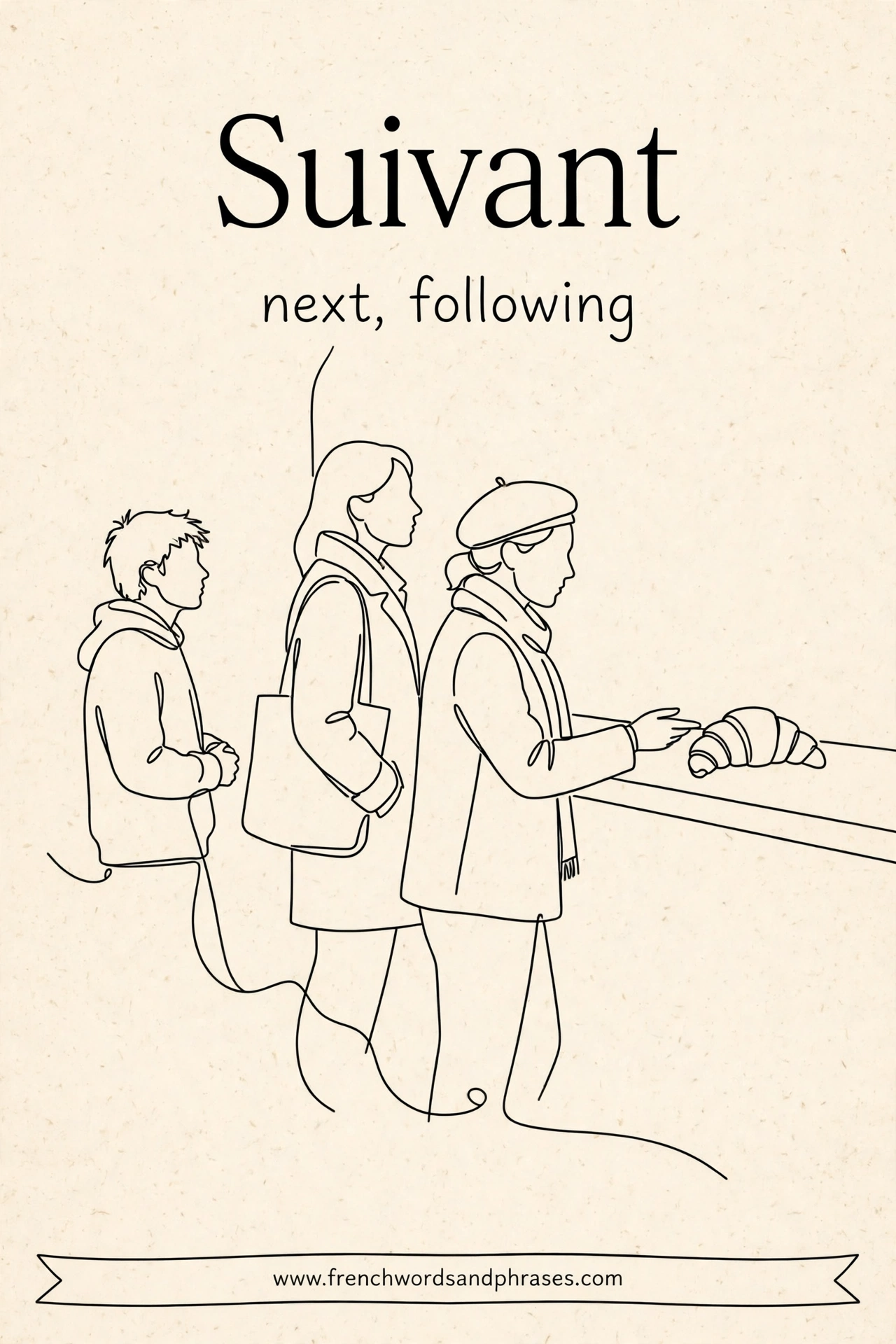
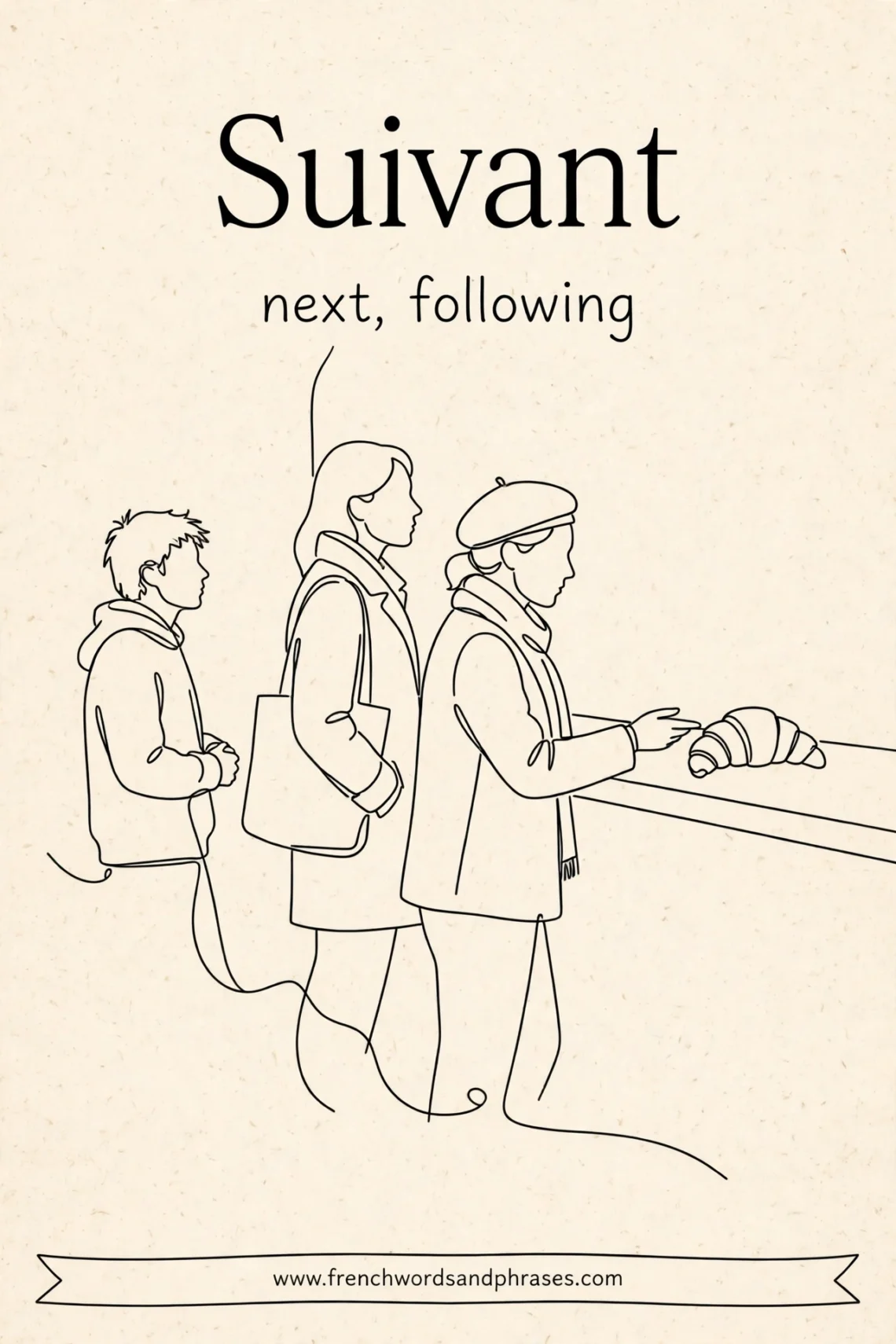
The baker calls a number, the queue shuffles forward, and a voice rings out: « Au suivant ! » — next, please. Suivant is the adjective of the one who comes after: the next page, the following day, the next customer in line, all waiting their turn behind the present one.
In this guide, you’ll learn what suivant means in English, how its feminine suivante is formed, where it stands in the sentence, and the second life it leads as a preposition meaning according to. Explore French examples, English translations, and practice quizzes.
Understanding the French Adjective Suivant
Suivant is a French adjective of sequence, and the present participle of the verb suivre, to follow, working as an adjective. Its feminine is suivante: le jour suivant, la semaine suivante, les pages suivantes. It stands after the noun and names whatever comes immediately after in an order — time, pages, queues, lists.
It means next, following — the one that comes after: le mois suivant, the following month; la fois suivante, the next time; les mots suivants, the following words. In shops and offices it calls the queue forward: au suivant !, next please! And it leads a double life as a preposition: suivant la loi, according to the law — same word, second job.
Type: Adjective of sequence — the one that comes immediately after
Answers the question: Which one in the order? — the next one
Changes form: Feminine suivante — suivant / suivante; plurals suivants / suivantes
English equivalents: Next; following.
One important usage detail: suivant always points forward in a known order — the next page of this book, the following week of this calendar. It stands after the noun: la semaine suivante, never before it in everyday French. And watch for its preposition twin at the head of a phrase: suivant les instructions, according to the instructions — there, suivant never changes form.
Experience the Word
Suivant is the adjective of the queue and the calendar — the promise that something is coming right after this.
Imagine the little bakery at eight in the morning, tickets in every hand, the smell of warm croissants — and the whole room’s happiness organised by one repeated word: au suivant ! Each call is a small promotion.
You have not just named an order. You have named the next in line — the following one, already stepping forward.
How to Use Suivant in French: Complete Guide
Let’s explore how suivant works in French, beginning with the whole word on one card.
Suivant at a Glance
Before the details, here is the whole word on one card.
The Whole Word on One Card
Meaning, type, position and forms — suivant in four lines.
| Point | Suivant |
|---|---|
| Meaning | next, following — the one that comes immediately after |
| Type | adjective of sequence — from suivre, to follow |
| Usual position | after the noun — la semaine suivante |
| Form | suivant / suivante — suivants / suivantes in the plural |
Example
La semaine suivante, nous partons en vacances.
The following week, we go on holiday.
The Four Forms of Suivant
Suivant agrees like a regular adjective: the feminine adds -e, and the plurals add s.
| Form | Suivant | Example |
|---|---|---|
| Masculine singular | suivant | le jour suivant — the following day |
| Feminine singular | suivante | la page suivante — the next page |
| Masculine plural | suivants | les jours suivants — the following days |
| Feminine plural | suivantes | les pages suivantes — the following pages |
Example
Les chapitres suivants racontent le voyage.
The following chapters tell of the journey.
Quick Quiz 1
What is the feminine of suivant?
Reveal the answer
suivante
La semaine suivante — the feminine adds -e to suivant.
The following week.
The Feminine of Suivant: Suivante
Suivante is not a separate word to learn later — it is half of this word’s life, formed by the regular addition of -e.
| Situation | Example |
|---|---|
| Masculine | le mois suivant — the following month |
| Feminine | la fois suivante — the next time |
| Why | the feminine adds -e to the masculine form |
| The plural | add s to the feminine — des fois suivantes, the following times |
Example
La fois suivante, elle a réussi du premier coup.
The next time, she succeeded at the first attempt.
Where Suivant Goes: After the Noun
Suivant follows the noun it describes — the next one always walks behind, true to its verb suivre.
| Pattern | Example |
|---|---|
| After the noun | la page suivante — the next page |
| After être | le point suivant est important — the next point is important |
| Calling the queue | au suivant ! — next, please! |
| Before the noun | la suivante page — not in everyday French |
Example
Tournez la page : l’exercice suivant est plus facile.
Turn the page: the next exercise is easier.
Quick Quiz 2
How do you say ‘the next page’ — la suivante page or la page suivante?
Reveal the answer
la page suivante
Suivant stands after the noun, in its feminine form suivante.
The next page.
More Suivant: Comparing with Suivant
Suivant names a position in a line, so it does not compare — the line itself is lengthened with the words for before and after.
| Degree | Example |
|---|---|
| The next one | le suivant — the following one |
| The one after the next | le surlendemain — the day after tomorrow (for days) |
| The previous one | le précédent — the one before |
| The last one | le dernier — the final one in the line |
Example
Le jour suivant, puis le surlendemain, la pluie continuait.
The following day, then the day after that, the rain went on.
Everyday Expressions with Suivant
Suivant appears wherever French queues, reads or plans — in bakeries, books and calendars.
| Expression | In English |
|---|---|
| au suivant ! | next, please! (calling the queue) |
| la page suivante | the next page |
| le jour suivant | the following day |
| la fois suivante | the next time |
| les mots suivants | the following words |
| suivant la loi | according to the law (preposition use) |
Example
Au suivant ! Qui a le ticket numéro douze ?
Next! Who has ticket number twelve?
Quick Quiz 3
What does au suivant ! mean at the bakery?
Reveal the answer
Next, please!
Au suivant ! — the call that moves the queue forward, one customer at a time.
Next!
Suivant and Its Neighbours
Suivant keeps company with the other words of order — the one before, the one after, the last.
| French | In English |
|---|---|
| précédent | previous — the one before |
| prochain | next — for the coming one in time: la semaine prochaine |
| dernier | last — the final one |
| premier | first — the head of the line |
| suivre | to follow — the verb suivant comes from |
Example
Après le premier chapitre, le chapitre suivant, puis le dernier.
After the first chapter, the next chapter, then the last.
Watch Out: The Traps Around Suivant
The traps here are position and the famous pair suivant/prochain: both can say next, but they look at the line differently.
| Trap | The truth |
|---|---|
| Position | la semaine suivante — suivant follows the noun |
| suivant vs prochain | suivant = the following one in an order being read or told; prochain = the next one coming in time: la semaine prochaine, next week |
| The preposition twin | suivant la loi — according to the law; there suivant never agrees |
| Agreement | les pages suivantes — suivant agrees like any adjective when it describes a noun |
Example
La semaine prochaine, nous lirons les pages suivantes.
Next week, we will read the following pages.
Quick Quiz 4
How do you say ‘the following words’?
Reveal the answer
les mots suivants
Suivant agrees with the masculine plural noun: suivants.
The following words.
Suivant in Everyday French: Real-Life Examples
Now that you know the word, let’s see how suivant appears in everyday French.
Example 1 — At the bakery
Au suivant ! C’est à qui le tour ?
Next! Whose turn is it?
Example 2 — Reading
La réponse se trouve à la page suivante.
The answer is on the next page.
Example 3 — Time
Le jour suivant, il faisait beau.
The following day, the weather was fine.
Example 4 — A story
Les mots suivants sont écrits au tableau.
The following words are written on the board.
Example 5 — Trying again
La fois suivante, il a fait plus attention.
The next time, he paid more attention.
Example 6 — Instructions
Suivant les instructions, mélangez doucement.
Following the instructions, mix gently.
Beyond Translation: The Meaning of Suivant
Suivant is suivre caught mid-step: the present participle of to follow, frozen into an adjective. That origin explains its manners — it always walks behind its noun, following it, exactly as its verb commands. French storytelling runs on it: le lendemain and le jour suivant carry every narrative from one morning to the next, and every queue in France advances to its call.
Suivant is the adjective of the order we trust — what is now, then what follows.
Learn it with its mirror précédent and its cousin prochain, and you can walk any list, calendar or queue in French without losing your place.
How to Remember the French Adjective Suivant
Remember it this way: Suivant is the next one in the order — suivant for him, suivante for her, always standing after its noun.
- You place it behind — la page suivante, le jour suivant.
- You split the pair — suivant follows in a told order; prochain comes next in time.
- You hear the queue call — au suivant !, next, please!
The key idea is suivant / suivante means next, following; au suivant ! = next, please!.
Test Your Knowledge of Suivant
Let’s see how much you’ve learned. Try answering these questions before revealing the answers.
Question 1
What does suivant mean?
Reveal the answer
Next, following — the one that comes immediately after.
Question 2
What is the feminine of suivant?
Reveal the answer
suivante — la page suivante.
Question 3
Translate: the following day.
Reveal the answer
Le jour suivant.
Question 4
Complete the sentence:
Les semaines ______ seront plus calmes.
Reveal the answer
suivantes
Les semaines suivantes seront plus calmes.
The following weeks will be calmer.
Question 5
What does suivant mean at the head of a phrase, as in suivant la loi?
Reveal the answer
According to — there, suivant works as a preposition and never changes form.
Your Final Challenge
Can You Use It?
How would you say this in French?
“The answer is on the next page.”
Reveal the answer
La réponse se trouve à la page suivante.
The answer is on the next page.
A little French. A little curiosity. A richer everyday life.
LEARN FRENCH ONE WORD AT A TIME