A French Word to Live By
Translate Soit to English
/swa/
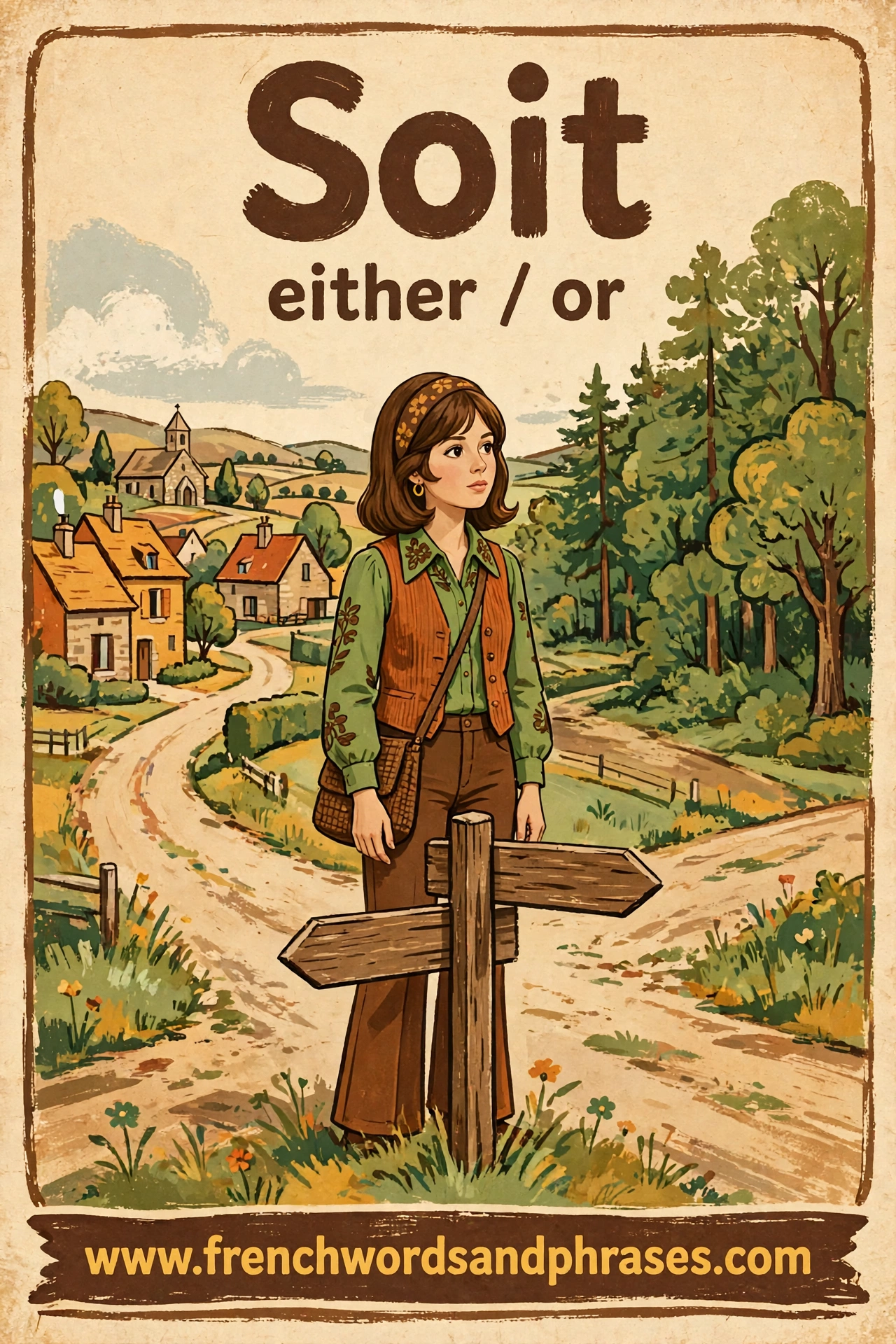
Soit means either / or.
« Soit on part à l’aube, soit on reste. » Two doors stand open, and soit holds one in each hand. It is the smallest of French crossroads — one syllable that lays two futures side by side and makes you choose.
In this guide, you’ll learn what soit means in English, how the pair soit… soit offers a choice, how the same word hides the subjunctive of être, and where you will meet it in maths, in shops and in shrugs. Explore French examples, English translations, and practice quizzes.
Understanding the French Conjunction Soit
Soit is a French correlative conjunction when it works in a pair — soit… soit, either… or. But the word has a double life: it is also the present subjunctive of être (to be), and French uses that second life in set phrases like soit dit en passant, be it said in passing.
In its pair, it means either… or: soit tu viens, soit tu restes — either you come, or you stay. The two options are laid out as equals, and the sentence waits for a choice. Alone before a noun, it can present a hypothesis: soit un triangle — let there be a triangle, given a triangle.
Type: Correlative conjunction (in the pair soit… soit)
Its partner: A second soit — the pair is the pattern
What follows each soit: Matching elements: two nouns, two verbs, two clauses
Hidden identity: Also the present subjunctive of être — ‘be it’
One important usage detail: in shops and cafés you will hear a bare « soit ! » meaning ‘fine, so be it’ — acceptance with a small sigh. And in mathematics, soit opens nearly every problem: soit x…, let x be…
Experience the Word
Soit is the conjunction of the open hand — it does not push you toward either option; it simply makes both of them visible.
Imagine a grandmother at the market with a grandchild who cannot decide: « soit la pomme, soit la poire — choisis ». The word waits, patient as a balance scale.
You have not made a decision. You have built the crossroads where the decision will happen.
How to Use Soit in French: Complete Guide
Let’s explore how soit works in French, beginning with the whole word on one card.
Soit at a Glance
Before the details, here is the whole word on one card.
The Whole Word on One Card
Meaning, job, partner and secret identity — soit in four lines.
| Point | Soit |
|---|---|
| Meaning | either… or (in the pair soit… soit) |
| Job | lays two options side by side as equals |
| Its partner | a second soit before the second option |
| Secret identity | the subjunctive of être — ‘be it’ |
Example
Soit nous marchons, soit nous prenons le bus.
Either we walk, or we take the bus.
How Soit Links: Two Doors, One Choice
Soit links by pairing. Each soit stands before one option, and the two options must match in shape — two clauses, two nouns, two infinitives.
| Pattern | Example |
|---|---|
| two clauses | soit il pleut, soit il neige — either it rains, or it snows |
| two nouns | soit le train, soit la voiture — either the train, or the car |
| two infinitives | soit partir, soit rester — either to leave, or to stay |
| two adjectives | soit chaud, soit froid — either hot, or cold |
Example
Soit tu m’aides, soit je le fais seul.
Either you help me, or I do it alone.
Quick Quiz 1
In ‘soit le café, soit le thé’, what must the two halves have in common?
Reveal the answer
The same shape — here, two nouns. The pair balances equal against equal.
Soit le café, soit le thé.
Either the coffee, or the tea.
The Mood Question: The Subjunctive in Disguise
Here is the twist: soit IS a subjunctive — the present subjunctive of être. In the pair soit… soit, the clauses after it keep their own verbs in the indicative. But in the literary pattern soit que… soit que…, a true subjunctive follows each que.
| Case | Example |
|---|---|
| In the pair (indicative clauses) | soit il vient, soit il téléphone — either he comes, or he phones |
| Soit que + subjunctive | soit qu’il vienne, soit qu’il écrive — whether he comes or he writes (literary) |
| Set phrase | soit dit en passant — be it said in passing |
| In mathematics | soit un point A — let there be a point A (the subjunctive of hypothesis) |
Example
Soit dit en passant, ton français s’améliore.
Be it said in passing, your French is improving.
Where Soit Goes: Before Each Option
Each soit stands immediately before the option it presents. The pair can open a sentence or sit inside it after a verb, and a comma usually separates the two doors.
| Position | Example |
|---|---|
| Start of the sentence | soit nous partons, soit nous restons — either we leave, or we stay |
| After a verb | je veux soit lire, soit dormir — I want either to read, or to sleep |
| Comma between options | soit le rouge, soit le bleu — either the red one, or the blue one |
| Alone, as acceptance | — D’accord ? — Soit. — Agreed? — So be it. |
Example
Il faut soit payer, soit partir.
You must either pay, or leave.
Quick Quiz 2
Soit is the subjunctive of which verb?
Reveal the answer
être — to be. ‘Be it’ is hiding inside ‘either’.
Soit !
So be it!
Everyday Expressions with Soit
Soit pops up far beyond its pair — in classrooms, in asides, and in small acceptances. Here is its working wardrobe.
| Expression | In English |
|---|---|
| soit… soit… | either… or… |
| soit ! | so be it! / fine! |
| soit dit en passant | incidentally — be it said in passing |
| soit… ou… | either… or… (a looser spoken variant of the pair) |
| quel qu’il soit | whatever it may be (the subjunctive life again) |
Example
Prends un fruit, quel qu’il soit.
Take a fruit, whichever it may be.
Close Cousins: Soit, Ou, Ou bien, Tantôt
French offers several ways to present alternatives; soit… soit is the balanced, slightly formal one.
| Word | The difference |
|---|---|
| soit… soit… | the balanced pair — formal, clear, written or careful speech |
| ou (simple) | plain ‘or’ — the everyday choice: thé ou café ? |
| ou bien | ‘or else / or rather’ — ou with a nudge |
| tantôt… tantôt… | ‘now… now…’ — alternating in time, not a choice: tantôt il rit, tantôt il pleure |
Example
Tu veux du thé ou du café ?
Do you want tea or coffee?
Quick Quiz 3
Which pair means ‘now this, now that’ over time, rather than a choice?
Reveal the answer
tantôt… tantôt… — it alternates; soit… soit chooses.
Tantôt elle chante, tantôt elle se tait.
Now she sings, now she falls silent.
Soit and Its Neighbours
Choice and its cousins: the plain word, the nudge, the warning, and the two-handed balance.
| French | In English |
|---|---|
| ou | or |
| ou bien | or else, or rather |
| tantôt… tantôt… | now… now… |
| d’une part… d’autre part… | on the one hand… on the other hand… |
| sinon | otherwise, if not |
Example
Dépêche-toi, sinon nous serons en retard.
Hurry up, otherwise we’ll be late.
Watch Out: The Traps Around Soit
Mind the balance of the pair, the formal flavour, and the spelling — soit is not soi, and not sois.
| Trap | The truth |
|---|---|
| unbalanced pair | match the shapes: soit le train, soit la voiture — a noun against a clause tips the scale |
| soi / sois / soit | soi = oneself; sois = be! (for tu); soit = either, or ‘be it’ for il/elle |
| over-formality | in a café, ‘ou’ does the job; soit… soit is for careful speech and writing |
| soit que in speech | the literary soit que… soit que… stays in books; speakers say soit… soit… |
Example
Soit tu ranges ta chambre, soit pas de dessert.
Either you tidy your room, or no dessert.
Quick Quiz 4
Spot the error: ‘Soit le bus, soit nous marchons.’
Reveal the answer
The pair is unbalanced — a noun against a clause.
Soit nous prenons le bus, soit nous marchons.
Either we take the bus, or we walk.
Soit in Everyday French: Real-Life Examples
Now that you know the word, let’s see how soit appears in everyday French.
Example 1 — A choice
Soit nous cuisinons, soit nous commandons une pizza.
Either we cook, or we order a pizza.
Example 2 — At the shop
Je prendrai soit la robe bleue, soit la verte.
I’ll take either the blue dress, or the green one.
Example 3 — An ultimatum
Soit tu t’excuses, soit je pars.
Either you apologise, or I leave.
Example 4 — Maths class
Soit un triangle ABC, avec un angle droit en A.
Let ABC be a triangle, with a right angle at A.
Example 5 — Acceptance
— Nous partons à cinq heures. — Soit, je serai prêt.
— We’re leaving at five. — So be it, I’ll be ready.
Example 6 — The weather
Demain, soit il fera beau, soit nous resterons à la maison.
Tomorrow, either the weather will be fine, or we’ll stay at home.
Beyond Translation: The Meaning of Soit
English says either… or for the pair soit… soit — but English hides its machinery, while French shows you the verb être doing the work: ‘be it this, be it that’.
Soit is the subjunctive moonlighting as a crossroads — every choice in French is secretly a small ‘let it be’.
From geometry problems to grandmothers at market stalls, the same syllable presents the options and steps back. It is the most diplomatic word in the language: it never chooses for you.
How to Remember the French Conjunction Soit
Remember it this way: Soit is a balance scale: one soit in each pan, and the two pans must match.
- You always bring the second soit — the pair is the pattern.
- You match the shapes — noun with noun, clause with clause.
- You remember its secret: soit is être in the subjunctive — ‘be it’.
The key idea is soit… soit lays two equal options side by side.
Test Your Knowledge of Soit
Let’s see how much you’ve learned. Try answering these questions before revealing the answers.
Question 1
What does soit… soit mean?
Reveal the answer
Either… or — it presents two options as equals.
Question 2
Soit is the subjunctive of which verb?
Reveal the answer
être — ‘be it’. The pair soit… soit is literally ‘be it this, be it that’.
Question 3
Translate: Either we pay, or we leave.
Reveal the answer
Soit nous payons, soit nous partons.
Question 4
What does a bare « Soit ! » mean in conversation?
Reveal the answer
‘So be it!’ / ‘Fine!’ — acceptance, sometimes with a sigh.
Question 5
Complete the pair:
______ tu m’écoutes, ______ tu sors.
Reveal the answer
Soit… soit
Soit tu m’écoutes, soit tu sors.
Either you listen to me, or you go out.
Your Final Challenge
Can You Use It?
How would you say this in French?
“Either we take the train, or we drive.”
Reveal the answer
Soit nous prenons le train, soit nous conduisons.
Either we take the train, or we drive.
A little French. A little curiosity. A richer everyday life.
LEARN FRENCH ONE WORD AT A TIME