A French Word to Live By
Translate S’il vous plaît to English
/sil vu plɛ/
S’il vous plaît means please — the polite phrase that softens any request.
A small café near the station, morning rush, the waiter flying between tables. You catch his eye, raise one finger and add the four words that turn an order into a courtesy: « Un café, s’il vous plaît. »
Let’s explore how s’il vous plaît works in French, beginning with the whole phrase on one card.
Understanding the French Phrase S’il vous plaît
S’il vous plaît is a French polite expression built from si (if), il (it), vous (to you — formal or plural) and plaît, from the verb plaire (to please — a verb that has its own page on this site). Word for word it is “if it pleases you” — a whole little act of courtesy folded into a request.
It means please. Un café, s’il vous plaît — a coffee, please. Ouvrez la fenêtre, s’il vous plaît — open the window, please. Nothing is really being asked about pleasure: the phrase is the oil in the machine of French daily life, the words that make a demand into a request and a stranger into a helper.
Type: Polite expression — requests (si + il + vous + plaît)
Answers the need: Asking for anything, politely, from anyone
Register: Formal and neutral — the vous form; the tu form is s’il te plaît
Strength: Essential — in France, a request without it sounds like an order
One important usage detail: the pronoun inside the phrase must match the person you are speaking to — s’il vous plaît for vous (formal, plural, strangers), s’il te plaît for tu (family, friends, children). Everything else stays frozen: si elides to s’ before il, and plaît keeps its circumflex hat, î, in both forms.
Experience the Word
S’il vous plaît is the first phrase every visitor to France learns — and the one that opens the most doors, counters and smiles.
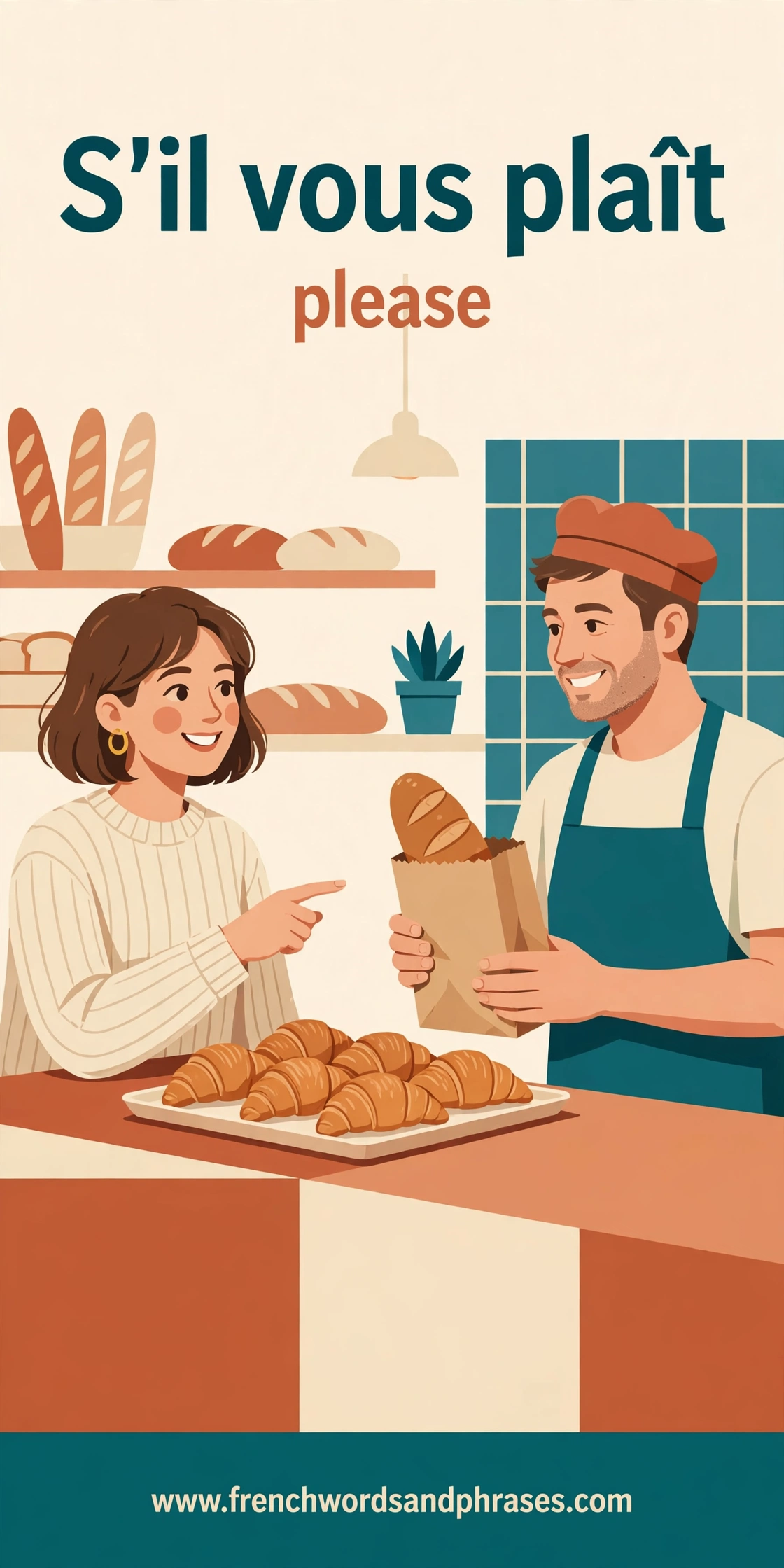
Imagine the bakery queue at eight in the morning. The woman ahead of you asks for her baguette with a s’il vous plaît; the baker wraps it with a flourish. Your turn comes, you forget the magic words, and the baguette arrives noticeably colder. France runs on this phrase.
English please is a single blunt word. French built a tiny ceremony instead: if it pleases you — the request bows before it speaks.
How to Use S’il vous plaît in French: Complete Guide
Let’s explore how s’il vous plaît works in French, beginning with the whole phrase on one card.
S’il vous plaît at a Glance
The Whole Phrase on One Card
Real meaning, literal picture, English twin and register — s’il vous plaît in five lines.
| Point | S’il vous plaît |
|---|---|
| What it really means | please — the softener of every request |
| Word for word | if it pleases you — si + il + vous + plaît (from plaire) |
| English equivalent | please |
| Register | polite and neutral — the vous form, safe with everyone |
| Use it for | orders, requests, questions, getting attention |
Example
L’addition, s’il vous plaît.
The bill, please.
Word by Word: Building the Courtesy
Four small pieces — take them one by one and the ceremony assembles itself.
| Word | Literal meaning | Its job in the phrase |
|---|---|---|
| s’ (si) | if | the condition — elided before il: s’il |
| il | it | the request itself, standing politely in the background |
| vous | to you | the person being pleased — vous formal/plural, te for tu |
| plaît | pleases | from plaire, to please — with its circumflex: plaît |
Example
Un thé, s’il te plaît, maman.
A tea, please, mum.
Quick Quiz 1
Word for word, what does s’il vous plaît say?
Reveal the answer
If it pleases you — si (if) + il (it) + vous (you) + plaît (pleases, from plaire).
Passez-moi le sel, s’il vous plaît.
Pass me the salt, please.
When You Say It: The Request Moments
S’il vous plaît fires at moments like these — wherever something is asked for, offered or repeated.
| Situation | Example |
|---|---|
| Ordering | un café, s’il vous plaît — a coffee, please |
| Asking the way | la gare, s’il vous plaît ? — the station, please? |
| Getting attention | s’il vous plaît ! — excuse me! (to a waiter, a driver) |
| Asking to repeat | encore une fois, s’il vous plaît — once more, please |
| On the phone | un moment, s’il vous plaît — one moment, please |
Example
Excusez-moi, la sortie, s’il vous plaît ?
Excuse me, the exit, please?
Make It Yours: Vous or Te, the Only Moving Part
The phrase is frozen except for one piece — the pronoun that matches your relationship with the listener.
| Form | French | In English |
|---|---|---|
| Formal / plural | s’il vous plaît | please (to vous) |
| Familiar | s’il te plaît | please (to tu) |
| At the end | un café, s’il vous plaît | a coffee, please |
| At the start | s’il vous plaît, ouvrez la porte | please, open the door |
| Alone, calling out | s’il vous plaît ! | excuse me! / over here, please! |
Example
Ferme la fenêtre, s’il te plaît.
Close the window, please.
Quick Quiz 2
Your little brother asks for the jam. Which form does he use to your mother — and which would you use to a stranger?
Reveal the answer
S’il te plaît to family, s’il vous plaît to a stranger — the pronoun matches the relationship; the rest of the phrase never moves.
Le beurre, s’il te plaît. — The butter, please (at home).
Everyday Expressions: Building on the Courtesy
S’il vous plaît slots into these everyday frames — each one ready to use as it stands.
| Frame | In English |
|---|---|
| l’addition, s’il vous plaît | the bill, please |
| un moment, s’il vous plaît | one moment, please |
| doucement, s’il vous plaît | gently / slowly, please |
| taisez-vous, s’il vous plaît | please be quiet (formal, firm) |
| s’il vous plaît ? | yes, please? / pardon? — answering a call or a knock |
Example
Un moment, s’il vous plaît, je vérifie.
One moment, please, I will check.
Close Cousins: The Other Polite Tools
French politeness is a small toolkit — s’il vous plaît asks; its cousins thank, excuse and soften.
| Expression | The difference |
|---|---|
| s’il vous plaît | please — before or after the request |
| merci | thank you — after the favour, the natural partner of s’il vous plaît |
| excusez-moi / pardon | excuse me, sorry — for apologies and squeezing past |
| je vous en prie | you’re welcome / please do — the formal reply to thanks |
| veuillez + infinitive | please (written, official) — veuillez patienter, please wait |
Example
Veuillez patienter, s’il vous plaît.
Please wait, if you would. (official notice)
Quick Quiz 3
A sign in a station reads: Veuillez patienter. What is it asking you to do?
Reveal the answer
Please wait — veuillez + infinitive is the written, official way of saying please do something.
Veuillez patienter, le train arrive.
Please wait, the train is arriving.
S’il vous plaît and Its Neighbours
The politeness shelf around the phrase — the words that keep French daily life smooth.
| French | In English |
|---|---|
| merci | thank you |
| de rien | you’re welcome (informal) |
| je vous en prie | you’re welcome (formal) |
| excusez-moi | excuse me |
| volontiers | gladly, with pleasure |
Example
Merci beaucoup. — Je vous en prie.
Thank you very much. — You’re welcome.
Watch Out: The Traps Around S’il vous plaît
The traps: the wrong pronoun, a lost circumflex, and the phrase forgotten altogether.
| Trap | The truth |
|---|---|
| vous to a friend, te to a stranger | match the pronoun to the relationship: te at home, vous everywhere else |
| « s’il vous plait » without the hat | plaît wears a circumflex: î. In careful writing it is never dropped |
| « si il vous plaît » unelided | si always elides before il: s’il vous plaît |
| skipping it entirely | in France, a bare request sounds like an order — the phrase is not optional decoration |
Example
Un café, s’il vous plaît — avec le chapeau sur le î, et le sourire en plus.
A coffee, please — with the hat on the î, and a smile besides.
Quick Quiz 4
True or false: s’il te plaît is the form for a police officer.
Reveal the answer
False — an official gets vous: s’il vous plaît. Te is for the tu circle: family, friends, children.
Monsieur l’agent, la gare, s’il vous plaît ?
Officer, the station, please?
S’il vous plaît in Everyday French: Real-Life Examples
Now that you know the word, let’s see how s’il vous plaît appears in everyday French.
Example 1 — At the café
Un café et un croissant, s’il vous plaît.
A coffee and a croissant, please.
Example 2 — Asking the way
Pardon, la gare, s’il vous plaît ?
Excuse me, the station, please?
Example 3 — At home
Passe-moi le pain, s’il te plaît.
Pass me the bread, please.
Example 4 — On the phone
Un moment, s’il vous plaît, je vous le passe.
One moment, please, I will put him on.
Example 5 — Getting attention
S’il vous plaît ! Je crois que c’est mon tour.
Excuse me! I believe it is my turn.
Example 6 — At the hotel
La clé de la chambre douze, s’il vous plaît.
The key to room twelve, please.
Beyond Translation: The Meaning of S’il vous plaît
English please is a worn-down coin — it once said “if you please”, but centuries of pockets have rubbed the words smooth. French never wore its coin down: s’il vous plaît still shows the whole design, if it pleases you, the request visibly bowing to the person who will grant it.
To say s’il vous plaît is to admit that the other person is free to refuse — and that is exactly why they so rarely do.
Learn this one phrase and half of French politeness comes with it: the vous and te inside it will teach your ear the whole geography of French relationships.
How to Remember the French Phrase S’il vous plaît
Remember it this way: S’il vous plaît means please — literally “if it pleases you”, with vous for strangers and te for the tu circle.
- You never skip it — in France a request without s’il vous plaît sounds like an order.
- You match the pronoun — s’il vous plaît for vous, s’il te plaît for tu.
- You keep the hat — plaît, with its circumflex, from the verb plaire.
The key idea is s’il vous plaît means please — if it pleases you; vous for formal, te for familiar.
Test Your Knowledge of S’il vous plaît
Let’s see how much you’ve learned. Try answering these questions before revealing the answers.
Question 1
What does s’il vous plaît mean?
Reveal the answer
Please — literally, if it pleases you.
Question 2
How do you say please to a close friend?
Reveal the answer
S’il te plaît — te replaces vous inside the same frozen phrase.
Question 3
Translate: The bill, please.
Reveal the answer
L’addition, s’il vous plaît.
Question 4
Which verb hides inside plaît?
Reveal the answer
Plaire — to please: s’il vous plaît is if it pleases you.
Question 5
Complete the sentence:
Un verre d’eau, ______ vous plaît. (please)
Reveal the answer
s’il
Un verre d’eau, s’il vous plaît.
A glass of water, please.
Your Final Challenge
Can You Use It?
How would you say this in French?
“A coffee, please.”
Reveal the answer
Un café, s’il vous plaît.
A coffee, please.
A little French. A little curiosity. A richer everyday life.
LEARN FRENCH ONE WORD AT A TIME