A French Word to Live By
How to Conjugate Plaire in French
/plɛʁ/
Plaire means to please.
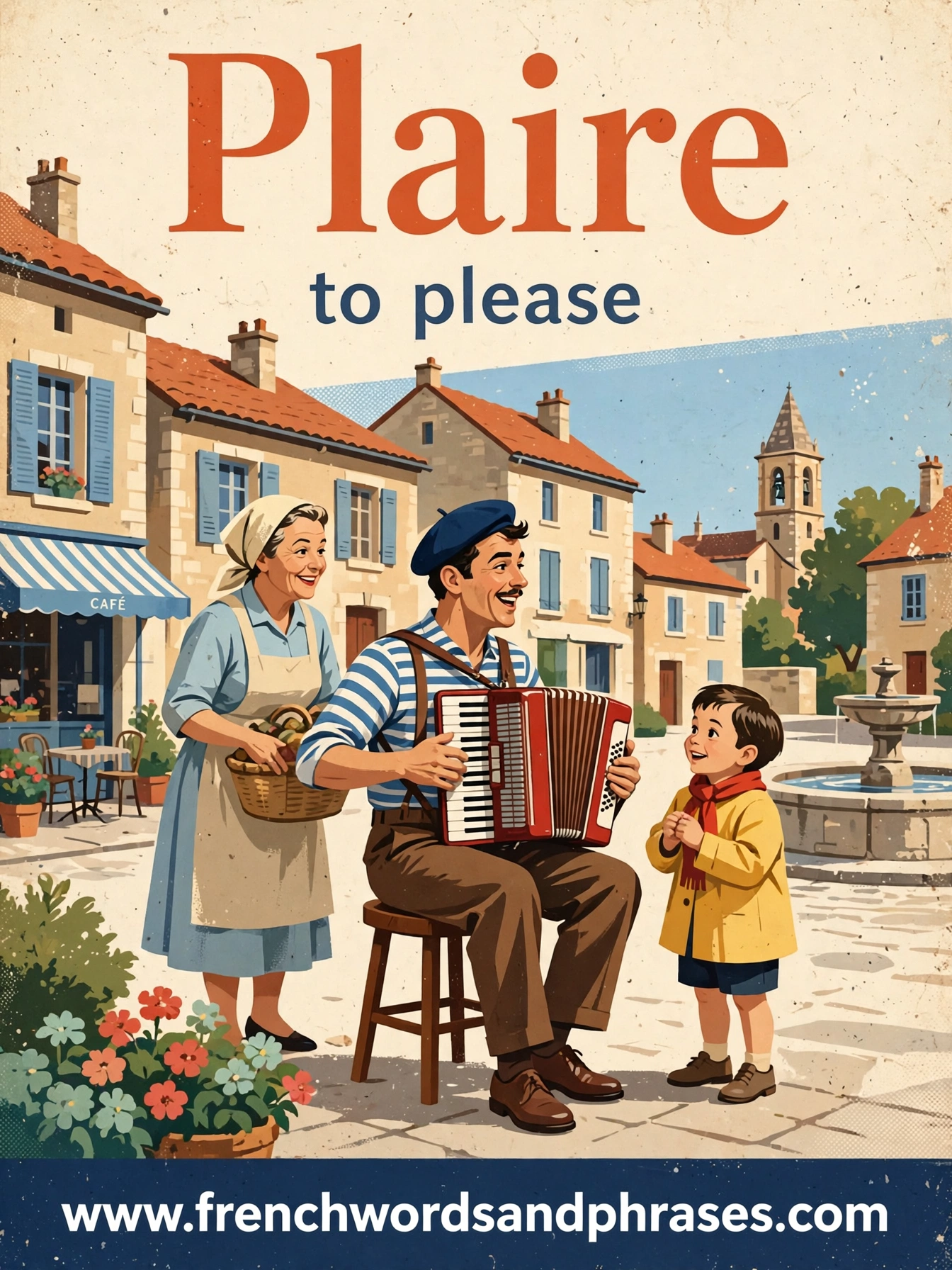
Some things simply win you over. A song you cannot stop humming, a smile across a café, a book you finish in one night — that is plaire.
In this guide, you’ll learn how to conjugate plaire in all the major French tenses and moods. Explore complete conjugation tables, French examples, English translations, and practice quizzes.
Understanding the French Verb Plaire
Plaire is an irregular French verb belonging to the third group of verbs, those ending in -re.
It means to please. It is commonly used in the pattern plaire à quelqu’un — something pleases someone — and in the set phrases s’il vous plaît, please, and ça me plaît, I like it.
Verb classification: Third group (irregular -re verb)
Auxiliary verb: Avoir
Past participle: plu
Present participle: plaisant
English equivalents: To please.
One important spelling detail: il plaît keeps a circumflex on the î, but the past forms change stem completely — je plus, il plut, and the past participle is plu, as in ce film a plu à tout le monde.
Experience the Word
Plaire is more than looking nice. It is the spark that makes people glad you are there, before you have said a word.
Imagine bringing a homemade cake to your neighbours. You watch their faces as they taste it, and the smiles tell you everything.
You have not just baked a cake. You have pleased.
How to Conjugate Plaire: Complete French Conjugation Guide
Let’s explore every major conjugation of plaire, beginning with the indicative mood.
How to Conjugate Plaire in the Indicative Mood
The indicative mood is used to express facts, observations, actions, and events.
How to Conjugate Plaire in the Present Tense (Présent)
Used for actions happening now, habitual actions, and general truths.
| Subject | Conjugation |
|---|---|
| je | plais |
| tu | plais |
| il / elle | plaît |
| nous | plaisons |
| vous | plaisez |
| ils / elles | plaisent |
Example
Ce livre plaît beaucoup aux enfants.
This book pleases the children a lot.
Quick Quiz 1
Complete the sentence:
Ce livre ______ beaucoup aux enfants.
Reveal the answer
plaît
Ce livre plaît beaucoup aux enfants.
This book pleases the children a lot.
How to Conjugate Plaire in the Passé Composé
Used for completed actions in the past. Plaire takes the auxiliary verb avoir.
| Subject | Conjugation |
|---|---|
| j’ | ai plu |
| tu | as plu |
| il / elle | a plu |
| nous | avons plu |
| vous | avez plu |
| ils / elles | ont plu |
Example
Le film a plu à tout le monde.
The film pleased everyone.
How to Conjugate Plaire in the Imparfait (Imperfect Tense)
Used for habitual past actions, descriptions, and ongoing situations in the past.
| Subject | Conjugation |
|---|---|
| je | plaisais |
| tu | plaisais |
| il / elle | plaisait |
| nous | plaisions |
| vous | plaisiez |
| ils / elles | plaisaient |
Example
Quand il était jeune, il plaisait à toutes les voisines.
When he was young, all the neighbours liked him.
Quick Quiz 2
Choose the correct form:
When he was young, all the neighbours liked him.
Quand il était jeune, il ______ à toutes les voisines.
Reveal the answer
plaisait
Quand il était jeune, il plaisait à toutes les voisines.
How to Conjugate Plaire in the Plus-que-parfait
Used to describe an action that had already been completed before another past event.
| Subject | Conjugation |
|---|---|
| j’ | avais plu |
| tu | avais plu |
| il / elle | avait plu |
| nous | avions plu |
| vous | aviez plu |
| ils / elles | avaient plu |
Example
Elle avait déjà plu à tout le monde avant qu’il n’arrive.
She had already pleased everyone before he arrived.
How to Conjugate Plaire in the Passé Simple
Primarily used in formal writing, literature, and historical narratives. It is rarely used in everyday conversation.
| Subject | Conjugation |
|---|---|
| je | plus |
| tu | plus |
| il / elle | plut |
| nous | plûmes |
| vous | plûtes |
| ils / elles | plurent |
Example
Il plut au roi par son honnêteté.
He pleased the king with his honesty.
How to Conjugate Plaire in the Passé Antérieur
A literary tense used to express an action completed immediately before another past action, generally in the passé simple.
| Subject | Conjugation |
|---|---|
| j’ | eus plu |
| tu | eus plu |
| il / elle | eut plu |
| nous | eûmes plu |
| vous | eûtes plu |
| ils / elles | eurent plu |
Example
Dès qu’elle eut plu au public, la salle applaudit.
As soon as she had pleased the audience, the hall applauded.
How to Conjugate Plaire in the Future Tense (Futur Simple)
Used to describe actions that will take place in the future.
| Subject | Conjugation |
|---|---|
| je | plairai |
| tu | plairas |
| il / elle | plaira |
| nous | plairons |
| vous | plairez |
| ils / elles | plairont |
Example
Demain, ce spectacle plaira à tout le monde.
Tomorrow, this show will please everyone.
How to Conjugate Plaire in the Futur Antérieur (Future Perfect)
Used for an action that will have been completed before a particular point in the future.
| Subject | Conjugation |
|---|---|
| j’ | aurai plu |
| tu | auras plu |
| il / elle | aura plu |
| nous | aurons plu |
| vous | aurez plu |
| ils / elles | auront plu |
Example
À Noël, ce jouet aura déjà plu à l’enfant.
By Christmas, this toy will already have pleased the child.
How to Conjugate Plaire in the Near Future (Futur Proche)
Used to describe something that is going to happen soon. Formed with aller + infinitive.
| Subject | Conjugation |
|---|---|
| je | vais plaire |
| tu | vas plaire |
| il / elle | va plaire |
| nous | allons plaire |
| vous | allez plaire |
| ils / elles | vont plaire |
Example
Ce dessert va plaire aux invités dès ce soir.
This dessert is going to please the guests this evening.
How to Conjugate Plaire in the Conditional Mood
The conditional mood expresses what would happen under certain circumstances. It is also frequently used to make polite requests or express wishes.
How to Conjugate Plaire in the Present Conditional
| Subject | Conjugation |
|---|---|
| je | plairais |
| tu | plairais |
| il / elle | plairait |
| nous | plairions |
| vous | plairiez |
| ils / elles | plairaient |
Example
Cette robe te plairait si tu l’essayais.
This dress would please you if you tried it on.
How to Conjugate Plaire in the Past Conditional
| Subject | Conjugation |
|---|---|
| j’ | aurais plu |
| tu | aurais plu |
| il / elle | aurait plu |
| nous | aurions plu |
| vous | auriez plu |
| ils / elles | auraient plu |
Example
Le film aurait plu aux enfants si j’avais su.
The film would have pleased the children if I had known.
Plaire in the Literary Past Conditional Form
This less common literary form uses the imperfect subjunctive of avoir.
| Subject | Conjugation |
|---|---|
| j’ | eusse plu |
| tu | eusses plu |
| il / elle | eût plu |
| nous | eussions plu |
| vous | eussiez plu |
| ils / elles | eussent plu |
Example
Elle eût plu au public si elle avait pu chanter.
She would have pleased the audience if she had been able to sing.
How to Conjugate Plaire in the Subjunctive Mood
The subjunctive is used to express wishes, emotions, doubts, necessity, and uncertainty. It frequently follows expressions such as il faut que (it is necessary that) or bien que (although).
How to Conjugate Plaire in the Present Subjunctive
| Subject | Conjugation |
|---|---|
| que je | plaise |
| que tu | plaises |
| qu’il / qu’elle | plaise |
| que nous | plaisions |
| que vous | plaisiez |
| qu’ils / qu’elles | plaisent |
Example
Il faut que ce cadeau plaise à Marie.
This gift needs to please Marie.
Quick Quiz 3
Complete the sentence using the subjunctive:
Il faut que ce cadeau ______ à Marie.
Reveal the answer
plaise
Il faut que ce cadeau plaise à Marie.
This gift needs to please Marie.
How to Conjugate Plaire in the Imperfect Subjunctive
A literary tense, rarely encountered in modern spoken French.
| Subject | Conjugation |
|---|---|
| que je | plusse |
| que tu | plusses |
| qu’il / qu’elle | plût |
| que nous | plussions |
| que vous | plussiez |
| qu’ils / qu’elles | plussent |
Example
Il souhaitait qu’elle plût à sa famille.
He wished that she would please his family.
How to Conjugate Plaire in the Pluperfect Subjunctive
A literary construction used to express an action completed before another past action.
| Subject | Conjugation |
|---|---|
| que j’ | eusse plu |
| tu | eusses plu |
| qu’il / qu’elle | eût plu |
| que nous | eussions plu |
| que vous | eussiez plu |
| qu’ils / qu’elles | eussent plu |
Example
Il regrettait que le spectacle eût plu si peu.
He regretted that the show had pleased so little.
How to Conjugate Plaire in the Past Subjunctive
| Subject | Conjugation |
|---|---|
| que j’ | aie plu |
| que tu | aies plu |
| qu’il / qu’elle | ait plu |
| que nous | ayons plu |
| que vous | ayez plu |
| qu’ils / qu’elles | aient plu |
Example
Je suis heureux que le cadeau t’ait plu.
I am happy that the gift pleased you.
How to Conjugate Plaire in the Imperative
The imperative is used to give commands, instructions, invitations, or suggestions. Subject pronouns are omitted.
How to Conjugate Plaire in the Present Imperative
| Person | Conjugation |
|---|---|
| (tu) | plais |
| (nous) | plaisons |
| (vous) | plaisez |
Example
Plais à ton public, chante avec le cœur !
Please your audience, sing with your heart!
Quick Quiz 4
How would you say Please your audience! (tu form)?
Reveal the answer
Plais à ton public !
French Participles of Plaire
Participles are verb forms that can be used in compound tenses and other grammatical constructions.
Present Participle of Plaire
plaisant
En plaisant aux clients, elle a doublé ses ventes.
By pleasing her customers, she doubled her sales.
Past Participle of Plaire
plu
Son discours a plu à nos voisins.
His speech pleased our neighbours.
Plaire in Everyday French: Real-Life Examples
Now that you know the conjugations, let’s see how plaire appears in everyday French.
Example 1 — Present
Ce quartier plaît beaucoup aux visiteurs.
This neighbourhood really pleases visitors.
Example 2 — Passé composé
Elle a plu au jury dès le premier jour.
She pleased the jury from the very first day.
Example 3 — Imparfait
Il plaisait à tout le monde par sa gentillesse.
He pleased everyone with his kindness.
Example 4 — Future
Ces jeux plairont aux enfants.
These games will please the children.
Example 5 — Conditional
Cette maison plairait à mes parents.
This house would please my parents.
Example 6 — Subjunctive
Bien que ce livre plaise aux critiques, il se vend peu.
Although this book pleases the critics, it sells little.
Beyond Translation: The Meaning of Plaire
English says please for politeness, but plaire works the other way round: the thing pleases the person. You do not like the book — the book pleases you, ce livre me plaît.
Pleasing is being liked.
To plaire is to win hearts without forcing anything. It evokes charm, taste, and the quiet joy of being appreciated.
How to Remember the French Verb Plaire
Remember it this way: Plaire is about being liked, charming without trying.
- You try a cake and smile — ce gâteau me plaît.
- You want to be polite — tu dis s’il te plaît.
- A song wins over the whole room — elle plaît à tout le monde.
The key idea is being liked, charming without trying.
Test Your Knowledge of Plaire
Let’s see how much you’ve learned. Try answering these questions before revealing the answers.
Question 1
What auxiliary verb is used with plaire in compound tenses?
Reveal the answer
Avoir
Question 2
How do you say This show will please everyone in French?
Reveal the answer
Ce spectacle plaira à tout le monde.
Question 3
Translate: His speech pleased our neighbours.
Reveal the answer
Son discours a plu à nos voisins.
Question 4
What is the present participle of plaire?
Reveal the answer
Plaisant.
Question 5
Complete the sentence:
Si tu l’essayais, cette robe te ______.
Reveal the answer
plairait
Cette robe te plairait si tu l’essayais.
This dress would please you if you tried it on.
Your Final Challenge
Can You Use It?
How would you say this in French?
“Tomorrow, I want to please my guests with a good meal.”
Reveal the answer
Demain, je veux plaire à mes invités avec un bon repas.
Tomorrow, I want to please my guests with a good meal.
A little French. A little curiosity. A richer everyday life.
LEARN FRENCH ONE WORD AT A TIME