A French Word to Live By
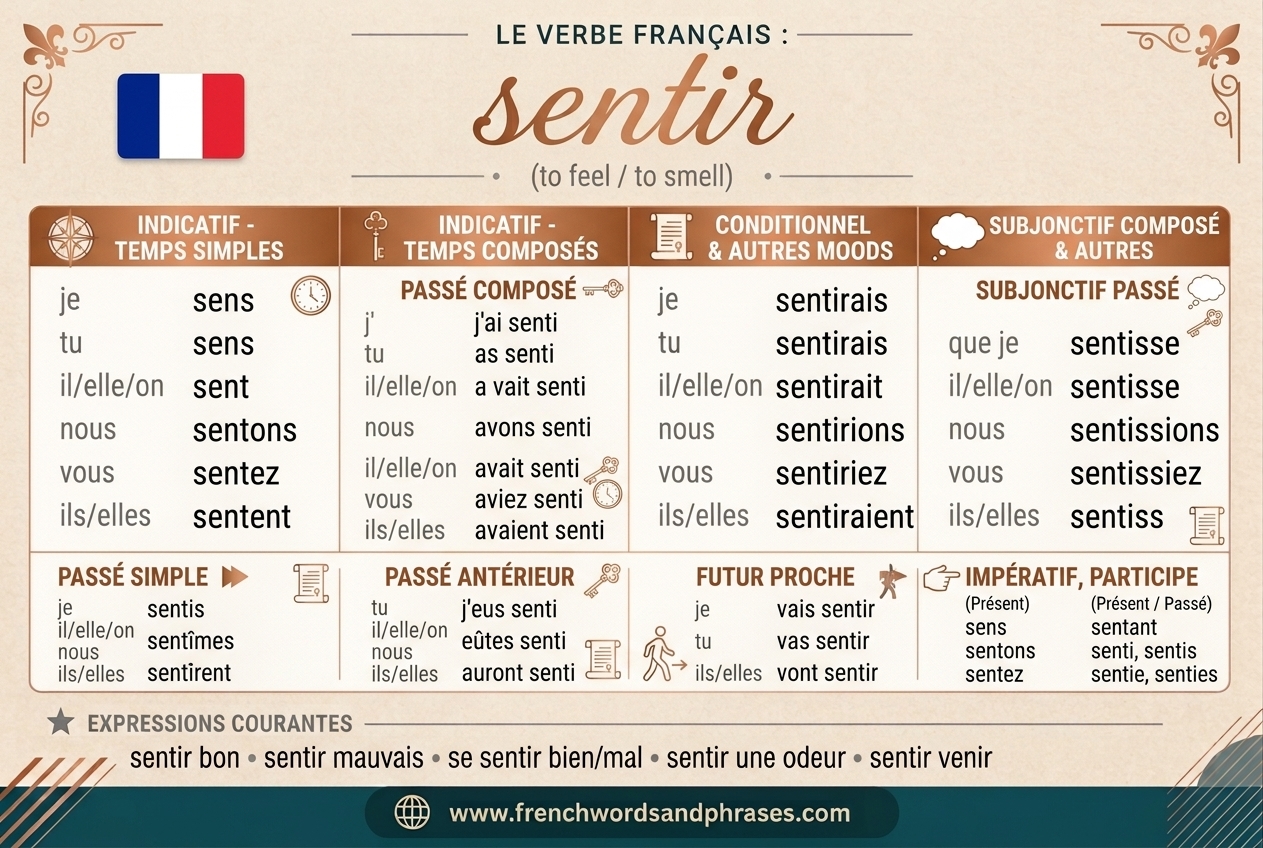
How to Conjugate Sentir in French
/sɑ̃.tiʁ/
Sentir means to feel, to smell, or to sense.
Some feelings arrive before words do. You feel the warmth of the sun, you smell fresh bread from a bakery, or you sense that something is about to change — that is sentir.
In this guide, you’ll learn how to conjugate sentir in all the major French tenses and moods. Explore complete conjugation tables, French examples, English translations, and practice quizzes.
Understanding the French Verb Sentir
Sentir is an irregular French verb belonging to the third group of verbs.
It means to feel, to smell, or to sense. It is commonly used for physical sensations, for smells, and for intuitions — what you feel in your body, what you smell in the air, and what you sense without being able to explain it.
Verb classification: Third group (irregular -ir verb)
Auxiliary verb: Avoir
Past participle: senti
Present participle: sentant
English equivalents: To feel, to smell, to sense.
One important spelling detail: the stem changes in the present tense — je sens, nous sentons, ils sentent — so the singular forms drop the -t- sound found in the infinitive.
Experience the Word
Sentir is more than feeling. It is noticing with your senses, before your mind has named what is happening.
Imagine walking past a bakery in the morning. You smell warm bread, you feel the cool air on your face, and you sense, somehow, that today will be a good day.
You have not just noticed something. You have felt it.
How to Conjugate Sentir: Complete French Conjugation Guide
Let’s explore every major conjugation of sentir, beginning with the indicative mood.
How to Conjugate Sentir in the Indicative Mood
The indicative mood is used to express facts, observations, actions, and events.
How to Conjugate Sentir in the Present Tense (Présent)
Used for actions happening now, habitual actions, and general truths.
| Subject | Conjugation |
|---|---|
| je | sens |
| tu | sens |
| il / elle | sent |
| nous | sentons |
| vous | sentez |
| ils / elles | sentent |
Example
Je sens une odeur de café.
I smell coffee.
Quick Quiz 1
Complete the sentence:
Nous ______ l’odeur du pain frais.
Reveal the answer
sentons
Nous sentons l’odeur du pain frais.
We smell the fresh bread.
How to Conjugate Sentir in the Passé Composé
Used for completed actions in the past. Sentir takes the auxiliary verb avoir.
| Subject | Conjugation |
|---|---|
| j’ | ai senti |
| tu | as senti |
| il / elle | a senti |
| nous | avons senti |
| vous | avez senti |
| ils / elles | ont senti |
Example
J’ai senti le froid ce matin.
I felt the cold this morning.
How to Conjugate Sentir in the Imparfait (Imperfect Tense)
Used for habitual past actions, descriptions, and ongoing situations in the past.
| Subject | Conjugation |
|---|---|
| je | sentais |
| tu | sentais |
| il / elle | sentait |
| nous | sentions |
| vous | sentiez |
| ils / elles | sentaient |
Example
Quand j’étais enfant, je sentais toujours l’odeur du pain.
When I was a child, I always smelled the bread.
Quick Quiz 2
Choose the correct form:
When we were children, we used to feel the cold in winter.
Quand nous étions enfants, nous ______ le froid en hiver.
Reveal the answer
sentions
Quand nous étions enfants, nous sentions le froid en hiver.
How to Conjugate Sentir in the Plus-que-parfait
Used to describe an action that had already been completed before another past event.
| Subject | Conjugation |
|---|---|
| j’ | avais senti |
| tu | avais senti |
| il / elle | avait senti |
| nous | avions senti |
| vous | aviez senti |
| ils / elles | avaient senti |
Example
J’avais déjà senti ce parfum avant.
I had already smelled this perfume before.
How to Conjugate Sentir in the Passé Simple
Primarily used in formal writing, literature, and historical narratives. It is rarely used in everyday conversation.
| Subject | Conjugation |
|---|---|
| je | sentis |
| tu | sentis |
| il / elle | sentit |
| nous | sentîmes |
| vous | sentîtes |
| ils / elles | sentirent |
Example
Il sentit soudain un danger.
He suddenly sensed a danger.
How to Conjugate Sentir in the Passé Antérieur
A literary tense used to express an action completed immediately before another past action, generally in the passé simple.
| Subject | Conjugation |
|---|---|
| j’ | eus senti |
| tu | eus senti |
| il / elle | eut senti |
| nous | eûmes senti |
| vous | eûtes senti |
| ils / elles | eurent senti |
Example
Dès qu’il eut senti l’odeur, il sortit de la cuisine.
As soon as he had smelled the odour, he left the kitchen.
How to Conjugate Sentir in the Future Tense (Futur Simple)
Used to describe actions that will take place in the future.
| Subject | Conjugation |
|---|---|
| je | sentirai |
| tu | sentiras |
| il / elle | sentira |
| nous | sentirons |
| vous | sentirez |
| ils / elles | sentiront |
Example
Demain, tu sentiras la différence.
Tomorrow, you will feel the difference.
How to Conjugate Sentir in the Futur Antérieur (Future Perfect)
Used for an action that will have been completed before a particular point in the future.
| Subject | Conjugation |
|---|---|
| j’ | aurai senti |
| tu | auras senti |
| il / elle | aura senti |
| nous | aurons senti |
| vous | aurez senti |
| ils / elles | auront senti |
Example
À midi, j’aurai déjà senti l’odeur du repas.
By noon, I will already have smelled the meal.
How to Conjugate Sentir in the Near Future (Futur Proche)
Used to describe something that is going to happen soon. Formed with aller + infinitive.
| Subject | Conjugation |
|---|---|
| je | vais sentir |
| tu | vas sentir |
| il / elle | va sentir |
| nous | allons sentir |
| vous | allez sentir |
| ils / elles | vont sentir |
Example
Je vais sentir les fleurs du jardin.
I am going to smell the flowers in the garden.
How to Conjugate Sentir in the Conditional Mood
The conditional mood expresses what would happen under certain circumstances. It is also frequently used to make polite requests or express wishes.
How to Conjugate Sentir in the Present Conditional
| Subject | Conjugation |
|---|---|
| je | sentirais |
| tu | sentirais |
| il / elle | sentirait |
| nous | sentirions |
| vous | sentiriez |
| ils / elles | sentiraient |
Example
Je sentirais mieux si je n’étais pas enrhumé.
I would feel better if I did not have a cold.
How to Conjugate Sentir in the Past Conditional
| Subject | Conjugation |
|---|---|
| j’ | aurais senti |
| tu | aurais senti |
| il / elle | aurait senti |
| nous | aurions senti |
| vous | auriez senti |
| ils / elles | auraient senti |
Example
J’aurais senti le danger si j’avais écouté.
I would have sensed the danger if I had listened.
Sentir in the Literary Past Conditional Form
This less common literary form uses the imperfect subjunctive of avoir.
| Subject | Conjugation |
|---|---|
| j’ | eusse senti |
| tu | eusses senti |
| il / elle | eût senti |
| nous | eussions senti |
| vous | eussiez senti |
| ils / elles | eussent senti |
Example
Il eût senti la tension s’il avait été là.
He would have sensed the tension if he had been there.
How to Conjugate Sentir in the Subjunctive Mood
The subjunctive is used to express wishes, emotions, doubts, necessity, and uncertainty. It frequently follows expressions such as il faut que (it is necessary that) or bien que (although).
How to Conjugate Sentir in the Present Subjunctive
| Subject | Conjugation |
|---|---|
| que je | sente |
| que tu | sentes |
| qu’il / qu’elle | sente |
| que nous | sentions |
| que vous | sentiez |
| qu’ils / qu’elles | sentent |
Example
Il faut que je sente le parfum avant de l’acheter.
I need to smell the perfume before buying it.
Quick Quiz 3
Complete the sentence using the subjunctive:
Il faut que nous ______ la différence.
Reveal the answer
sentions
Il faut que nous sentions la différence.
We need to feel the difference.
How to Conjugate Sentir in the Imperfect Subjunctive
A literary tense, rarely encountered in modern spoken French.
| Subject | Conjugation |
|---|---|
| que je | sentisse |
| que tu | sentisses |
| qu’il / qu’elle | sentît |
| que nous | sentissions |
| que vous | sentissiez |
| qu’ils / qu’elles | sentissent |
Example
Il souhaitait qu’elle sentît la joie du moment.
He wished that she would feel the joy of the moment.
How to Conjugate Sentir in the Pluperfect Subjunctive
A literary construction used to express an action completed before another past action.
| Subject | Conjugation |
|---|---|
| que j’ | eusse senti |
| que tu | eusses senti |
| qu’il / qu’elle | eût senti |
| que nous | eussions senti |
| que vous | eussiez senti |
| qu’ils / qu’elles | eussent senti |
Example
Il regrettait que nous eussions senti si peu de choses.
He regretted that we had felt so little.
How to Conjugate Sentir in the Past Subjunctive
| Subject | Conjugation |
|---|---|
| que j’ | aie senti |
| que tu | aies senti |
| qu’il / qu’elle | ait senti |
| que nous | ayons senti |
| que vous | ayez senti |
| qu’ils / qu’elles | aient senti |
Example
Je suis heureux que tu aies senti la différence.
I am happy that you felt the difference.
How to Conjugate Sentir in the Imperative
The imperative is used to give commands, instructions, invitations, or suggestions. Subject pronouns are omitted.
How to Conjugate Sentir in the Present Imperative
| Person | Conjugation |
|---|---|
| (tu) | sens |
| (nous) | sentons |
| (vous) | sentez |
Example
Sens cette fleur, elle est parfumée !
Smell this flower, it is fragrant!
Quick Quiz 4
How would you say “Feel this fabric”? (tu form)
Reveal the answer
Sens ce tissu !
French Participles of Sentir
Participles are verb forms that can be used in compound tenses and other grammatical constructions.
Present Participle of Sentir
sentant
En sentant l’odeur, j’ai souri.
Smelling the scent, I smiled.
Past Participle of Sentir
senti
Nous avons senti la chaleur du soleil.
We felt the warmth of the sun.
Sentir in Everyday French: Real-Life Examples
Now that you know the conjugations, let’s see how sentir appears in everyday French.
Example 1 — Present
Je sens que quelque chose va changer.
I sense that something is going to change.
Example 2 — Passé composé
Nous avons senti une odeur étrange.
We smelled a strange odour.
Example 3 — Imparfait
Elle sentait toujours bon.
She always smelled good.
Example 4 — Future
Ils sentiront le froid ce soir.
They will feel the cold tonight.
Example 5 — Conditional
Je sentirais plus de joie si tu étais là.
I would feel more joy if you were here.
Example 6 — Subjunctive
Bien que nous sentions le froid, nous restons dehors.
Although we feel the cold, we stay outside.
Beyond Translation: The Meaning of Sentir
English has words such as feel, smell, and sense. Each captures part of the meaning of sentir, but the French word covers all three in one verb.
Feeling, smelling, and sensing — together.
To sentir is to use your senses to understand the world around you. It evokes a direct, physical way of knowing, before words or explanations arrive.
How to Remember the French Verb Sentir
Remember it this way: Sentir is about feeling, smelling, and sensing with your body.
- You breathe in and notice a scent — you sentez something.
- You place your hand in water and notice the temperature — tu sens le froid.
- You walk into a room and know something is wrong — tu sens la tension.
The key idea is feeling, smelling, and sensing with your body.
Test Your Knowledge of Sentir
Let’s see how much you’ve learned. Try answering these questions before revealing the answers.
Question 1
What auxiliary verb is used with sentir in compound tenses?
Reveal the answer
Avoir
Question 2
How do you say “I will feel” in French?
Reveal the answer
Je sentirai.
Question 3
Translate: “We felt the warmth of the sun.”
Reveal the answer
Nous avons senti la chaleur du soleil.
Question 4
What is the present participle of sentir?
Reveal the answer
Sentant.
Question 5
Complete the sentence:
Si je n’étais pas enrhumé, je ______ mieux.
Reveal the answer
sentirais
Si je n’étais pas enrhumé, je sentirais mieux.
If I did not have a cold, I would feel better.
Your Final Challenge
Can You Use It?
How would you say this in French?
“Tomorrow, I want to feel the sea air.”
Reveal the answer
Demain, je veux sentir l’air de la mer.
Tomorrow, I want to feel the sea air.
A little French. A little curiosity. A richer everyday life.
LEARN FRENCH ONE WORD AT A TIME