How to Conjugate Se parfumer in French
/sə paʁ.fy.me/
Se parfumer means to wear perfume — to put scent on your own skin: a drop behind the ears, a cloud over the wrists, before the door opens.
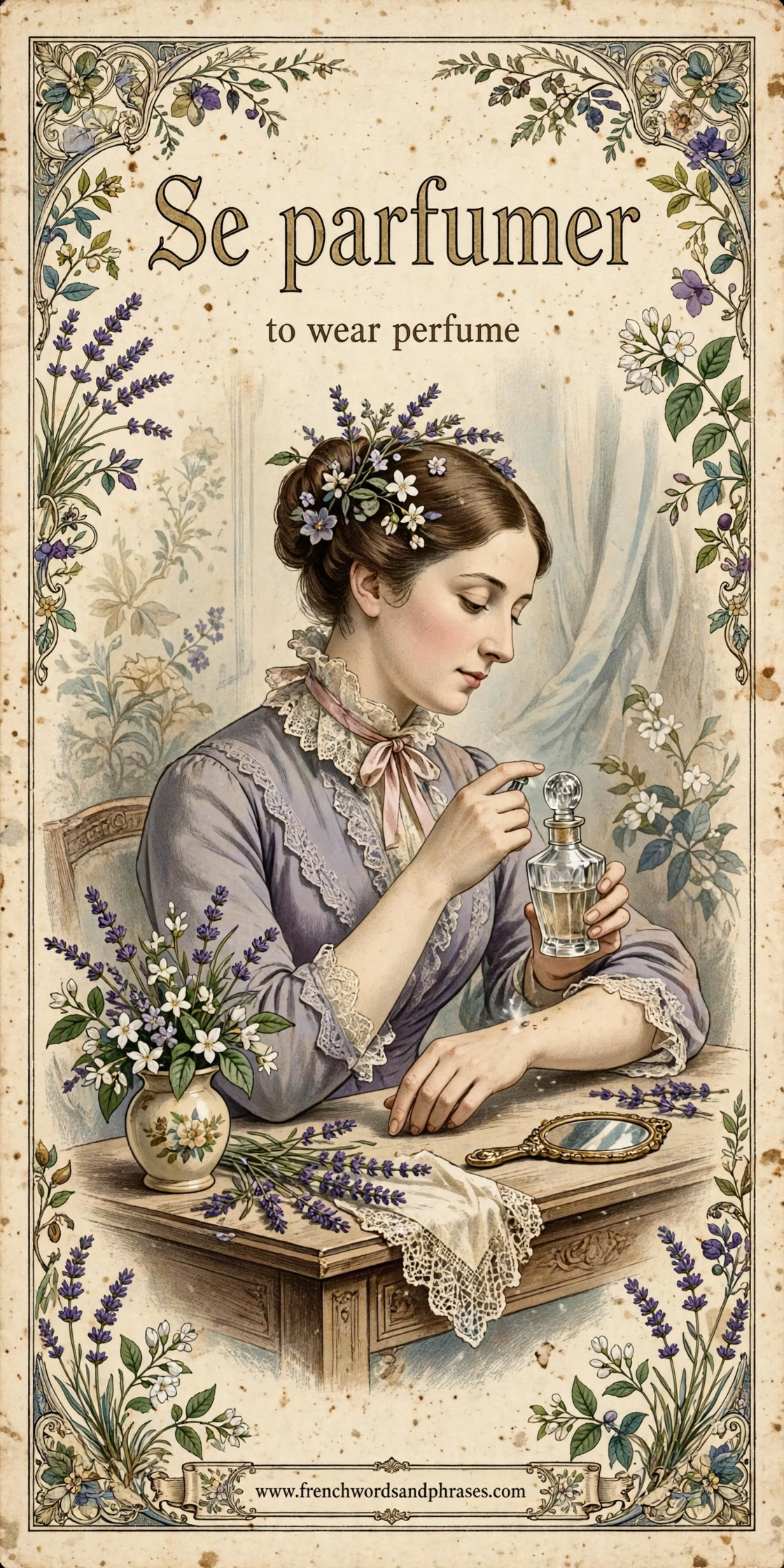
A dressing table at seven in the evening: the stopper lifts, two drops behind the ears, one at each wrist, and the whole evening changes key. Se parfumer is parfumer turned on oneself — the small daily ceremony by which a person chooses the scent they will walk into the world wearing.
In this guide, you’ll learn how to conjugate se parfumer in all the major French tenses and moods. Explore complete conjugation tables, French examples, English translations, and practice quizzes.
Understanding the French Verb Se parfumer
Se parfumer is a regular French verb belonging to the first group of verbs, those ending in -er.
It means to wear perfume. Se parfumer is the everyday verb of wearing scent — neither as grand as embaumer nor as technical as appliquer du parfum. It covers the morning spritz and the marquise’s rose essence alike, and French uses it to judge measure: se parfumer légèrement is a compliment to one’s taste; se parfumer trop is a small social catastrophe in a lift.
Verb classification: First group (-er), reflexive
Auxiliary verb: Être
Past participle: parfumé
Present participle: parfumant
English equivalents: To wear perfume, to put perfume on; se parfumer avant de sortir — to put perfume on before going out; se parfumer légèrement — to wear perfume lightly; se parfumer au jasmin — to wear jasmine perfume; elle se parfume trop — she wears too much perfume.
One important detail: se parfumer is a direct reflexive — you scent yourself — so the past participle agrees: elle s’est parfumée, elles se sont parfumées. Compound tenses take être, as with all reflexives. The tu imperative tucks the pronoun behind the verb: parfume-toi !, and the negative wraps around it: ne te parfume pas trop ! Do not confuse the pair: parfumer scents rooms, linen and food; se parfumer is only ever for people and their skin.
Experience the Word
Se parfumer is the last sentence of getting dressed — written in scent, read by everyone you pass.
Imagine a young woman in Paris before her first evening at the opera. Dress, shoes, hair — all done. She hesitates over two bottles, chooses the jasmine, se parfume with two careful drops, and something in her posture changes: she is no longer going to the opera; she is arriving at it.
The dress had not changed. Only the air around her — parfumée, deliberate, hers.
How to Conjugate Se parfumer: Complete French Conjugation Guide
Let’s explore every major conjugation of se parfumer, beginning with the indicative mood.
How to Conjugate Se parfumer in the Indicative Mood
The indicative mood is used to express facts, observations, actions, and events.
How to Conjugate Se parfumer in the Present Tense (Présent)
Used for actions happening now, habitual actions, and general truths.
| Subject | Conjugation |
|---|---|
| je | me parfume |
| tu | te parfumes |
| il / elle | se parfume |
| nous | nous parfumons |
| vous | vous parfumez |
| ils / elles | se parfument |
Elle se parfume toujours avant de sortir.
She always puts perfume on before going out.
Complete the sentence:
Nous nous ______ avant de sortir.
Reveal the answer
parfumons
Nous nous parfumons avant de sortir.
We put perfume on before going out.
How to Conjugate Se parfumer in the Passé Composé
Used for completed actions in the past. Se parfumer takes the auxiliary verb être.
| Subject | Conjugation |
|---|---|
| je | me suis parfumé / me suis parfumée |
| tu | t’es parfumé / t’es parfumée |
| il / elle | s’est parfumé / s’est parfumée |
| nous | nous sommes parfumés / nous sommes parfumées |
| vous | vous êtes parfumés / vous êtes parfumées / vous êtes parfumé / vous êtes parfumée |
| ils / elles | se sont parfumés / se sont parfumées |
Elle s’est parfumée d’un soupçon de jasmin.
She put on a hint of jasmine perfume.
How to Conjugate Se parfumer in the Imparfait (Imperfect Tense)
Used for habitual past actions, descriptions, and ongoing situations in the past.
| Subject | Conjugation |
|---|---|
| je | me parfumais |
| tu | te parfumais |
| il / elle | se parfumait |
| nous | nous parfumions |
| vous | vous parfumiez |
| ils / elles | se parfumaient |
Autrefois, les dames se parfumaient derrière les oreilles.
In the old days, ladies put perfume behind their ears.
Choose the correct form:
She put her perfume on.
Elle s’est ______. (parfumée / parfumé)
Reveal the answer
parfumée
Elle s’est parfumée.
Se parfumer is a direct reflexive: the participle agrees with the subject.
How to Conjugate Se parfumer in the Plus-que-parfait
Used to describe an action that had already been completed before another past event.
| Subject | Conjugation |
|---|---|
| je | m’étais parfumé / m’étais parfumée |
| tu | t’étais parfumé / t’étais parfumée |
| il / elle | s’était parfumé / s’était parfumée |
| nous | nous étions parfumés / nous étions parfumées |
| vous | vous étiez parfumés / vous étiez parfumées / vous étiez parfumé / vous étiez parfumée |
| ils / elles | s’étaient parfumés / s’étaient parfumées |
Elle s’était parfumée quand son amie est arrivée.
She had put her perfume on when her friend arrived.
How to Conjugate Se parfumer in the Passé Simple
Primarily used in formal writing, literature, and historical narratives. It is rarely used in everyday conversation.
| Subject | Conjugation |
|---|---|
| je | me parfumai |
| tu | te parfumas |
| il / elle | se parfuma |
| nous | nous parfumâmes |
| vous | vous parfumâtes |
| ils / elles | se parfumèrent |
La marquise se parfuma d’essence de rose avant le bal.
The marquise put on rose essence before the ball.
How to Conjugate Se parfumer in the Passé Antérieur
A literary tense used to express an action completed immediately before another past action, generally in the passé simple.
| Subject | Conjugation |
|---|---|
| je | me fus parfumé / me fus parfumée |
| tu | te fus parfumé / te fus parfumée |
| il / elle | se fut parfumé / se fut parfumée |
| nous | nous fûmes parfumés / nous fûmes parfumées |
| vous | vous fûtes parfumés / vous fûtes parfumées / vous fûtes parfumé / vous fûtes parfumée |
| ils / elles | se furent parfumés / se furent parfumées |
Quand elle se fut parfumée, elle mit ses gants de soie.
When she had put her perfume on, she put on her silk gloves.
How to Conjugate Se parfumer in the Future Tense (Futur Simple)
Used to describe actions that will take place in the future.
| Subject | Conjugation |
|---|---|
| je | me parfumerai |
| tu | te parfumeras |
| il / elle | se parfumera |
| nous | nous parfumerons |
| vous | vous parfumerez |
| ils / elles | se parfumeront |
Demain, tu te parfumeras pour le rendez-vous.
Tomorrow, you will put perfume on for the date.
How to Conjugate Se parfumer in the Futur Antérieur (Future Perfect)
Used for an action that will have been completed before a particular point in the future.
| Subject | Conjugation |
|---|---|
| je | me serai parfumé / me serai parfumée |
| tu | te seras parfumé / te seras parfumée |
| il / elle | se sera parfumé / se sera parfumée |
| nous | nous serons parfumés / nous serons parfumées |
| vous | vous serez parfumés / vous serez parfumées / vous serez parfumé / vous serez parfumée |
| ils / elles | se seront parfumés / se seront parfumées |
Quand elle se sera parfumée, nous pourrons partir.
When she has put her perfume on, we can leave.
How to Conjugate Se parfumer in the Near Future (Futur Proche)
Used to describe something that is going to happen soon. Formed with aller + infinitive.
| Subject | Conjugation |
|---|---|
| je | vais me parfumer |
| tu | vas te parfumer |
| il / elle | va se parfumer |
| nous | allons nous parfumer |
| vous | allez vous parfumer |
| ils / elles | vont se parfumer |
Vite, elle va se parfumer et nous partons.
Quick, she is going to put perfume on and then we leave.
How to Conjugate Se parfumer in the Conditional Mood
The conditional mood expresses what would happen under certain circumstances. It is also frequently used to make polite requests or express wishes.
How to Conjugate Se parfumer in the Present Conditional
| Subject | Conjugation |
|---|---|
| je | me parfumerais |
| tu | te parfumerais |
| il / elle | se parfumerait |
| nous | nous parfumerions |
| vous | vous parfumeriez |
| ils / elles | se parfumeraient |
Elle se parfumerait davantage si le flacon n’était pas presque vide.
She would put on more perfume if the bottle were not almost empty.
How to Conjugate Se parfumer in the Past Conditional
| Subject | Conjugation |
|---|---|
| je | me serais parfumé / me serais parfumée |
| tu | te serais parfumé / te serais parfumée |
| il / elle | se serait parfumé / se serait parfumée |
| nous | nous serions parfumés / nous serions parfumées |
| vous | vous seriez parfumés / vous seriez parfumées / vous seriez parfumé / vous seriez parfumée |
| ils / elles | se seraient parfumés / se seraient parfumées |
Elle se serait parfumée sans l’allergie de son mari.
She would have put perfume on if it had not been for her husband’s allergy.
Se parfumer in the Literary Past Conditional Form
This less common literary form uses the imperfect subjunctive of être.
| Subject | Conjugation |
|---|---|
| je | me fusse parfumé / me fusse parfumée |
| tu | te fusses parfumé / te fusses parfumée |
| il / elle | se fût parfumé / se fût parfumée |
| nous | nous fussions parfumés / nous fussions parfumées |
| vous | vous fussiez parfumés / vous fussiez parfumées / vous fussiez parfumé / vous fussiez parfumée |
| ils / elles | se fussent parfumés / se fussent parfumées |
Elle se fût parfumée de musc, si la mode l’eût permis.
She would have perfumed herself with musk, if fashion had allowed it.
How to Conjugate Se parfumer in the Subjunctive Mood
The subjunctive is used to express wishes, emotions, doubts, necessity, and uncertainty. It frequently follows expressions such as il faut que (it is necessary that) or bien que (although).
How to Conjugate Se parfumer in the Present Subjunctive
| Subject | Conjugation |
|---|---|
| que je | me parfume |
| que tu | te parfumes |
| qu’il / qu’elle | se parfume |
| que nous | nous parfumions |
| que vous | vous parfumiez |
| qu’ils / qu’elles | se parfument |
Il faut qu’elle se parfume légèrement pour le bureau.
She must wear perfume lightly for the office.
Complete the sentence using the subjunctive:
Il faut que tu te ______ avec discrétion.
Reveal the answer
parfumes
Il faut que tu te parfumes avec discrétion.
You must wear perfume discreetly.
How to Conjugate Se parfumer in the Imperfect Subjunctive
A literary tense, rarely encountered in modern spoken French.
| Subject | Conjugation |
|---|---|
| que je | me parfumasse |
| que tu | te parfumasses |
| qu’il / qu’elle | se parfumât |
| que nous | nous parfumassions |
| que vous | vous parfumassiez |
| qu’ils / qu’elles | se parfumassent |
Sa mère voulait qu’elle se parfumât avec discrétion.
Her mother wanted her to wear perfume discreetly.
How to Conjugate Se parfumer in the Pluperfect Subjunctive
A literary construction used to express an action completed before another past action.
| Subject | Conjugation |
|---|---|
| que je | me fusse parfumé / me fusse parfumée |
| que tu | te fusses parfumé / te fusses parfumée |
| qu’il / qu’elle | se fût parfumé / se fût parfumée |
| que nous | nous fussions parfumés / nous fussions parfumées |
| que vous | vous fussiez parfumés / vous fussiez parfumées / vous fussiez parfumé / vous fussiez parfumée |
| qu’ils / qu’elles | se fussent parfumés / se fussent parfumées |
On racontait qu’elle se fût parfumée d’un parfum interdit.
People said she had worn a forbidden perfume.
How to Conjugate Se parfumer in the Past Subjunctive
| Subject | Conjugation |
|---|---|
| que je | me sois parfumé / me sois parfumée |
| que tu | te sois parfumé / te sois parfumée |
| qu’il / qu’elle | se soit parfumé / se soit parfumée |
| que nous | nous soyons parfumés / nous soyons parfumées |
| que vous | vous soyez parfumés / vous soyez parfumées / vous soyez parfumé / vous soyez parfumée |
| qu’ils / qu’elles | se soient parfumés / se soient parfumées |
Je suis surpris qu’elle se soit parfumée si tôt.
I am surprised she put perfume on so early.
How to Conjugate Se parfumer in the Imperative
The imperative is used to give commands, instructions, invitations, or suggestions. Subject pronouns are omitted.
How to Conjugate Se parfumer in the Present Imperative
| Person | Conjugation |
|---|---|
| (tu) | parfume-toi |
| (nous) | parfumons-nous |
| (vous) | parfumez-vous |
Parfume-toi légèrement, le parfum est très fort !
Put perfume on lightly, the scent is very strong!
How would you say Put perfume on lightly (tu form)?
Reveal the answer
Parfume-toi légèrement !
French Participles of Se parfumer
Participles are verb forms that can be used in compound tenses and other grammatical constructions.
Present Participle of Se parfumer
parfumant
En se parfumant, elle a renversé le flacon.
While putting perfume on, she knocked over the bottle.
Past Participle of Se parfumer
parfumé
Parfumée avec soin, elle entra dans le salon.
Carefully perfumed, she entered the drawing room.
Se parfumer in Everyday French: Real-Life Examples
Now that you know the conjugations, let’s see how se parfumer appears in everyday French.
Elle se parfume avant de sortir.
She puts perfume on before going out.
Elle s’est parfumée au jasmin.
She put on jasmine perfume.
Les dames se parfumaient derrière les oreilles.
Ladies put perfume behind their ears.
Tu te parfumeras pour le rendez-vous.
You will put perfume on for the date.
Elle se parfumerait davantage, si elle osait.
She would put on more perfume if she dared.
Parfume-toi légèrement !
Put perfume on lightly!
Beyond Translation: The Meaning of Se parfumer
The reflexive does delicate work here: parfumer a room is housekeeping, se parfumer is identity — the scent you choose is the one announcement you make without speaking.
French perfume culture lives inside this little pronoun.
From the marquise’s essence de rose to the morning spritz before the métro, se parfumer marks the border between being dressed and being ready — a border France has always taken seriously.
How to Remember the French Verb Se parfumer
Remember it this way: Se parfumer is about two drops of jasmine behind the ears before the opera.
- The participle agrees: elle s’est parfumée — a direct reflexive, with être.
- People only: rooms and food take plain parfumer; skin takes se parfumer.
- Tu imperative: parfume-toi ! — and the negative wraps it: ne te parfume pas trop !
The key idea is two drops of jasmine behind the ears before the opera.
Test Your Knowledge of Se parfumer
Let’s see how much you’ve learned. Try answering these questions before revealing the answers.
Does the participle agree in elle s’est parfumée?
Reveal the answer
Yes — se parfumer is a direct reflexive, so the participle agrees with the subject: parfumée, parfumés, parfumées.
How do you say She put on a hint of jasmine perfume in French?
Reveal the answer
Elle s’est parfumée d’un soupçon de jasmin.
Translate: Put perfume on lightly, the scent is very strong!
Reveal the answer
Parfume-toi légèrement, le parfum est très fort !
Which auxiliary does se parfumer use?
Reveal the answer
Être — it is a reflexive verb: nous nous sommes parfumés.
Complete the sentence:
Il faut qu’elle se ______ légèrement pour le bureau.
Reveal the answer
parfume
Il faut qu’elle se parfume légèrement pour le bureau.
She must wear perfume lightly for the office.
Can You Use It?
How would you say this in French?
She puts on a hint of jasmine perfume, and the evening begins before even the first note.
Reveal the answer
Elle se parfume d’un soupçon de jasmin, et la soirée commence avant même la première note.
She puts on a hint of jasmine perfume, and the evening begins before even the first note.
LEARN FRENCH ONE WORD AT A TIME