How to Conjugate Se pâmer in French
/sə pa.me/
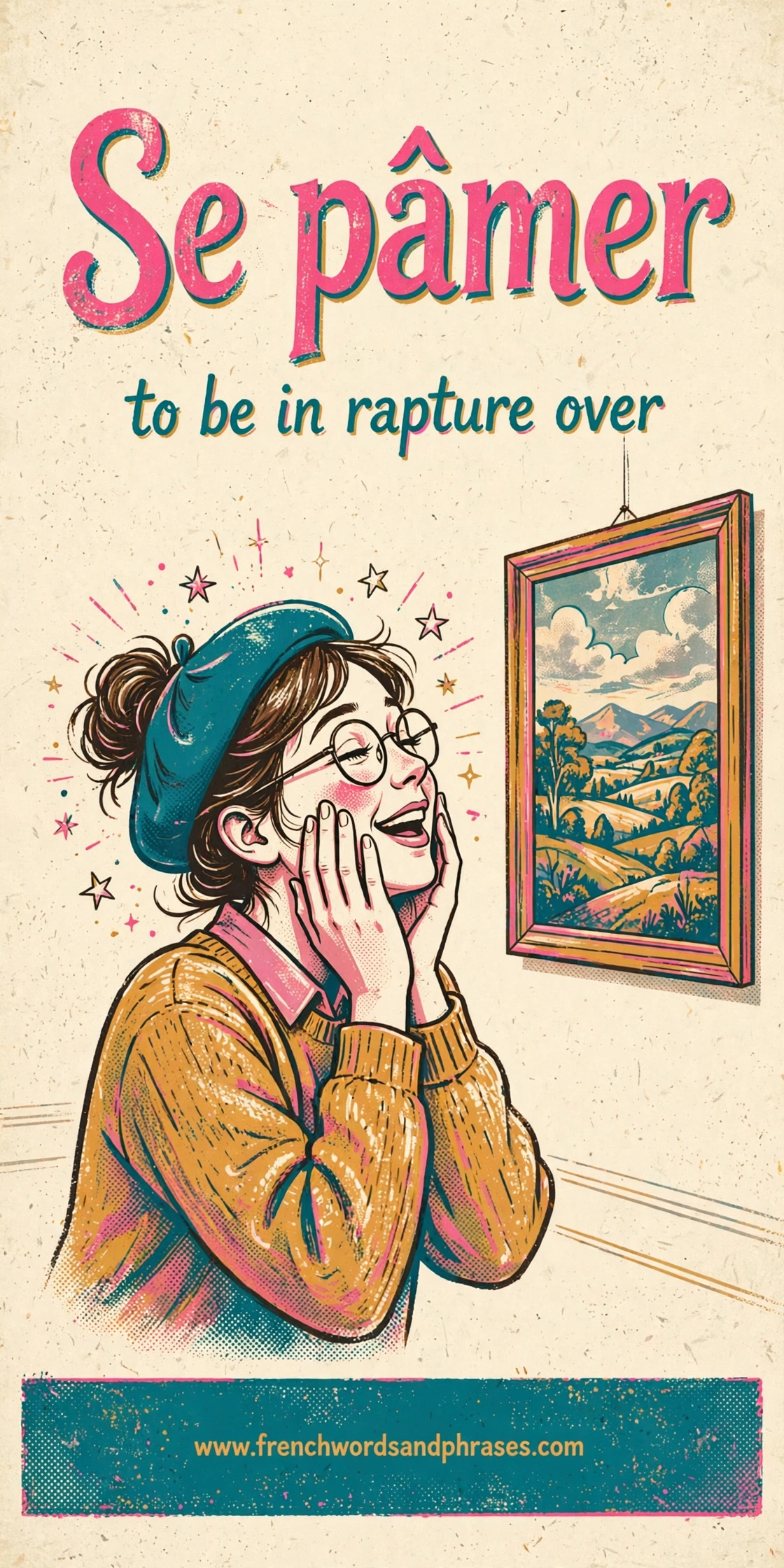
Se pâmer means to be in rapture over — to melt with delight before a voice, a painting, a sunset, until admiration itself becomes a kind of delicious faint.
At the opera, the tenor’s last note hangs in the air and an old lady in the third row closes her eyes, transported. Before a pastry chef’s window, a child stands rooted, nose to the glass. Se pâmer is the verb of blissful admiration: to swoon with pleasure over something beautiful, always with the preposition de naming the cause of the rapture.
In this guide, you’ll learn how to conjugate se pâmer in all the major French tenses and moods. Explore complete conjugation tables, French examples, English translations, and practice quizzes.
Understanding the French Verb Se pâmer
Se pâmer is a regular French verb belonging to the first group of verbs, those ending in -er.
It means to be in rapture over. It is the living heir of the old swoon: where pâmer faints, se pâmer melts — with joy, admiration, pleasure or laughter. Critics se pâment devant a performance, gourmets devant a dessert, grandparents devant a baby’s first steps. The tone ranges from sincere rapture to gentle irony: il se pâme devant ses propres tableaux is not a compliment.
Verb classification: First group (-er), reflexive
Auxiliary verb: Être
Past participle: pâmé
Present participle: pâmant
English equivalents: To be in rapture over, to swoon with delight; se pâmer de joie — to be beside oneself with joy; se pâmer d’admiration — to melt with admiration; se pâmer devant un tableau — to go into raptures before a painting; se pâmer de rire — to be helpless with laughter.
One important detail: se pâmer is always followed by de naming what overwhelms you — se pâmer de joie, d’admiration, de plaisir, de rire — and the elision is automatic before a vowel: d’admiration. Being reflexive, it takes être in every compound tense and the participle agrees with the subject: elle s’est pâmée d’admiration, ils se sont pâmés de rire. The tu imperative tucks the pronoun behind the verb: pâme-toi devant ce coucher de soleil ! Do not confuse it with plain pâmer, to faint outright — se pâmer is the swoon of delight, and nobody needs smelling salts for it.
Experience the Word
Se pâmer is the swoon turned sweet — the body gives way not to weakness but to too much beauty at once.
Imagine a small concert hall in Vienna. The violinist draws the last phrase out to a thread of sound, and in the front row a grey-haired man se pâme — eyes closed, hands clasped, gone from the room entirely — d’admiration, the way he has melted at this concerto for fifty years.
He has not fainted and needs no help. He is in rapture — pâmé de bonheur — exactly where the music wanted him.
How to Conjugate Se pâmer: Complete French Conjugation Guide
Let’s explore every major conjugation of se pâmer, beginning with the indicative mood.
How to Conjugate Se pâmer in the Indicative Mood
The indicative mood is used to express facts, observations, actions, and events.
How to Conjugate Se pâmer in the Present Tense (Présent)
Used for actions happening now, habitual actions, and general truths.
| Subject | Conjugation |
|---|---|
| je | me pâme |
| tu | te pâmes |
| il / elle | se pâme |
| nous | nous pâmons |
| vous | vous pâmez |
| ils / elles | se pâment |
Elle se pâme devant les couchers de soleil.
She goes into raptures over sunsets.
Complete the sentence:
Nous nous ______ devant ce panorama.
Reveal the answer
pâmons
Nous nous pâmons devant ce panorama.
We are going into raptures over this panorama.
How to Conjugate Se pâmer in the Passé Composé
Used for completed actions in the past. Se pâmer takes the auxiliary verb être.
| Subject | Conjugation |
|---|---|
| je | me suis pâmé / me suis pâmée |
| tu | t’es pâmé / t’es pâmée |
| il / elle | s’est pâmé / s’est pâmée |
| nous | nous sommes pâmés / nous sommes pâmées |
| vous | vous êtes pâmés / vous êtes pâmées / vous êtes pâmé / vous êtes pâmée |
| ils / elles | se sont pâmés / se sont pâmées |
Il s’est pâmé d’admiration devant la cathédrale.
He melted with admiration before the cathedral.
How to Conjugate Se pâmer in the Imparfait (Imperfect Tense)
Used for habitual past actions, descriptions, and ongoing situations in the past.
| Subject | Conjugation |
|---|---|
| je | me pâmais |
| tu | te pâmais |
| il / elle | se pâmait |
| nous | nous pâmions |
| vous | vous pâmiez |
| ils / elles | se pâmaient |
Les critiques se pâmaient devant chacune de ses toiles.
The critics used to go into raptures over each of his canvases.
Choose the correct form:
She melted with admiration.
Elle ______ d’admiration. (s’est pâmée / a pâmé)
Reveal the answer
s’est pâmée
Elle s’est pâmée d’admiration.
Se pâmer is reflexive: être, with the participle agreeing.
How to Conjugate Se pâmer in the Plus-que-parfait
Used to describe an action that had already been completed before another past event.
| Subject | Conjugation |
|---|---|
| je | m’étais pâmé / m’étais pâmée |
| tu | t’étais pâmé / t’étais pâmée |
| il / elle | s’était pâmé / s’était pâmée |
| nous | nous étions pâmés / nous étions pâmées |
| vous | vous étiez pâmés / vous étiez pâmées / vous étiez pâmé / vous étiez pâmée |
| ils / elles | s’étaient pâmés / s’étaient pâmées |
Elle s’était pâmée de rire bien avant la chute de l’histoire.
She had been helpless with laughter long before the punchline.
How to Conjugate Se pâmer in the Passé Simple
Primarily used in formal writing, literature, and historical narratives. It is rarely used in everyday conversation.
| Subject | Conjugation |
|---|---|
| je | me pâmai |
| tu | te pâmas |
| il / elle | se pâma |
| nous | nous pâmâmes |
| vous | vous pâmâtes |
| ils / elles | se pâmèrent |
La salle entière se pâma au dernier accord.
The whole hall melted in rapture at the final chord.
How to Conjugate Se pâmer in the Passé Antérieur
A literary tense used to express an action completed immediately before another past action, generally in the passé simple.
| Subject | Conjugation |
|---|---|
| je | me fus pâmé / me fus pâmée |
| tu | te fus pâmé / te fus pâmée |
| il / elle | se fut pâmé / se fut pâmée |
| nous | nous fûmes pâmés / nous fûmes pâmées |
| vous | vous fûtes pâmés / vous fûtes pâmées / vous fûtes pâmé / vous fûtes pâmée |
| ils / elles | se furent pâmés / se furent pâmées |
Dès qu’elle se fut pâmée devant le dessert, le chef sourit.
As soon as she had melted in rapture over the dessert, the chef smiled.
How to Conjugate Se pâmer in the Future Tense (Futur Simple)
Used to describe actions that will take place in the future.
| Subject | Conjugation |
|---|---|
| je | me pâmerai |
| tu | te pâmeras |
| il / elle | se pâmera |
| nous | nous pâmerons |
| vous | vous pâmerez |
| ils / elles | se pâmeront |
Tu te pâmeras devant la vue, je te le promets.
You will go into raptures over the view, I promise you.
How to Conjugate Se pâmer in the Futur Antérieur (Future Perfect)
Used for an action that will have been completed before a particular point in the future.
| Subject | Conjugation |
|---|---|
| je | me serai pâmé / me serai pâmée |
| tu | te seras pâmé / te seras pâmée |
| il / elle | se sera pâmé / se sera pâmée |
| nous | nous serons pâmés / nous serons pâmées |
| vous | vous serez pâmés / vous serez pâmées / vous serez pâmé / vous serez pâmée |
| ils / elles | se seront pâmés / se seront pâmées |
À la fin du concert, ils se seront pâmés dix fois.
By the end of the concert, they will have melted in rapture ten times.
How to Conjugate Se pâmer in the Near Future (Futur Proche)
Used to describe something that is going to happen soon. Formed with aller + infinitive.
| Subject | Conjugation |
|---|---|
| je | vais me pâmer |
| tu | vas te pâmer |
| il / elle | va se pâmer |
| nous | allons nous pâmer |
| vous | allez vous pâmer |
| ils / elles | vont se pâmer |
Regarde-la, elle va se pâmer devant le gâteau.
Watch her, she is going to melt with delight over the cake.
How to Conjugate Se pâmer in the Conditional Mood
The conditional mood expresses what would happen under certain circumstances. It is also frequently used to make polite requests or express wishes.
How to Conjugate Se pâmer in the Present Conditional
| Subject | Conjugation |
|---|---|
| je | me pâmerais |
| tu | te pâmerais |
| il / elle | se pâmerait |
| nous | nous pâmerions |
| vous | vous pâmeriez |
| ils / elles | se pâmeraient |
Sans son mauvais goût, il se pâmerait devant de vraies œuvres.
But for his bad taste, he would go into raptures over real works of art.
How to Conjugate Se pâmer in the Past Conditional
| Subject | Conjugation |
|---|---|
| je | me serais pâmé / me serais pâmée |
| tu | te serais pâmé / te serais pâmée |
| il / elle | se serait pâmé / se serait pâmée |
| nous | nous serions pâmés / nous serions pâmées |
| vous | vous seriez pâmés / vous seriez pâmées / vous seriez pâmé / vous seriez pâmée |
| ils / elles | se seraient pâmés / se seraient pâmées |
Elle se serait pâmée de joie si elle avait vu son fils sur scène.
She would have been beside herself with joy if she had seen her son on stage.
Se pâmer in the Literary Past Conditional Form
This less common literary form uses the imperfect subjunctive of être.
| Subject | Conjugation |
|---|---|
| je | me fusse pâmé / me fusse pâmée |
| tu | te fusses pâmé / te fusses pâmée |
| il / elle | se fût pâmé / se fût pâmée |
| nous | nous fussions pâmés / nous fussions pâmées |
| vous | vous fussiez pâmés / vous fussiez pâmées / vous fussiez pâmé / vous fussiez pâmée |
| ils / elles | se fussent pâmés / se fussent pâmées |
Il se fût pâmé d’admiration sans sa jalousie d’artiste.
He would have melted with admiration, but for his artist’s jealousy.
How to Conjugate Se pâmer in the Subjunctive Mood
The subjunctive is used to express wishes, emotions, doubts, necessity, and uncertainty. It frequently follows expressions such as il faut que (it is necessary that) or bien que (although).
How to Conjugate Se pâmer in the Present Subjunctive
| Subject | Conjugation |
|---|---|
| que je | me pâme |
| que tu | te pâmes |
| qu’il / qu’elle | se pâme |
| que nous | nous pâmions |
| que vous | vous pâmiez |
| qu’ils / qu’elles | se pâment |
Il est charmant qu’elle se pâme de si bon cœur.
It is charming that she goes into raptures so wholeheartedly.
Complete the sentence using the subjunctive:
Il est charmant que tu te ______ devant ces fleurs.
Reveal the answer
pâmes
Il est charmant que tu te pâmes devant ces fleurs.
It is charming that you go into raptures over these flowers.
How to Conjugate Se pâmer in the Imperfect Subjunctive
A literary tense, rarely encountered in modern spoken French.
| Subject | Conjugation |
|---|---|
| que je | me pâmasse |
| que tu | te pâmasses |
| qu’il / qu’elle | se pâmât |
| que nous | nous pâmassions |
| que vous | vous pâmassiez |
| qu’ils / qu’elles | se pâmassent |
On s’étonnait qu’il se pâmât devant des tableaux si médiocres.
People were astonished that he went into raptures over such mediocre paintings.
How to Conjugate Se pâmer in the Pluperfect Subjunctive
A literary construction used to express an action completed before another past action.
| Subject | Conjugation |
|---|---|
| que j’ | me fusse pâmé / me fusse pâmée |
| que tu | te fusses pâmé / te fusses pâmée |
| qu’il / qu’elle | se fût pâmé / se fût pâmée |
| que nous | nous fussions pâmés / nous fussions pâmées |
| que vous | vous fussiez pâmés / vous fussiez pâmées / vous fussiez pâmé / vous fussiez pâmée |
| qu’ils / qu’elles | se fussent pâmés / se fussent pâmées |
On racontait qu’ils se fussent pâmés devant le trésor.
It was said they had melted in rapture before the treasure.
How to Conjugate Se pâmer in the Past Subjunctive
| Subject | Conjugation |
|---|---|
| que j’ | me sois pâmé / me sois pâmée |
| que tu | te sois pâmé / te sois pâmée |
| qu’il / qu’elle | se soit pâmé / se soit pâmée |
| que nous | nous soyons pâmés / nous soyons pâmées |
| que vous | vous soyez pâmés / vous soyez pâmées / vous soyez pâmé / vous soyez pâmée |
| qu’ils / qu’elles | se soient pâmés / se soient pâmées |
Je suis ravi qu’elle se soit pâmée devant ton poème.
I am delighted she went into raptures over your poem.
How to Conjugate Se pâmer in the Imperative
The imperative is used to give commands, instructions, invitations, or suggestions. Subject pronouns are omitted.
How to Conjugate Se pâmer in the Present Imperative
| Person | Conjugation |
|---|---|
| (tu) | pâme-toi |
| (nous) | pâmons-nous |
| (vous) | pâmez-vous |
Pâme-toi devant ce paysage, il le mérite !
Go into raptures over this landscape, it deserves it!
How would you say Go into raptures over this view (tu form)?
Reveal the answer
Pâme-toi devant cette vue !
French Participles of Se pâmer
Participles are verb forms that can be used in compound tenses and other grammatical constructions.
Present Participle of Se pâmer
pâmant
En se pâmant de rire, elle a renversé son verre.
Melting with laughter, she knocked over her glass.
Past Participle of Se pâmer
pâmé
Pâmée d’admiration, la vieille dame a applaudi debout.
In rapture with admiration, the old lady applauded standing up.
Se pâmer in Everyday French: Real-Life Examples
Now that you know the conjugations, let’s see how se pâmer appears in everyday French.
Elle se pâme devant les couchers de soleil.
She goes into raptures over sunsets.
Il s’est pâmé d’admiration devant la cathédrale.
He melted with admiration before the cathedral.
Les critiques se pâmaient devant ses toiles.
The critics used to go into raptures over his canvases.
Tu te pâmeras devant la vue.
You will go into raptures over the view.
Elle se pâmerait de joie en voyant son fils.
She would be beside herself with joy on seeing her son.
Pâme-toi devant ce paysage !
Go into raptures over this landscape!
Beyond Translation: The Meaning of Se pâmer
The old swoon grew a second, happier life: Latin spasmus gave French first the faint, then the rapture.
Se pâmer is admiration with the body.
Critics, lovers and gourmets all se pâment — and the de that follows is the signature of the verb: whatever you are melting over, French makes you name it: de joie, d’admiration, de rire.
How to Remember the French Verb Se pâmer
Remember it this way: Se pâmer is about the old lady at the opera, eyes closed, melting with admiration.
- Always de after it: se pâmer de joie, d’admiration, de rire — name your rapture.
- Reflexive, so être and agreement: elle s’est pâmée, ils se sont pâmés.
- Plain pâmer faints; se pâmer melts with pleasure — the se makes all the difference.
The key idea is the old lady at the opera, eyes closed, melting with admiration.
Test Your Knowledge of Se pâmer
Let’s see how much you’ve learned. Try answering these questions before revealing the answers.
Which preposition always follows se pâmer, and what does it introduce?
Reveal the answer
De — it names the cause of the rapture: se pâmer de joie, d’admiration, de rire.
How do you say She goes into raptures over sunsets in French?
Reveal the answer
Elle se pâme devant les couchers de soleil.
Translate: He melted with admiration before the cathedral.
Reveal the answer
Il s’est pâmé d’admiration devant la cathédrale.
What is the past participle of se pâmer, and how does it agree?
Reveal the answer
Pâmé — with être it agrees with the subject: pâmée, pâmés, pâmées.
Complete the sentence:
Je suis ravi qu’elle se ______ devant ton poème.
Reveal the answer
soit pâmée
Je suis ravi qu’elle se soit pâmée devant ton poème.
I am delighted she went into raptures over your poem.
Can You Use It?
How would you say this in French?
Before the evening sea, she melts in rapture in silence, and words become useless.
Reveal the answer
Devant la mer du soir, elle se pâme en silence, et les mots deviennent inutiles.
Before the evening sea, she melts in rapture in silence, and words become useless.
LEARN FRENCH ONE WORD AT A TIME