A French Word to Live By
How to Conjugate Se embarrer in French
/sə ɑ̃.ba.ʁe/
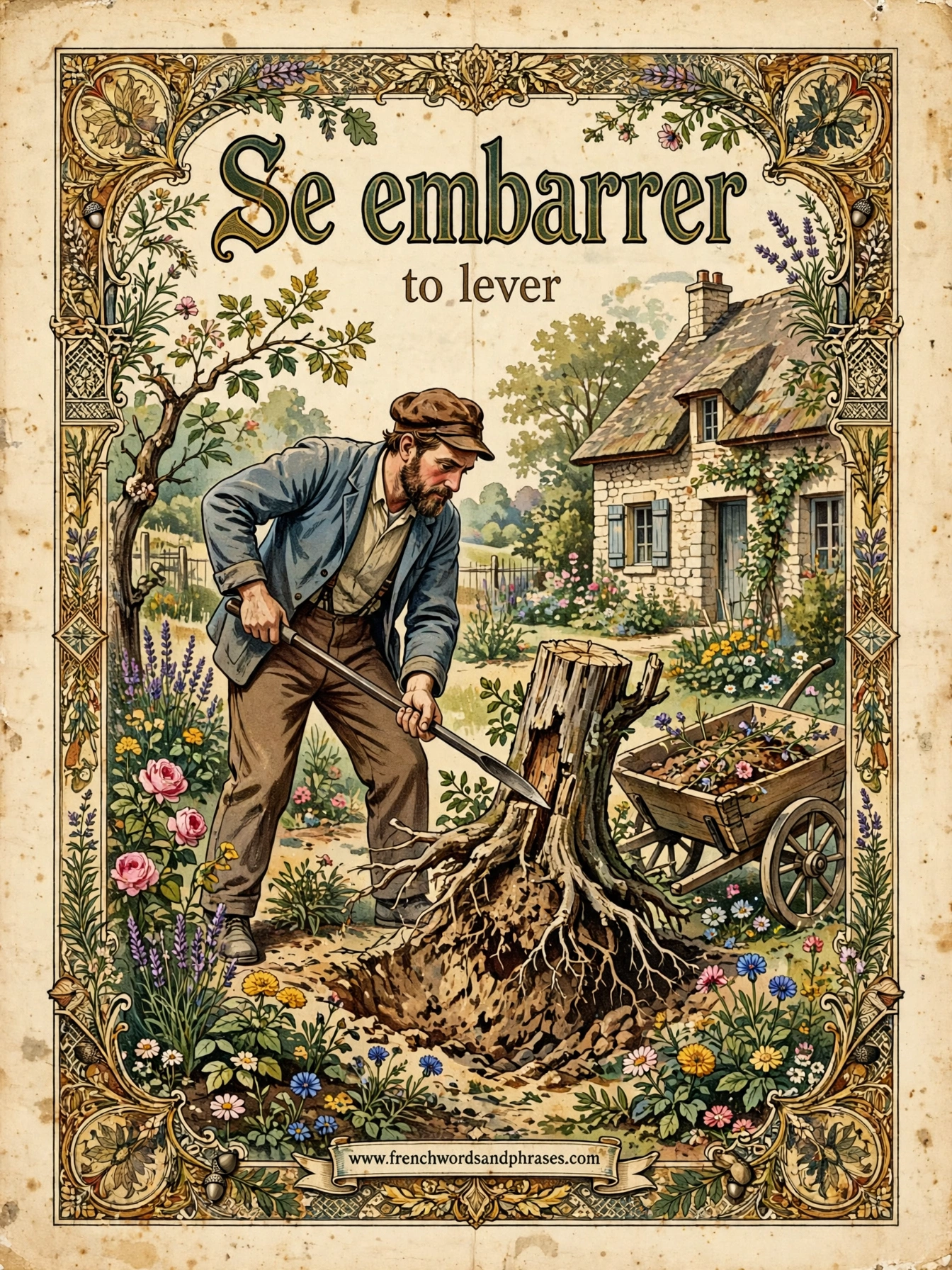
Se embarrer means to lever — to work yourself, or your boat, free and moving by pushing on a bar or pole.
A boatman on a muddy backwater at dawn, a barge settled against a quay, a fisherman pushing off from a stony shore — se embarrer is the reflexive face of the bar: the boat and its crew are the weight, the pole is the lever, and the two together get themselves moving.
In this guide, you’ll learn how to conjugate se embarrer in all the major French tenses and moods. Explore complete conjugation tables, French examples, English translations, and practice quizzes.
Understanding the French Verb Se embarrer
Se embarrer is a regular French verb belonging to the first group of verbs, those ending in-er.
It means to lever. It is used of boats and boatmen pushing themselves off banks, quays and mudbanks with a pole, in the slow world of canals, backwaters and tidal shores. The reflexive shape is the point: mover and moved are the same — the vessel levers itself into motion, with its crew leaning on the bar.
Verb classification: First group (-er), reflexive
Auxiliary verb: Être
Past participle: embarré
Present participle: embarrant
English equivalents: To lever oneself, to pole oneself off; s’embarrer loin du quai — to push oneself away from the quay; s’embarrer hors de la vase — to lever oneself out of the mud; le bateau s’embarre — the boat pushes off with a pole; s’embarrer dès l’aube — to pole oneself off at dawn.
One important detail: se embarrer is a rare reflexive of the towpath and the harbour — where plain embarrer moves a stone or a stranger’s boat, the reflexive moves your own: the boatman plants his pole (sa barre) on the bottom and the boat, with him aboard, works itself free of the bank or the mud. Being reflexive, it takes être in every compound tense and the past participle agrees: la chaloupe s’est embarrée, les péniches se sont embarrées. Outside river and harbour language it is scarcely heard, and a sober dictionary honesty applies: most French speakers will never need it, but boatmen still do.
Experience the Word
Se embarrer is the verb of the self-launched boat — no engine, no tow, just a pole on the riverbed and a long push.
Imagine a fisherman before sunrise, his flat boat settled in the mud of a backwater. He plants the long pole, leans his whole weight on it, and slowly — elle s’embarre — the boat sighs free of the mud and slides into the dark current, carrying him with it.
No one pushed him off. He has levered himself — embarré, pole, mud and dawn and all — into motion.
How to Conjugate Se embarrer: Complete French Conjugation Guide
Let’s explore every major conjugation of se embarrer, beginning with the indicative mood.
How to Conjugate Se embarrer in the Indicative Mood
The indicative mood is used to express facts, observations, actions, and events.
How to Conjugate Se embarrer in the Present Tense (Présent)
Used for actions happening now, habitual actions, and general truths.
| Subject | Conjugation |
|---|---|
| je | m’embarre |
| tu | t’embarres |
| il / elle | s’embarre |
| nous | nous embarrons |
| vous | vous embarrez |
| ils / elles | s’embarrent |
Example
Le batelier s’embarre pour quitter la berge.
The boatman poles himself off to leave the bank.
Quick Quiz 1
Complete the sentence:
À l’aube, nous nous ______ loin de la berge.
Reveal the answer
embarrons
À l’aube, nous nous embarrons loin de la berge.
At dawn, we pole ourselves away from the bank.
How to Conjugate Se embarrer in the Passé Composé
Used for completed actions in the past. Se embarrer takes the auxiliary verb être.
| Subject | Conjugation |
|---|---|
| je | me suis embarré / me suis embarrée |
| tu | t’es embarré / t’es embarrée |
| il / elle | s’est embarré / s’est embarrée |
| nous | nous sommes embarrés / nous sommes embarrées |
| vous | vous êtes embarrés / vous êtes embarrées / vous êtes embarré / vous êtes embarrée |
| ils / elles | se sont embarrés / se sont embarrées |
Example
La péniche s’est embarrée loin du quai.
The barge pushed itself away from the quay.
How to Conjugate Se embarrer in the Imparfait (Imperfect Tense)
Used for habitual past actions, descriptions, and ongoing situations in the past.
| Subject | Conjugation |
|---|---|
| je | m’embarrais |
| tu | t’embarrais |
| il / elle | s’embarrait |
| nous | nous embarrions |
| vous | vous embarriez |
| ils / elles | s’embarraient |
Example
Chaque matin, il s’embarrait pour traverser le bras mort.
Every morning, he used to pole himself across the backwater.
Quick Quiz 2
Choose the correct form:
The barge pushed itself away from the quay.
La péniche ______ loin du quai. (s’est embarrée / a embarré)
Reveal the answer
s’est embarrée
La péniche s’est embarrée loin du quai.
Se embarrer is reflexive, takes être, and the participle agrees: embarrée.
How to Conjugate Se embarrer in the Plus-que-parfait
Used to describe an action that had already been completed before another past event.
| Subject | Conjugation |
|---|---|
| je | m’étais embarré / m’étais embarrée |
| tu | t’étais embarré / t’étais embarrée |
| il / elle | s’était embarré / s’était embarrée |
| nous | nous étions embarrés / nous étions embarrées |
| vous | vous étiez embarrés / vous étiez embarrées / vous étiez embarré / vous étiez embarrée |
| ils / elles | s’étaient embarrés / s’étaient embarrées |
Example
Ils s’étaient embarrés hors de la vase avant la marée.
They had levered themselves out of the mud before the tide.
How to Conjugate Se embarrer in the Passé Simple
Primarily used in formal writing, literature, and historical narratives. It is rarely used in everyday conversation.
| Subject | Conjugation |
|---|---|
| je | m’embarrai |
| tu | t’embarras |
| il / elle | s’embarra |
| nous | nous embarrâmes |
| vous | vous embarrâtes |
| ils / elles | s’embarrèrent |
Example
Le pêcheur s’embarra et gagna le large.
The fisherman poled himself off and reached open water.
How to Conjugate Se embarrer in the Passé Antérieur
A literary tense used to express an action completed immediately before another past action, generally in the passé simple.
| Subject | Conjugation |
|---|---|
| je | me fus embarré / me fus embarrée |
| tu | te fus embarré / te fus embarrée |
| il / elle | se fut embarré / se fut embarrée |
| nous | nous fûmes embarrés / nous fûmes embarrées |
| vous | vous fûtes embarrés / vous fûtes embarrées / vous fûtes embarré / vous fûtes embarrée |
| ils / elles | se furent embarrés / se furent embarrées |
Example
Dès qu’elle se fut embarrée, la barque prit le courant.
As soon as it had pushed off, the boat caught the current.
How to Conjugate Se embarrer in the Future Tense (Futur Simple)
Used to describe actions that will take place in the future.
| Subject | Conjugation |
|---|---|
| je | m’embarrerai |
| tu | t’embarreras |
| il / elle | s’embarrera |
| nous | nous embarrerons |
| vous | vous embarrerez |
| ils / elles | s’embarreront |
Example
Demain, nous nous embarrerons dès l’aube.
Tomorrow, we shall pole ourselves off at dawn.
How to Conjugate Se embarrer in the Futur Antérieur (Future Perfect)
Used for an action that will have been completed before a particular point in the future.
| Subject | Conjugation |
|---|---|
| je | me serai embarré / me serai embarrée |
| tu | te seras embarré / te seras embarrée |
| il / elle | se sera embarré / se sera embarrée |
| nous | nous serons embarrés / nous serons embarrées |
| vous | vous serez embarrés / vous serez embarrées / vous serez embarré / vous serez embarrée |
| ils / elles | se seront embarrés / se seront embarrées |
Example
À marée basse, ils se seront embarrés trois fois.
By low tide, they will have poled themselves off three times.
How to Conjugate Se embarrer in the Near Future (Futur Proche)
Used to describe something that is going to happen soon. Formed with aller + infinitive.
| Subject | Conjugation |
|---|---|
| je | vais m’embarrer |
| tu | vas t’embarrer |
| il / elle | va s’embarrer |
| nous | allons nous embarrer |
| vous | allez vous embarrer |
| ils / elles | vont s’embarrer |
Example
La chaloupe va s’embarrer, tenez-vous bien.
The boat is about to push off, hold on tight.
How to Conjugate Se embarrer in the Conditional Mood
The conditional mood expresses what would happen under certain circumstances. It is also frequently used to make polite requests or express wishes.
How to Conjugate Se embarrer in the Present Conditional
| Subject | Conjugation |
|---|---|
| je | m’embarrerais |
| tu | t’embarrerais |
| il / elle | s’embarrerait |
| nous | nous embarrerions |
| vous | vous embarreriez |
| ils / elles | s’embarreraient |
Example
Sans perche, le batelier ne s’embarrerait pas.
Without a pole, the boatman would not push off.
How to Conjugate Se embarrer in the Past Conditional
| Subject | Conjugation |
|---|---|
| je | me serais embarré / me serais embarrée |
| tu | te serais embarré / te serais embarrée |
| il / elle | se serait embarré / se serait embarrée |
| nous | nous serions embarrés / nous serions embarrées |
| vous | vous seriez embarrés / vous seriez embarrées / vous seriez embarré / vous seriez embarrée |
| ils / elles | se seraient embarrés / se seraient embarrées |
Example
Elle se serait embarrée plus tôt sans le vent contraire.
It would have pushed off earlier without the headwind.
Se embarrer in the Literary Past Conditional Form
This less common literary form uses the imperfect subjunctive of être.
| Subject | Conjugation |
|---|---|
| je | me fusse embarré / me fusse embarrée |
| tu | te fusses embarré / te fusses embarrée |
| il / elle | se fût embarré / se fût embarrée |
| nous | nous fussions embarrés / nous fussions embarrées |
| vous | vous fussiez embarrés / vous fussiez embarrées / vous fussiez embarré / vous fussiez embarrée |
| ils / elles | se fussent embarrés / se fussent embarrées |
Example
Il se fût embarré seul sur le fleuve immense.
He would have poled himself off alone on the immense river.
How to Conjugate Se embarrer in the Subjunctive Mood
The subjunctive is used to express wishes, emotions, doubts, necessity, and uncertainty. It frequently follows expressions such as il faut que (it is necessary that) or bien que (although).
How to Conjugate Se embarrer in the Present Subjunctive
| Subject | Conjugation |
|---|---|
| que je | m’embarre |
| que tu | t’embarres |
| qu’il / qu’elle | s’embarre |
| que nous | nous embarrions |
| que vous | vous embarriez |
| qu’ils / qu’elles | s’embarrent |
Example
Il faut que le bateau s’embarre avant la nuit.
The boat must push off before nightfall.
Quick Quiz 3
Complete the sentence using the subjunctive:
Il faut que tu ______ avant la marée.
Reveal the answer
t’embarres
Il faut que tu t’embarres avant la marée.
You must pole yourself off before the tide.
How to Conjugate Se embarrer in the Imperfect Subjunctive
A literary tense, rarely encountered in modern spoken French.
| Subject | Conjugation |
|---|---|
| que je | m’embarrasse |
| que tu | t’embarrasses |
| qu’il / qu’elle | s’embarrât |
| que nous | nous embarrassions |
| que vous | vous embarrassiez |
| qu’ils / qu’elles | s’embarrassent |
Example
Le capitaine ordonna que la chaloupe s’embarrât sur-le-champ.
The captain ordered the boat to push off at once.
How to Conjugate Se embarrer in the Pluperfect Subjunctive
A literary construction used to express an action completed before another past action.
| Subject | Conjugation |
|---|---|
| que je | me fusse embarré / me fusse embarrée |
| que tu | te fusses embarré / te fusses embarrée |
| qu’il / qu’elle | se fût embarré / se fût embarrée |
| que nous | nous fussions embarrés / nous fussions embarrées |
| que vous | vous fussiez embarrés / vous fussiez embarrées / vous fussiez embarré / vous fussiez embarrée |
| qu’ils / qu’elles | se fussent embarrés / se fussent embarrées |
Example
On racontait que les marins se fussent embarrés dans la brume.
People said the sailors had poled themselves off into the mist.
How to Conjugate Se embarrer in the Past Subjunctive
| Subject | Conjugation |
|---|---|
| que je | me sois embarré / me sois embarrée |
| que tu | te sois embarré / te sois embarrée |
| qu’il / qu’elle | se soit embarré / se soit embarrée |
| que nous | nous soyons embarrés / nous soyons embarrées |
| que vous | vous soyez embarrés / vous soyez embarrées / vous soyez embarré / vous soyez embarrée |
| qu’ils / qu’elles | se soient embarrés / se soient embarrées |
Example
Je suis surpris que la péniche se soit embarrée si vite.
I am surprised the barge pushed off so quickly.
How to Conjugate Se embarrer in the Imperative
The imperative is used to give commands, instructions, invitations, or suggestions. Subject pronouns are omitted.
How to Conjugate Se embarrer in the Present Imperative
| Person | Conjugation |
|---|---|
| (tu) | embarre-toi |
| (nous) | embarrons-nous |
| (vous) | embarrez-vous |
Example
Embarre-toi loin de ces rochers !
Push yourself off, away from those rocks!
Quick Quiz 4
How would you say Push yourself off, away from those rocks (tu form)?
Reveal the answer
Embarre-toi loin de ces rochers !
French Participles of Se embarrer
Participles are verb forms that can be used in compound tenses and other grammatical constructions.
Present Participle of Se embarrer
embarrant
En s’embarrant, la barque a raclé le fond.
As it pushed off, the boat scraped the bottom.
Past Participle of Se embarrer
embarré
Embarrée dès l’aube, la chaloupe filait déjà vers le large.
Pushed off at dawn, the boat was already heading out to sea.
Se embarrer in Everyday French: Real-Life Examples
Now that you know the conjugations, let’s see how se embarrer appears in everyday French.
Example 1 — Present
Le batelier s’embarre pour quitter la berge.
The boatman poles himself off to leave the bank.
Example 2 — Passé composé
La péniche s’est embarrée loin du quai.
The barge pushed itself away from the quay.
Example 3 — Imparfait
Il s’embarrait chaque matin pour traverser le bras mort.
He used to pole himself across the backwater every morning.
Example 4 — Future
Nous nous embarrerons dès l’aube.
We shall pole ourselves off at dawn.
Example 5 — Conditional
Sans perche, le batelier ne s’embarrerait pas.
Without a pole, the boatman would not push off.
Example 6 — Imperative
Embarre-toi loin de ces rochers !
Push yourself off, away from those rocks!
Beyond Translation: The Meaning of Se embarrer
Reflexive verbs usually describe what a person does to their own body; se embarrer stretches the idea to a boat and its crew together — the vessel is the body, the pole is the arm, and the push is one gesture shared by both.
Mover and moved are one.
That unity is the poetry of the towpath world: a man and his barge, setting off into the mist with a single lean on a single bar, in a word most of France has forgotten and the rivers remember.
How to Remember the French Verb Se embarrer
Remember it this way: Se embarrer is about the fisherman at dawn, leaning on his pole to sigh free of the mud.
- Reflexive and river-born: the boat levers itself — la péniche s’est embarrée loin du quai.
- Être in compound tenses, with agreement: elle s’est embarrée, ils se sont embarrés.
- Regular -er underneath: je m’embarre, nous nous embarrons, past participle embarré; the tool is une barre, une perche.
The key idea is the fisherman at dawn, leaning on his pole to sigh free of the mud.
Test Your Knowledge of Se embarrer
Let’s see how much you’ve learned. Try answering these questions before revealing the answers.
Question 1
How does se embarrer differ from embarrer?
Reveal the answer
The reflexive moves your own boat (or yourself) — the boatman poles himself off; plain embarrer levers a stone, a log or someone else’s boat.
Question 2
How do you say The barge pushed itself away from the quay in French?
Reveal the answer
La péniche s’est embarrée loin du quai.
Question 3
Translate: The boatman poles himself off to leave the bank.
Reveal the answer
Le batelier s’embarre pour quitter la berge.
Question 4
What is the past participle of se embarrer?
Reveal the answer
Embarré — agreeing: embarrée, embarrés, embarrées.
Question 5
Complete the sentence:
Il faut que le bateau ______ avant la nuit.
Reveal the answer
s’embarre
Il faut que le bateau s’embarre avant la nuit.
The boat must push off before nightfall.
Your Final Challenge
Can You Use It?
How would you say this in French?
At dawn, the fisherman poles himself off in silence and glides into the river mist.
Reveal the answer
À l’aube, le pêcheur s’embarre en silence et glisse dans la brume du fleuve.
At dawn, the fisherman poles himself off in silence and glides into the river mist.
A little French. A little curiosity. A richer everyday life.
LEARN FRENCH ONE WORD AT A TIME