A French Word to Live By
How to Conjugate Se effrayer in French
/sə e.fʁe.je/
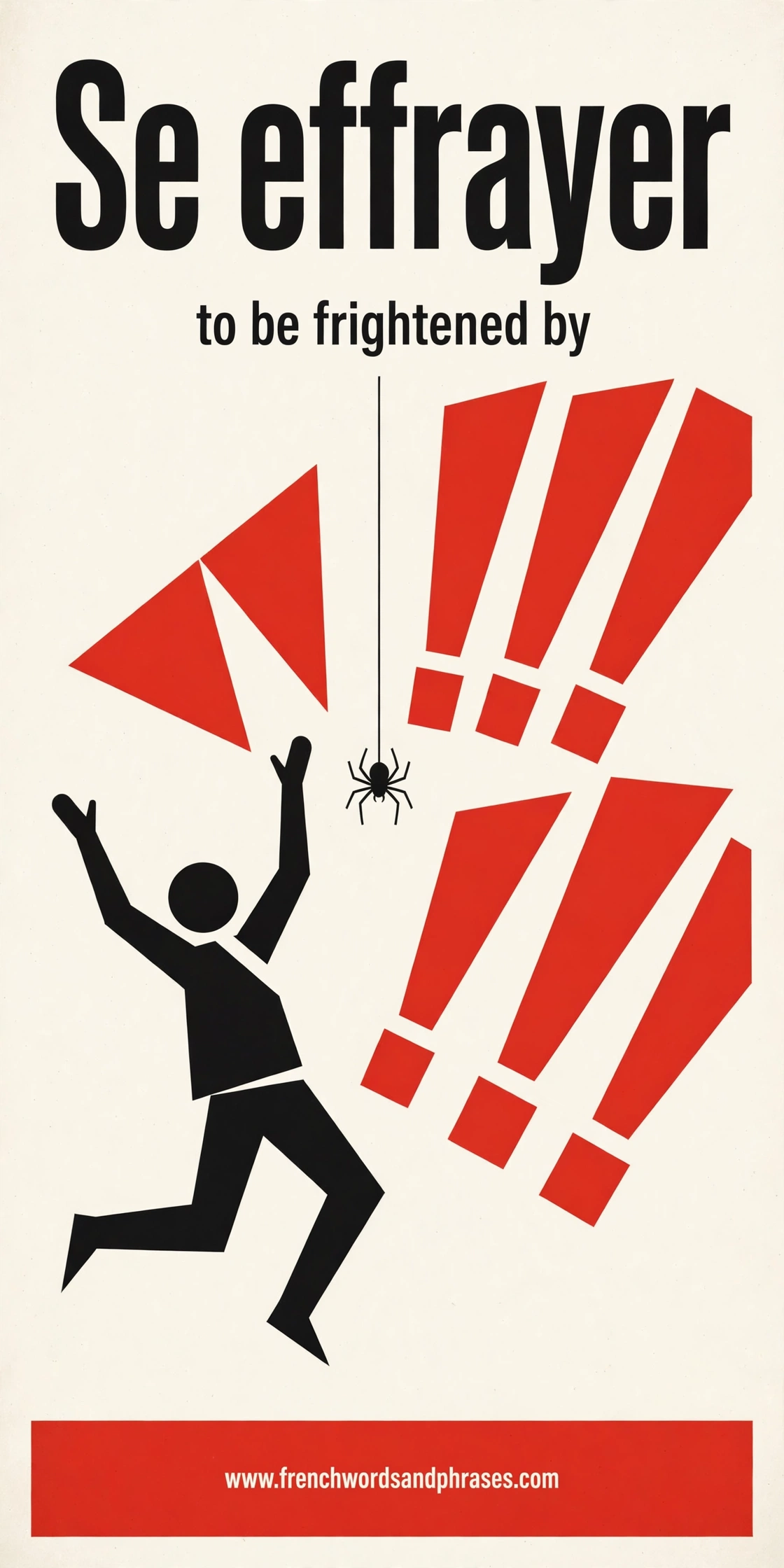
Se effrayer means to be frightened by — to take fright at something, to feel the scare arrive and take hold.
A horse shying at a plastic bag, a child starting at a slammed door, an investor alarmed by a falling graph — se effrayer is the other side of the scare: not giving fright, but receiving it, with de naming what caused it.
In this guide, you’ll learn how to conjugate se effrayer in all the major French tenses and moods. Explore complete conjugation tables, French examples, English translations, and practice quizzes.
Understanding the French Verb Se effrayer
Se effrayer is a regular French verb belonging to the first group of verbs, those ending in-er.
It means to be frightened by. It is used of animals shying and starting — horses above all, who s’effrayent d’un rien — and of people taking alarm: patients s’effrayent d’un diagnostic, markets s’effrayent d’une rumeur. Where effrayer is the scare given, se effrayer is the scare felt, and de always points at the cause.
Verb classification: First group (-er), reflexive
Auxiliary verb: Être
Past participle: effrayé
Present participle: effrayant
English equivalents: To be frightened by, to take fright at; s’effrayer de quelque chose — to be frightened by something; s’effrayer d’un rien — to take fright at nothing, at the slightest thing; le cheval s’effraie des voitures — the horse shies at cars; ne t’effraie pas ! — don’t be frightened!
One important detail: se effrayer names its cause with de: s’effrayer de quelque chose, elle s’est effrayée du bruit, les chevaux s’effrayent d’un rien — build the construction into every use. It is the same -ayer verb as effrayer, so the modern spelling patches y to i before a silent e: je m’effraie, tu t’effraies, il s’effraie, ils s’effraient, while nous and vous keep the y: nous nous effrayons, vous vous effrayez. Future and conditional take the i throughout: je m’effraierai. Being reflexive, it takes être and the participle agrees: elle s’est effrayée de l’orage.
Experience the Word
Se effrayer is the verb of the flinch — the moment fright lands in a body and the body answers before the mind can.
Imagine a young horse on its first ride through the village. A flag snaps in the wind above the bakery — le cheval s’effraie, dances sideways, ears flat, heart hammering against the rider’s legs. Nothing has touched him; a sound and a colour were enough.
Nobody attacked or even approached him. He has taken fright — il s’est effrayé d’un rien — at almost nothing at all.
How to Conjugate Se effrayer: Complete French Conjugation Guide
Let’s explore every major conjugation of se effrayer, beginning with the indicative mood.
How to Conjugate Se effrayer in the Indicative Mood
The indicative mood is used to express facts, observations, actions, and events.
How to Conjugate Se effrayer in the Present Tense (Présent)
Used for actions happening now, habitual actions, and general truths.
| Subject | Conjugation |
|---|---|
| je | m’effraye |
| tu | t’effrayes |
| il / elle | s’effraye |
| nous | nous effrayons |
| vous | vous effrayez |
| ils / elles | s’effrayent |
Example
Le cheval s’effraie des voitures qui passent trop vite.
The horse takes fright at cars that pass too fast.
Quick Quiz 1
Complete the sentence:
Nous nous ______ des sirènes la nuit.
Reveal the answer
effrayons
Nous nous effrayons des sirènes la nuit.
We are frightened by the sirens at night.
How to Conjugate Se effrayer in the Passé Composé
Used for completed actions in the past. Se effrayer takes the auxiliary verb être.
| Subject | Conjugation |
|---|---|
| je | me suis effrayé / me suis effrayée |
| tu | t’es effrayé / t’es effrayée |
| il / elle | s’est effrayé / s’est effrayée |
| nous | nous sommes effrayés / nous sommes effrayées |
| vous | vous êtes effrayés / vous êtes effrayées / vous êtes effrayé / vous êtes effrayée |
| ils / elles | se sont effrayés / se sont effrayées |
Example
Elle s’est effrayée du tonnerre et a couru se cacher.
She was frightened by the thunder and ran to hide.
How to Conjugate Se effrayer in the Imparfait (Imperfect Tense)
Used for habitual past actions, descriptions, and ongoing situations in the past.
| Subject | Conjugation |
|---|---|
| je | m’effrayais |
| tu | t’effrayais |
| il / elle | s’effrayait |
| nous | nous effrayions |
| vous | vous effrayiez |
| ils / elles | s’effrayaient |
Example
Les moutons s’effrayaient du moindre bruit la nuit.
The sheep used to take fright at the slightest noise at night.
Quick Quiz 2
Choose the correct form:
She was frightened by the thunder.
Elle ______ du tonnerre. (s’est effrayée / a effrayé)
Reveal the answer
s’est effrayée
Elle s’est effrayée du tonnerre.
Feeling the fright is reflexive: être, agreement, and de for the cause.
How to Conjugate Se effrayer in the Plus-que-parfait
Used to describe an action that had already been completed before another past event.
| Subject | Conjugation |
|---|---|
| je | m’étais effrayé / m’étais effrayée |
| tu | t’étais effrayé / t’étais effrayée |
| il / elle | s’était effrayé / s’était effrayée |
| nous | nous étions effrayés / nous étions effrayées |
| vous | vous étiez effrayés / vous étiez effrayées / vous étiez effrayé / vous étiez effrayée |
| ils / elles | s’étaient effrayés / s’étaient effrayées |
Example
Il s’était effrayé d’une ombre avant de reconnaître son frère.
He had been frightened by a shadow before recognising his brother.
How to Conjugate Se effrayer in the Passé Simple
Primarily used in formal writing, literature, and historical narratives. It is rarely used in everyday conversation.
| Subject | Conjugation |
|---|---|
| je | m’effrayai |
| tu | t’effrayas |
| il / elle | s’effraya |
| nous | nous effrayâmes |
| vous | vous effrayâtes |
| ils / elles | s’effrayèrent |
Example
La jument s’effraya d’un lièvre et fit un écart.
The mare took fright at a hare and shied sideways.
How to Conjugate Se effrayer in the Passé Antérieur
A literary tense used to express an action completed immediately before another past action, generally in the passé simple.
| Subject | Conjugation |
|---|---|
| je | me fus effrayé / me fus effrayée |
| tu | te fus effrayé / te fus effrayée |
| il / elle | se fut effrayé / se fut effrayée |
| nous | nous fûmes effrayés / nous fûmes effrayées |
| vous | vous fûtes effrayés / vous fûtes effrayées / vous fûtes effrayé / vous fûtes effrayée |
| ils / elles | se furent effrayés / se furent effrayées |
Example
Dès que l’enfant se fut effrayé du noir, on alluma la lampe.
As soon as the child had been frightened by the dark, the lamp was lit.
How to Conjugate Se effrayer in the Future Tense (Futur Simple)
Used to describe actions that will take place in the future.
| Subject | Conjugation |
|---|---|
| je | m’effrayerai |
| tu | t’effrayeras |
| il / elle | s’effrayera |
| nous | nous effrayerons |
| vous | vous effrayerez |
| ils / elles | s’effrayeront |
Example
Ne t’inquiète pas, le chien ne s’effraiera pas de toi.
Do not worry, the dog will not be frightened by you.
How to Conjugate Se effrayer in the Futur Antérieur (Future Perfect)
Used for an action that will have been completed before a particular point in the future.
| Subject | Conjugation |
|---|---|
| je | me serai effrayé / me serai effrayée |
| tu | te seras effrayé / te seras effrayée |
| il / elle | se sera effrayé / se sera effrayée |
| nous | nous serons effrayés / nous serons effrayées |
| vous | vous serez effrayés / vous serez effrayées / vous serez effrayé / vous serez effrayée |
| ils / elles | se seront effrayés / se seront effrayées |
Example
À la première sirène, les oiseaux se seront effrayés et envolés.
At the first siren, the birds will have taken fright and flown off.
How to Conjugate Se effrayer in the Near Future (Futur Proche)
Used to describe something that is going to happen soon. Formed with aller + infinitive.
| Subject | Conjugation |
|---|---|
| je | vais m’effrayer |
| tu | vas t’effrayer |
| il / elle | va s’effrayer |
| nous | allons nous effrayer |
| vous | allez vous effrayer |
| ils / elles | vont s’effrayer |
Example
Attention, le cheval va s’effrayer du tracteur !
Careful, the horse is going to take fright at the tractor!
How to Conjugate Se effrayer in the Conditional Mood
The conditional mood expresses what would happen under certain circumstances. It is also frequently used to make polite requests or express wishes.
How to Conjugate Se effrayer in the Present Conditional
| Subject | Conjugation |
|---|---|
| je | m’effrayerais |
| tu | t’effrayerais |
| il / elle | s’effrayerait |
| nous | nous effrayerions |
| vous | vous effrayeriez |
| ils / elles | s’effrayeraient |
Example
Sans son cavalier, la jument s’effraierait de tout.
Without her rider, the mare would take fright at everything.
How to Conjugate Se effrayer in the Past Conditional
| Subject | Conjugation |
|---|---|
| je | me serais effrayé / me serais effrayée |
| tu | te serais effrayé / te serais effrayée |
| il / elle | se serait effrayé / se serait effrayée |
| nous | nous serions effrayés / nous serions effrayées |
| vous | vous seriez effrayés / vous seriez effrayées / vous seriez effrayé / vous seriez effrayée |
| ils / elles | se seraient effrayés / se seraient effrayées |
Example
Elle ne se serait pas effrayée du bruit si on l’avait prévenue.
She would not have been frightened by the noise if she had been warned.
Se effrayer in the Literary Past Conditional Form
This less common literary form uses the imperfect subjunctive of être.
| Subject | Conjugation |
|---|---|
| je | me fusse effrayé / me fusse effrayée |
| tu | te fusses effrayé / te fusses effrayée |
| il / elle | se fût effrayé / se fût effrayée |
| nous | nous fussions effrayés / nous fussions effrayées |
| vous | vous fussiez effrayés / vous fussiez effrayées / vous fussiez effrayé / vous fussiez effrayée |
| ils / elles | se fussent effrayés / se fussent effrayées |
Example
Le cheval se fût effrayé du drapeau sans son cavalier.
The horse would have taken fright at the flag without its rider.
How to Conjugate Se effrayer in the Subjunctive Mood
The subjunctive is used to express wishes, emotions, doubts, necessity, and uncertainty. It frequently follows expressions such as il faut que (it is necessary that) or bien que (although).
How to Conjugate Se effrayer in the Present Subjunctive
| Subject | Conjugation |
|---|---|
| que je | m’effraye |
| que tu | t’effrayes |
| qu’il / qu’elle | s’effraye |
| que nous | nous effrayions |
| que vous | vous effrayiez |
| qu’ils / qu’elles | s’effrayent |
Example
Je ne crois pas que le chien s’effraie des enfants.
I do not think the dog is frightened by children.
Quick Quiz 3
Complete the sentence using the subjunctive:
Je ne crois pas que le cheval se ______ des voitures.
Reveal the answer
effraie
Je ne crois pas que le cheval s’effraie des voitures.
I do not think the horse is frightened by cars.
How to Conjugate Se effrayer in the Imperfect Subjunctive
A literary tense, rarely encountered in modern spoken French.
| Subject | Conjugation |
|---|---|
| que je | m’effrayasse |
| que tu | t’effrayasses |
| qu’il / qu’elle | s’effrayât |
| que nous | nous effrayassions |
| que vous | vous effrayassiez |
| qu’ils / qu’elles | s’effrayassent |
Example
Il fallait tenir la bride pour que le cheval ne s’effrayât pas du train.
The bridle had to be held so the horse would not take fright at the train.
How to Conjugate Se effrayer in the Pluperfect Subjunctive
A literary construction used to express an action completed before another past action.
| Subject | Conjugation |
|---|---|
| que je | me fusse effrayé / me fusse effrayée |
| que tu | te fusses effrayé / te fusses effrayée |
| qu’il / qu’elle | se fût effrayé / se fût effrayée |
| que nous | nous fussions effrayés / nous fussions effrayées |
| que vous | vous fussiez effrayés / vous fussiez effrayées / vous fussiez effrayé / vous fussiez effrayée |
| qu’ils / qu’elles | se fussent effrayés / se fussent effrayées |
Example
On disait que la jument se fût effrayée d’un simple papillon.
People said the mare had taken fright at a mere butterfly.
How to Conjugate Se effrayer in the Past Subjunctive
| Subject | Conjugation |
|---|---|
| que je | me sois effrayé / me sois effrayée |
| que tu | te sois effrayé / te sois effrayée |
| qu’il / qu’elle | se soit effrayé / se soit effrayée |
| que nous | nous soyons effrayés / nous soyons effrayées |
| que vous | vous soyez effrayés / vous soyez effrayées / vous soyez effrayé / vous soyez effrayée |
| qu’ils / qu’elles | se soient effrayés / se soient effrayées |
Example
Je suis étonné qu’elle se soit effrayée d’un si petit bruit.
I am surprised she was frightened by such a small noise.
How to Conjugate Se effrayer in the Imperative
The imperative is used to give commands, instructions, invitations, or suggestions. Subject pronouns are omitted.
How to Conjugate Se effrayer in the Present Imperative
| Person | Conjugation |
|---|---|
| (tu) | effraye-toi |
| (nous) | effrayons-nous |
| (vous) | effrayez-vous |
Example
Ne t’effraie pas de l’orage, je suis là.
Do not be frightened by the storm, I am here.
Quick Quiz 4
How would you say Do not be frightened by the storm (tu form)?
Reveal the answer
Ne t’effraie pas de l’orage !
French Participles of Se effrayer
Participles are verb forms that can be used in compound tenses and other grammatical constructions.
Present Participle of Se effrayer
effrayant
En s’effrayant d’un rien, le cheval use son cavalier.
By taking fright at nothing, the horse wears out its rider.
Past Participle of Se effrayer
effrayé
Effrayée du tonnerre, la chienne s’est réfugiée sous le lit.
Frightened by the thunder, the dog took refuge under the bed.
Se effrayer in Everyday French: Real-Life Examples
Now that you know the conjugations, let’s see how se effrayer appears in everyday French.
Example 1 — Present
Le cheval s’effraie des voitures.
The horse takes fright at cars.
Example 2 — Passé composé
Elle s’est effrayée du tonnerre.
She was frightened by the thunder.
Example 3 — Imparfait
Les moutons s’effrayaient du moindre bruit.
The sheep used to take fright at the slightest noise.
Example 4 — Future
Le chien ne s’effraiera pas de toi.
The dog will not be frightened by you.
Example 5 — Conditional
La jument s’effraierait de tout sans son cavalier.
The mare would take fright at everything without her rider.
Example 6 — Imperative
Ne t’effraie pas de l’orage !
Do not be frightened by the storm!
Beyond Translation: The Meaning of Se effrayer
French splits the scare into two verbs where English makes do with adjectives: effrayer frightens, se effrayer is frightened — and the little word de carries the cause like a label.
S’effrayer d’un rien is the phrase to keep.
It is what high-strung horses, nervous patients and jittery markets all do — take fright at nothing, at a shadow, at a rumour — and it says more about the frightened one than about the thing feared.
How to Remember the French Verb Se effrayer
Remember it this way: Se effrayer is about the young horse shying at a flag — fright felt, de pointing at the cause.
- De names the cause, always: s’effrayer du bruit, s’effrayer d’un rien.
- The -ayer patch inside the reflexive: je m’effraie, nous nous effrayons.
- Être, with agreement: elle s’est effrayée de l’orage.
The key idea is the young horse shying at a flag — fright felt, de pointing at the cause.
Test Your Knowledge of Se effrayer
Let’s see how much you’ve learned. Try answering these questions before revealing the answers.
Question 1
Which preposition names the cause after se effrayer?
Reveal the answer
De — s’effrayer de quelque chose: elle s’est effrayée du tonnerre.
Question 2
How do you say The horse takes fright at cars in French?
Reveal the answer
Le cheval s’effraie des voitures.
Question 3
Translate: She was frightened by the thunder.
Reveal the answer
Elle s’est effrayée du tonnerre.
Question 4
What is the past participle of se effrayer?
Reveal the answer
Effrayé — agreeing: effrayée, effrayés, effrayées.
Question 5
Complete the sentence:
Je suis étonné qu’elle se soit ______ d’un si petit bruit.
Reveal the answer
effrayée
Je suis étonné qu’elle se soit effrayée d’un si petit bruit.
I am surprised she was frightened by such a small noise.
Your Final Challenge
Can You Use It?
How would you say this in French?
The horse takes fright at a butterfly, then grazes as if nothing had happened.
Reveal the answer
Le cheval s’effraie d’un papillon, puis broute l’herbe comme si de rien n’était.
The horse takes fright at a butterfly, then grazes as if nothing had happened.
A little French. A little curiosity. A richer everyday life.
LEARN FRENCH ONE WORD AT A TIME