A French Word to Live By
How to Conjugate Effriter in French
/e.fʁi.te/
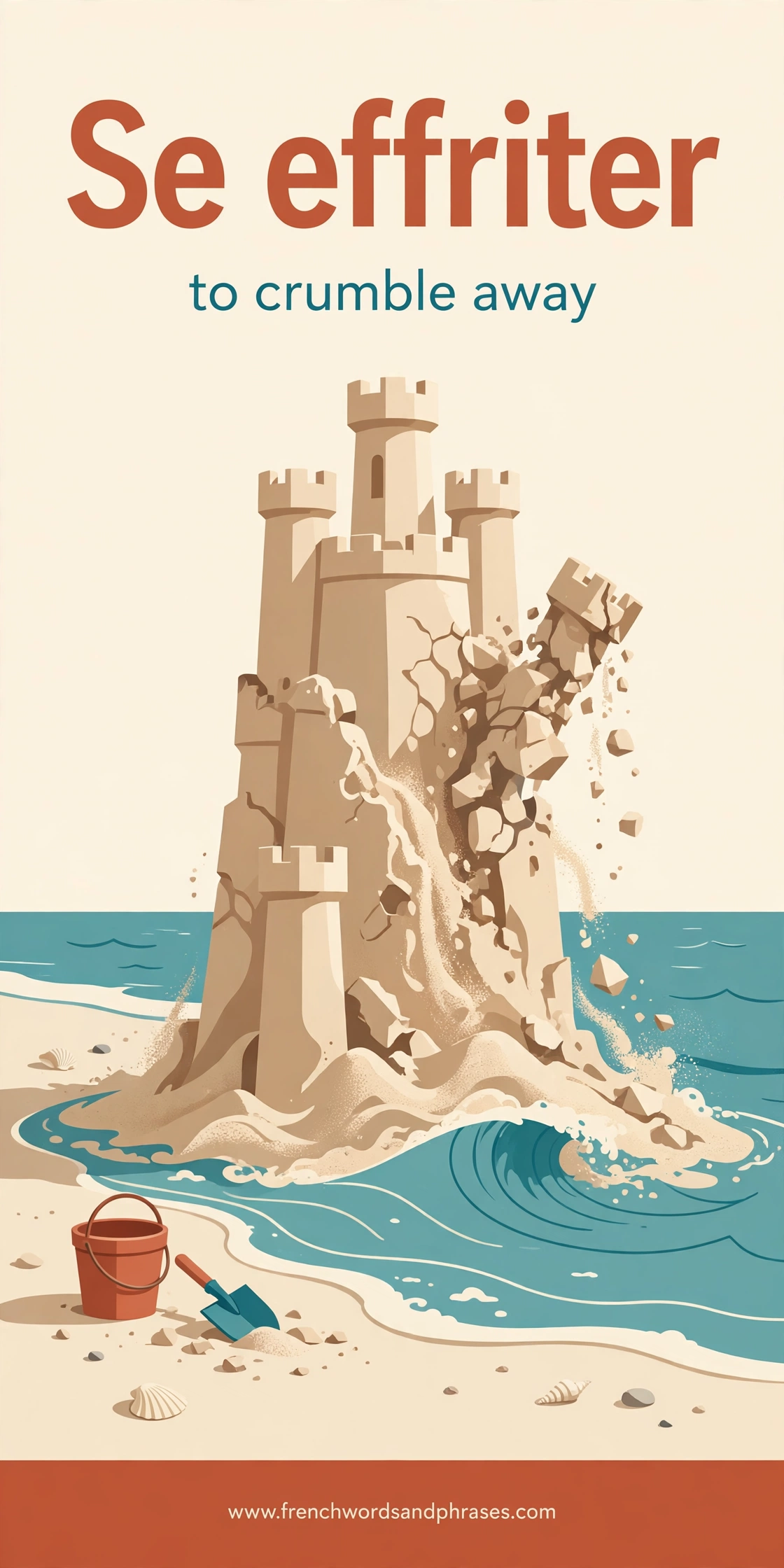
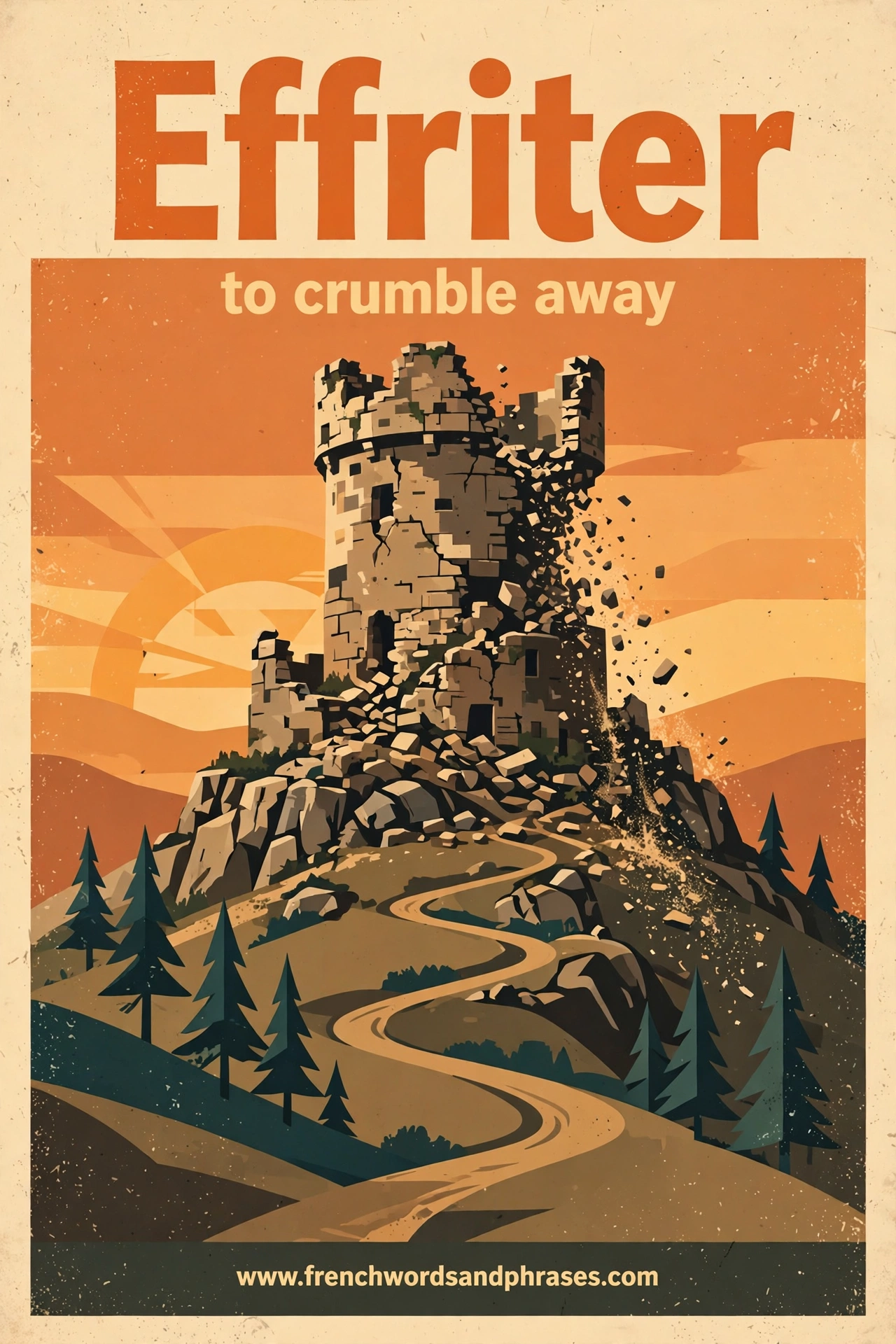
Effriter means to crumble away — to reduce something friable to crumbs and powder, the way fingers crumble dry earth or old stone.
A gardener rubbing dry soil between his palms, an archaeologist breaking up a clod of earth around a buried shard, winter frost working at a garden wall — effriter is the verb of crumbling something away, grain by grain, until only dust is left.
In this guide, you’ll learn how to conjugate effriter in all the major French tenses and moods. Explore complete conjugation tables, French examples, English translations, and practice quizzes.
Understanding the French Verb Effriter
Effriter is a regular French verb belonging to the first group of verbs, those ending in-er.
It means to crumble away. It is used by gardeners crumbling soil, cooks crumbling stock cubes and bread, builders and geologists describing stone and mortar reduced to powder — always with something doing the crumbling to something friable.
Verb classification: First group (-er)
Auxiliary verb: Avoir
Past participle: effrité
Present participle: effritant
English equivalents: To crumble away, to crumble into powder; effriter la terre — to crumble the soil; effriter du pain — to crumble bread; effriter une roche — to crumble a rock away; friable — crumbly (the adjective behind the verb); s’effriter — to crumble (by itself).
One important detail: effriter is transitive — hands, frost or tools crumble the material — while its reflexive twin s’effriter, to crumble away by oneself, has its own page and does most of the everyday work. The verb is perfectly regular: je effrite, nous effritons, past participle effrité. Its family is the adjective friable, crumbly: only friable things — dry earth, old mortar, stale bread, soft rock — can be effrités, and the verb always ends in crumbs.
Experience the Word
Effriter is the verb of the rubbing palms — solid matter surrendering, grain by grain, into dust.
Imagine a gardener in March, kneeling by a cold bed. He takes a clod of earth in both hands and effrite it slowly over the furrow, feeling for stones and roots, until the soil falls like brown sugar — ready, at last, for seed.
The clod has not broken or been cut. It has been crumbled away — effrité — between patient fingers.
How to Conjugate Effriter: Complete French Conjugation Guide
Let’s explore every major conjugation of effriter, beginning with the indicative mood.
How to Conjugate Effriter in the Indicative Mood
The indicative mood is used to express facts, observations, actions, and events.
How to Conjugate Effriter in the Present Tense (Présent)
Used for actions happening now, habitual actions, and general truths.
| Subject | Conjugation |
|---|---|
| je | effrite |
| tu | effrites |
| il / elle | effrite |
| nous | effritons |
| vous | effritez |
| ils / elles | effritent |
Example
Le jardinier effrite la terre sèche entre ses doigts.
The gardener crumbles the dry earth between his fingers.
Quick Quiz 1
Complete the sentence:
Nous ______ les mottes avant de semer.
Reveal the answer
effritons
Nous effritons les mottes avant de semer.
We crumble the clods before sowing.
How to Conjugate Effriter in the Passé Composé
Used for completed actions in the past. Effriter takes the auxiliary verb avoir.
| Subject | Conjugation |
|---|---|
| j’ | ai effrité |
| tu | as effrité |
| il / elle | a effrité |
| nous | avons effrité |
| vous | avez effrité |
| ils / elles | ont effrité |
Example
Elle a effrité le bouillon cube au-dessus de la soupe.
She crumbled the stock cube over the soup.
How to Conjugate Effriter in the Imparfait (Imperfect Tense)
Used for habitual past actions, descriptions, and ongoing situations in the past.
| Subject | Conjugation |
|---|---|
| je | effritais |
| tu | effritais |
| il / elle | effritait |
| nous | effritions |
| vous | effritiez |
| ils / elles | effritaient |
Example
Le gel effritait peu à peu le mur de pierres.
The frost used to crumble the stone wall away little by little.
Quick Quiz 2
Choose the correct form:
She crumbled the bread for the birds.
Elle ______ le pain pour les oiseaux. (a effrité / s’est effritée)
Reveal the answer
a effrité
Elle a effrité le pain pour les oiseaux.
Her hands do the crumbling: transitive effriter takes avoir.
How to Conjugate Effriter in the Plus-que-parfait
Used to describe an action that had already been completed before another past event.
| Subject | Conjugation |
|---|---|
| j’ | avais effrité |
| tu | avais effrité |
| il / elle | avait effrité |
| nous | avions effrité |
| vous | aviez effrité |
| ils / elles | avaient effrité |
Example
Ils avaient effrité la roche pour passer le sentier.
They had crumbled the rock away to clear the path.
How to Conjugate Effriter in the Passé Simple
Primarily used in formal writing, literature, and historical narratives. It is rarely used in everyday conversation.
| Subject | Conjugation |
|---|---|
| je | effritai |
| tu | effritas |
| il / elle | effrita |
| nous | effritâmes |
| vous | effritâtes |
| ils / elles | effritèrent |
Example
Il effrita la motte et la sema sur le sillon.
He crumbled the clod and scattered it over the furrow.
How to Conjugate Effriter in the Passé Antérieur
A literary tense used to express an action completed immediately before another past action, generally in the passé simple.
| Subject | Conjugation |
|---|---|
| j’ | eus effrité |
| tu | eus effrité |
| il / elle | eut effrité |
| nous | eûmes effrité |
| vous | eûtes effrité |
| ils / elles | eurent effrité |
Example
Quand elle eut effrité le pain, elle le donna aux oiseaux.
When she had crumbled the bread, she gave it to the birds.
How to Conjugate Effriter in the Future Tense (Futur Simple)
Used to describe actions that will take place in the future.
| Subject | Conjugation |
|---|---|
| je | effriterai |
| tu | effriteras |
| il / elle | effritera |
| nous | effriterons |
| vous | effriterez |
| ils / elles | effriteront |
Example
Demain, nous effriterons les mottes avant de semer.
Tomorrow, we will crumble the clods before sowing.
How to Conjugate Effriter in the Futur Antérieur (Future Perfect)
Used for an action that will have been completed before a particular point in the future.
| Subject | Conjugation |
|---|---|
| j’ | aurai effrité |
| tu | auras effrité |
| il / elle | aura effrité |
| nous | aurons effrité |
| vous | aurez effrité |
| ils / elles | auront effrité |
Example
Au printemps, le gel aura effrité toutes les mottes du champ.
By spring, the frost will have crumbled all the clods in the field.
How to Conjugate Effriter in the Near Future (Futur Proche)
Used to describe something that is going to happen soon. Formed with aller + infinitive.
| Subject | Conjugation |
|---|---|
| je | vais effriter |
| tu | vas effriter |
| il / elle | va effriter |
| nous | allons effriter |
| vous | allez effriter |
| ils / elles | vont effriter |
Example
Tu vas effriter le biscuit partout, fais attention !
You are going to crumble the biscuit everywhere, be careful!
How to Conjugate Effriter in the Conditional Mood
The conditional mood expresses what would happen under certain circumstances. It is also frequently used to make polite requests or express wishes.
How to Conjugate Effriter in the Present Conditional
| Subject | Conjugation |
|---|---|
| je | effriterais |
| tu | effriterais |
| il / elle | effriterait |
| nous | effriterions |
| vous | effriteriez |
| ils / elles | effriteraient |
Example
Avec de meilleurs outils, on effriterait cette roche en une heure.
With better tools, we would crumble this rock away in an hour.
How to Conjugate Effriter in the Past Conditional
| Subject | Conjugation |
|---|---|
| j’ | aurais effrité |
| tu | aurais effrité |
| il / elle | aurait effrité |
| nous | aurions effrité |
| vous | auriez effrité |
| ils / elles | auraient effrité |
Example
Le gel aurait effrité le mur plus vite sans la peinture.
The frost would have crumbled the wall faster without the paint.
Effriter in the Literary Past Conditional Form
This less common literary form uses the imperfect subjunctive of avoir.
| Subject | Conjugation |
|---|---|
| j’ | eusse effrité |
| tu | eusses effrité |
| il / elle | eût effrité |
| nous | eussions effrité |
| vous | eussiez effrité |
| ils / elles | eussent effrité |
Example
Le temps eût effrité la falaise avant même les grandes marées.
Time would have crumbled the cliff away even before the spring tides.
How to Conjugate Effriter in the Subjunctive Mood
The subjunctive is used to express wishes, emotions, doubts, necessity, and uncertainty. It frequently follows expressions such as il faut que (it is necessary that) or bien que (although).
How to Conjugate Effriter in the Present Subjunctive
| Subject | Conjugation |
|---|---|
| que je | effrite |
| que tu | effrites |
| qu’il / qu’elle | effrite |
| que nous | effritions |
| que vous | effritiez |
| qu’ils / qu’elles | effritent |
Example
Il faut que tu effrites la terre avant de planter.
You must crumble the soil before planting.
Quick Quiz 3
Complete the sentence using the subjunctive:
Il faut que vous ______ le fromage au-dessus des pâtes.
Reveal the answer
effritiez
Il faut que vous effritiez le fromage au-dessus des pâtes.
You must crumble the cheese over the pasta.
How to Conjugate Effriter in the Imperfect Subjunctive
A literary tense, rarely encountered in modern spoken French.
| Subject | Conjugation |
|---|---|
| que je | effritasse |
| que tu | effritasses |
| qu’il / qu’elle | effritât |
| que nous | effritassions |
| que vous | effritassiez |
| qu’ils / qu’elles | effritassent |
Example
Le maçon voulait que l’on effritât le vieux mortier à la main.
The mason wanted the old mortar to be crumbled away by hand.
How to Conjugate Effriter in the Pluperfect Subjunctive
A literary construction used to express an action completed before another past action.
| Subject | Conjugation |
|---|---|
| que j’ | eusse effrité |
| que tu | eusses effrité |
| qu’il / qu’elle | eût effrité |
| que nous | eussions effrité |
| que vous | eussiez effrité |
| qu’ils / qu’elles | eussent effrité |
Example
On voyait que le gel eût effrité la moitié du mur.
You could see the frost had crumbled half the wall away.
How to Conjugate Effriter in the Past Subjunctive
| Subject | Conjugation |
|---|---|
| que j’ | aie effrité |
| que tu | aies effrité |
| qu’il / qu’elle | ait effrité |
| que nous | ayons effrité |
| que vous | ayez effrité |
| qu’ils / qu’elles | aient effrité |
Example
Je suis content que vous ayez effrité les mottes à temps.
I am glad you crumbled the clods in time.
How to Conjugate Effriter in the Imperative
The imperative is used to give commands, instructions, invitations, or suggestions. Subject pronouns are omitted.
How to Conjugate Effriter in the Present Imperative
| Person | Conjugation |
|---|---|
| (tu) | effrite |
| (nous) | effritons |
| (vous) | effritez |
Example
Effritez le fromage au-dessus des pâtes.
Crumble the cheese over the pasta.
Quick Quiz 4
How would you say Crumble the soil (tu form)?
Reveal the answer
Effrite la terre !
French Participles of Effriter
Participles are verb forms that can be used in compound tenses and other grammatical constructions.
Present Participle of Effriter
effritant
En effritant la terre, le jardinier prépare un lit doux pour les graines.
By crumbling the soil, the gardener prepares a soft bed for the seeds.
Past Participle of Effriter
effrité
Effritée par le gel, la pierre tombe en poussière.
Crumbled away by the frost, the stone falls into dust.
Effriter in Everyday French: Real-Life Examples
Now that you know the conjugations, let’s see how effriter appears in everyday French.
Example 1 — Present
Le jardinier effrite la terre entre ses doigts.
The gardener crumbles the earth between his fingers.
Example 2 — Passé composé
Elle a effrité le bouillon cube sur la soupe.
She crumbled the stock cube over the soup.
Example 3 — Imparfait
Le gel effritait le mur de pierres.
The frost used to crumble the stone wall away.
Example 4 — Future
Nous effriterons les mottes demain.
We will crumble the clods tomorrow.
Example 5 — Conditional
On effriterait cette roche avec de meilleurs outils.
We would crumble this rock away with better tools.
Example 6 — Imperative
Effrite la terre avant de planter !
Crumble the soil before planting!
Beyond Translation: The Meaning of Effriter
The adjective friable — crumbly, from Latin friare, to rub to pieces — is the soul of effriter.
Nothing hard was ever effrité.
The verb belongs to the dry, the aged and the porous: soil, mortar, stale bread, soft stone — matter that has already half surrendered, waiting for fingers or frost to finish the work.
How to Remember the French Verb Effriter
Remember it this way: Effriter is about the gardener’s palms, rubbing a clod of earth into dust.
- Friable is the key: only crumbly things — earth, mortar, stale bread — get effrités.
- Transitive with avoir: le jardinier a effrité la terre; crumbling alone is s’effriter.
- Regular -er: je effrite, nous effritons, past participle effrité.
The key idea is the gardener’s palms, rubbing a clod of earth into dust.
Test Your Knowledge of Effriter
Let’s see how much you’ve learned. Try answering these questions before revealing the answers.
Question 1
What kind of material can be effrité?
Reveal the answer
Friable material only — dry earth, old mortar, stale bread, soft rock: things that fall into crumbs.
Question 2
How do you say The gardener crumbles the earth between his fingers in French?
Reveal the answer
Le jardinier effrite la terre entre ses doigts.
Question 3
Translate: She crumbled the stock cube over the soup.
Reveal the answer
Elle a effrité le bouillon cube au-dessus de la soupe.
Question 4
What is the past participle of effriter?
Reveal the answer
Effrité.
Question 5
Complete the sentence:
Il faut que tu ______ la terre avant de planter.
Reveal the answer
effrites
Il faut que tu effrites la terre avant de planter.
You must crumble the soil before planting.
Your Final Challenge
Can You Use It?
How would you say this in French?
The gardener crumbles the last clod, and the furrow drinks the brown dust.
Reveal the answer
Le jardinier effrite la dernière motte, et le sillon boit la poussière brune.
The gardener crumbles the last clod, and the furrow drinks the brown dust.
A little French. A little curiosity. A richer everyday life.
LEARN FRENCH ONE WORD AT A TIME