A French Word to Live By
How to Conjugate Se effilocher in French
/se.fi.lɔ.ʃe/
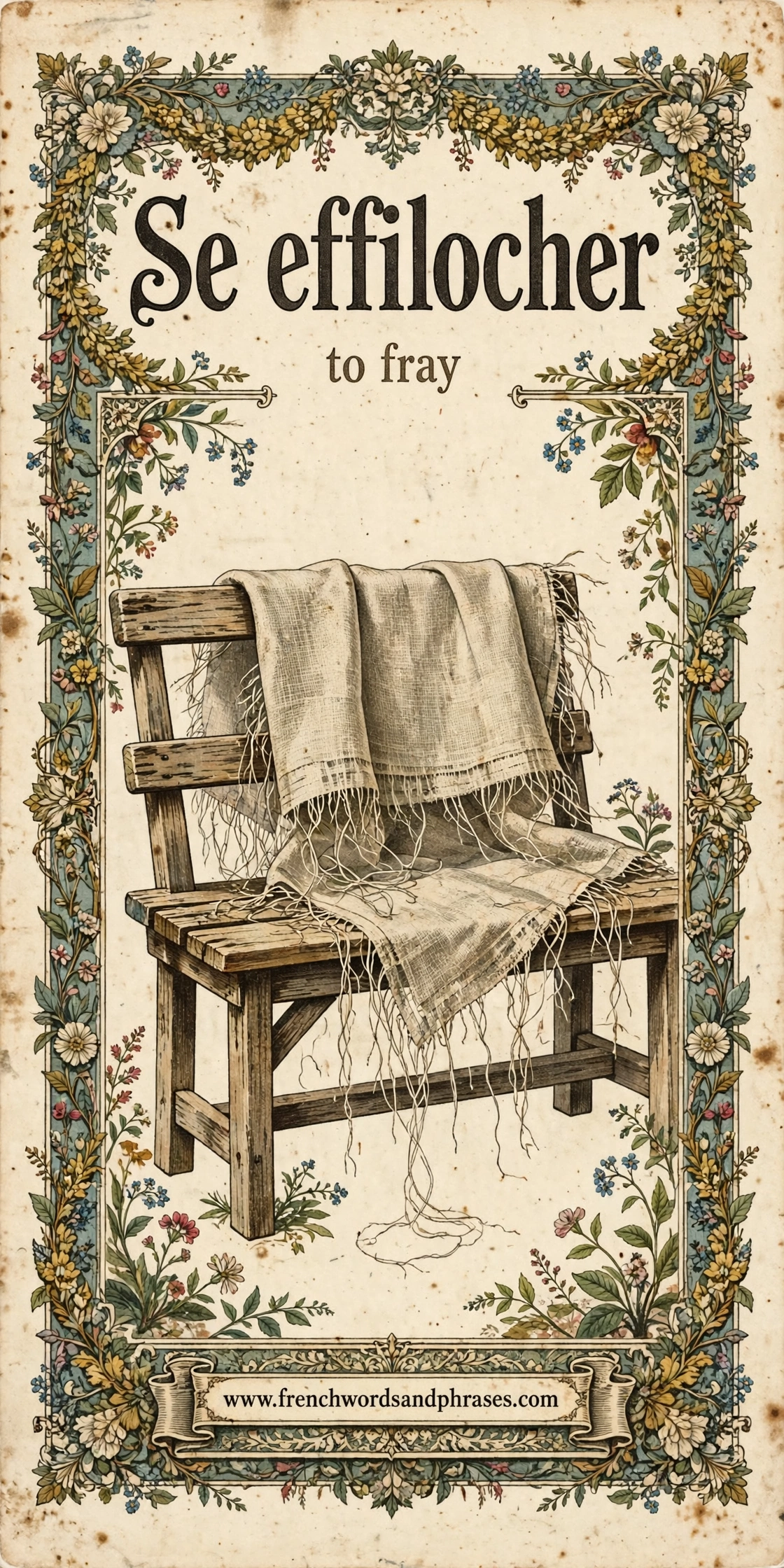
Se effilocher means to fray — to come apart into threads and fluff at the edges, as worn cloth does all by itself.
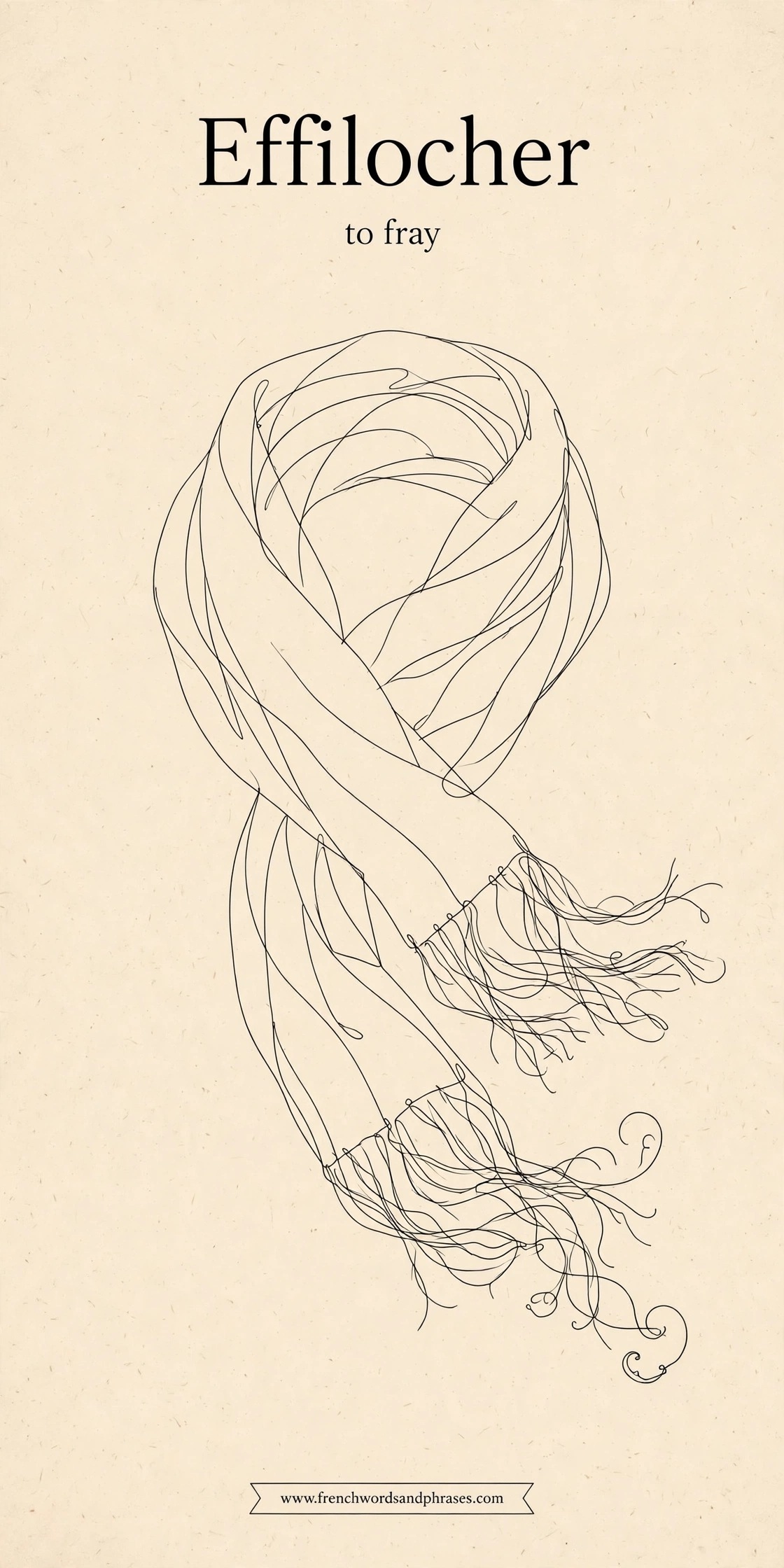
The hem of a favourite old scarf, opening into a soft fringe nobody designed; a towel whose edges have gone to whiskers — se effilocher is cloth quietly unmaking itself, thread by thread, wherever it is rubbed, washed and worn.
In this guide, you’ll learn how to conjugate se effilocher in all the major French tenses and moods. Explore complete conjugation tables, French examples, English translations, and practice quizzes.
Understanding the French Verb Se effilocher
Se effilocher is a regular French verb belonging to the first group of verbs, those ending in-er.
It means to fray. It is commonly used of hems, cuffs, towels, scarves and upholstery that fray with washing and wear, and figuratively of anything woven that loosens at the edges — patience, a story, a friendship coming apart strand by strand.
Verb classification: First group (-er), reflexive
Auxiliary verb: Être
Past participle: effiloché
Present participle: effilochant
English equivalents: To fray, to come apart into threads; le tissu s’effiloche — the fabric is fraying; un ourlet qui s’effiloche — a hem that is fraying; la corde s’effiloche — the rope is fraying into strands; des manches effilochées — frayed cuffs.
One important detail: se effilocher is what cloth does on its own, where plain effilocher is what hands do to it — the fabric’s edges loosen into threads and fluff without being torn. Being reflexive, it takes être and the participle agrees: la nappe s’est effilochée, les serviettes se sont effilochées. It suggests a softer, fluffier undoing than s’effiler: ropes and hems s’effilent, but cloth, wool and towels s’effilochent.
Experience the Word
Se effilocher is the verb of worn cloth giving notice — first a thread, then a fringe, then a whiskery edge.
Imagine the blue scarf you have worn for ten winters. This morning, in the mirror, you notice its ends have changed: no longer a clean cut but a soft little beard of threads — ton écharpe s’effiloche, faithfully falling apart in your service.
Nothing has ripped it. It has frayed — effilochée — by ten years of necks and winters.
How to Conjugate Se effilocher: Complete French Conjugation Guide
Let’s explore every major conjugation of se effilocher, beginning with the indicative mood.
How to Conjugate Se effilocher in the Indicative Mood
The indicative mood is used to express facts, observations, actions, and events.
How to Conjugate Se effilocher in the Present Tense (Présent)
Used for actions happening now, habitual actions, and general truths.
| Subject | Conjugation |
|---|---|
| je | m’effiloche |
| tu | t’effiloches |
| il / elle | s’effiloche |
| nous | nous effilochons |
| vous | vous effilochez |
| ils / elles | s’effilochent |
Example
Les bords de la nappe s’effilochent à chaque lavage.
The tablecloth’s edges fray a little more with every wash.
Quick Quiz 1
Complete the sentence:
Les serviettes ______ après tant de lavages.
Reveal the answer
s’effilochent
Les serviettes s’effilochent après tant de lavages.
The towels are fraying after so many washes.
How to Conjugate Se effilocher in the Passé Composé
Used for completed actions in the past. Se effilocher takes the auxiliary verb être.
| Subject | Conjugation |
|---|---|
| je | me suis effiloché / me suis effilochée |
| tu | t’es effiloché / t’es effilochée |
| il / elle | s’est effiloché / s’est effilochée |
| nous | nous sommes effilochés / nous sommes effilochées |
| vous | vous êtes effilochés / vous êtes effilochées / vous êtes effiloché / vous êtes effilochée |
| ils / elles | se sont effilochés / se sont effilochées |
Example
Son écharpe préférée s’est effilochée aux extrémités.
Her favourite scarf has frayed at the ends.
How to Conjugate Se effilocher in the Imparfait (Imperfect Tense)
Used for habitual past actions, descriptions, and ongoing situations in the past.
| Subject | Conjugation |
|---|---|
| je | m’effilochais |
| tu | t’effilochais |
| il / elle | s’effilochait |
| nous | nous effilochions |
| vous | vous effilochiez |
| ils / elles | s’effilochaient |
Example
Les serviettes s’effilochaient après des années de service.
The towels were fraying after years of service.
Quick Quiz 2
Choose the correct form:
The curtain frayed at the bottom.
Le rideau ______ en bas. (s’est effiloché / a effiloché)
Reveal the answer
s’est effiloché
Le rideau s’est effiloché en bas.
Se effilocher is reflexive and takes être.
How to Conjugate Se effilocher in the Plus-que-parfait
Used to describe an action that had already been completed before another past event.
| Subject | Conjugation |
|---|---|
| je | m’étais effiloché / m’étais effilochée |
| tu | t’étais effiloché / t’étais effilochée |
| il / elle | s’était effiloché / s’était effilochée |
| nous | nous étions effilochés / nous étions effilochées |
| vous | vous étiez effilochés / vous étiez effilochées / vous étiez effiloché / vous étiez effilochée |
| ils / elles | s’étaient effilochés / s’étaient effilochées |
Example
Le bas du rideau s’était effiloché jusqu’à la couture.
The bottom of the curtain had frayed right up to the seam.
How to Conjugate Se effilocher in the Passé Simple
Primarily used in formal writing, literature, and historical narratives. It is rarely used in everyday conversation.
| Subject | Conjugation |
|---|---|
| je | m’effilochai |
| tu | t’effilochas |
| il / elle | s’effilocha |
| nous | nous effilochâmes |
| vous | vous effilochâtes |
| ils / elles | s’effilochèrent |
Example
Le vieux tapis s’effilocha lentement aux quatre coins.
The old carpet slowly frayed at all four corners.
How to Conjugate Se effilocher in the Passé Antérieur
A literary tense used to express an action completed immediately before another past action, generally in the passé simple.
| Subject | Conjugation |
|---|---|
| je | me fus effiloché / me fus effilochée |
| tu | te fus effiloché / te fus effilochée |
| il / elle | se fut effiloché / se fut effilochée |
| nous | nous fûmes effilochés / nous fûmes effilochées |
| vous | vous fûtes effilochés / vous fûtes effilochées / vous fûtes effiloché / vous fûtes effilochée |
| ils / elles | se furent effilochés / se furent effilochées |
Example
Quand le tissu se fut effiloché, elle le transforma en chiffons.
When the fabric had frayed, she turned it into rags.
How to Conjugate Se effilocher in the Future Tense (Futur Simple)
Used to describe actions that will take place in the future.
| Subject | Conjugation |
|---|---|
| je | m’effilocherai |
| tu | t’effilocheras |
| il / elle | s’effilochera |
| nous | nous effilocherons |
| vous | vous effilocherez |
| ils / elles | s’effilocheront |
Example
Ce lin s’effilochera si on le lave trop souvent.
This linen will fray if it is washed too often.
How to Conjugate Se effilocher in the Futur Antérieur (Future Perfect)
Used for an action that will have been completed before a particular point in the future.
| Subject | Conjugation |
|---|---|
| je | me serai effiloché / me serai effilochée |
| tu | te seras effiloché / te seras effilochée |
| il / elle | se sera effiloché / se sera effilochée |
| nous | nous serons effilochés / nous serons effilochées |
| vous | vous serez effilochés / vous serez effilochées / vous serez effiloché / vous serez effilochée |
| ils / elles | se seront effilochés / se seront effilochées |
Example
À la fin de l’hiver, ton écharpe se sera effilochée.
By the end of winter, your scarf will have frayed.
How to Conjugate Se effilocher in the Near Future (Futur Proche)
Used to describe something that is going to happen soon. Formed with aller + infinitive.
| Subject | Conjugation |
|---|---|
| je | vais m’effilocher |
| tu | vas t’effilocher |
| il / elle | va s’effilocher |
| nous | allons nous effilocher |
| vous | allez vous effilocher |
| ils / elles | vont s’effilocher |
Example
Regarde, l’ourlet de ta jupe va s’effilocher.
Look, the hem of your skirt is going to fray.
How to Conjugate Se effilocher in the Conditional Mood
The conditional mood expresses what would happen under certain circumstances. It is also frequently used to make polite requests or express wishes.
How to Conjugate Se effilocher in the Present Conditional
| Subject | Conjugation |
|---|---|
| je | m’effilocherais |
| tu | t’effilocherais |
| il / elle | s’effilocherait |
| nous | nous effilocherions |
| vous | vous effilocheriez |
| ils / elles | s’effilocheraient |
Example
La nappe s’effilocherait moins avec un surjet.
The tablecloth would fray less with an overlocked edge.
How to Conjugate Se effilocher in the Past Conditional
| Subject | Conjugation |
|---|---|
| je | me serais effiloché / me serais effilochée |
| tu | te serais effiloché / te serais effilochée |
| il / elle | se serait effiloché / se serait effilochée |
| nous | nous serions effilochés / nous serions effilochées |
| vous | vous seriez effilochés / vous seriez effilochées / vous seriez effiloché / vous seriez effilochée |
| ils / elles | se seraient effilochés / se seraient effilochées |
Example
Le rideau se serait effiloché sans la doublure.
The curtain would have frayed without the lining.
Se effilocher in the Literary Past Conditional Form
This less common literary form uses the imperfect subjunctive of être.
| Subject | Conjugation |
|---|---|
| je | me fusse effiloché / me fusse effilochée |
| tu | te fusses effiloché / te fusses effilochée |
| il / elle | se fût effiloché / se fût effilochée |
| nous | nous fussions effilochés / nous fussions effilochées |
| vous | vous fussiez effilochés / vous fussiez effilochées / vous fussiez effiloché / vous fussiez effilochée |
| ils / elles | se fussent effilochés / se fussent effilochées |
Example
Le tapis se fût effiloché en un an sans les soins de la maison.
The carpet would have frayed within a year without the household’s care.
How to Conjugate Se effilocher in the Subjunctive Mood
The subjunctive is used to express wishes, emotions, doubts, necessity, and uncertainty. It frequently follows expressions such as il faut que (it is necessary that) or bien que (although).
How to Conjugate Se effilocher in the Present Subjunctive
| Subject | Conjugation |
|---|---|
| que je | m’effiloche |
| que tu | t’effiloches |
| qu’il / qu’elle | s’effiloche |
| que nous | nous effilochions |
| que vous | vous effilochiez |
| qu’ils / qu’elles | s’effilochent |
Example
Je crains que les bords du tapis s’effilochent.
I fear the carpet’s edges are fraying.
Quick Quiz 3
Complete the sentence using the subjunctive:
Je crains que ta jupe ______ à l’ourlet.
Reveal the answer
s’effiloche
Je crains que ta jupe s’effiloche à l’ourlet.
I fear your skirt is fraying at the hem.
How to Conjugate Se effilocher in the Imperfect Subjunctive
A literary tense, rarely encountered in modern spoken French.
| Subject | Conjugation |
|---|---|
| que je | m’effilochasse |
| que tu | t’effilochasses |
| qu’il / qu’elle | s’effilochât |
| que nous | nous effilochassions |
| que vous | vous effilochassiez |
| qu’ils / qu’elles | s’effilochassent |
Example
Il fallait recoudre l’ourlet avant qu’il s’effilochât.
The hem had to be resewn before it frayed.
How to Conjugate Se effilocher in the Pluperfect Subjunctive
A literary construction used to express an action completed before another past action.
| Subject | Conjugation |
|---|---|
| que je | me fusse effiloché / me fusse effilochée |
| que tu | te fusses effiloché / te fusses effilochée |
| qu’il / qu’elle | se fût effiloché / se fût effilochée |
| que nous | nous fussions effilochés / nous fussions effilochées |
| que vous | vous fussiez effilochés / vous fussiez effilochées / vous fussiez effiloché / vous fussiez effilochée |
| qu’ils / qu’elles | se fussent effilochés / se fussent effilochées |
Example
On disait que les rideaux se fussent effilochés dès la première année.
People said the curtains had frayed in the very first year.
How to Conjugate Se effilocher in the Past Subjunctive
| Subject | Conjugation |
|---|---|
| que je | me sois effiloché / me sois effilochée |
| que tu | te sois effiloché / te sois effilochée |
| qu’il / qu’elle | se soit effiloché / se soit effilochée |
| que nous | nous soyons effilochés / nous soyons effilochées |
| que vous | vous soyez effilochés / vous soyez effilochées / vous soyez effiloché / vous soyez effilochée |
| qu’ils / qu’elles | se soient effilochés / se soient effilochées |
Example
Je suis étonné que ton écharpe se soit effilochée si vite.
I am surprised your scarf frayed so quickly.
How to Conjugate Se effilocher in the Imperative
The imperative is used to give commands, instructions, invitations, or suggestions. Subject pronouns are omitted.
How to Conjugate Se effilocher in the Present Imperative
| Person | Conjugation |
|---|---|
| (tu) | effiloche-toi |
| (nous) | effilochons-nous |
| (vous) | effilochez-vous |
Example
Ne t’effiloche pas, vieille nappe, tiens encore un été !
Do not fray, old tablecloth, last one more summer!
Quick Quiz 4
How would you say Do not fray (tu form)?
Reveal the answer
Ne t’effiloche pas !
French Participles of Se effilocher
Participles are verb forms that can be used in compound tenses and other grammatical constructions.
Present Participle of Se effilocher
effilochant
En s’effilochant, le tissu perd ses bords nets.
As it frays, the fabric loses its clean edges.
Past Participle of Se effilocher
effiloché
Effilochée aux extrémités, l’écharpe a gagné un charme nouveau.
Frayed at the ends, the scarf has gained a new charm.
Se effilocher in Everyday French: Real-Life Examples
Now that you know the conjugations, let’s see how se effilocher appears in everyday French.
Example 1 — Present
Les bords de la nappe s’effilochent.
The tablecloth’s edges are fraying.
Example 2 — Passé composé
Son écharpe s’est effilochée aux extrémités.
Her scarf has frayed at the ends.
Example 3 — Imparfait
Les serviettes s’effilochaient après des années.
The towels were fraying after years.
Example 4 — Future
Ce lin s’effilochera à force de lavages.
This linen will fray with repeated washing.
Example 5 — Conditional
La nappe s’effilocherait moins avec un surjet.
The tablecloth would fray less with an overlocked edge.
Example 6 — Imperative
Ne t’effiloche pas, vieille nappe !
Do not fray, old tablecloth!
Beyond Translation: The Meaning of Se effilocher
Fashion has made its peace with this verb: the frayed hem, l’ourlet effiloché, is a deliberate style on jeans and linen jackets.
What wear does by accident, style now does on purpose.
The word stays gentle either way — a thing that s’effiloche is not ruined, only softened at the edges, like a story retold until its borders blur.
How to Remember the French Verb Se effilocher
Remember it this way: Se effilocher is about the beloved old scarf, its ends turned to a soft little beard of threads.
- The cloth does it to itself: la nappe s’effiloche — être, and the participle agrees (l’écharpe s’est effilochée).
- Fluffier than s’effiler: cloth, wool and towels s’effilochent; ropes and cords s’effilent.
- Regular -er underneath: je m’effiloche, nous nous effilochons, past participle effiloché.
The key idea is the beloved old scarf, its ends turned to a soft little beard of threads.
Test Your Knowledge of Se effilocher
Let’s see how much you’ve learned. Try answering these questions before revealing the answers.
Question 1
Which auxiliary does se effilocher use, and why?
Reveal the answer
Être — it is a reflexive verb: l’écharpe s’est effilochée aux extrémités.
Question 2
How do you say Her favourite scarf has frayed at the ends in French?
Reveal the answer
Son écharpe préférée s’est effilochée aux extrémités.
Question 3
Translate: The towels were fraying after years of service.
Reveal the answer
Les serviettes s’effilochaient après des années de service.
Question 4
What is the past participle of se effilocher?
Reveal the answer
Effiloché — agreeing: effilochée, effilochés, effilochées.
Question 5
Complete the sentence:
Je crains que les bords du tapis ______.
Reveal the answer
s’effilochent
Je crains que les bords du tapis s’effilochent.
I fear the carpet’s edges are fraying.
Your Final Challenge
Can You Use It?
How would you say this in French?
After ten winters of good service, the blue scarf is gently fraying at the ends.
Reveal the answer
Après dix hivers de bons services, l’écharpe bleue s’effiloche doucement aux extrémités.
After ten winters of good service, the blue scarf is gently fraying at the ends.
A little French. A little curiosity. A richer everyday life.
LEARN FRENCH ONE WORD AT A TIME