A French Word to Live By
How to Conjugate Se défâcher in French
/sə de.fɑ.ʃe/
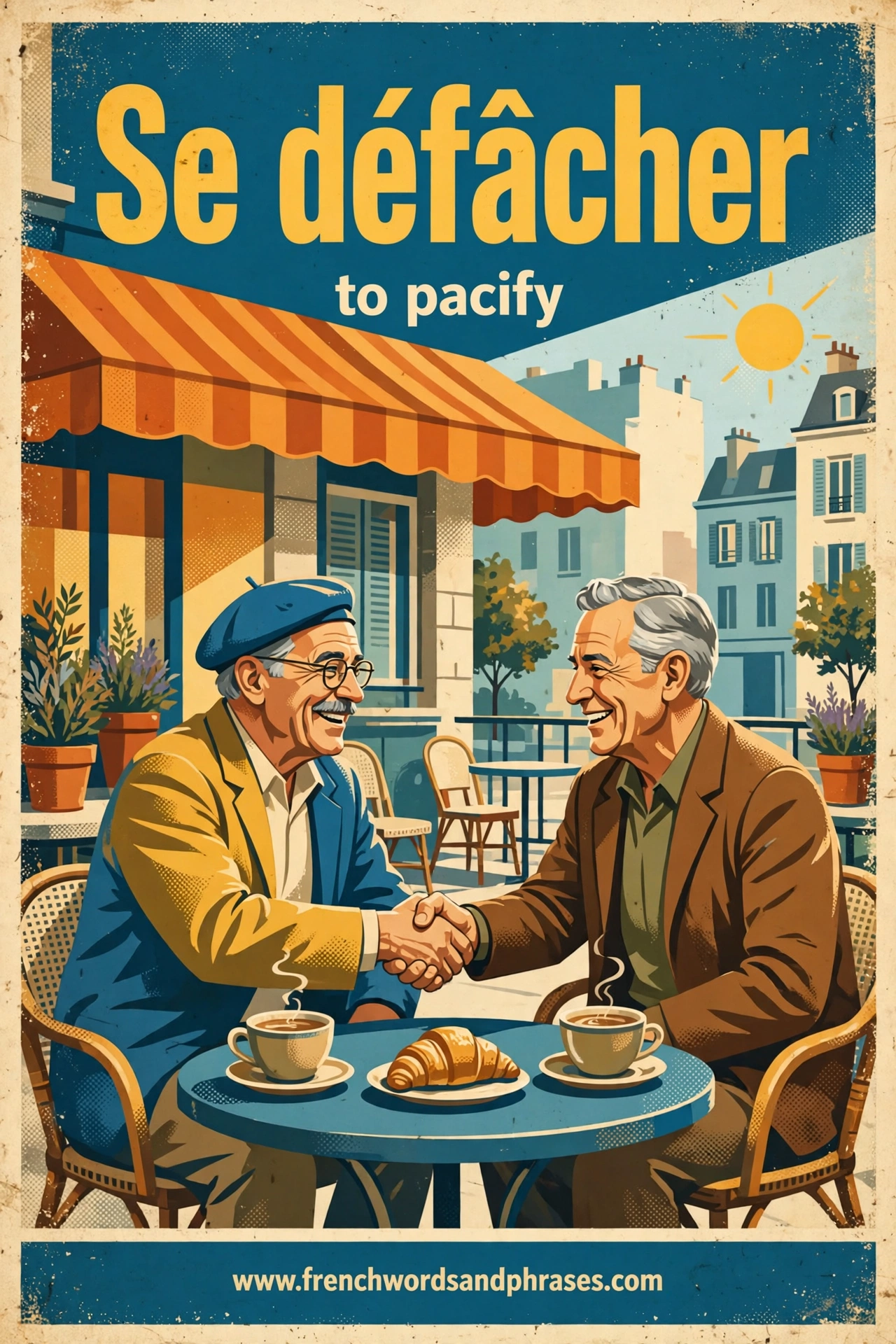
Se défâcher means to pacify — to calm down, let the anger go, and make peace after a quarrel.
Two brothers not speaking since Sunday lunch, a friend who has been sulking for a week — se défâcher is the verb of the thaw: the moment anger lets go, shoulders drop, and the conversation can start again.
In this guide, you’ll learn how to conjugate se défâcher in all the major French tenses and moods. Explore complete conjugation tables, French examples, English translations, and practice quizzes.
Understanding the French Verb Se défâcher
Se défâcher is a regular French verb belonging to the first group of verbs, those ending in -er.
It means to pacify. It is commonly used after family quarrels and friends’ sulks — se défâcher avec quelqu’un, to make up with someone — for the first smile after a storm, and in the gentle imperative of reconciliation: allez, défâche-toi !
Verb classification: First group (-er), reflexive
Auxiliary verb: Être
Past participle: défâché
Present participle: défâchant
English equivalents: To calm down, to stop being angry, to make it up; défâcher quelqu’un — to appease someone, to talk them round.
One important detail: se défâcher is se fâcher read backwards — dé- undoes the anger that fâcher put there. The family keeps the circumflex on the â in every form: je me défâche, nous nous défâchons. Being reflexive, it takes être and the participle agrees: elle s’est défâchée. The plain verb défâcher also exists, used on someone else: défâcher un ami, to appease a friend — usually with a joke, a coffee or an apology.
Experience the Word
Se défâcher is the verb of the storm passing — nothing is forgotten, but the weather has changed.
Imagine two sisters who quarrelled over nothing at breakfast. All day the house is quiet. Then one puts the kettle on, the other takes two cups from the cupboard without being asked — and by the second cup, elles se sont défâchées, without a single word about the quarrel.
The argument has not been won by anyone. The anger has simply been let go — défâché, and done with.
How to Conjugate Se défâcher: Complete French Conjugation Guide
Let’s explore every major conjugation of se défâcher, beginning with the indicative mood.
How to Conjugate Se défâcher in the Indicative Mood
The indicative mood is used to express facts, observations, actions, and events.
How to Conjugate Se défâcher in the Present Tense (Présent)
Used for actions happening now, habitual actions, and general truths.
| Subject | Conjugation |
|---|---|
| je | me défâche |
| tu | te défâches |
| il / elle | se défâche |
| nous | nous défâchons |
| vous | vous défâchez |
| ils / elles | se défâchent |
Example
Ils se défâchent toujours autour d’un café.
They always make up over a coffee.
Quick Quiz 1
Complete the sentence:
Nous nous ______ toujours vite.
Reveal the answer
défâchons
Nous nous défâchons toujours vite.
We always make up quickly.
How to Conjugate Se défâcher in the Passé Composé
Used for completed actions in the past. Se défâcher takes the auxiliary verb être.
| Subject | Conjugation |
|---|---|
| je | me suis défâché / me suis défâchée |
| tu | t’es défâché / t’es défâchée |
| il / elle | s’est défâché / s’est défâchée |
| nous | nous sommes défâchés / nous sommes défâchées |
| vous | vous êtes défâchés / vous êtes défâchées / vous êtes défâché / vous êtes défâchée |
| ils / elles | se sont défâchés / se sont défâchées |
Example
Elle s’est défâchée en voyant son sourire.
She stopped being angry when she saw his smile.
How to Conjugate Se défâcher in the Imparfait (Imperfect Tense)
Used for habitual past actions, descriptions, and ongoing situations in the past.
| Subject | Conjugation |
|---|---|
| je | me défâchais |
| tu | te défâchais |
| il / elle | se défâchait |
| nous | nous défâchions |
| vous | vous défâchiez |
| ils / elles | se défâchaient |
Example
Enfants, ils se défâchaient cinq minutes après chaque dispute.
As children, they used to make up five minutes after every argument.
Quick Quiz 2
Choose the correct form:
She calmed down yesterday.
Elle ______ hier. (s’est défâchée / a défâché)
Reveal the answer
s’est défâchée
Elle s’est défâchée.
Se défâcher is reflexive, takes être, and the participle agrees: défâchée.
How to Conjugate Se défâcher in the Plus-que-parfait
Used to describe an action that had already been completed before another past event.
| Subject | Conjugation |
|---|---|
| je | m’étais défâché / m’étais défâchée |
| tu | t’étais défâché / t’étais défâchée |
| il / elle | s’était défâché / s’était défâchée |
| nous | nous étions défâchés / nous étions défâchées |
| vous | vous étiez défâchés / vous étiez défâchées / vous étiez défâché / vous étiez défâchée |
| ils / elles | s’étaient défâchés / s’étaient défâchées |
Example
Elles s’étaient défâchées avant même le dessert.
They had made up before dessert had even arrived.
How to Conjugate Se défâcher in the Passé Simple
Primarily used in formal writing, literature, and historical narratives. It is rarely used in everyday conversation.
| Subject | Conjugation |
|---|---|
| je | me défâchai |
| tu | te défâchas |
| il / elle | se défâcha |
| nous | nous défâchâmes |
| vous | vous défâchâtes |
| ils / elles | se défâchèrent |
Example
À ce mot gentil, il se défâcha aussitôt.
At that kind word, he calmed down at once.
How to Conjugate Se défâcher in the Passé Antérieur
A literary tense used to express an action completed immediately before another past action, generally in the passé simple.
| Subject | Conjugation |
|---|---|
| je | me fus défâché / me fus défâchée |
| tu | te fus défâché / te fus défâchée |
| il / elle | se fut défâché / se fut défâchée |
| nous | nous fûmes défâchés / nous fûmes défâchées |
| vous | vous fûtes défâchés / vous fûtes défâchées / vous fûtes défâché / vous fûtes défâchée |
| ils / elles | se furent défâchés / se furent défâchées |
Example
Dès qu’ils se furent défâchés, la fête reprit.
As soon as they had made up, the party started again.
How to Conjugate Se défâcher in the Future Tense (Futur Simple)
Used to describe actions that will take place in the future.
| Subject | Conjugation |
|---|---|
| je | me défâcherai |
| tu | te défâcheras |
| il / elle | se défâchera |
| nous | nous défâcherons |
| vous | vous défâcherez |
| ils / elles | se défâcheront |
Example
Ne t’inquiète pas, elle se défâchera demain.
Do not worry, she will calm down tomorrow.
How to Conjugate Se défâcher in the Futur Antérieur (Future Perfect)
Used for an action that will have been completed before a particular point in the future.
| Subject | Conjugation |
|---|---|
| je | me serai défâché / me serai défâchée |
| tu | te seras défâché / te seras défâchée |
| il / elle | se sera défâché / se sera défâchée |
| nous | nous serons défâchés / nous serons défâchées |
| vous | vous serez défâchés / vous serez défâchées / vous serez défâché / vous serez défâchée |
| ils / elles | se seront défâchés / se seront défâchées |
Example
À la fin de la semaine, ils se seront défâchés depuis longtemps.
By the end of the week, they will have made up long ago.
How to Conjugate Se défâcher in the Near Future (Futur Proche)
Used to describe something that is going to happen soon. Formed with aller + infinitive.
| Subject | Conjugation |
|---|---|
| je | vais me défâcher |
| tu | vas te défâcher |
| il / elle | va se défâcher |
| nous | allons nous défâcher |
| vous | allez vous défâcher |
| ils / elles | vont se défâcher |
Example
Je crois qu’il va se défâcher avec un peu de temps.
I think he is going to calm down with a little time.
How to Conjugate Se défâcher in the Conditional Mood
The conditional mood expresses what would happen under certain circumstances. It is also frequently used to make polite requests or express wishes.
How to Conjugate Se défâcher in the Present Conditional
| Subject | Conjugation |
|---|---|
| je | me défâcherais |
| tu | te défâcherais |
| il / elle | se défâcherait |
| nous | nous défâcherions |
| vous | vous défâcheriez |
| ils / elles | se défâcheraient |
Example
Avec des excuses sincères, elle se défâcherait tout de suite.
With a sincere apology, she would stop being angry at once.
How to Conjugate Se défâcher in the Past Conditional
| Subject | Conjugation |
|---|---|
| je | me serais défâché / me serais défâchée |
| tu | te serais défâché / te serais défâchée |
| il / elle | se serait défâché / se serait défâchée |
| nous | nous serions défâchés / nous serions défâchées |
| vous | vous seriez défâchés / vous seriez défâchées / vous seriez défâché / vous seriez défâchée |
| ils / elles | se seraient défâchés / se seraient défâchées |
Example
Il se serait défâché plus tôt si on l’avait écouté.
He would have calmed down sooner if people had listened to him.
Se défâcher in the Literary Past Conditional Form
This less common literary form uses the imperfect subjunctive of être.
| Subject | Conjugation |
|---|---|
| je | me fusse défâché / me fusse défâchée |
| tu | te fusses défâché / te fusses défâchée |
| il / elle | se fût défâché / se fût défâchée |
| nous | nous fussions défâchés / nous fussions défâchées |
| vous | vous fussiez défâchés / vous fussiez défâchées / vous fussiez défâché / vous fussiez défâchée |
| ils / elles | se fussent défâchés / se fussent défâchées |
Example
Elle se fût défâchée pour un simple sourire.
She would have let her anger go for a simple smile.
How to Conjugate Se défâcher in the Subjunctive Mood
The subjunctive is used to express wishes, emotions, doubts, necessity, and uncertainty. It frequently follows expressions such as il faut que (it is necessary that) or bien que (although).
How to Conjugate Se défâcher in the Present Subjunctive
| Subject | Conjugation |
|---|---|
| que je | me défâche |
| que tu | te défâches |
| qu’il / qu’elle | se défâche |
| que nous | nous défâchions |
| que vous | vous défâchiez |
| qu’ils / qu’elles | se défâchent |
Example
Il faut que tu te défâches, la dispute est finie.
You must let it go now, the argument is over.
Quick Quiz 3
Complete the sentence using the subjunctive:
Il faut que vous vous ______.
Reveal the answer
défâchiez
Il faut que vous vous défâchiez.
You must make up.
How to Conjugate Se défâcher in the Imperfect Subjunctive
A literary tense, rarely encountered in modern spoken French.
| Subject | Conjugation |
|---|---|
| que je | me défâchasse |
| que tu | te défâchasses |
| qu’il / qu’elle | se défâchât |
| que nous | nous défâchassions |
| que vous | vous défâchassiez |
| qu’ils / qu’elles | se défâchassent |
Example
Je doutais qu’elle se défâchât avant le soir.
I doubted she would calm down before the evening.
How to Conjugate Se défâcher in the Pluperfect Subjunctive
A literary construction used to express an action completed before another past action.
| Subject | Conjugation |
|---|---|
| que je | me fusse défâché / me fusse défâchée |
| que tu | te fusses défâché / te fusses défâchée |
| qu’il / qu’elle | se fût défâché / se fût défâchée |
| que nous | nous fussions défâchés / nous fussions défâchées |
| que vous | vous fussiez défâchés / vous fussiez défâchées / vous fussiez défâché / vous fussiez défâchée |
| qu’ils / qu’elles | se fussent défâchés / se fussent défâchées |
Example
On espérait qu’ils se fussent défâchés avant les fêtes.
People hoped they had made up before the holidays.
How to Conjugate Se défâcher in the Past Subjunctive
| Subject | Conjugation |
|---|---|
| que je | me sois défâché / me sois défâchée |
| que tu | te sois défâché / te sois défâchée |
| qu’il / qu’elle | se soit défâché / se soit défâchée |
| que nous | nous soyons défâchés / nous soyons défâchées |
| que vous | vous soyez défâchés / vous soyez défâchées / vous soyez défâché / vous soyez défâchée |
| qu’ils / qu’elles | se soient défâchés / se soient défâchées |
Example
Je suis content que vous vous soyez défâchés.
I am glad you have made up.
How to Conjugate Se défâcher in the Imperative
The imperative is used to give commands, instructions, invitations, or suggestions. Subject pronouns are omitted.
How to Conjugate Se défâcher in the Present Imperative
| Person | Conjugation |
|---|---|
| (tu) | défâche-toi |
| (nous) | défâchons-nous |
| (vous) | défâchez-vous |
Example
Défâche-toi, la vie est trop courte !
Let it go, life is too short!
Quick Quiz 4
How would you say Let it go (tu form)?
Reveal the answer
Défâche-toi !
French Participles of Se défâcher
Participles are verb forms that can be used in compound tenses and other grammatical constructions.
Present Participle of Se défâcher
défâchant
En se défâchant, il a tendu la main à son frère.
As he calmed down, he held out his hand to his brother.
Past Participle of Se défâcher
défâché
Défâchés après le thé, ils ont ri de leur dispute.
No longer angry after the tea, they laughed about their quarrel.
Se défâcher in Everyday French: Real-Life Examples
Now that you know the conjugations, let’s see how se défâcher appears in everyday French.
Example 1 — Present
On se défâche vite dans cette famille.
People make up quickly in this family.
Example 2 — Passé composé
Elle s’est défâchée en cinq minutes.
She calmed down in five minutes.
Example 3 — Imparfait
Ils se défâchaient toujours avant le dîner.
They always made up before dinner.
Example 4 — Future
Vous vous défâcherez, comme toujours.
You will make up, as always.
Example 5 — Conditional
Tu te défâcherais si tu savais la vérité.
You would stop being angry if you knew the truth.
Example 6 — Imperative
Défâchez-vous, tous les deux !
Make up, both of you!
Beyond Translation: The Meaning of Se défâcher
English needs a phrase — calm down, make up, let it go; French se défâcher builds the reconciliation into the verb itself, with dé- doing the un-angering.
It is the mirror of se fâcher.
One verb puts the storm up, the other takes it down — and a family that knows both verbs rarely stays under the clouds for long.
How to Remember the French Verb Se défâcher
Remember it this way: Se défâcher is about the thaw after the quarrel — anger let go, peace made.
- Dé- undoes fâcher: se défâcher is se fâcher in reverse — the anger leaving.
- Reflexive and être: elle s’est défâchée — the participle agrees with the subject.
- Défâcher quelqu’un — to appease someone else, with a joke or an apology.
The key idea is the thaw after the quarrel — anger let go, peace made.
Test Your Knowledge of Se défâcher
Let’s see how much you’ve learned. Try answering these questions before revealing the answers.
Question 1
Which auxiliary does se défâcher use, and why?
Reveal the answer
Être — it is a reflexive verb: elle s’est défâchée.
Question 2
How do you say They made up over a coffee in French?
Reveal the answer
Ils se sont défâchés autour d’un café.
Question 3
Translate: She calmed down when she saw his smile.
Reveal the answer
Elle s’est défâchée en voyant son sourire.
Question 4
What is the past participle of se défâcher?
Reveal the answer
Défâché — agreeing: défâchée, défâchés, défâchées.
Question 5
Complete the sentence:
Il faut que tu te ______ maintenant.
Reveal the answer
défâches
Il faut que tu te défâches maintenant.
You must let it go now.
Your Final Challenge
Can You Use It?
How would you say this in French?
They made up over a coffee, and the day could begin.
Reveal the answer
Ils se sont défâchés autour d’un café, et la journée a pu commencer.
They made up over a coffee, and the day could begin.
A little French. A little curiosity. A richer everyday life.
LEARN FRENCH ONE WORD AT A TIME