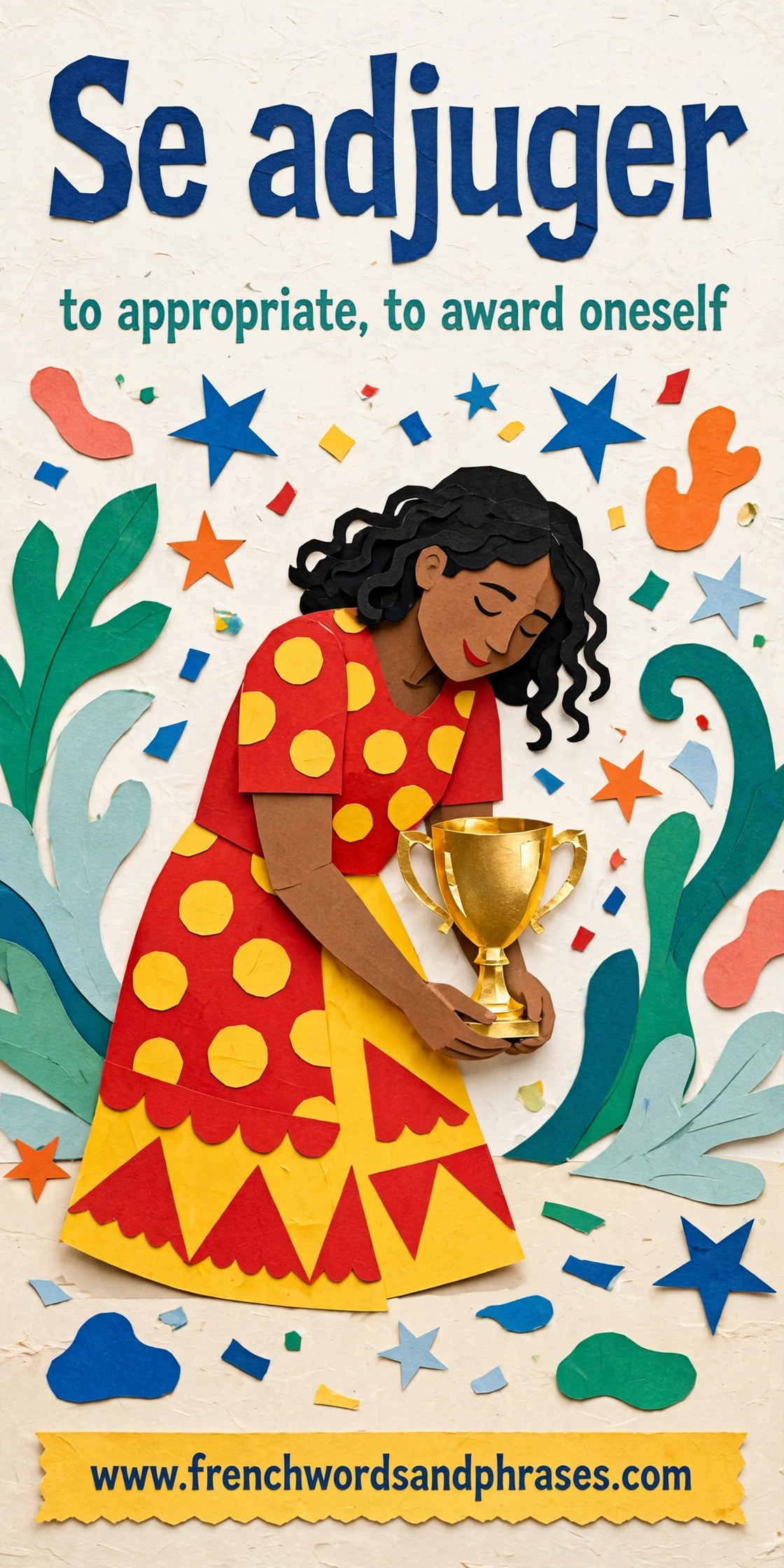
A French Word to Live By
How to Conjugate Se adjuger in French
/sad.ʒy.ʒe/
Se adjuger means to appropriate, to award oneself — to walk off with a title, a prize or the biggest share, as if you had held the auction and knocked the lot down to yourself.
The sprinter who takes the title in the final stride, the colleague who quietly claims the best office and the credit for the project — s’adjuger is the verb of awarding things to yourself: part victory, part quiet appropriation, depending on who is telling the story.
In this guide, you’ll learn how to conjugate se adjuger in all the major French tenses and moods. Explore complete conjugation tables, French examples, English translations, and practice quizzes.
Understanding the French Verb Se adjuger
Se adjuger is a regular French verb belonging to the first group of verbs, those ending in-er.
It means to appropriate, to award oneself. It is commonly used in sport for titles, trophies and records that a champion takes, and in everyday and journalistic French, with a raised eyebrow, for anyone who helps themselves to the credit, the market or the biggest share without waiting to be awarded it.
Verb classification: First group (-er), reflexive
Auxiliary verb: Être
Past participle: adjugé
Present participle: adjugeant
English equivalents: To award oneself, to walk off with, to appropriate; s’adjuger un titre — to claim a title; s’adjuger la première place — to take first place; s’adjuger un trophée — to carry off a trophy; s’adjuger la plus grosse part — to take the biggest share for oneself.
One important detail: s’adjuger is a -ger verb — nous nous adjugeons, je m’adjugeais keep the protective e — and it hides a fine agreement trap. The reflexive pronoun is an indirect object (you award the prize to yourself), so when the thing awarded follows, the participle does not agree: elle s’est adjugé la première place. But if the prize is mentioned before the verb, agreement returns: la place qu’elle s’est adjugée. Everyday examples: s’adjuger un titre, s’adjuger la victoire, s’adjuger la plus grosse part du gâteau.
Experience the Word
Se adjuger is the verb of the self-awarded prize — the champion’s honest victory and the office politician’s quiet land-grab in a single word.
Imagine the last lap of a cycling race. The favourite has marked every attack, saved his legs all day, and in the final two hundred metres he s’adjuge la victoire with a sprint so clean that the crowd is on its feet before he crosses the line.
Nobody handed him the race. He awarded it to himself — il se l’est adjugée — by being strongest when it counted.
How to Conjugate Se adjuger: Complete French Conjugation Guide
Let’s explore every major conjugation of se adjuger, beginning with the indicative mood.
How to Conjugate Se adjuger in the Indicative Mood
The indicative mood is used to express facts, observations, actions, and events.
How to Conjugate Se adjuger in the Present Tense (Présent)
Used for actions happening now, habitual actions, and general truths.
| Subject | Conjugation |
|---|---|
| je | m’adjuge |
| tu | t’adjuges |
| il / elle | s’adjuge |
| nous | nous adjugeons |
| vous | vous adjugez |
| ils / elles | s’adjugent |
Example
Chaque année, ce club s’adjuge le titre de champion.
Every year, this club claims the championship title.
Quick Quiz 1
Complete the sentence:
Nous nous ______ le titre cette année.
Reveal the answer
adjugeons
Nous nous adjugeons le titre cette année.
We are claiming the title this year — note the protective e of the -ger verbs.
How to Conjugate Se adjuger in the Passé Composé
Used for completed actions in the past. Se adjuger takes the auxiliary verb être.
| Subject | Conjugation |
|---|---|
| je | me suis adjugé / me suis adjugée |
| tu | t’es adjugé / t’es adjugée |
| il / elle | s’est adjugé / s’est adjugée |
| nous | nous sommes adjugés / nous sommes adjugées |
| vous | vous êtes adjugés / vous êtes adjugées / vous êtes adjugé / vous êtes adjugée |
| ils / elles | se sont adjugés / se sont adjugées |
Example
Elle s’est adjugé la première place au sprint final.
She took first place in the final sprint.
How to Conjugate Se adjuger in the Imparfait (Imperfect Tense)
Used for habitual past actions, descriptions, and ongoing situations in the past.
| Subject | Conjugation |
|---|---|
| je | m’adjugeais |
| tu | t’adjugeais |
| il / elle | s’adjugeait |
| nous | nous adjugions |
| vous | vous adjugiez |
| ils / elles | s’adjugeaient |
Example
Il s’adjugeait toujours la plus grosse part du gâteau.
He always used to take the biggest slice of the cake for himself.
Quick Quiz 2
Choose the correct form:
She took first place.
Elle ______ la première place. (s’est adjugé / a adjugée)
Reveal the answer
s’est adjugé
Elle s’est adjugé la première place.
S’adjuger is reflexive with an indirect pronoun, so the participle does not agree when the prize follows.
How to Conjugate Se adjuger in the Plus-que-parfait
Used to describe an action that had already been completed before another past event.
| Subject | Conjugation |
|---|---|
| je | m’étais adjugé / m’étais adjugée |
| tu | t’étais adjugé / t’étais adjugée |
| il / elle | s’était adjugé / s’était adjugée |
| nous | nous étions adjugés / nous étions adjugées |
| vous | vous étiez adjugés / vous étiez adjugées / vous étiez adjugé / vous étiez adjugée |
| ils / elles | s’étaient adjugés / s’étaient adjugées |
Example
Ils s’étaient adjugé le marché avant même l’appel d’offres.
They had cornered the contract for themselves before the tender was even announced.
How to Conjugate Se adjuger in the Passé Simple
Primarily used in formal writing, literature, and historical narratives. It is rarely used in everyday conversation.
| Subject | Conjugation |
|---|---|
| je | m’adjugeai |
| tu | t’adjugeas |
| il / elle | s’adjugea |
| nous | nous adjugeâmes |
| vous | vous adjugeâtes |
| ils / elles | s’adjugeèrent |
Example
Le favori s’adjugea la victoire sans trembler.
The favourite carried off the victory without faltering.
How to Conjugate Se adjuger in the Passé Antérieur
A literary tense used to express an action completed immediately before another past action, generally in the passé simple.
| Subject | Conjugation |
|---|---|
| je | me fus adjugé / me fus adjugée |
| tu | te fus adjugé / te fus adjugée |
| il / elle | se fut adjugé / se fut adjugée |
| nous | nous fûmes adjugés / nous fûmes adjugées |
| vous | vous fûtes adjugés / vous fûtes adjugées / vous fûtes adjugé / vous fûtes adjugée |
| ils / elles | se furent adjugés / se furent adjugées |
Example
Dès qu’elle se fut adjugé le titre, les caméras l’entourèrent.
As soon as she had claimed the title, the cameras surrounded her.
How to Conjugate Se adjuger in the Future Tense (Futur Simple)
Used to describe actions that will take place in the future.
| Subject | Conjugation |
|---|---|
| je | m’adjugerai |
| tu | t’adjugeras |
| il / elle | s’adjugera |
| nous | nous adjugerons |
| vous | vous adjugerez |
| ils / elles | s’adjugeront |
Example
Cette équipe s’adjugera encore le trophée, tu verras.
This team will carry off the trophy again, you will see.
How to Conjugate Se adjuger in the Futur Antérieur (Future Perfect)
Used for an action that will have been completed before a particular point in the future.
| Subject | Conjugation |
|---|---|
| je | me serai adjugé / me serai adjugée |
| tu | te seras adjugé / te seras adjugée |
| il / elle | se sera adjugé / se sera adjugée |
| nous | nous serons adjugés / nous serons adjugées |
| vous | vous serez adjugés / vous serez adjugées / vous serez adjugé / vous serez adjugée |
| ils / elles | se seront adjugés / se seront adjugées |
Example
À la fin de la saison, il se sera adjugé trois titres.
By the end of the season, he will have claimed three titles.
How to Conjugate Se adjuger in the Near Future (Futur Proche)
Used to describe something that is going to happen soon. Formed with aller + infinitive.
| Subject | Conjugation |
|---|---|
| je | vais m’adjuger |
| tu | vas t’adjuger |
| il / elle | va s’adjuger |
| nous | allons nous adjuger |
| vous | allez vous adjuger |
| ils / elles | vont s’adjuger |
Example
Regarde-la, elle va s’adjuger la victoire.
Watch her, she is going to walk off with the victory.
How to Conjugate Se adjuger in the Conditional Mood
The conditional mood expresses what would happen under certain circumstances. It is also frequently used to make polite requests or express wishes.
How to Conjugate Se adjuger in the Present Conditional
| Subject | Conjugation |
|---|---|
| je | m’adjugerais |
| tu | t’adjugerais |
| il / elle | s’adjugerait |
| nous | nous adjugerions |
| vous | vous adjugeriez |
| ils / elles | s’adjugeraient |
Example
Sans ce penalty, ils s’adjugeraient la coupe.
Without that penalty, they would take the cup.
How to Conjugate Se adjuger in the Past Conditional
| Subject | Conjugation |
|---|---|
| je | me serais adjugé / me serais adjugée |
| tu | te serais adjugé / te serais adjugée |
| il / elle | se serait adjugé / se serait adjugée |
| nous | nous serions adjugés / nous serions adjugées |
| vous | vous seriez adjugés / vous seriez adjugées / vous seriez adjugé / vous seriez adjugée |
| ils / elles | se seraient adjugés / se seraient adjugées |
Example
Elle se serait adjugé la médaille sans cette chute.
She would have claimed the medal without that fall.
Se adjuger in the Literary Past Conditional Form
This less common literary form uses the imperfect subjunctive of être.
| Subject | Conjugation |
|---|---|
| je | me fusse adjugé / me fusse adjugée |
| tu | te fusses adjugé / te fusses adjugée |
| il / elle | se fût adjugé / se fût adjugée |
| nous | nous fussions adjugés / nous fussions adjugées |
| vous | vous fussiez adjugés / vous fussiez adjugées / vous fussiez adjugé / vous fussiez adjugée |
| ils / elles | se fussent adjugés / se fussent adjugées |
Example
Il se fût adjugé le prix sans les jalousies de la cour.
He would have awarded himself the prize without the court’s jealousies.
How to Conjugate Se adjuger in the Subjunctive Mood
The subjunctive is used to express wishes, emotions, doubts, necessity, and uncertainty. It frequently follows expressions such as il faut que (it is necessary that) or bien que (although).
How to Conjugate Se adjuger in the Present Subjunctive
| Subject | Conjugation |
|---|---|
| que je | m’adjuge |
| que tu | t’adjuges |
| qu’il / qu’elle | s’adjuge |
| que nous | nous adjugions |
| que vous | vous adjugiez |
| qu’ils / qu’elles | s’adjugent |
Example
Je ne crois pas qu’il s’adjuge le titre cette année.
I do not think he will claim the title this year.
Quick Quiz 3
Complete the sentence using the subjunctive:
Je doute que vous vous ______ tous les honneurs.
Reveal the answer
adjugiez
Je doute que vous vous adjugiez tous les honneurs.
I doubt you will take all the honours for yourselves.
How to Conjugate Se adjuger in the Imperfect Subjunctive
A literary tense, rarely encountered in modern spoken French.
| Subject | Conjugation |
|---|---|
| que je | m’adjugasse |
| que tu | t’adjugasses |
| qu’il / qu’elle | s’adjugât |
| que nous | nous adjugassions |
| que vous | vous adjugassiez |
| qu’ils / qu’elles | s’adjugassent |
Example
On craignait qu’elle s’adjugeât tous les honneurs.
People feared she would take all the honours for herself.
How to Conjugate Se adjuger in the Pluperfect Subjunctive
A literary construction used to express an action completed before another past action.
| Subject | Conjugation |
|---|---|
| que je | me fusse adjugé / me fusse adjugée |
| que tu | te fusses adjugé / te fusses adjugée |
| qu’il / qu’elle | se fût adjugé / se fût adjugée |
| que nous | nous fussions adjugés / nous fussions adjugées |
| que vous | vous fussiez adjugés / vous fussiez adjugées / vous fussiez adjugé / vous fussiez adjugée |
| qu’ils / qu’elles | se fussent adjugés / se fussent adjugées |
Example
On racontait qu’il se fût adjugé le marché en secret.
People said he had appropriated the contract in secret.
How to Conjugate Se adjuger in the Past Subjunctive
| Subject | Conjugation |
|---|---|
| que je | me sois adjugé / me sois adjugée |
| que tu | te sois adjugé / te sois adjugée |
| qu’il / qu’elle | se soit adjugé / se soit adjugée |
| que nous | nous soyons adjugés / nous soyons adjugées |
| que vous | vous soyez adjugés / vous soyez adjugées / vous soyez adjugé / vous soyez adjugée |
| qu’ils / qu’elles | se soient adjugés / se soient adjugées |
Example
Je suis étonné qu’elle se soit adjugé la victoire si facilement.
I am amazed she walked off with the victory so easily.
How to Conjugate Se adjuger in the Imperative
The imperative is used to give commands, instructions, invitations, or suggestions. Subject pronouns are omitted.
How to Conjugate Se adjuger in the Present Imperative
| Person | Conjugation |
|---|---|
| (tu) | adjuge-toi |
| (nous) | adjugeons-nous |
| (vous) | adjugez-vous |
Example
Adjuge-toi la victoire, tu l’as méritée !
Take the victory, you have earned it!
Quick Quiz 4
How would you say Take the victory (tu form)?
Reveal the answer
Adjuge-toi la victoire !
French Participles of Se adjuger
Participles are verb forms that can be used in compound tenses and other grammatical constructions.
Present Participle of Se adjuger
adjugeant
En s’adjugeant la première place, elle a battu son record.
By taking first place, she beat her own record.
Past Participle of Se adjuger
adjugé
La victoire qu’il s’est adjugée restera dans les mémoires.
The victory he claimed for himself will live in people’s memories.
Se adjuger in Everyday French: Real-Life Examples
Now that you know the conjugations, let’s see how se adjuger appears in everyday French.
Example 1 — Present
Ce club s’adjuge le titre de champion.
This club claims the championship title.
Example 2 — Passé composé
Elle s’est adjugé la première place.
She took first place.
Example 3 — Imparfait
Il s’adjugeait toujours la plus grosse part.
He always used to take the biggest share.
Example 4 — Future
Cette équipe s’adjugera encore le trophée.
This team will carry off the trophy again.
Example 5 — Conditional
Sans ce penalty, ils s’adjugeraient la coupe.
Without that penalty, they would take the cup.
Example 6 — Imperative
Adjuge-toi la victoire, tu l’as méritée !
Take the victory, you have earned it!
Beyond Translation: The Meaning of Se adjuger
English has no tidy equivalent — to walk off with, to claim, to appropriate each cover a slice of s’adjuger, and the raised eyebrow comes free in French.
It keeps the auction room inside the verb.
To s’adjuger a title is to imagine the world as an auction where you hold both the paddle and the hammer — which is why journalists use it for champions with admiration and for monopolies without any.
How to Remember the French Verb Se adjuger
Remember it this way: Se adjuger is about the champion knocking the trophy down to herself.
- The agreement trap: elle s’est adjugé la première place (no agreement — the prize follows), but la place qu’elle s’est adjugée (agreement — the prize comes first).
- -ger spelling: nous nous adjugeons, je m’adjugeais keep the protective e.
- Its favourite prizes: un titre, la victoire, la première place, la plus grosse part.
The key idea is the champion knocking the trophy down to herself.
Test Your Knowledge of Se adjuger
Let’s see how much you’ve learned. Try answering these questions before revealing the answers.
Question 1
Why is there no agreement in Elle s’est adjugé la première place ?
Reveal the answer
Because s’ is an indirect object (she awarded the place to herself) and the direct object follows the verb — so the participle stays invariable: adjugé.
Question 2
How do you say She took first place in French?
Reveal the answer
Elle s’est adjugé la première place.
Question 3
Translate: Take the victory, you have earned it!
Reveal the answer
Adjuge-toi la victoire, tu l’as méritée !
Question 4
What is the past participle of s’adjuger?
Reveal the answer
Adjugé — invariable when the prize follows (elle s’est adjugé la place), agreeing with a preceding prize (la place qu’elle s’est adjugée).
Question 5
Complete the sentence:
Je ne crois pas qu’il ______ le titre cette année.
Reveal the answer
s’adjuge
Je ne crois pas qu’il s’adjuge le titre cette année.
I do not think he will claim the title this year.
Your Final Challenge
Can You Use It?
How would you say this in French?
On the last lap, the champion claims the victory for herself, and the whole stadium rises.
Reveal the answer
Au dernier tour, la championne s’adjuge la victoire, et le stade entier se lève.
On the last lap, the champion claims the victory for herself, and the whole stadium rises.
A little French. A little curiosity. A richer everyday life.
LEARN FRENCH ONE WORD AT A TIME